How to Find Specialized Analytical Chemistry Services Without Losing Your Sanity
Why Finding the Right Specialized Analytical Chemistry Services Is Harder Than It Looks
Specialized analytical chemistry services cover a wide range of testing, measurement, and analysis solutions used across industries like pharmaceuticals, aerospace, environmental monitoring, and food safety. Here’s a quick-reference breakdown to help you evaluate what you need:
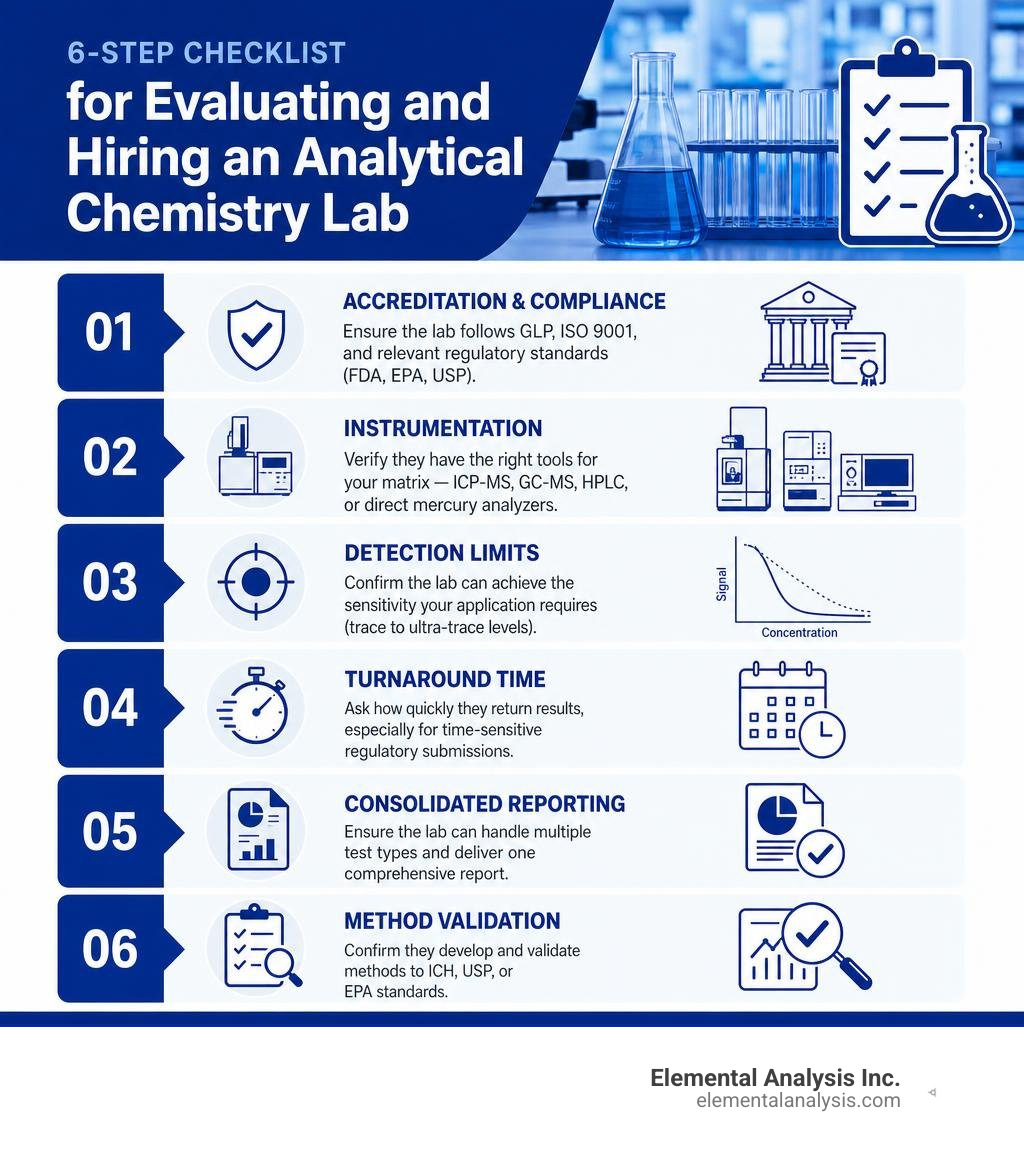
What to look for when hiring an analytical lab:
- Accreditation and compliance – Does the lab follow GLP, ISO 9001, and relevant regulatory standards (FDA, EPA, USP)?
- Instrumentation – Does it have the right tools for your matrix — ICP-MS, GC-MS, HPLC, or direct mercury analyzers?
- Detection limits – Can it hit the sensitivity your application requires (trace to ultra-trace levels)?
- Turnaround time – How fast does it return results, especially for time-sensitive regulatory submissions?
- Consolidated reporting – Can it handle multiple test types under one invoice?
- Method validation – Does it develop and validate methods to ICH, USP, or EPA standards?
Finding the right lab feels simple — until it isn’t.
You need fast results. Low detection limits. A team that understands your regulatory requirements. And ideally, one lab that can handle everything without you managing five vendors at once.
The problem? The analytical chemistry landscape is huge. You have government labs, contract research organizations, niche specialty labs, and generalist testing facilities — all offering overlapping services with very different capabilities.
The median salary for analytical chemists sits around $87,180, and employment in the field is projected to grow 8% through 2032. That tells you demand for these services is rising — which means more providers, more noise, and more decisions to make.
This guide cuts through that noise. Whether you’re sourcing trace-element analysis for aerospace components, elemental impurity testing for a pharmaceutical submission, or environmental contaminant screening, you’ll know exactly what to look for — and what questions to ask.
Specialized analytical chemistry services vocabulary:
- alloy verification laboratory analysis
- induced coupled plasma
- inductively coupled argon plasma spectrometry
Navigating Specialized Analytical Chemistry Services Across Key Industries
Every major sector relies on chemical validation to transform raw materials into safe, functional, and marketable products. However, different industries speak vastly different regulatory languages. When you evaluate Services for your business, understanding how these testing domains intersect is key to choosing a partner that fits your workflow.
In pharmaceutical testing, the focus is on molecule-by-molecule validation. Labs must support drug discovery and development by isolating impurities, evaluating stability, and characterizing active pharmaceutical ingredients (APIs). Precision and regulatory compliance are non-negotiable; a single undetected residual solvent can stall a regulatory filing for months.
Nutraceuticals and herbal products present a different challenge: matrix complexity. Unlike synthetic pharmaceuticals, botanical extracts contain hundreds of naturally occurring compounds. Analytical labs must perform phytochemical screening to verify active ingredients while simultaneously running rigorous contaminant screens for heavy metals, pesticides, and microbial pathogens.
Food safety testing relies on rapid, high-throughput screening. Here, specialized services verify nutritional labels, confirm the absence of allergens, and monitor shelf-life stability. Similarly, environmental monitoring programs require ultra-trace detection capabilities to identify pollutants in water, soil, and air, tracking environmental recovery or identifying industrial contamination hazards.
To simplify this process, many organizations seek a comprehensive A to Z Testing partner capable of managing diverse matrices under one roof, eliminating the logistical headache of splitting samples across multiple specialized providers.
Quality Control and Regulatory Compliance in Specialized Analytical Chemistry Services
Quality control isn’t just about getting a number; it’s about proving that the number is accurate, reproducible, and legally defensible. Modern analytical chemistry services operate within a strict web of global guidelines designed to protect public safety.
In the pharmaceutical sector, testing must align with strict compendial standards. For example, residual solvents are governed by USP <467> standards, while elemental impurities are evaluated under ICH Q3D guidelines. To dive deeper into these requirements, see our guide on USP Elemental Impurities What Pharma Manufacturers Need to Know.
Beyond pharmaceuticals, environmental and industrial testing must adhere to specific agency methods. Whether it is EPA Method 7473 for direct mercury analysis or ASTM standards for petrochemical testing, working with a lab that understands these frameworks is critical. Navigating these requirements can be daunting, which is why we put together A Beginner Guide to Industry Standard Methods to help demystify the compliance landscape.
Government Agencies vs. Private Commercial Laboratories
When sourcing analytical testing, you will encounter two primary types of organizations: public scientific agencies and private commercial contract laboratories. Understanding their differing mandates helps clarify where to send your samples.
Government scientific bodies, such as the USGS Mineral Resources Program, focus heavily on public-interest research, regional geological mapping, and environmental emergency response. For instance, USGS scientists develop microanalytical reference materials to help researchers examine complex mineral structures and predict environmental vulnerabilities from legacy mining sites. They are designed for macro-level scientific inquiry and public policy support rather than commercial product development.
In contrast, private commercial contract laboratories are built for speed, proprietary security, and compliance-driven product release. Commercial labs focus on B2B service delivery, offering optimized turnaround times, customized method validation, and dedicated customer support. While a government lab might spend months developing a reference standard for a regional survey, a private commercial lab is optimized to validate your specific manufacturing batch, protect your intellectual property, and deliver a certified report to meet your shipping deadline.
Advanced Instrumentation and Purification in Pharma and Biotech
Bringing a new therapeutic molecule from discovery to market requires an extraordinary level of analytical precision. Modern biotech and pharmaceutical innovations rely on state-of-the-art instrumentation to isolate, purify, and characterize drug candidates.

At the heart of this process is preparative High-Performance Liquid Chromatography (HPLC). While analytical HPLC is used to identify and quantify components in a mixture, preparative HPLC is designed to physically separate and collect target compounds. To achieve high purity on a meaningful scale, laboratories utilize Dynamic Axial Compression (DAC) technology. DAC systems pack columns (ranging from 20 to 50 mm ID) in-house, ensuring a highly stable, tightly packed stationary phase that maintains column performance over repeated runs. This setup allows researchers to isolate and purify active compounds from milligram to multi-gram scales.
Overcoming Analytical Challenges with Specialized Analytical Chemistry Services
The road to drug approval is paved with complex chemical challenges, particularly when dealing with chiral molecules and structural impurities.
- Chiral Separations: Many modern drug candidates are chiral, meaning they exist as mirror-image enantiomers. Often, only one enantiomer provides the therapeutic benefit, while the other may be inactive or even toxic. Specialized labs develop custom chiral analytical methods to separate and isolate these enantiomers, ensuring therapeutic safety.
- Impurity Profiling: During synthesis, side reactions can generate structural impurities. Isolating and identifying these trace compounds is essential for regulatory approval. This requires a combination of high-resolution mass spectrometry and NMR spectroscopy to map the exact molecular structures.
- Nanometrology: As nanotechnology becomes more integrated into drug delivery systems (such as lipid nanoparticles), characterizing materials at the nanoscale is a major challenge. Nanometrology requires highly specialized tools to measure nanoparticle size, distribution, and surface charge without destroying the delicate sample structure. If you are struggling with these advanced materials, explore our guide on How to Characterize Nanomaterials Without Losing Your Mind.
Data Integrity, Automation, and Emerging Technologies
As we progress through 2026, the lab bench looks very different than it did a decade ago. The modern analytical laboratory is defined by a shift away from manual, repetitive testing toward secure, automated, and digitally integrated workflows.
A primary driver of this evolution is data integrity. In FDA-regulated environments, compliance with 21 CFR Part 11 is mandatory. This regulation requires that all electronic records, signatures, and audit trails are secure, untampered, and fully traceable. Every injection on an HPLC or mass spectrometer must generate a permanent, unalterable digital footprint, ensuring that data cannot be deleted or selectively omitted to pass quality control checks.
Simultaneously, artificial intelligence (AI) and laboratory automation are redefining the role of the analytical chemist. Instead of manually preparing dilutions and running routine injections, automated sample preparation systems handle the physical labor. AI algorithms then act as digital collaborators, processing massive datasets, identifying anomalies, predicting compound behavior, and validating complex chromatography runs in real-time.
| Feature / Workflow | Traditional Manual Testing | Automated & AI-Driven Workflow |
|---|---|---|
| Sample Preparation | Manual pipetting, dilution, and filtration (prone to human error) | Robotic liquid handlers and automated digestion systems |
| Data Recording | Paper notebooks or basic, unlinked spreadsheets | 21 CFR Part 11 compliant software with automated audit trails |
| Data Analysis | Manual peak integration and visual chromatogram review | AI-assisted peak detection, predictive modeling, and anomaly flagging |
| Turnaround Time | Days to weeks depending on batch backlogs | Hours to days with continuous, overnight automated runs |
Trace Element Analysis and Low Detection Limits
In industries like petrochemicals, environmental monitoring, and semiconductor manufacturing, detecting contaminants at parts-per-million (ppm), parts-per-billion (ppb), or even parts-per-trillion (ppt) levels is critical. Achieving these low detection limits requires specialized instrumentation designed to minimize sample preparation and eliminate external contamination.
For instance, mercury analysis has traditionally been a slow, acid-heavy process. Today, systems like the DMA-80 allow laboratories to perform direct mercury analysis on solid, liquid, or gaseous matrices in as few as 6 minutes without any chemical pre-treatment, fully complying with EPA Method 7473.
Similarly, sulfur analysis is crucial for evaluating fuel quality and protecting industrial refining equipment. To understand how laboratories measure these elements at trace levels, check out our resources:
- In-Depth Guide to Low Detection Limits
- The Complete Guide to Total and Trace Sulfur Analysis
- A Guide to Measuring Sulfur in Petroleum and Marine Fuels
- Carbon and Sulfur Analysis Principles Prices and LECO Systems
The Human Element: Training and Careers in Analytical Chemistry
While advanced hardware is essential, an analytical laboratory is only as good as the minds operating the equipment. The demand for highly skilled analytical chemists remains strong, driven by the increasing complexity of regulatory compliance and the growth of the biotech sector.

According to the Bureau of Labor Statistics Chemist Outlook, the median annual salary for analytical chemists is approximately $87,180, with a projected job growth rate of 8% from 2022 to 2032. Entering this field requires a solid foundation:
- Education: A bachelor’s degree in chemistry or a closely related discipline is the minimum entry-level requirement. However, roles involving complex method development, forensic toxicology, or advanced pharmaceutical research typically require a master’s degree or a Ph.D.
- Skills: Beyond theoretical chemistry, modern chemists must be proficient in instrument troubleshooting, data science, and regulatory frameworks (such as GLP/GMP).
- Training Programs: Because academic programs cannot always replicate the environment of a commercial testing facility, specialized laboratory training programs are critical. These programs bridge the gap, training professionals on real-world workflows, 21 CFR Part 11 software, and advanced sample preparation techniques.
Frequently Asked Questions About Analytical Testing
How do laboratories ensure data integrity in pharmaceutical testing?
Laboratories ensure data integrity by deploying validated laboratory information management systems (LIMS) and chromatography data software that fully comply with FDA 21 CFR Part 11. This includes setting up strict user access controls (preventing unauthorized changes), enabling automated, unalterable audit trails that record every action taken during an analysis, and conducting regular system validations and software calibrations.
What technologies are used for preparative column packing?
Preparative HPLC columns are typically packed using Dynamic Axial Compression (DAC) technology. This approach applies continuous hydraulic pressure to the column bed, preventing the stationary phase from settling or forming voids over time. DAC allows laboratories to pack columns ranging from 20 to 50 mm ID in-house, ensuring optimal resolution, column stability, and reproducible separations.
How are herbal and nutraceutical products validated for safety and purity?
Herbal and nutraceutical validation involves a multi-step analytical approach. First, phytochemical screening (often via HPLC-UV or LC-MS) verifies the identity and concentration of active botanical ingredients. Second, inductive coupled plasma mass spectrometry (ICP-MS) screens for heavy metal contaminants like lead, arsenic, cadmium, and mercury. Finally, microbial testing and shelf-life stability studies are conducted to ensure the product remains safe and potent throughout its commercial lifecycle.
Conclusion
Finding the right specialized analytical chemistry services doesn’t have to be a stressful journey. By focusing on laboratories that offer a clear combination of robust regulatory compliance, advanced instrumentation, and transparent data integrity practices, you can secure reliable data without the administrative headache.
At Elemental Analysis Inc., based in Lexington, Kentucky, we specialize in helping businesses navigate these exact analytical challenges. As the first commercial Proton Induced X-ray Emission (PIXE) laboratory, we offer a unique blend of non-destructive and destructive testing services. Whether you need trace element identification, quantification, or speciation, we deliver highly sensitive analysis with fast turnaround times and competitive pricing.
To learn more about how our Kentucky-based laboratory can support your next project, explore our introductory guide Elemental Testing Lab 101 or take the next step and Partner with Elemental Analysis Inc. for ICP Testing today!