Carbon and Sulfur Analysis: Principles, Prices, and LECO Systems
What Is a Carbon and Sulfur Analyzer — and Why Does It Matter?
A carbon and sulfur analyzer is an instrument that measures the exact concentration of carbon and sulfur in a material sample — typically by burning the sample in pure oxygen and detecting the resulting gases with infrared sensors.
Quick answer for lab managers and technical teams:
| Question | Answer |
|---|---|
| What does it measure? | Carbon (C) and sulfur (S) content in solids, liquids, or gases |
| How does it work? | Combustion in oxygen → CO₂ and SO₂ gases → infrared (NDIR) detection |
| Typical analysis time | 40 seconds to 5 minutes depending on instrument and sample type |
| Detection limits | As low as 0.6 ppm for modern induction-furnace systems |
| Common sample types | Steel, alloys, ores, coal, cement, ceramics, soils |
| Key standards | ASTM E1019, DIN EN ISO 15350, ASTM D4239 |
Both carbon and sulfur are critical quality indicators across a wide range of industries. In metals, carbon controls hardness, strength, and machinability. Sulfur affects ductility and corrosion resistance — and in many applications, even trace amounts matter. For example, sulfur content in advanced pipeline steels is often recommended below 0.5 ppm.
Getting these measurements wrong doesn’t just affect a lab report. It can cause process failures, off-spec products, and real safety risks.
Modern carbon and sulfur analyzers solve this with fast, automated, high-precision combustion analysis — completing measurements in under a minute in many configurations, with detection limits in the sub-ppm range.
This guide covers everything you need to know: how these instruments work, what types exist, which industries rely on them, and what to look for when evaluating a system.
Working Principles of a Carbon and Sulfur Analyzer
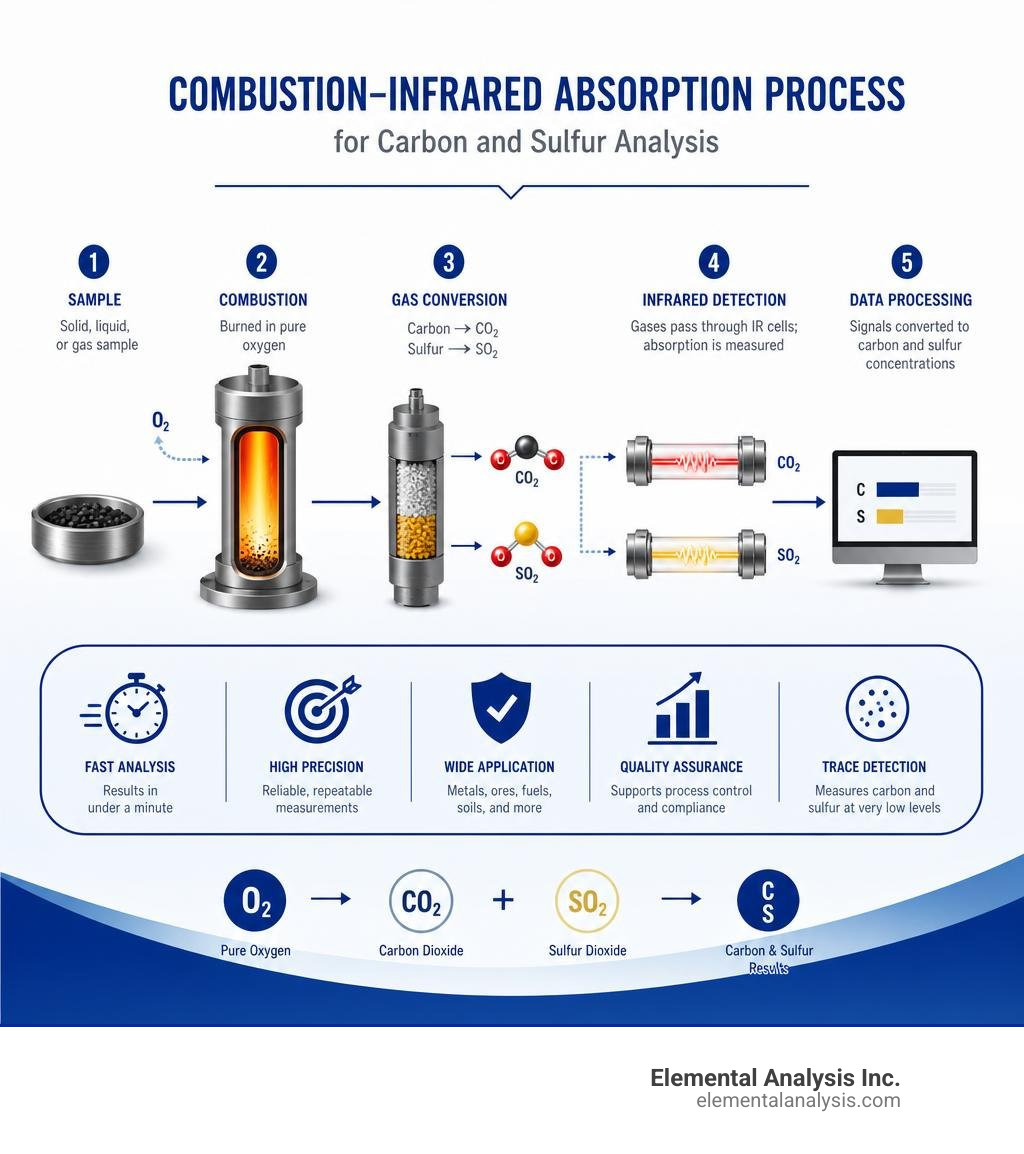
At its core, a carbon and sulfur analyzer relies on a beautifully simple scientific principle: burning a sample completely to convert its carbon and sulfur content into gases, and then measuring those gases with extreme precision. This method is formally known as the oxygen stream combustion-infrared absorption method.
Let’s break down the step-by-step process of how this works in a modern laboratory setup:
- Combustion in a Pure Oxygen Stream: The sample is placed inside a furnace (either an induction or resistance furnace) and heated to extreme temperatures in the presence of pure oxygen.
- Gas Conversion: The high-temperature combustion oxidizes the carbon in the sample into carbon dioxide ($CO2$) and a small amount of carbon monoxide ($CO$). Meanwhile, the sulfur is converted entirely into sulfur dioxide ($SO2$).
- Gas Conditioning and Filtration: Before these gases can be measured, they must be cleaned. The gas stream passes through dust filters, heated moisture traps, and chemical scrubbers to remove particulates and water vapor. Removing $H2O$ is absolutely vital because water vapor absorbs infrared light at similar wavelengths to $SO2$ and $CO_2$, which could easily skew the results.
- Non-Dispersive Infrared (NDIR) Detection: The purified gas stream is directed into NDIR detection cells. As the gases pass through, they absorb specific wavelengths of infrared light. By measuring how much light is absorbed, the analyzer determines the exact concentration of carbon and sulfur present.

This entire process relies on the Beer-Lambert Law, which states that the absorption of light is directly proportional to the concentration of the absorbing gas in the cell. To learn more about how this integrates with broader organic testing, you can read about our CHN/O Analysis options.
Induction vs. Resistance Furnaces in a Carbon and Sulfur Analyzer
The choice of furnace dictates what types of materials you can analyze. Modern systems typically employ one of two heating methods:
- High-Frequency Induction Furnaces: These systems utilize radio frequency (RF) energy to induce electrical currents within a conducting sample (or within a metal accelerator). This method achieves blistering temperatures exceeding 2,000°C (and often over 2,300°C) in a matter of seconds. Induction furnaces are the gold standard for inorganic materials like primary steels, iron, superalloys, ceramics, and ores. Because the heating is so rapid, a typical measurement cycle in an induction system takes only 40 to 70 seconds.
- Resistance Furnaces: These furnaces use traditional electrical resistance elements to heat a ceramic tube to a steady, programmable temperature, typically up to 1,450°C (or up to 1,550°C for brief periods). Resistance heating allows for gradual, controlled combustion curves. This is highly advantageous for organic matrices such as coal, coke, soils, agricultural plants, and polymers. Analysis times in resistance furnaces are slightly longer, typically ranging from 3 to 5 minutes.
To achieve complete combustion in an induction furnace, we rely on combustion accelerators (also known as fluxes). Because materials like ceramics or certain low-carbon steels do not couple well with RF induction currents on their own, we add metal fluxes like tungsten, tin, copper, or iron. These fluxes melt at low temperatures, dissolve the sample, and dramatically raise the local temperature to ensure every last atom of carbon and sulfur is oxidized.
Non-Dispersive Infrared (NDIR) Detection Technology
Once the sample is oxidized, the NDIR detector takes center stage. But how does it handle samples that have vastly different concentrations? For instance, how can one instrument measure a steel sample with 0.6 ppm sulfur alongside a polymer sample containing 10% carbon?
Modern high-performance analyzers solve this by using dual-path NDIR detection cells. These systems feature multiple infrared paths of varying lengths (cuvettes) optimized for different concentration ranges. A short path is used for high concentrations to prevent the detector from becoming saturated, while a long path provides the sensitivity needed to detect ultra-trace ppm levels. The analyzer’s software automatically selects the optimal cell path based on the signal strength, ensuring a wide dynamic range without requiring manual sample dilution.
Key Components and System Configurations
To understand how these systems maintain their ruggedness in heavy industrial environments, it helps to look at the individual components that make up a complete analyzer.
| Feature / Specification | Induction Furnace System | Resistance Furnace System |
|---|---|---|
| Typical Target Materials | Steels, alloys, ceramics, ores, catalysts | Coal, coke, soils, waste, organic chemicals |
| Max Operating Temperature | > 2,000°C (up to 2,300°C+ with flux) | 1,200°C to 1,450°C (up to 1,800°C with tin enthalpy) |
| Average Analysis Time | 40 to 70 seconds | 3 to 5 minutes |
| Typical Sample Weight | ~ 1,000 mg (1 gram) | 50 mg to 400 mg (up to 1,000 mg for coal) |
| Primary Gas Requirement | Pure Oxygen (99.5%+) | Pure Oxygen (99.5%+) |
A robust system configuration includes several critical auxiliary components:
- Heated Dust Traps and Filters: Combustion produces fine dust and soot. Heated traps prevent these particulates from settling in the gas lines, while heated filters prevent sulfur dioxide ($SO_2$) gas from condensing or dissolving in any residual moisture before it reaches the detector.
- Gas Purification Systems: For ultra-low carbon analysis, even the tiny amount of carbon dioxide present in your carrier gas can cause significant background drift. Purifier units containing molecular sieves and $CO_2$ absorbers are installed to clean the incoming oxygen stream.
- Autosamplers: To support 24/7 high-throughput laboratory workflows, systems can be fitted with automated carousels holding anywhere from 60 to 120 samples.
For those interested in exploring various system designs, the 744 Series – LECO Corporation provides an excellent example of modern, high-durability induction furnace engineering.
Advanced Analyzer Systems and Industry Standards
When selecting or operating a carbon and sulfur analyzer, compliance with international testing standards is non-negotiable. These standards ensure that laboratories worldwide produce comparable, reliable data.
Some of the most prominent standards include:
- ASTM E1019: The standard test method for determination of carbon, sulfur, nitrogen, and oxygen in steel, iron, nickel, and cobalt alloys.
- DIN EN ISO 15350: Specifies the combustion-infrared absorption method for determining carbon and sulfur in low-alloy steels.
- ASTM D4239: The standard test method for sulfur in the analysis sample of coal and coke using high-temperature tube furnace combustion.
- ISO 15178: Soil quality guidelines for the determination of total sulfur by dry combustion.
For highly automated, heavy-industry applications such as cement manufacturing and mining, specialized systems like the QCX® Carbon Sulphur Analyser are designed to integrate directly into robotic laboratory lines to ensure continuous compliance and process control.
Sample Handling for Solids, Liquids, and Gases
The key to achieving repeatable results is meticulous sample preparation. Depending on the physical state of your sample, the handling techniques will differ:
- Solid Samples: Metals are typically analyzed as chips, pins, or drillings. Ores and minerals are ground into fine powders. These are weighed into pre-heated ceramic crucibles. Pre-heating crucibles at 1,100°C for at least 10 minutes prior to analysis is a crucial best practice to burn off any atmospheric carbon contamination.
- Liquid Samples: Oils, fuels, and liquid chemicals are typically wrapped in high-purity tin foil or sealed inside tin capsules. The tin capsule prevents volatile liquids from evaporating prematurely and provides an exothermic reaction (tin enthalpy) that briefly spikes the combustion temperature up to 1,800°C to ensure complete oxidation.
- Acidified Samples (TOC/TIC): To separate Total Organic Carbon (TOC) from Total Inorganic Carbon (TIC) in soils or sediments, the sample is treated with acid to drive off carbonate minerals as $CO_2$ before combustion.
For a deeper dive into how researchers acquire and configure these instruments for diverse academic and industrial research projects, you can read about the Acquisition of a Leco SC-832HT Carbon/Sulfur Analyzer.
Industrial Applications and Quality Control
Because carbon and sulfur concentrations dictate the physical properties of so many materials, elemental analysis is a cornerstone of quality assurance programs globally.
Here is how different industries leverage a carbon and sulfur analyzer to optimize their processes:
- Metallurgy and Steelmaking: In steel production, carbon content must be controlled down to the third or fourth decimal place to achieve the correct hardness and tensile strength. Sulfur is generally considered an undesirable impurity that causes “hot shortness” (brittleness during hot working). Steel mills use rapid induction combustion to test samples directly from the furnace floor in under 60 seconds, allowing for real-time chemistry adjustments.
- Coal, Coke, and Energy Production: Power plants and coal processors must monitor sulfur content to comply with environmental emissions regulations and to calculate the calorific value of their fuels.
- Cement and Lime Manufacturing: Monitoring organic and inorganic carbon in clinker and raw mix helps optimize the pyro-processing kiln temperatures and ensures the structural integrity of the final concrete.
- Environmental and Soil Science: Measuring total organic carbon (TOC) and sulfur in soils helps agricultural laboratories assess soil health, organic matter decomposition, and nutrient availability.
To see the full scope of elemental testing services we provide across these diverse sectors, explore our comprehensive A to Z Testing portfolio.
Trace Detection Limits and Accuracy Levels
Modern elemental analyzers are incredibly sensitive. Take, for instance, high-performance induction systems which can measure carbon and sulfur concentrations ranging from a mere 0.6 ppm up to more than 6% for a standard 1,000 mg sample weight.
Achieving this level of precision requires exceptional instrument stability. High-end analyzers boast a blank accuracy (the standard deviation of repeated empty runs) of $\sigma_{n-1} \le 0.3 \text{ ppm}$ for both carbon and sulfur. For homogeneous substances, you can expect a relative standard deviation (RSD) of less than 1% for carbon and less than 1.5% for sulfur.
Maximizing Throughput with an Automated Carbon and Sulfur Analyzer
In high-volume testing laboratories, manual sample loading is a significant bottleneck. This is why automated, high-throughput systems are becoming the industry standard.
Modern automated analyzers offer several key operational advantages:
- Unattended 24/7 Operation: Equipped with large capacity autosamplers (often ranging from 60 to 120 positions), these instruments can run overnight without any operator intervention.
- Automatic Cleaning Mechanisms: Combustion in an induction furnace inevitably leaves behind dust and metal oxides. Advanced systems feature built-in vacuum systems and automatic crucible cleaners that sweep the combustion chamber after each run. This allows the system to perform up to 200 repeatable measurements before requiring manual maintenance.
- Self-Optimizing Software: The control software can dynamically adjust the oxygen flow rate and combustion time based on the sample weight and real-time element peak detection, maximizing gas efficiency and reducing overall cycle times.
Frequently Asked Questions about Carbon and Sulfur Analysis
What is the typical analysis time for carbon and sulfur determination?
For inorganic samples (like steel or alloys) combusted in an induction furnace, the typical analysis time is extremely rapid — usually between 40 and 70 seconds per sample. For organic samples (like coal, soil, or chemicals) processed in a resistance furnace, the cycle time is slightly longer, typically taking 3 to 5 minutes as the sample undergoes a controlled burn.
Why are combustion accelerators like tungsten and tin used?
Combustion accelerators (or fluxes) serve two vital purposes in induction heating. First, they provide the necessary magnetic coupling in the radio-frequency field for non-magnetic or non-conductive samples, allowing them to heat up. Second, they lower the melting point of refractory metals and undergo an exothermic reaction, rapidly elevating the local temperature above 2,000°C to ensure complete release of all trapped carbon and sulfur gases.
How do modern analyzers prevent moisture interference?
Water vapor is a major source of spectral interference in infrared spectroscopy. Modern carbon and sulfur analyzers prevent this by passing the combustion gases through chemical moisture absorbents (such as anhydrous magnesium perchlorate) and utilizing heated dust filters. This ensures that no moisture condenses in the gas lines, preventing the physical absorption or dissolution of $SO_2$ gas before it can be measured by the NDIR detectors.
Conclusion
Whether you are manufacturing high-strength steel alloys, monitoring soil quality, or verifying the sulfur content of coal, a high-performance carbon and sulfur analyzer is an indispensable tool for modern quality control. By combining the rapid heat of induction or resistance combustion with the pinpoint accuracy of non-dispersive infrared (NDIR) detection, these instruments deliver reliable, standard-compliant results in a matter of seconds.
At Elemental Analysis Inc., we specialize in delivering world-class elemental testing services with rapid turnarounds and competitive pricing. From trace identification to bulk quantification, our Lexington, Kentucky-based laboratory is equipped to handle your most demanding analytical challenges.
Ready to optimize your testing workflows and ensure absolute material compliance? More info about our analytical services is just a click away — contact our team of specialists today to discuss your project requirements!