
Elemental Testing Lab 101
Why an Elemental Testing Lab Is the Backbone of Safe, Compliant Products
An elemental testing lab is a specialized analytical facility that identifies and quantifies the chemical elements present in a material — down to parts per trillion (ppt) levels in some cases.
Quick answer: Here is what an elemental testing lab does and who needs it:
| What it does | Who needs it |
|---|---|
| Detects trace and ultra-trace elements in samples | Aerospace & defense engineers |
| Confirms regulatory compliance (ICH Q3D, USP 232/233) | Pharmaceutical QA/QC managers |
| Tests soil, water, and air for contamination | Environmental monitoring teams |
| Identifies catalyst poisons and material impurities | Petrochemical & materials scientists |
| Uses non-destructive methods to preserve samples | Forensic, heritage, and R&D labs |
Whether you need to meet a regulatory deadline or track down a mystery contaminant in a production batch, the right lab makes the difference between a pass and a costly failure.
Even tiny amounts of the wrong element — at concentrations invisible to the naked eye — can compromise a drug’s safety, cause a component to fail under stress, or push an environmental discharge over a legal limit. That’s not a hypothetical. Elemental impurities can significantly affect chemical, physical, or functional properties even at trace levels, and those contaminants are often introduced during processing or production without any obvious warning signs.
The stakes are high. The margin for error is essentially zero.
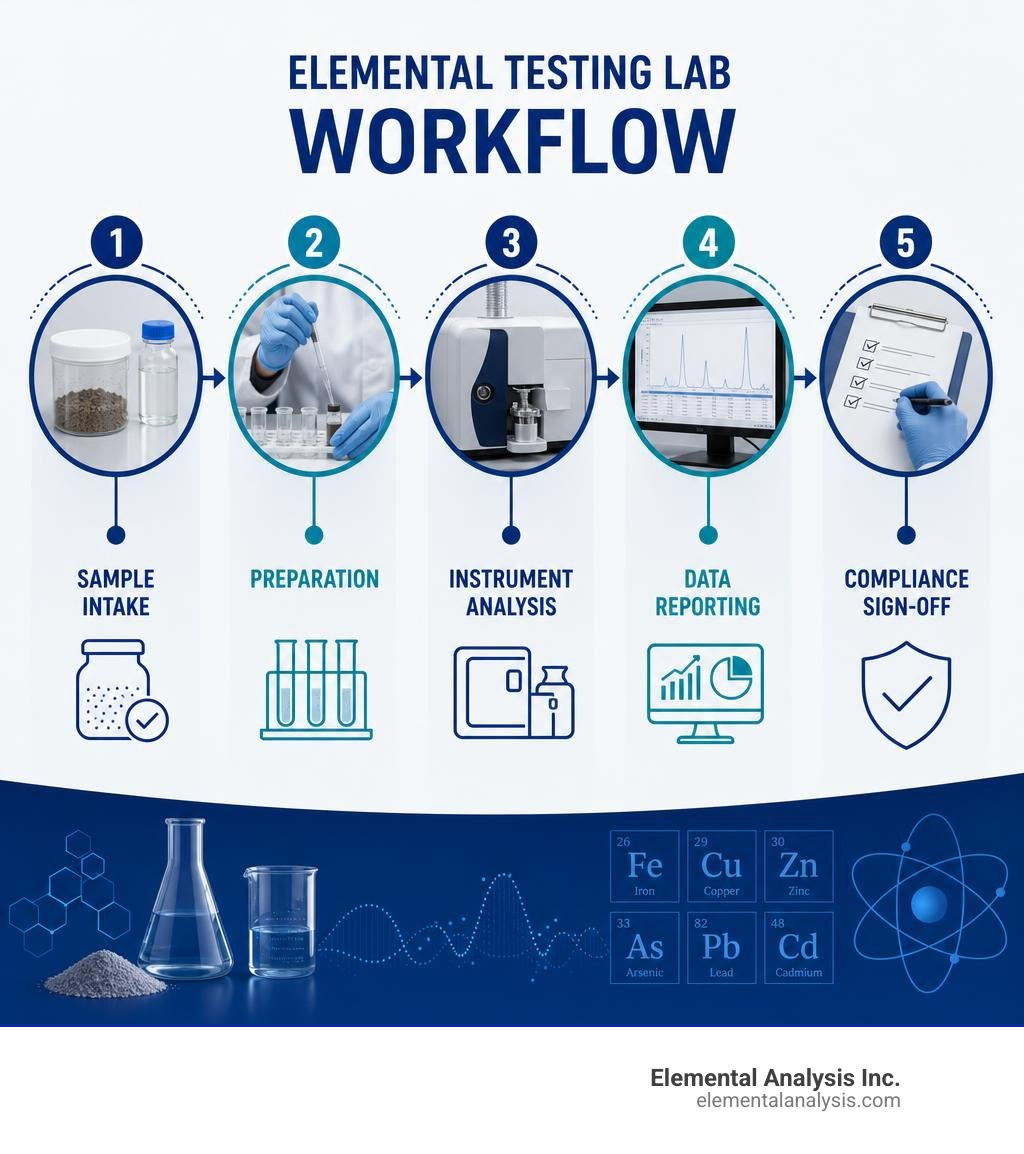
What is an Elemental Testing Lab and Why is it Critical?
At its heart, an elemental testing lab is a high-tech detective agency for materials. Instead of tracking down missing persons, we track down missing (or unwelcome) elements. By utilizing a suite of advanced analytical chemistry methods, we can break a material down to its atomic components and tell you exactly what it is made of, in what ratios, and whether any unwanted guests are hiding in the matrix.
This process of material characterization is vital throughout the entire product lifecycle. During early-stage research and development, knowing the precise chemical composition of your raw ingredients ensures that your experimental formulations behave exactly as intended. As you move into commercial production, routine quality control checks prevent manufacturing defects and verify that your suppliers are sending you pure materials. Finally, when a product is in the hands of consumers, elemental analysis acts as your shield against regulatory non-compliance, product liability, and brand-damaging recalls.
To achieve this level of oversight, analytical chemistry relies on two primary approaches: destructive and non-destructive testing. Depending on the nature of your sample, its value, and your testing goals, we will employ one or both of these approaches.
| Testing Characteristic | Destructive Testing | Non-Destructive Testing (NDT) |
|---|---|---|
| Sample Preservation | The sample is consumed, dissolved, or permanently altered. | The sample remains completely intact and can be reused. |
| Primary Techniques | ICP-MS, ICP-OES, Combustion Analysis (CHNO). | PIXE, XRF. |
| Detection Limits | Extremely low (often down to parts per billion or trillion). | Moderate to low (parts per million range). |
| Best Used For | Homogeneous liquids, bulk powders, and ultra-trace analysis. | Rare artifacts, forensic evidence, and finished components. |
| Preparation Required | Often requires acid digestion or high-temperature combustion. | Minimal to no sample preparation required. |
Core Services of a Modern Elemental Testing Lab
A fully equipped elemental testing lab does not just run one type of test. Because samples come in all shapes, sizes, and states of matter—from liquid industrial effluents to solid metal alloys—we offer a broad spectrum of services to cover every analytical scenario.
Our core analytical capabilities include trace and ultra-trace detection, which allow us to find elements that make up less than 0.01% of a sample. We also specialize in speciation services. Elemental speciation is the practice of identifying not just which elements are in a sample, but what chemical form they take. For example, finding arsenic in a food sample is concerning, but knowing whether it is highly toxic inorganic arsenic or relatively harmless organic arsenic is what allows you to make an informed safety decision.
From routine screening to complex custom investigations, our A to Z Testing protocols ensure that no element goes unnoticed. We design our tailored analytical services to match the unique physical properties of your sample matrix and your specific compliance targets.
Key Industries Served by an Elemental Testing Lab
No single industry has a monopoly on the need for chemical purity. In fact, elemental testing is a quiet partner in almost every major sector of the global economy:
- Aerospace & Defense: In these high-stakes industries, material failure is simply not an option. We analyze turbine blades, structural fasteners, and electronic components to ensure they meet strict alloy specifications and do not contain trace impurities that could lead to premature fatigue or stress corrosion cracking.
- Pharmaceuticals & Medical Devices: Patient safety relies on strict control over elemental impurities. We help drug manufacturers comply with international pharmacopeia standards by scanning raw materials, active pharmaceutical ingredients (APIs), and finished drug products for toxic heavy metals.
- Environmental Monitoring: Protecting our ecosystems requires vigilant testing of soil, water, and air. We work alongside environmental engineers and municipal agencies to detect industrial runoff, agricultural contamination, and hazardous waste leaks before they threaten public health.
To learn more about our history and our dedication to technical excellence across these industries, visit our About Us page.
Advanced Instrumentation and Analytical Techniques

To find a needle in a haystack, you need a very good magnet. To find a single part-per-trillion atom of lead in a complex liquid pharmaceutical, you need some of the most advanced scientific instrumentation on the planet. Our laboratory in Lexington, Kentucky, houses a suite of cutting-edge instruments that allow us to achieve incredibly low detection limits.
ICP-MS and ICP-OES for Trace Analysis
Inductively Coupled Plasma Mass Spectrometry (ICP-MS) and Inductively Coupled Plasma Optical Emission Spectrometry (ICP-OES) are the twin workhorses of trace metal analysis. Both techniques rely on an extremely hot argon plasma torch—burning at temperatures equivalent to the surface of the sun (around 10,000 Kelvin)—to atomize and ionize the sample.
- ICP-OES measures the light emitted by excited atoms as they return to their ground state. Because each element emits light at characteristic wavelengths, we can identify and quantify multiple elements simultaneously. This technique is ideal for major and minor element concentrations down to parts per million (ppm) levels.
- ICP-MS takes the process a step further by directing the ions from the plasma into a mass spectrometer. By separating the ions based on their mass-to-charge ratio, ICP-MS can detect almost any element on the periodic table at ultra-trace levels, often down to parts per billion (ppb) or parts per trillion (ppt).
For a deeper dive into how we apply these plasma-based techniques to solve your toughest analytical challenges, explore our guide to ICP Laboratory Analysis and learn how we configure our trace metal analysis workflows for maximum accuracy.
XRF and PIXE for Non-Destructive Testing
While destructive techniques like ICP require us to dissolve your sample in strong acids, some samples are too precious, rare, or structurally important to destroy. That is where our non-destructive testing (NDT) capabilities shine.
We are proud to be the first commercial Proton-Induced X-ray Emission (PIXE) laboratory. PIXE is an incredibly powerful, non-destructive analytical technique that uses a beam of high-energy protons generated by a particle accelerator to excite the atoms in a sample. As these atoms relax, they emit characteristic X-rays that tell us exactly which elements are present on the surface and near-surface layers. Because the proton beam does not damage the sample, PIXE is the gold standard for analyzing historical artifacts, delicate thin films, and valuable forensic evidence.
For more routine non-destructive testing, we also utilize X-ray Fluorescence (XRF). XRF works on a similar principle to PIXE but uses primary X-rays instead of a proton beam to excite the sample. It is a fast, highly reliable method for identifying metal alloys, checking plating thickness, and verifying raw material compositions.
You can read more about how we apply these unique non-destructive tools on our dedicated XRF and PIXE capability pages.
Organic Elemental Analysis (CHNO and Oc Ec)
While metals are critical, organic materials make up a massive portion of the physical world. For samples composed primarily of carbon, hydrogen, nitrogen, oxygen, and sulfur, we use specialized combustion analysis techniques.
Our CHNO analysis involves flash-combusting the sample in a pure oxygen environment at high temperatures. This converts the organic elements into simple gases (like carbon dioxide, water vapor, and nitrogen dioxide), which are then separated and measured with high-precision thermal conductivity or infrared detectors. This technique is essential for verifying the purity of synthetic chemicals, polymers, and pharmaceuticals.
Additionally, we offer Organic Carbon / Elemental Carbon analysis. This specialized method is widely used in environmental and atmospheric science to differentiate between organic carbon (which volatilizes at lower temperatures) and elemental carbon (soot or black carbon, which requires oxygen to burn at high temperatures). This distinction is critical for air quality monitoring and climate change research.
Specialized Techniques: NAA and Halogen Analysis
To round out our analytical toolkit, we offer highly specialized methods for elements that are difficult to measure using standard plasma spectrometry.
Neutron Activation Analysis is a highly sensitive nuclear process used to determine the concentrations of elements in a vast range of materials. By bombarding a sample with neutrons, we cause the elements within it to form radioactive isotopes. As these isotopes decay, they emit gamma rays at specific energy levels, allowing us to perform non-destructive, bulk elemental analysis with incredible precision.
We also perform halogen analysis (fluorine, chlorine, bromine, and iodine) using oxygen flask combustion followed by ion chromatography. This is a critical service for industries looking to verify halogen-free compliance in plastics, electronics, and consumer goods.
Key Applications and Regulatory Compliance
In the modern regulatory landscape, simply generating data is not enough. The data must be accurate, traceable, and legally defensible. We maintain a rigorous quality management system, including ISO/IEC 17025:2017 accreditation, to ensure that our clients can confidently present our findings to regulatory bodies worldwide.
Pharmaceutical Impurities (ICH Q3D and USP 232/233)
Pharmaceutical manufacturers must comply with strict limits on elemental impurities in drug products, as outlined in the International Council for Harmonisation (ICH) Q3D guidelines and United States Pharmacopeia (USP) Chapters 232 and 233.
These regulations group toxic elements into classes based on their toxicity and the likelihood of their occurrence in the manufacturing process:
- Class 1 Metals: The “big four” highly toxic elements—lead (Pb), cadmium (Cd), arsenic (As), and mercury (Hg)—which must be monitored across all drug delivery routes.
- Class 2 Metals: Elements like cobalt (Co), nickel (Ni), and vanadium (V), which are toxic depending on the route of administration.
- Class 3 Metals: Elements with lower toxicities but which still require risk assessments, such as lithium (Li) and antimony (Sb).
Our state-of-the-art ICP-MS laboratory is fully validated to perform USP 232/233 limit testing and quantitative analysis, helping you secure rapid approval for your drug formulations. Learn more about how we support pharmaceutical compliance on our Services page.
Environmental Testing and Soil/Water Analysis
Protecting public health starting with clean soil and water is a collective responsibility. Our environmental testing services help municipalities, industrial facilities, and engineering firms monitor local ecosystems for harmful contaminants.
We analyze drinking water, wastewater, agricultural soil, and industrial sludge for heavy metals and other toxic elements. In addition to standard metal scans, we track emerging contaminants of concern, such as per- and polyfluoroalkyl substances (PFAS). While PFAS molecules are organic, analyzing their elemental fluorine content is an increasingly important screening tool.
To support regional compliance and environmental stewardship, we collaborate with local resources and reference standards, such as those maintained by the Analytical and Lab – Kentucky Geological Survey. This ensures that our environmental testing protocols align with regional geological baselines and regulatory expectations.
Catalyst Poison Analysis and Material Science
In the chemical and petrochemical industries, catalysts are used to speed up reactions and improve yields. However, these expensive materials are highly susceptible to “poisoning”—a process where trace impurities in the feedstock bind to the active sites of the catalyst, permanently deactivating it.
Using trace elemental analysis, we can scan your raw chemical feeds to identify potential catalyst poisons (such as sulfur, phosphorus, arsenic, or lead) before they reach your reactor beds. This preventative testing saves companies millions of dollars in premature catalyst replacement costs and unplanned facility shutdowns.
Stay up to date on the latest trends in industrial chemistry, materials science, and contamination control by reading our regular updates on the Blog.
Frequently Asked Questions about Elemental Testing
What is the difference between trace and ultra-trace elemental analysis?
The difference lies in the concentration levels we are looking for:
- Trace analysis typically deals with elements present at concentrations between 1 part per million (ppm) and 100 ppm (or 0.0001% to 0.01% of the sample).
- Ultra-trace analysis goes much deeper, targeting elements present at concentrations below 1 part per million, often measured in parts per billion (ppb) or parts per trillion (ppt). To put that in perspective, 1 part per trillion is equivalent to a single drop of water in 20 Olympic-sized swimming pools!
Why is non-destructive testing preferred for certain samples?
Non-destructive testing (NDT) is preferred when the sample itself is irreplaceable, highly valuable, or must be preserved for future use. For example, if a forensic investigator needs to analyze a paint chip from a crime scene, destroying it during testing would eliminate the physical evidence. Similarly, when assessing the composition of historical coins, art pieces, or expensive aerospace prototypes, NDT methods like PIXE allow us to gather precise chemical data without leaving a scratch.
How long does a typical elemental analysis take?
Our standard turnaround time for most routine analyses is 5 to 7 business days from the moment we receive your samples at our Lexington, KY facility. However, we understand that manufacturing emergencies and regulatory deadlines happen. That is why we offer expedited testing options, including 24-hour and 48-hour rush services for urgent troubleshooting and critical quality control checks.
Conclusion
When the stakes are high, you cannot afford to guess what is in your materials. Partnering with a dedicated elemental testing lab gives you the precise chemical data you need to ensure safety, maintain regulatory compliance, and protect your brand’s reputation.
At Elemental Analysis Inc., we combine nearly 50 years of analytical experience with a warm, customer-first approach. Operating as the world’s first commercial PIXE laboratory from our headquarters in Lexington, Kentucky, we provide a unique blend of destructive and non-destructive testing services. Our fast turnaround times, competitive pricing, and commitment to technical excellence make us the ideal partner for your most challenging analytical projects.
Ready to unlock the secrets of your samples? Contact Us today to speak with one of our analytical experts, or browse our full suite of Services to find the exact testing solution for your industry.