
Hot Stuff: How Inductively Coupled Argon Plasma Spectrometry Powers Modern Mass Spec
What Inductively Coupled Argon Plasma Spectrometry Actually Does (and Why It Matters)
Inductively coupled argon plasma spectrometry is an analytical technique that uses a superheated argon plasma — reaching up to 10,000 Kelvin — to atomize and ionize virtually any element in a sample, then measures those ions by mass or optical emission to deliver trace-level elemental data across most of the periodic table.
Quick answer for lab managers:
- What it is: A family of techniques (mainly ICP-MS and ICP-OES) that use argon plasma as an ionization source for elemental analysis
- What it measures: Nearly all elements, from lithium to uranium, at concentrations down to the nanomol/L (parts-per-trillion) range
- Who uses it: Clinical, environmental, pharmaceutical, aerospace, and forensic laboratories
- Key advantage: Multi-element analysis in a single run — no need to re-run samples for each analyte
- Main variants: ICP-MS (mass spectrometry detection) and ICP-AES/OES (optical emission detection)
If your lab is chasing sub-ppb detection limits, needs to screen dozens of elements at once, and can’t afford to run samples multiple times, this is the technology built for that problem.
The technique has roots going back to 1980, when researchers first demonstrated that an inductively coupled argon plasma could serve as an ion source for mass spectrometric trace element determination. Since then, it has steadily displaced older single-element methods like atomic absorption spectroscopy in labs that demand speed, sensitivity, and breadth — all from a single analysis.
In the sections below, we’ll walk through exactly how the physics works, what the instrument looks like inside, how to prepare samples and handle interferences, and what it takes to implement ICP-MS in a real-world lab setting.
Inductively coupled argon plasma spectrometry word guide:
The Physics of Inductively Coupled Argon Plasma Spectrometry
To understand why this technique is so dominant, we have to look at the physics of the plasma itself. The heart of the system is the induction plasma torch, which typically consists of three concentric quartz tubes. High-purity argon gas (usually 99.9% pure or higher) flows through these channels.
To initiate the plasma, we apply a radiofrequency (RF) signal—usually operating at 27.12 MHz or 40 MHz—to a water-cooled copper induction coil wrapped around the end of the torch. This RF field creates an intense, oscillating electromagnetic field. At this stage, however, argon is just a cold, inert gas that does not conduct electricity.
To kickstart the process, a brief, high-voltage spark from a Tesla coil is introduced. This spark strips a few electrons from the argon atoms, creating a small population of free electrons and argon ions. Once these charged particles are present, they are accelerated by the oscillating electromagnetic field. As they zip back and forth, they collide with other neutral argon atoms, stripping away more electrons in a rapid, self-sustaining cascade.
This process generates a stable, continuous, electrode-free induction plasma fireball. Because the energy transfer occurs inductively, there are no metal electrodes in contact with the plasma, which completely eliminates a major source of sample contamination.
The temperatures within this argon fireball are astonishing, reaching up to 10,000 Kelvin in the outer induction region and stabilizing around 6,000 to 7,000 Kelvin in the central channel where the sample is injected. At these extreme temperatures, any sample introduced is instantly dried, vaporized, atomized, and ionized.
Argon is chosen as the primary plasma gas for several reasons:
- It is chemically inert, meaning it won’t react with the torch components or sample matrix.
- It is relatively abundant and cost-effective compared to other noble gases like helium.
- It has a high first ionization potential of 15.76 eV.
Because argon’s first ionization potential is so high, the plasma has more than enough energy to ionize almost every other element on the periodic table. Most elements have first ionization potentials well below 15.76 eV, meaning they easily lose their most loosely bound electron to become singly charged positive ions ($M^+$). At the same time, because argon’s second ionization potential is much higher, we minimize the creation of unwanted doubly charged ions ($M^{2+}$), which can complicate mass spectra.
For a deeper dive into the fundamental physics of plasma generation, check out our Essential Guide to Inductively Coupled Plasma.
Comparing Inductively Coupled Argon Plasma Spectrometry to ICP-OES
While both ICP-OES (Optical Emission Spectroscopy, sometimes called ICP-AES) and ICP-MS use the exact same superheated argon plasma to process samples, they differ entirely in how they detect and measure the elements.
In ICP-OES, we look at the light emitted by the excited atoms and ions. As the sample elements pass through the plasma, their outer-shell electrons are promoted to higher energy levels. When these electrons drop back down to their ground states, they emit light at highly specific, element-characteristic wavelengths.
An optical spectrometer disperses this light using a diffraction grating, and a detector (such as a charge-coupled device, or CCD) measures the intensity of the emission lines. We then use these intensities to determine concentration.
In contrast, ICP-MS does not look at light. Instead, it uses the argon plasma purely as an ion source. The physical ions generated in the plasma are extracted directly into a mass spectrometer. The mass spectrometer separates these ions based on their mass-to-charge ($m/z$) ratio, and a detector counts the individual ions hitting it.
This fundamental difference in detection mechanism leads to distinct analytical advantages:
- Detection Limits: ICP-MS offers vastly superior sensitivity. While ICP-OES can comfortably measure down to parts-per-billion (ppb) levels, ICP-MS regularly achieves parts-per-trillion (ppt) or nmol/L detection limits for the majority of the periodic table.
- Spectral Simplicity: ICP-OES spectra can be incredibly complex, with single heavy elements emitting hundreds of individual light wavelengths that can overlap and interfere with one another. ICP-MS spectra are much simpler because they are sorted by atomic mass, meaning there are only a few isotopes to monitor per element.
- Isotopic Analysis: Because ICP-MS measures mass, it can distinguish between different isotopes of the same element (e.g., Lead-206 vs. Lead-208), a task that is virtually impossible with optical emission.
- Linear Dynamic Range: ICP-MS detectors feature an extraordinary linear dynamic range of approximately 8 to 12 orders of magnitude, allowing the instrument to measure trace and major elements simultaneously in a single run.
For a detailed comparison to help you choose the right technique for your laboratory’s needs, read our guide on ICP Analysis for Heavy Metals: Choosing Between ICP-OES and ICP-MS.
Anatomy of an ICP-MS Instrument
An ICP-MS is a masterpiece of engineering that bridges two wildly different physical environments: a superheated, atmospheric-pressure plasma fire on one end, and an ultra-high vacuum mass spectrometer on the other.

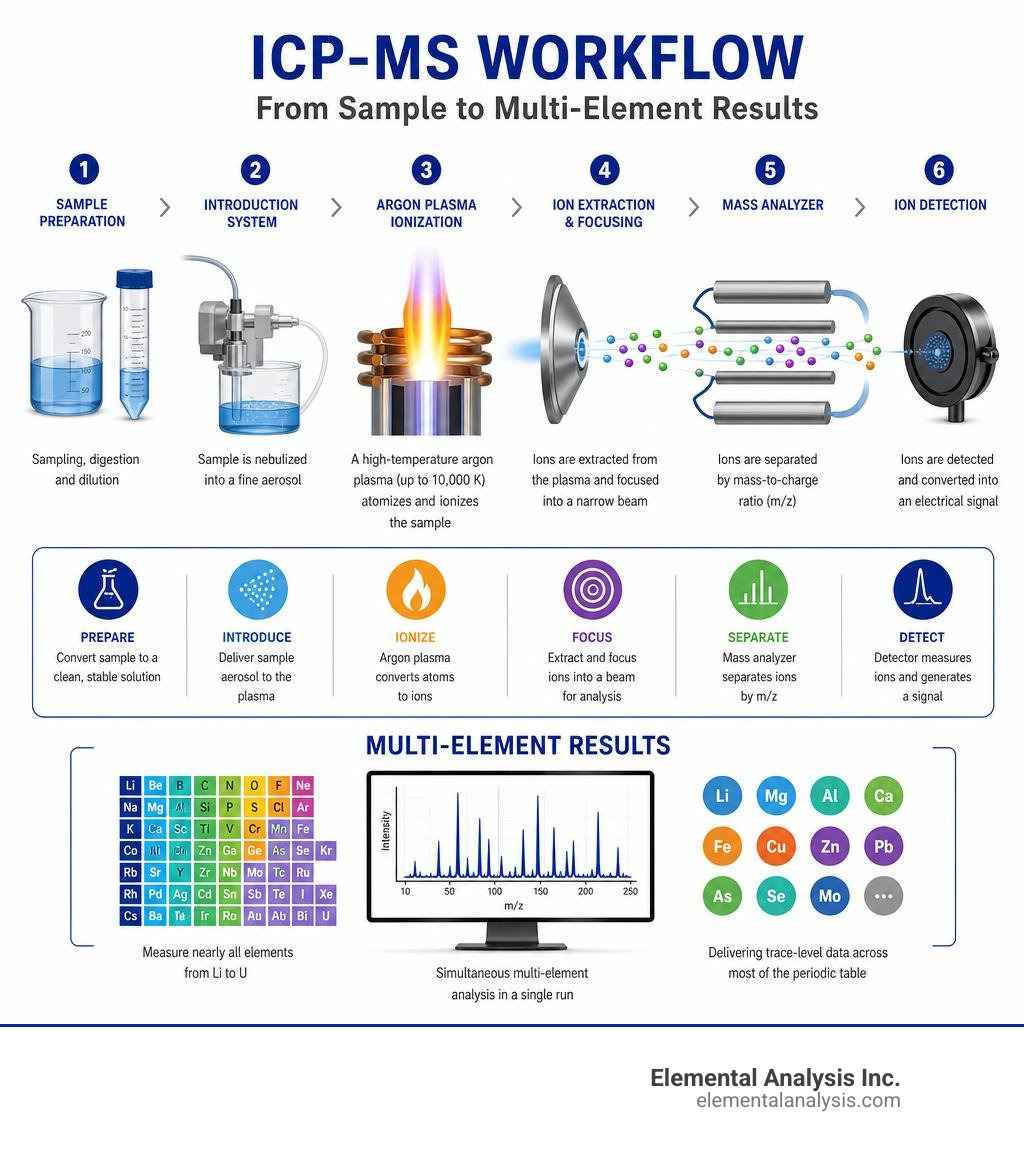
Understanding how these components function together is key to getting the most out of the technology. The general workflow of inductively coupled plasma mass spectrometry can be broken down into five core hardware stages:
- Sample Introduction System: Converts the liquid sample into a fine aerosol and sweeps it into the torch.
- The ICP Torch: Generates the superheated argon plasma that dries, atomizes, and ionizes the sample.
- The Interface Region: Extracts the ions from the atmospheric plasma and transfers them into the vacuum system.
- Ion Optics: Focuses the ion beam while removing neutral particles and photons to minimize background noise.
- Mass Analyzer & Detector: Separates the ions by their $m/z$ ratio and counts them.
Sample Introduction in Inductively Coupled Argon Plasma Spectrometry
Before a liquid sample can be ionized in a 10,000 K plasma, it must be converted into an incredibly fine mist. If the droplets are too large, they will cool the plasma, destabilize it, or fail to atomize completely.
This critical job belongs to the sample introduction system, which consists of a peristaltic pump, a nebulizer, and a spray chamber. The pump delivers the liquid sample at a steady, controlled rate to the nebulizer.
Using a high-velocity stream of argon gas, the nebulizer shears the liquid into a fine aerosol. This aerosol then enters the spray chamber, which is typically cooled to around 2°C to reduce water vapor pressure and maintain plasma stability.
The spray chamber acts as a physical filter. It allows only the smallest droplets—those under 10 micrometers in diameter—to pass through the injector tube and into the plasma.
In fact, only about 1% to 2% of the nebulized sample actually reaches the plasma; the remaining 98% to 99% of the liquid is drained away as waste. This low efficiency is a necessary compromise to keep the plasma running stably and to prevent the water solvent from extinguishing the “fire.”
For more details on how this process unfolds inside the instrument, see our article ICP-MS Explained: How We Weigh Atoms in a Plasma Fire.
The Interface and Mass Analyzer
Once the sample is ionized in the plasma, the ions must be moved into the mass spectrometer. This is the job of the interface region, which is arguably the most demanding engineering component of the instrument.
The interface consists of two water-cooled metal cones, typically made of high-purity nickel or platinum:
- The Sampler Cone: Positioned directly in front of the plasma, featuring a central orifice of approximately 1.0 mm.
- The Skimmer Cone: Positioned immediately behind the sampler cone, with a smaller orifice of roughly 0.45 mm.
As the plasma gas impinges on the sampler cone, a portion of the gas is drawn through the orifice into a region of intermediate vacuum (around 150 to 300 Pa) maintained by a high-capacity rotary pump. This rapid drop in pressure causes the gas to expand supersonically.
The central portion of this expanding jet then passes through the skimmer cone orifice, entering the high-vacuum region ($10^{-3}$ to $10^{-5}$ Pa) where the ion optics and mass analyzer reside. This design was first pioneered in the landmark 1980 paper, Inductively Coupled Argon Plasma as an Ion Source for Mass Spectrometric Determination of Trace Elements.
Once inside the high vacuum, the positive ions are focused by a series of electrostatic lenses (the ion optics) into a tight beam. Photons and neutral species, which would otherwise create intense background noise on the detector, are blocked or deflected out of the path.
The focused ion beam then enters the mass analyzer—most commonly a quadrupole. The quadrupole consists of four parallel, extremely precise metal rods. By applying a combination of direct current (DC) and radiofrequency (RF) voltages to these rods, we can create an oscillating electrostatic field that acts as a mass filter.
At any given voltage setting, only ions of a specific mass-to-charge ($m/z$) ratio will have stable trajectories and travel all the way through the quadrupole to the detector. All other ions will spiral out of control and crash into the rods. By rapidly scanning these voltages (taking only milliseconds to scan the entire mass range), the instrument can measure nearly the entire periodic table in seconds.
Typical quadrupole ICP-MS instruments operate at a resolution of approximately 300 ($M/\Delta M$), resulting in a peak width of about 0.75 amu at 10% peak height. They also boast an abundance sensitivity of $10^{-7}$, meaning that a massive signal of $10^7$ counts at mass $M$ will contribute only 1 count of background noise at the adjacent masses ($M \pm 1$).
Sample Preparation and Calibration Strategies
Getting exceptional data from inductively coupled argon plasma spectrometry starts long before the sample is injected into the instrument. Because ICP-MS is highly sensitive, sample preparation must be meticulous.
When working with biological fluids like whole blood, urine, or serum, we face unique challenges. These matrices are loaded with proteins, lipids, and high concentrations of dissolved salts.
If introduced directly, these components would quickly clog the nebulizer, coat the interface cones, and cause severe signal drift. To prevent this, we must adhere to a strict rule of thumb: keep the total dissolved solids (TDS) content under 0.2% (2 g/L).
To achieve this, biological samples are typically diluted 10-fold to 50-fold. Rather than using deionized water—which can cause proteins to precipitate and some elements to become unstable—we use specialized diluents.
These diluents typically consist of:
- Very dilute nitric acid ($HNO3$) or ammonium hydroxide ($NH4OH$) to keep analytes in solution.
- A mild surfactant like Triton X-100 to help solubilize lipids and membrane proteins.
- Chelating agents like EDTA to keep transition metals from binding to container walls.
For solid samples, such as tissue or food, we must perform a complete acid digestion—often using concentrated nitric acid and hydrogen peroxide in a closed-vessel microwave digestion system—to break down the organic matrix completely before analysis.
For step-by-step guidance on avoiding contamination and preparing your samples correctly, check out our ICP-MS Lab Guide: How to Get Accurate Trace Element Testing.
Calibration and Quantification Methods
To convert raw detector counts into highly accurate concentration values, we rely on several sophisticated calibration strategies:
- External Calibration: We prepare a series of calibration standards of known concentration in a clean matrix. The instrument measures these standards to build a calibration curve of signal intensity versus concentration. This is the most common and highest-throughput method, but it requires that the matrix of the standards closely matches the matrix of the samples to avoid physical interferences.
- Internal Standardization: To correct for physical interferences (like viscosity differences) and long-term instrument drift, we add a constant concentration of non-interfering elements (such as Indium, Rhodium, or Yttrium) to every blank, standard, and sample. The instrument monitors the ratio of the analyte signal to the internal standard signal, automatically compensating for any fluctuations in sample delivery or plasma temperature.
- Method of Standard Additions: When dealing with highly complex or unpredictable matrices where perfect matrix matching is impossible, we use standard additions. We split the sample into several aliquots and “spike” them with increasing, known amounts of the target analyte. By plotting the resulting signals and back-extrapolating to zero, we can determine the original concentration, completely bypassing matrix effects.
- Isotope Dilution: The absolute gold standard for accuracy. We spike the sample with a known quantity of an enriched, non-natural isotope of the element we want to measure (for example, Lead-206). By measuring the altered isotope ratio ($^{206}Pb/^{208}Pb$) in the sample, we can calculate the exact concentration. Because this method relies on a ratio, it is completely immune to physical losses during sample prep, instrument drift, and matrix suppression.
Overcoming Spectroscopic and Non-Spectroscopic Interferences
No analytical technique is entirely free of interferences, and ICP-MS is no exception. These interferences fall into two major categories: spectroscopic and non-spectroscopic.

Spectroscopic interferences occur when an unwanted ion shares the exact same nominal mass-to-charge ratio as your target analyte. There are three main types:
- Isobaric Interferences: Caused by isotopes of different elements that share the same mass. For example, Calcium-40 ($^{40}Ca$) overlaps with Argon-40 ($^{40}Ar$). Because argon is the plasma gas, we simply cannot measure the main isotope of calcium at mass 40. Instead, we must select an alternative, less abundant isotope like $^{44}Ca$.
- Polyatomic Interferences: These occur when elements from the plasma, solvent, or reagents combine to form molecular ions in the plasma. A classic example is the combination of Argon ($^{40}Ar$) and Oxygen ($^{16}O$) to form $^{40}Ar^{16}O^+$, which has a mass of 56—the exact mass of the most abundant iron isotope ($^{56}Fe$). Another notorious example is $^{40}Ar^{35}Cl^+$, which interferes with Arsenic ($^{75}As$) in samples containing chloride (like urine or seawater).
- Doubly Charged Ions: Some elements with low second ionization energies (like Barium or Rare Earth Elements) can form doubly charged ions ($M^{2+}$) in the plasma. A $^{136}Ba^{2+}$ ion will appear at mass-to-charge 68 ($136/2$), creating a spectral interference on Zinc ($^{68}Zn$).
To eliminate these polyatomic interferences, modern ICP-MS instruments utilize a Collision/Reaction Cell (CRC) positioned just before the mass analyzer.
In collision mode, we fill the cell with an inert gas like helium. As the ions pass through, they collide with the helium atoms. Because polyatomic molecular ions (like $^{40}Ar^{16}O^+$) are physically larger than monatomic analyte ions (like $^{56}Fe^+$), they undergo many more collisions.
Each collision strips away kinetic energy. By applying a small electrostatic barrier at the exit of the cell (a process called Kinetic Energy Discrimination, or KED), we block the low-energy polyatomic ions while allowing the energetic analyte ions to pass through to the analyzer.
For extremely challenging interferences, we can run the cell in reaction mode, introducing reactive gases like hydrogen, oxygen, or ammonia. These gases react chemically with either the interference (to neutralize it) or the analyte (to shift it to a clean mass), leaving the target mass free of overlap.
To read more about the mechanisms of interference control, consult this comprehensive review on Inductively Coupled Plasma Mass Spectrometry – PMC – NIH.
Non-Spectroscopic Interferences and Drift
Non-spectroscopic interferences, often called matrix effects, do not produce overlapping spectral peaks. Instead, they physically alter the instrument’s sensitivity.
They can be caused by:
- Physical Interferences: High levels of dissolved salts or acids change the surface tension and viscosity of the sample, which alters the droplet size distribution produced by the nebulizer.
- Ionization Suppression/Enhancement: High concentrations of easily ionized elements (like Sodium or Potassium) in the plasma can shift the ionization equilibrium, suppressing the ionization of analytes with higher ionization energies.
- Space Charge Effects: Once inside the high vacuum of the mass spectrometer, the dense ion beam is dominated by positive charges. Because like charges repel, the ions push against one another. If the sample matrix contains a high concentration of heavy ions (like Lead), these massive ions will physically push lighter analyte ions (like Lithium or Boron) out of the central beam path, leading to a dramatic loss in sensitivity for the light elements.
The most effective way to combat these non-spectroscopic interferences and the natural drift of the instrument over time is the rigorous use of internal standardization, as discussed in our guide, The Ins and Outs of Inductively Coupled Plasma Mass Spectrometry.
Advanced Applications: Speciation and Clinical Implementation
One of the most exciting frontiers in analytical chemistry is elemental speciation. In many fields, particularly clinical toxicology and environmental science, knowing the total concentration of an element is not enough.
The chemical form (species) of the element dictates its toxicity, bioavailability, and mobility. For example, inorganic arsenic species (arsenite and arsenate) are highly toxic carcinogens.
In contrast, organic arsenic species like arsenobetaine—which is highly abundant in seafood—are completely non-toxic and pass through the human body harmlessly. If a clinical lab only measures “total arsenic,” a patient who recently ate a seafood dinner might trigger a false alarm for heavy metal poisoning.
To solve this, we couple a separation technique like High-Performance Liquid Chromatography (HPLC) directly to the sample introduction system of the ICP-MS.
In an HPLC-ICP-MS setup, the HPLC column separates the different chemical species in time. As each species elutes from the column, it flows directly into the ICP-MS nebulizer, where the argon plasma instantly ionizes it.
The mass spectrometer then records a series of chromatographic peaks over time, allowing us to identify and quantify each individual chemical species with extreme sensitivity.
This approach is highly valuable for distinguishing:
- Toxic inorganic arsenic from organic forms.
- Highly toxic methylmercury from inorganic mercury.
- Hexavalent chromium (a carcinogen) from trivalent chromium (an essential nutrient).
For a deeper look at how this technology is used to monitor human exposure to dangerous toxins, read our comprehensive guide on Heavy Metal Analysis by ICP-MS: The Ultimate Guide to Screening Toxins.
Clinical Lab Implementation and ICP-MS Advantages
For clinical laboratories looking to modernize their elemental analysis capabilities, upgrading to ICP-MS represents a major leap forward. To help visualize where ICP-MS fits compared to older, traditional techniques, we have compiled a comparison table below:
| Feature | Flame Atomic Absorption (FAA) | Graphite Furnace AA (GFAAS) | ICP-OES / ICP-AES | ICP-MS |
|---|---|---|---|---|
| Detection Limits | Poor (ppm to high ppb) | Excellent (ppb to ppt) | Moderate (ppb) | Outstanding (ppt to ppq) |
| Throughput | Low (Single element at a time) | Very Low (Single element, long thermal cycles) | High (Multi-element, fast) | Very High (Multi-element, very fast) |
| Linear Dynamic Range | Narrow (1–3 orders) | Narrow (2–3 orders) | Wide (5–6 orders) | Extreme (8–12 orders) |
| Sample Volume Required | High (several mLs) | Low (tens of $\mu$Ls) | High (several mLs) | Very Low (under 100 $\mu$Ls) |
| Interferences | Few (mostly chemical) | Severe (matrix/background) | Moderate (spectral overlaps) | Moderate (polyatomic/matrix) |
| Capital & Running Cost | Low | Moderate | Moderate-High | High |
| Expertise Required | Low | Moderate | Moderate | High |
While the initial capital investment and argon gas consumption costs for an ICP-MS are higher than for atomic absorption systems, the return on investment comes from its unmatched throughput and multi-element capability. A clinical laboratory can process hundreds of patient blood or urine samples per day, screening for a complete panel of toxic and essential elements (Lead, Cadmium, Mercury, Arsenic, Copper, Zinc, Selenium) in a single, two-minute run per sample.
Frequently Asked Questions about ICP-MS
What is the detection limit of ICP-MS?
For the vast majority of elements on the periodic table, ICP-MS delivers detection limits in the parts-per-trillion (ppt) or nanomol/L (nmol/L) range. For ultra-trace elements under cleanroom conditions, some high-resolution or triple-quadrupole instruments can even reach parts-per-quadrillion (ppq) detection limits.
Why is argon used as the plasma gas?
Argon is used because it is chemically inert, relatively inexpensive, and has an exceptionally high first ionization potential of 15.76 eV. This high energy allows it to efficiently ionize almost every other element on the periodic table while minimizing the formation of unwanted doubly charged ions.
How does HPLC-ICP-MS help in clinical toxicology?
HPLC-ICP-MS allows laboratories to perform elemental speciation. By separating different chemical forms of an element before detection, clinicians can distinguish between highly toxic species (like inorganic arsenic or methylmercury) and non-toxic, dietary species (like arsenobetaine found in seafood), preventing false-positive toxicity diagnoses.
Conclusion
Inductively coupled argon plasma spectrometry remains the gold standard for trace element identification, quantification, and speciation. Whether you are monitoring environmental water quality, testing pharmaceuticals for elemental impurities, or running critical clinical toxicology panels, this technology delivers the sensitivity, speed, and multi-element capability that modern laboratories demand.
At Elemental Analysis Inc., based in Lexington, Kentucky, we have spent years mastering these advanced analytical techniques. As the first commercial Proton Induced X-ray Emission (PIXE) laboratory, we pride ourselves on offering a unique suite of both non-destructive and destructive testing services.
If your organization needs fast turnaround times, competitive pricing, and highly accurate trace element data, we are here to help. Contact us today to learn how our Inductively Coupled Plasma services can support your next project.