
An Essential Guide to Inductively Coupled Plasma
What Inductively Coupled Plasma Actually Is (And Why It Matters for Elemental Analysis)
Inductively coupled plasma is a high-temperature ionization source — reaching up to 10,000 K — that strips atoms from a sample and converts them into ions for detection and measurement.
Here is a quick overview of what ICP is and why labs use it:
- What it is: A plasma sustained by electromagnetic induction, typically using argon gas, that fully breaks down a sample into its individual elements
- How hot it gets: 5,000–10,000 K (hotter than the surface of the sun)
- What it detects: Most elements across the periodic table, down to nanogram-per-liter (parts per trillion) concentrations
- Why labs use it: Multi-element analysis, high sensitivity, wide dynamic range (up to 12 orders of magnitude), and fast sample throughput
- Main analytical forms: ICP-MS (mass spectrometry) and ICP-OES (optical emission spectroscopy)
For lab supervisors and technical managers in aerospace, pharma, or environmental testing, ICP systems are often the go-to solution when you need low detection limits, simultaneous multi-element results, and high sample throughput — all on a single analytical platform.
Older techniques like flame atomic absorption or graphite furnace atomic absorption can measure trace elements, but they typically handle only one element at a time. ICP changed that. For about 60 elements, the degree of ionization in the plasma exceeds 90%, which means you get reliable, consistent signal across nearly the entire periodic table in a single run.
This guide covers everything you need to know: how the plasma is generated, how ICP-MS instruments work, which technique fits your application, how to handle interferences, and how to get your calibration right.
What is Inductively Coupled Plasma and How is it Generated?
To understand how this technology works, we have to look at the plasma itself. The IUPAC – inductively-coupled plasma (08488) standard defines it as a plasma produced by a high-frequency electromagnetic field where the observation region is free from the field.
In practical terms, an Inductively coupled plasma – Wikipedia source is a highly ionized gas (usually argon) containing a balanced mixture of electrons, positive ions, and neutral atoms. To generate and sustain this state, we need three key ingredients:
- An induction coil (often made of copper) wrapped around a quartz torch.
- A radio frequency (RF) generator.
- A steady stream of high-purity argon gas.
During routine operation, the ICP torch consumes approximately 1,250–1,550 W of power. The RF generator feeds alternating current (typically operating at frequencies of 27.12 MHz or 40 MHz) into the induction coil, creating a rapidly oscillating magnetic field. When we spark the argon gas with a Tesla coil, it releases seed electrons. These free electrons are accelerated by the oscillating magnetic field, colliding with neighboring argon atoms and causing a cascade of ionization.
Once ignited, this process becomes self-sustaining. The resulting plasma has incredibly high electron densities, on the order of 10^15 cm^-3. In the analytical zone where our sample is introduced, the temperature in the ICP torch reaches 5,000–6,000 K, while the core of the plasma can soar up to 10,000 K.
The Physics of Inductively Coupled Plasma Generation
The underlying physics of an Induction plasma relies directly on Faraday-Lenz’s law of electromagnetic induction. The time-varying magnetic field produced by the RF coil induces circular electric currents (eddy currents) within the ionized gas.
When the plasma first ignites, it undergoes an E-to-H mode transition:
- E-mode (Capacitive): A low-density, weakly glowing plasma sustained by the capacitive electric field between the coil turns.
- H-mode (Inductive): As the RF power increases, the plasma density jumps dramatically, and the system transitions into an inductive mode. The magnetic field now drives high-density circular currents, heating the gas via Joule heating.
Due to the “skin effect” common in high-frequency induction heating, the RF current flows primarily near the outer boundary of the plasma. This creates an annular, or “bagel-shaped,” discharge. The center of the bagel remains slightly cooler and offers a path of lower physical resistance, which is where we inject our sample aerosol. This unique geometry ensures the sample is completely surrounded by the hottest regions of the plasma, maximizing heat transfer and ionization energy.
Torch Design and Gas Dynamics
The physical housing for this reaction is the Fassel torch, which consists of three concentric quartz tubes:
- Outer Tube (Plasma Gas): Carries the main argon flow (typically 13–18 L/min) tangentially along the inner wall. This tangential flow cools the quartz walls to prevent them from melting while sustaining the bulk of the plasma.
- Intermediate Tube (Auxiliary Gas): Directs a smaller flow of argon (around 1 L/min) to lift the plasma slightly away from the inner tubes, protecting them from thermal damage and carbon buildup.
- Inner Tube (Nebulizer/Carrier Gas): Delivers the sample aerosol (around 1 L/min) directly into the center of the plasma.
How ICP-MS Works: From Sample to Detection
When we couple an ICP source to a mass spectrometer, we get one of the most powerful analytical tools available: Inductively coupled plasma mass spectrometry – Wikipedia (ICP-MS).
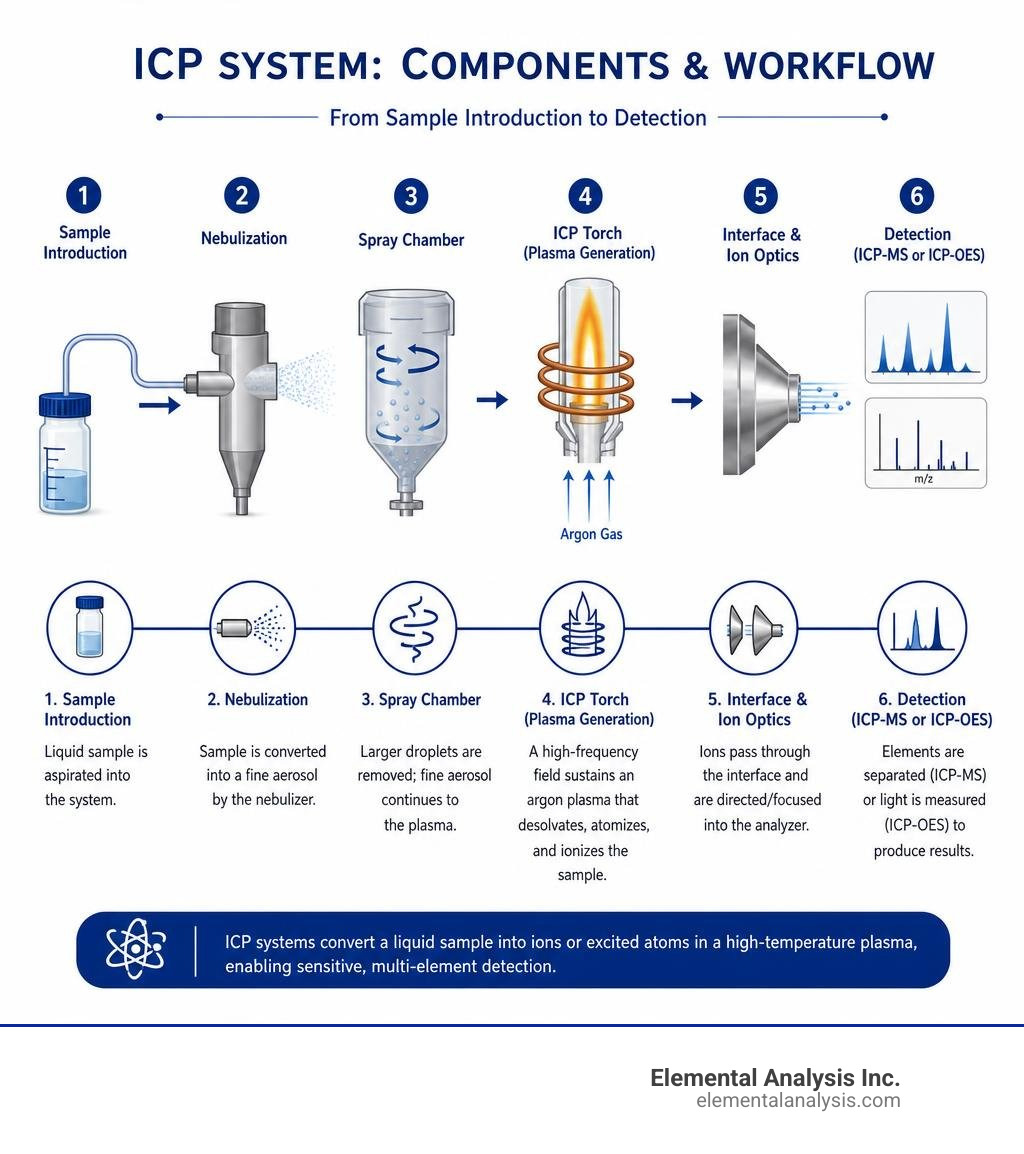
As we outline in our guide on Unlocking the Elements with ICP Laboratory Analysis, the process follows a strict sequence: sample introduction, nebulization, ionization, ion extraction, mass filtering, and detection.
- Sample Introduction: The liquid sample is drawn up by a peristaltic pump and mixed with argon gas in a nebulizer to create a fine aerosol.
- Spray Chamber: The aerosol passes through a spray chamber, which filters out larger droplets. Only about 1% to 2% of the original sample is fine enough to pass into the plasma torch; the rest goes to waste.
- Ionization: The fine droplets enter the plasma, where they are dried, vaporized, atomized, and ionized.
The Role of Inductively Coupled Plasma in Mass Spectrometry
The primary job of the plasma in an ICP-MS system is to convert the elements in our sample into positive, single-charged ions ($M^+$).
Because the plasma is so hot, the sample undergoes rapid desolvation (evaporating the solvent) and atomization (breaking chemical bonds). The high temperature then strips a single electron from almost every atom. For about 60 elements, the degree of ionization in the torch exceeds 90%.
These positive ions are then extracted from the atmospheric pressure plasma into the high-vacuum region of the mass spectrometer. This transition is managed by the interface, which consists of two water-cooled metal cones: the sampler cone and the skimmer cone. The ions pass through the small orifices of these cones, guided by ion optics that focus the ion beam while discarding neutral species and light photons to keep background noise as low as possible.
Mass Analyzers and Detector Configurations
Once inside the high-vacuum analyzer chamber, the ions must be separated by their mass-to-charge ($m/z$) ratio. Depending on the level of resolution required, laboratories use different mass analyzer configurations. For example, local researchers at the Mass Spectrometry | University of Kentucky College of Medicine utilize advanced mass analyzers for high-sensitivity biological and clinical studies.
The three primary mass analyzer designs are:
- Quadrupole: The most common and cost-effective analyzer. It uses four parallel metal rods with alternating RF and DC voltages to filter ions. It has a resolution of about 0.75 amu, allowing it to scan the entire mass range from lithium to uranium in milliseconds.
- Triple Quadrupole (ICP-MS/MS): Features two quadrupole mass filters separated by a collision/reaction cell. This configuration allows for tandem mass spectrometry, which is incredibly useful for removing complex chemical interferences in difficult matrices.
- Magnetic Sector (High-Resolution): Uses an electrostatic analyzer combined with a magnetic field to separate ions. It offers three resolution modes (low, medium, and high up to $m/\Delta m = 10,000$), allowing it to separate analytes from spectral interferences that have almost identical masses.
Once separated, the ions hit a dual-mode detector. This detector uses a pulse-counting mode for ultra-low concentrations and an analog mode for higher concentrations. This dual-setup gives ICP-MS an incredible linear dynamic range of approximately 8–12 orders of magnitude, allowing us to measure parts-per-trillion trace elements and parts-per-million major elements in the exact same run.
Comparing ICP-MS to Other Elemental Analysis Techniques
When deciding on the right metal analysis strategy for your project, it helps to compare the strengths of each method. As we discuss in Elemental My Dear Watson: A Guide to ICP Metal Analysis, choosing the correct instrument depends on your target detection limits, sample volume, and budget.
To help you compare, we have compiled a quick reference table of the major elemental analysis techniques, including Inductively Coupled Plasma-Optical Emission Spectroscopy (ICP-OES):
| Feature | Flame Atomic Absorption (FAA) | Graphite Furnace AA (GFAA) | ICP-OES | ICP-MS |
|---|---|---|---|---|
| Detection Limits | ppm (mg/L) | ppb ($\mu$g/L) | ppb to ppm | ppt (ng/L) to nmol/L |
| Sample Throughput | Slow (1 element at a time) | Very slow (single element) | Fast (multi-element) | Very fast (multi-element) |
| Linear Dynamic Range | 10^2 | 10^2 | 10^6 | 10^8 to 10^12 |
| Interferences | Few chemical | Significant physical | Moderate spectral | Moderate to high spectral |
| Running Cost | Low | Medium | High (Argon consumption) | High (Argon & vacuum parts) |
Key Applications Across Industries
Because ICP-MS is incredibly sensitive and fast, it is widely used across many fields:
- Clinical Toxicology: Testing whole blood, serum, or urine for heavy metal exposure (such as lead, cadmium, arsenic, and mercury).
- Environmental Monitoring: Checking drinking water, soils, and wastewater for trace contaminants to ensure regulatory compliance.
- Pharmaceutical Impurities: Screening active pharmaceutical ingredients (APIs) for toxic catalysts and heavy metals in line with USP <232>/<233> guidelines.
- Geochemistry: Analyzing rare earth elements and measuring isotope ratios for geological dating.
- Speciation Analysis: Coupling high-performance liquid chromatography (HPLC) with ICP-MS to separate and measure different chemical forms of an element (such as distinguishing highly toxic inorganic arsenic from harmless organic arsenic in seafood).
- Single-Particle Analysis (spICP-MS): Measuring the size, concentration, and composition of metal nanoparticles suspended in liquids.
Managing Interferences and Calibration in ICP-MS
To get accurate results in our Category: ICP Laboratory Analysis workflows, we must actively identify and correct interferences. These fall into two main categories: spectroscopic and non-spectroscopic.
Spectroscopic Interferences
These occur when an interfering ion has the same mass-to-charge ratio as our target analyte. They include:
- Isobaric Overlaps: Two different elements having isotopes of the exact same nominal mass (e.g., argon-40 and calcium-40).
- Polyatomic Ions: Molecules formed in the plasma from combination of argon, solvent, and matrix elements (e.g., $^{40}\text{Ar}^{35}\text{Cl}^+$ overlapping with $^{75}\text{As}^+$).
To eliminate these, modern instruments use a Collision/Reaction Cell (CRC). By introducing a collision gas like helium, we can use Kinetic Energy Discrimination (KED) to filter out larger polyatomic molecules. Alternatively, reaction gases like oxygen or ammonia can react chemically with either the analyte or the interferent to shift one of them to a different mass.
Non-Spectroscopic Interferences (Matrix Effects)
These physical interferences affect how the sample is nebulized, transported, or ionized. High concentrations of dissolved solids (such as salts in seawater) can clog the nebulizer or deposit on the interface cones.
To keep our systems running smoothly, we keep total dissolved solids (TDS) below 0.2% by diluting samples. We also maintain our spray chambers at a cool 2 °C to minimize water vapor, which reduces oxide interferences in the plasma.
Calibration and Quality Control Strategies
To correct for instrument drift and physical matrix effects, we use several calibration and quality control strategies:
- Internal Standardization: We add a known concentration of elements not present in the sample (like Yttrium, Indium, or Terbium) to every blank, standard, and sample. The instrument monitors these internal standards to automatically correct for signal drift or physical transport differences.
- Method of Standard Additions: For highly complex matrices where matching the background is impossible, we spike increasing amounts of our target standards directly into aliquots of the sample. This allows us to build a custom calibration curve within the sample’s unique chemical environment.
- Isotope Dilution: The gold standard of calibration. We spike the sample with a known amount of an enriched isotope of the analyte and measure the change in the isotope ratio. This provides highly accurate quantification, even if some of the sample is lost during preparation.
- Certified Reference Materials (CRMs): We regularly run independent, certified reference standards alongside our samples to verify our calibration curves and prove our method’s accuracy.
Frequently Asked Questions about ICP
What is the difference between ICP-OES and ICP-MS?
The main difference is how they detect and measure elements. Inductively coupled plasma atomic emission spectroscopy – Wikipedia (ICP-OES/AES) measures the light emitted by excited atoms and ions as they return to their ground state in the plasma. ICP-MS, on the other hand, physically extracts the ions from the plasma and separates them by their mass-to-charge ratio.
ICP-MS is much more sensitive, offering detection limits in the parts-per-trillion (ppt) range, whereas ICP-OES typically measures down to parts-per-billion (ppb) levels. However, ICP-OES is usually more affordable to purchase and maintain, and it can handle samples with higher total dissolved solids.
Why is argon used as the primary gas in inductively coupled plasma systems?
Argon is the ideal gas for several reasons:
- High Ionization Potential: At 15.76 eV, argon’s first ionization potential is higher than that of most elements on the periodic table, ensuring efficient ionization of your sample.
- Inertness: It does not react chemically with the analytes or torch components.
- Abundance and Cost: It is much more abundant and cost-effective than other noble gases like helium or neon.
What are the main sample preparation requirements for ICP-MS?
Most samples must be in a liquid form with low total dissolved solids (TDS < 0.2%) to prevent clogging the nebulizer and interface cones. Solid samples, like soils or tissues, typically undergo closed-vessel microwave acid digestion using ultra-pure nitric acid. We also use ultra-pure water (18.2 M$\Omega\cdot$cm) and acid-washed plasticware to prevent background contamination, which is critical when measuring elements at parts-per-trillion levels.
Conclusion
Understanding inductively coupled plasma is the key to unlocking highly accurate, ultra-trace elemental analysis. Whether you are monitoring heavy metals in drinking water, checking pharmaceutical ingredients for impurities, or analyzing complex alloys, choosing the right ICP configuration is essential for getting reliable results.
At Elemental Analysis Inc., located in Lexington, KY, we specialize in trace element identification, quantification, and speciation. As the first commercial Proton Induced X-ray Emission (PIXE) laboratory, we offer a unique mix of non-destructive and destructive testing services. We are dedicated to providing fast turnaround times, competitive pricing, and the deep technical expertise you need to solve your analytical challenges.
Ready to see how we can help with your next project? Explore our ICP testing services today, or reach out to our team in Lexington to discuss your specific testing needs.