
ICP-MS Explained: How We Weigh Atoms in a Plasma Fire
What Is Inductively Coupled Mass Spectrometry — and Why It Matters
Inductively coupled mass spectrometry (ICP-MS) is one of the most powerful trace element analysis techniques available today. It uses a superheated argon plasma — reaching around 10,000 Kelvin — to break down a sample into individual atoms, ionize them, and then sort those ions by mass. The result: detection of nearly every element in the periodic table, often at concentrations as low as one part per trillion.
Quick answer — what ICP-MS does in plain terms:
- Vaporizes and ionizes your sample inside an argon plasma torch
- Separates ions by their mass-to-charge ratio using a mass analyzer
- Counts ions element by element to give you concentrations
- Reports results across most of the periodic table in a single run
- Achieves detection limits from parts per billion down to parts per quadrillion
If you need to know exactly how much lead, arsenic, mercury, or any other trace element is in a clinical sample, an environmental matrix, a pharmaceutical product, or an aerospace alloy — ICP-MS is typically the method that gets you there fastest, with the lowest detection limits and the broadest elemental coverage.
It is significantly faster and more sensitive than traditional atomic absorption spectroscopy, and it can measure dozens of elements simultaneously rather than one at a time.
This guide walks through how ICP-MS works, what the instrument is made of, how samples are prepared, and how modern technology handles the interferences that can complicate results.
The Core Principles of Inductively Coupled Mass Spectrometry
At its heart, inductively coupled mass spectrometry is an elegant marriage of two distinct scientific worlds: high-temperature plasma chemistry and high-vacuum mass filtering. The official IUPAC – inductively-coupled plasma mass spectrometry (08490) definition highlights it as a measurement method of atomic spectrometry that uses an inductively coupled plasma to excite and ionize atoms.
In our laboratory, we think of it as a highly sophisticated atomic scale. Instead of weighing a bulk material on a balance, we are stripping away electrons from individual atoms, flying them through a vacuum, and counting them one by one based on their mass.
The magic begins with the plasma. By subjecting high-purity argon gas to an intense radiofrequency (RF) field, we create a self-sustaining “plasma fire” that reaches temperatures up to 10,000 Kelvin (roughly 17,500°F). For context, that is nearly twice as hot as the surface of the sun!
At these temperatures, any chemical bond holding your sample together is instantly ripped apart. The sample is reduced to its individual constituent atoms, and because argon has a very high first ionization potential, it efficiently strips a single electron from almost every element in the periodic table, turning them into positively charged, single-valence ions ($M^+$).
How Inductively Coupled Mass Spectrometry Works
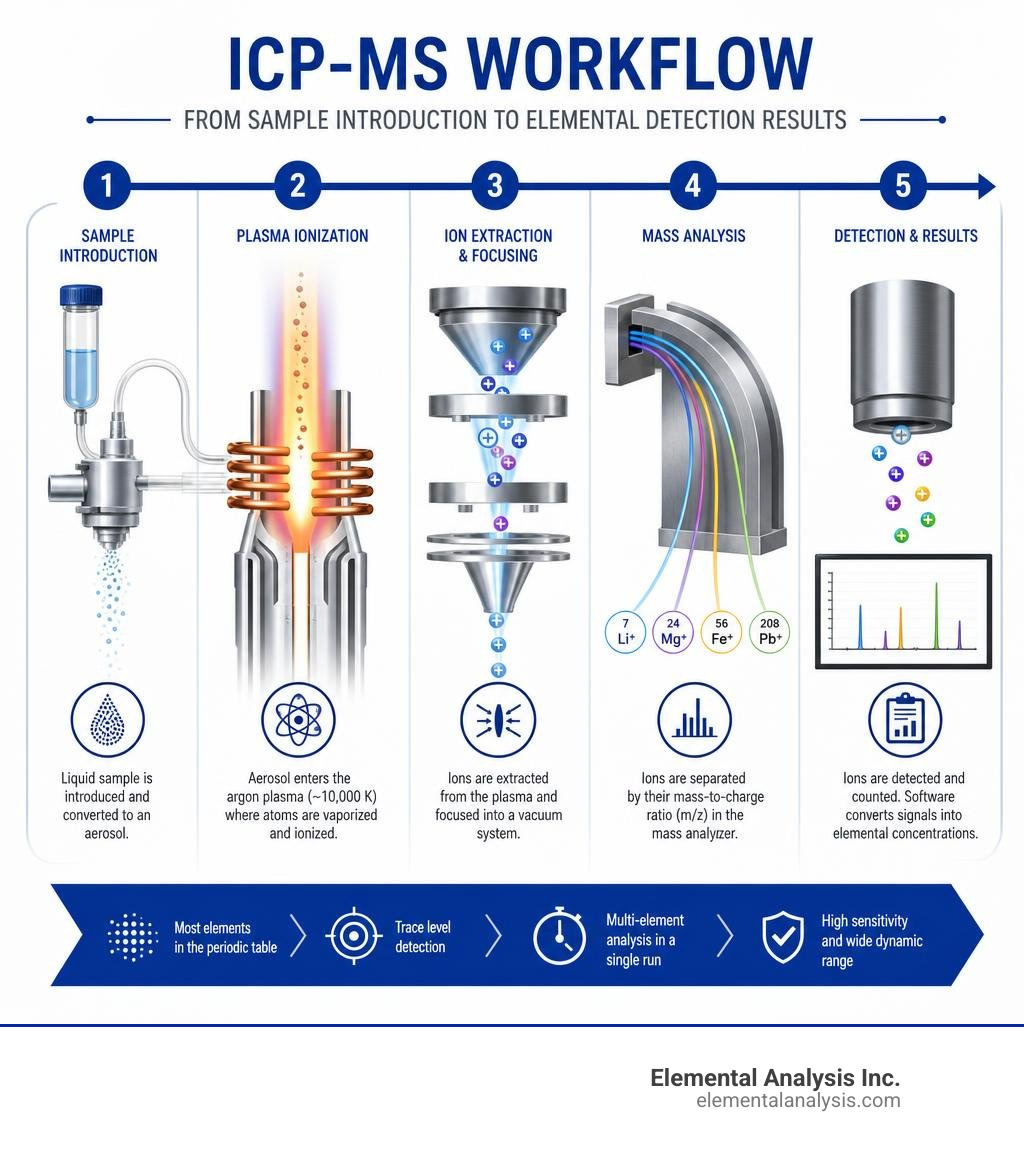
To understand the journey of a sample through an Inductively coupled plasma mass spectrometry system, we can break down the process into five distinct physical stages:
- Aerosol Generation: The liquid sample is pumped into a nebulizer, where a high-velocity stream of argon gas breaks the liquid into a fine mist of micro-droplets.
- Desolvation & Atomization: This aerosol travels into the spray chamber, which filters out the larger droplets. Only the smallest droplets (about 1–2% of the nebulized sample) make it into the plasma. Inside the plasma, the solvent is instantly evaporated (desolvated), leaving behind solid micro-particles that are then vaporized and broken down into free, ground-state atoms (atomization).
- Ionization: As these free atoms travel through the core of the 10,000 K plasma, they collide with high-energy electrons and argon ions, stripping away a single electron to form positive ions.
- Ion Extraction: The ions must now transition from the ultra-hot plasma at atmospheric pressure into the cool, ultra-high vacuum environment ($10^{-5}$ Torr or lower) of the mass spectrometer. This transition is managed by a series of metal interface cones.
- Mass Separation & Detection: Once inside the vacuum, the ion beam is focused by electromagnetic lenses and directed into a mass analyzer (usually a quadrupole). The analyzer acts as a rapid bandpass filter, scanning the entire analytical spectrum from lithium to uranium in milliseconds, allowing only one specific mass-to-charge ($m/z$) ratio to reach the detector at any given moment.
Anatomy of an ICP-MS Instrument
An ICP-MS instrument is a marvel of precision engineering, comprised of several distinct components working in perfect harmony:
- The Sample Introduction System: Consists of a peristaltic pump, a nebulizer, and a temperature-controlled spray chamber. Keeping the spray chamber chilled (typically to around 2 °C) is vital because it stabilizes vapor pressure and minimizes oxide formation.
- The Plasma Torch: Made of three concentric quartz tubes. Argon gas flows through these tubes while an RF induction coil (operating at 27.12 MHz or 40 MHz with up to 2 kW of RF power) couples energy into the gas, maintaining the plasma.
- The Interface: The bridge between fire and vacuum. It contains two or three water-cooled metal cones (usually nickel or platinum) — the sampler cone and the skimmer cone. A third cone, such as a hyper-skimmer, is used in some advanced systems described in The 30-Minute Guide to ICP-MS to provide a gentle, three-step pressure reduction that minimizes ion beam divergence.
- Ion Optics: A series of electrostatic lenses that attract the positively charged ions, focus them into a tight beam, and steer them away from neutral species and photons (light from the plasma) to prevent detector noise.
- The Mass Analyzer: Usually a quadrupole consisting of four parallel metal rods. By applying combined radiofrequency and direct-current voltages, the analyzer permits only ions of a specific mass-to-charge ratio to pass through.
- The Detector: Typically an electron multiplier that converts the physical impact of an ion into an electrical pulse. Dual-mode detectors can switch between pulse and analog modes, extending the instrument’s dynamic range to an astonishing 12 orders of magnitude.
Calibration and Quantification Strategies
Generating raw ion counts is only half the battle; we must convert those counts into accurate concentration values. Because every sample matrix behaves differently, we employ several calibration strategies to ensure absolute precision:
- External Calibration: We run a series of certified reference standards to build a calibration curve of signal intensity versus concentration. This curve is incredibly linear, often spanning up to 9 or 10 orders of magnitude in a single run.
- Internal Standardization: To correct for physical interferences (such as viscosity differences) and long-term instrument drift, we spike every sample and standard with a constant concentration of non-interfering elements (like Indium, Yttrium, or Bismuth). The software monitors these internal standards and corrects the analyte signals in real-time.
- Isotope Dilution: The gold standard of calibration. We spike the sample with a known amount of an enriched, stable isotope of the target element. By measuring the altered isotope ratio, we can calculate the exact concentration of the element, completely independent of sample recovery or physical drift.
To learn more about how we select and configure these parameters for specific laboratory setups, you can read our guide on Induced Coupled Plasma: Finding the Perfect Match for Your Lab.
Sample Preparation, Applications, and Hyphenated Systems

While the plasma torch is incredibly efficient at destroying chemical bonds, it cannot handle raw solids or highly viscous liquids directly without some preparation. Achieving ultra-trace detection limits requires clean chemistry and meticulous sample preparation.
Sample Preparation for Inductively Coupled Mass Spectrometry
The old saying “garbage in, garbage out” has never been truer than in trace metal analysis. Because we are routinely measuring elements at parts-per-billion (ppb) and parts-per-trillion (ppt) levels, even a single speck of dust can ruin an analysis.
Liquid samples, such as natural waters, are the easiest to analyze, but they must still be filtered and acidified (usually with 1–2% high-purity nitric acid) to keep the metals in solution. For solid matrices — such as soils, biological tissues, or pharmaceutical powders — we must perform complete acid digestion.
This is typically done using a closed-vessel microwave digestion system with concentrated nitric acid, sometimes combined with hydrochloric acid or hydrogen peroxide. The microwave heats the mixture under high pressure, completely dissolving the organic matrix and leaving behind a clear, aqueous solution.
When preparing samples, we must keep the Total Dissolved Solids (TDS) below 0.2% (2,000 mg/L). If the TDS is too high, salt will deposit on the tiny 1 mm orifices of the interface cones, blocking the ion path and causing severe signal drift. Therefore, dilution is one of our most common and effective tools.
For more details on preparing complex matrices for elemental testing, explore our article Unlocking the Elements with ICP Laboratory Analysis. For a broader look at how we approach metal characterization, see Elemental My Dear Watson: A Guide to ICP Metal Analysis.
Common Applications of Trace Analysis
Because ICP-MS is highly sensitive and capable of rapid multi-element scanning, it has become the standard technique across many industries:
- Clinical Toxicology: Analyzing whole blood, urine, or serum to detect exposure to heavy metals like lead, cadmium, and mercury. According to Inductively Coupled Plasma Mass Spectrometry: Introduction to … , clinical biochemistry labs rely heavily on the multi-element speed of ICP-MS to monitor occupational exposure and nutritional status (measuring essential trace elements like selenium, copper, and zinc).
- Environmental Monitoring: Testing drinking water, soils, and wastewater for toxic metal runoff to ensure compliance with EPA standards.
- Pharmaceutical Impurities: Screening active pharmaceutical ingredients (APIs) and raw materials for elemental impurities (catalysts like palladium or platinum, and toxic “big four” metals: arsenic, cadmium, lead, and mercury) in strict accordance with USP <232>/<233> guidelines.
- Forensics: Comparing the trace elemental “fingerprint” of glass fragments, paint chips, or even recovered lipstick from crime scenes to link suspects to physical evidence.
Speciation and Hyphenated Systems
Standard ICP-MS tells you the total concentration of an element in a sample, but sometimes the chemical form (species) of that element is what actually matters. For example, inorganic arsenic is highly toxic, whereas organic arsenic (arsenobetaine found in seafood) is virtually harmless.
To differentiate these forms, we couple a separation technique directly to the ICP-MS. This is known as a hyphenated system:
- HPLC-ICP-MS: High-Performance Liquid Chromatography separates the different chemical species over time, and as they exit the column, they flow directly into the ICP-MS nebulizer for elemental detection. This is the gold standard for metal speciation.
- LA-ICP-MS: Laser Ablation uses a high-energy pulsed laser to blast microscopic particles off the surface of a solid sample. These dry particles are swept into the plasma by an argon carrier gas. This allows us to map the spatial distribution of trace elements directly across solid surfaces, such as geological minerals or biological tissues, without liquid digestion.
To explore how these instruments are manufactured and configured for extreme research environments, you can read about the technical specifications of systems built by organizations like the Inductively Coupled Plasma Mass Spectrometer (ICPMS) – Bhabha Atomic Research Centre ( BARC ) .
Routine Maintenance and Operational Considerations
Operating an ICP-MS at peak performance requires a dedicated routine maintenance schedule:
- Cone Maintenance: Interface cones must be removed and cleaned regularly in a dilute acid bath to remove accumulated matrix deposits. Platinum cones last longer and offer better acid resistance than nickel, but require a higher initial budget.
- Vacuum System Care: The roughing pump oil must be changed every 2–3 months to maintain the high vacuum required by the mass spectrometer.
- Sample Introduction Cleaning: Nebulizers can clog over time and must be back-flushed, while the spray chamber must be checked for proper drainage to prevent signal pulsation.
Overcoming Interferences and Advanced Technologies
Despite its incredible sensitivity, ICP-MS is not immune to spectral interferences. These occur when an unwanted ion shares the exact same nominal mass-to-charge ($m/z$) ratio as your target analyte.
Interferences fall into two main categories:
- Isobaric Overlap: Two different elements share isotopes with the same mass (e.g., Argon-40 and Calcium-40, or Rubidium-87 and Strontium-87).
- Polyatomic Interferences: Combining elements from the plasma gas (Argon), the solvent (Oxygen, Hydrogen), or the sample matrix (Chlorine, Sulfur, Carbon) to form molecular ions that mimic analytes. A classic example is ArO+ (mass 56), which interferes with the primary isotope of Iron ($^{56}Fe$). Another is ArCl+ (mass 75), which interferes with Arsenic ($^{75}As$).
To overcome these hurdles, modern instruments use a Collision/Reaction Cell (CRC). This is a small pressurized cell located just before the mass analyzer.
- In Collision Mode, we introduce an inert gas like Helium. Larger polyatomic ions collide with the helium atoms more frequently than smaller monoatomic analyte ions, losing kinetic energy in the process. A small energy barrier at the exit of the cell then blocks these slow-moving polyatomic ions—a process called Kinetic Energy Discrimination (KED).
- In Reaction Mode, we introduce a reactive gas like Hydrogen, Oxygen, or Ammonia. This gas chemically reacts with either the interference (neutralizing it) or the analyte (shifting it to a new mass), leaving the target analyte free to be measured without interference.
A comprehensive breakdown of these reaction pathways is detailed in the tutorial Review Inductively coupled plasma – Tandem mass spectrometry (ICP-MS/MS): A powerful and universal tool for the interference-free determination of (ultra)trace elements – A tutorial review .
Triple Quadrupole and High-Resolution ICP-MS
For the most challenging sample matrices, standard single-quadrupole instruments can struggle to resolve complex interferences. This has driven the development of advanced mass spectrometer designs:
- Triple Quadrupole (ICP-MS/MS): This technology places a first quadrupole (Q1) before the collision/reaction cell, acting as a strict mass filter. Only the target mass is allowed into the cell, preventing side-reactions from other matrix elements and allowing us to control the reaction chemistry with absolute predictability.
- High-Resolution (HR-ICP-MS): Also known as Sector Field ICP-MS. Instead of a quadrupole, it uses a combination of magnetic and electrostatic sectors to physically separate ions based on tiny differences in their actual mass. With a resolving power of up to 10,000, it can easily separate $^{56}Fe$ (mass 55.9349) from $^{40}Ar^{16}O$ (mass 55.9549) without using a collision gas.
These advanced technologies, discussed in detail by Inductively Coupled Plasma Mass Spectrometry (ICP-MS) Information , have pushed the boundaries of trace analysis, making “interference-free” measurements a reality even in complex industrial samples.
Comparing ICP-MS to Other Elemental Analysis Techniques
When deciding which elemental analysis technique is right for your project, it helps to compare the options side-by-side. Each method has its strengths, depending on your detection limit requirements, budget, and sample throughput.
| Feature / Metric | Flame Atomic Absorption (FAA) | Graphite Furnace AA (GFAA) | Inductively Coupled Plasma Optical Emission (ICP-OES) | Inductively Coupled Plasma Mass Spectrometry (ICP-MS) |
|---|---|---|---|---|
| Detection Limits | ppm to high ppb (mg/L to $\mu$g/L) | ppb to ppt ($\mu$g/L to ng/L) | ppb to high ppt ($\mu$g/L to ng/L) | ppt to ppq (ng/L to pg/L) |
| Dynamic Range | 10^3 (3 orders of magnitude) | 10^2 (2 orders of magnitude) | 10^6 (6 orders of magnitude) | 10^12 (12 orders of magnitude) |
| Throughput | Slow (1 element at a time) | Very slow (1 element at a time) | Fast (multi-element, ~1 min/sample) | Very fast (multi-element, ~2-3 min/sample) |
| Sample Volume | High (several mL) | Low ($\mu$L range) | Medium (1–5 mL) | Low to Medium (< 1 mL) |
| Isotopic Analysis | No | No | No | Yes |
While atomic absorption techniques are excellent for simple, single-element analyses, and ICP-OES is highly robust for major and minor elements in high-matrix samples, ICP-MS stands alone in its ability to deliver ultra-trace sensitivity and rapid multi-element scanning in a single run.
For a deeper dive into choosing between these two plasma-based powerhouses, check out our comparison guide: ICP Analysis for Heavy Metals: Choosing Between ICP-OES and ICP-MS.
Conclusion

Understanding the fundamental principles of inductively coupled mass spectrometry is the first step toward unlocking the chemical secrets of your samples. Whether you are tracking environmental pollutants, verifying pharmaceutical purity, or investigating forensic evidence, ICP-MS provides the speed, sensitivity, and isotopic precision needed to get the job done right.
At Elemental Analysis Inc., based in Lexington, Kentucky, we combine this powerful technology with a comprehensive suite of analytical services. As the world’s first commercial Proton Induced X-ray Emission (PIXE) laboratory, we specialize in both non-destructive and destructive testing. This allows us to select the absolute best method for your specific matrix—balancing rapid turnarounds, competitive pricing, and unmatched scientific accuracy.
Need to weigh the atoms in your samples? We are here to help. Explore our full range of trace metal capabilities by visiting our ICP services page today, and let us find the perfect analytical match for your laboratory’s needs.