
Induced Coupled Plasma: Finding the Perfect Match for Your Lab
What Is Induced Coupled Plasma — and Which System Does Your Lab Actually Need?
Induced coupled plasma (ICP) is a high-temperature plasma source — reaching up to 10,000 K, hotter than the surface of the sun — used to atomize and ionize samples for ultra-sensitive trace element analysis.
If you’re a lab supervisor evaluating ICP systems, here’s a fast-reference summary:
| System | Best For | Typical Detection Limits |
|---|---|---|
| ICP-OES | Multi-element screening, high-concentration samples | µg/L (ppb) range |
| ICP-MS | Ultra-trace elements, isotope ratios, clinical/environmental | nmol/L (sub-ppb) range |
| ICP-RIE | Semiconductor etching, thin-film surface processing | N/A (materials, not analytical) |
Key facts at a glance:
- ICP can fully ionize over 60 elements at >90% efficiency in a single run
- Plasma electron temperatures range from ~6,000 K to ~10,000 K
- RF power typically operates at 27–41 MHz, consuming roughly 1,250–1,550 W
- A single ICP-MS run can replace multiple single-element atomic absorption analyses
For aerospace, pharmaceutical, and environmental labs, the pressure to deliver fast, accurate, multi-element results — without juggling multiple vendors — is real. A single ICP platform can consolidate what used to require several instruments and workflows.
But not every ICP system is the right fit for every lab. The choice between ICP-OES and ICP-MS, between a single-quadrupole and a triple-quadrupole, or between different sample introduction setups can meaningfully affect your detection limits, throughput, and total cost of ownership.
This guide walks you through everything you need to make a confident purchasing decision.
Fundamentals of Plasma Generation and Torch Mechanics
To understand why an induced coupled plasma system is such a powerhouse, we have to look at the physics of how it generates plasma. At its core, the system relies on electromagnetic induction, governed by the Faraday-Lenz law.
When a time-varying radiofrequency (RF) current flows through an induction coil, it creates an oscillating magnetic field. This magnetic field, in turn, induces circular electric currents (eddy currents) in the flowing gas. If we seed this environment with a few free electrons using a Tesla coil spark, these electrons are rapidly accelerated by the induced electric fields. As they collide with neutral gas atoms, they strip away more electrons, initiating a cascade of ionization that sustains a stable, continuous plasma discharge.
An incredibly useful physical phenomenon here is the skin effect. Because of electromagnetic shielding within highly conductive media, the RF power is primarily deposited in the outer radial regions of the plasma. This creates an annular, or “donut-shaped,” plasma path. When viewed on-axis, the hottest zone of the discharge resembles a bright bagel.
This annular shape is a massive practical benefit: it allows us to inject sample aerosols directly through the cooler center of the plasma without extinguishing it. This fundamental engineering principle is explored in depth in the literature on Induction plasma and standardized by chemical authorities, as detailed in the IUPAC – inductively-coupled plasma (08488) guidelines.
Fundamentals of Induced Coupled Plasma Technology
When evaluating plasma sources, a common comparison is between induced coupled plasma and capacitively coupled plasma (CCP) systems. In a CCP setup, plasma is sustained by an electric field established between two physical electrodes. While CCP is useful for certain low-pressure material treatments, it has a major drawback for analytical chemistry: electrode contamination.
Because the plasma is in direct contact with physical electrodes, sputtering inevitably occurs. This erodes the electrodes and introduces unwanted background signals into your measurements.
By contrast, an ICP discharge is an electrode-free design. Energy is coupled to the plasma entirely via the external RF induction coil. This lack of physical electrodes prevents contamination, making it ideal for trace and ultra-trace elemental analysis.
The physics behind this clean, high-density ionization source is documented in resources such as Physics:Inductively coupled plasma – HandWiki , which highlight how external electromagnetic coupling maintains sample integrity.
Torch Components and Argon Gas Dynamics
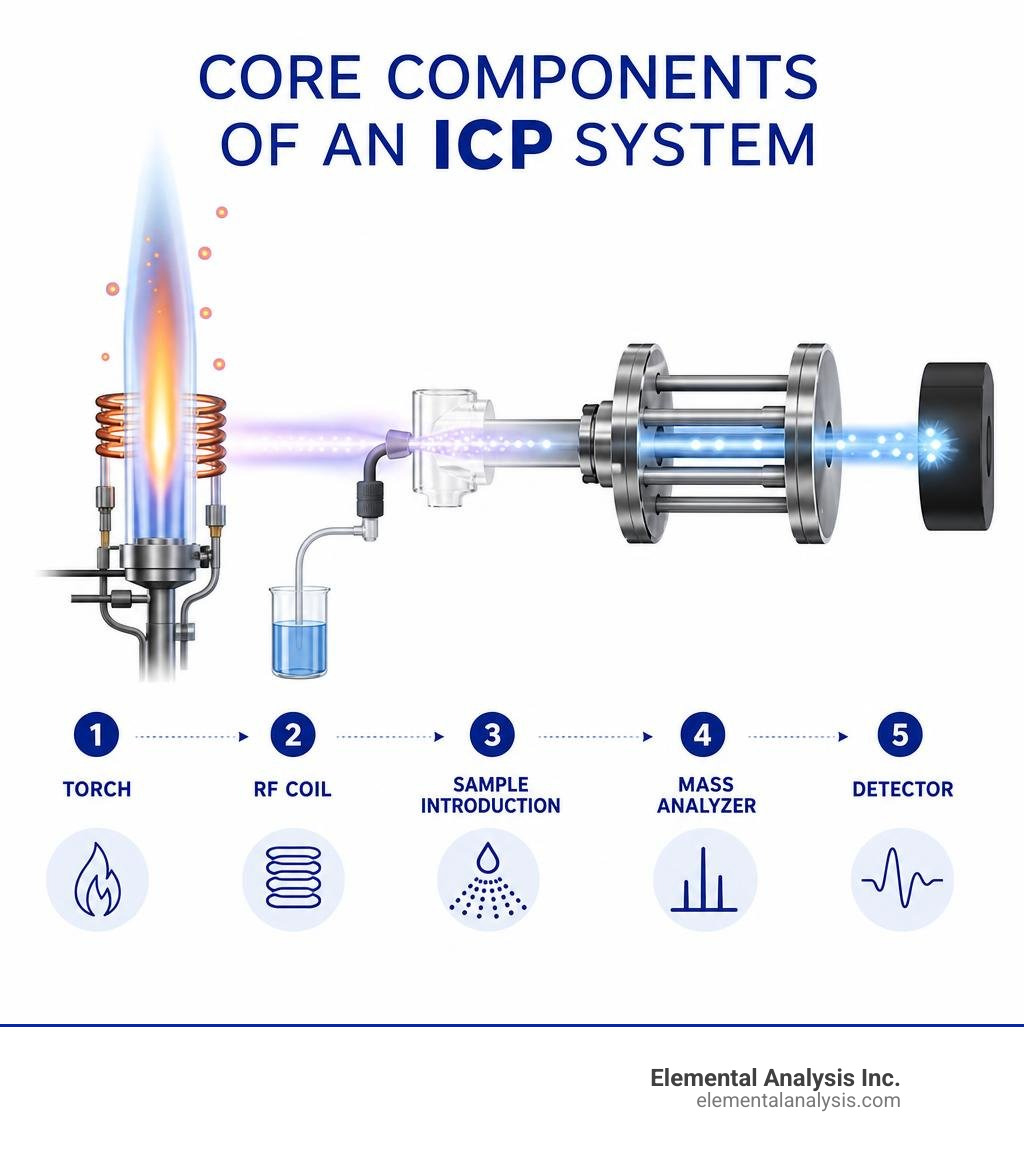
The physical home of this intense reaction is the plasma torch. A standard analytical torch consists of three concentric quartz tubes:
- Outer Tube (Coolant/Plasma Gas): Delivers argon gas at a high flow rate (typically 13 to 18 liters per minute). This gas is introduced with a tangential swirl. The swirling motion creates a vortex that centers the plasma and keeps it away from the quartz walls, preventing the torch from melting.
- Intermediate Tube (Auxiliary Gas): Flows argon at about 1 liter per minute. It helps push the hot plasma base away from the injection nozzle, protecting the delicate tips of the inner tubes.
- Central Tube (Nebulizer/Carrier Gas): Carries the sample aerosol into the core of the plasma at roughly 1 liter per minute.
We typically use argon as the plasma gas because it is chemically inert, relatively abundant, and has a high first ionization potential of 15.76 eV. This ionization potential is high enough to ionize almost any element on the periodic table but not so high that it makes the plasma impossible to sustain.
Operating Conditions and Plasma Parameters
Operating an ICP system requires balancing several physical parameters. The plasma exhibits an extremely high electron density, typically on the order of $10^{15}\text{ cm}^{-3}$. This high density ensures rapid energy transfer to the sample.
The plasma’s physical temperature ranges from 5,500 to 6,500 K in the outer regions, while the electron temperature (the kinetic energy of the free electrons) can soar between 6,000 K and 10,000 K.
To maintain these extreme conditions, the RF generator typically operates at a frequency of 27.12 MHz or 40 MHz, drawing continuous power of 1250 to 1550 W.
In industrial and research settings, engineers monitor these plasma parameters using diagnostic tools like Langmuir probes, retarding field energy analyzers (RFEAs), and voltage-current (VI) probes. These tools measure electron density, ion energy, and sheath voltages, allowing precise control over plasma performance.
Electromagnetic Coupling: E-Mode, H-Mode, and Torch Geometries
An interesting quirk of ICP physics is that the plasma does not ignite instantly into its high-density state. Instead, it undergoes a distinct transition between two operating modes: the E-mode (capacitive) and the H-mode (inductive).
When RF power is first applied to the induction coil, the voltage across the coil creates an electrostatic field. This field weakly ionizes the gas, generating a low-density, dim plasma sustained by capacitive coupling (E-mode).
As the RF power increases, the magnetic field grows stronger. Once a threshold power is crossed, the induced magnetic field becomes strong enough to drive closed-loop eddy currents. At this point, the system undergoes a sudden, dramatic transition into the inductive H-mode.
This transition is marked by a sudden jump in plasma density (often by several orders of magnitude) and a bright, intense glow. In the H-mode, the plasma becomes highly conductive and efficient at transferring energy to your samples.
Planar, Cylindrical, and Half-Toroidal Geometries
Depending on the application, ICP systems are engineered in three primary geometries:
- Cylindrical Geometry: This is the classic design used in analytical chemistry torches. The induction coil wraps around a cylindrical quartz tube, creating a symmetric, axial magnetic field. This setup is perfect for generating the stable, uniform, donut-shaped plasma needed for sample introduction.
- Planar Geometry: Often used in industrial plasma chambers for semiconductor etching and deposition. Instead of wrapping around a tube, the induction coil is a flat, planar spiral placed on top of a dielectric window. This geometry creates a wide, uniform plasma sheet over large flat surfaces, such as silicon wafers.
- Half-Toroidal Geometry: A specialized configuration designed to optimize spatial uniformity and minimize wall losses in high-power industrial chemical processing.
Analytical Applications: ICP-OES vs. ICP-MS vs. ICP-RIE
If you are looking to purchase an induced coupled plasma system, you are likely choosing between two dominant analytical techniques: Optical Emission Spectroscopy (ICP-OES) and Mass Spectrometry (ICP-MS).
While both use the same high-temperature argon plasma to decompose samples, they detect elements in fundamentally different ways.

Choosing the right technique depends heavily on your laboratory’s specific analytical needs. For a broader look at how these technologies fit into a modern laboratory workflow, you can read our overview on Unlocking the Elements with ICP Laboratory Analysis.
To dive deeper into the optical side of things, check out the resources provided by the Inductively Coupled Plasma-Optical Emission Spectroscopy guide.
Key Applications of Induced Coupled Plasma in Modern Industry
Beyond analytical chemistry, ICP technology is highly valued in the semiconductor and materials science industries. In these fields, ICP chambers are used for reactive-ion etching (ICP-RIE), thin-film deposition, and surface modification.
By operating at lower pressures, ICP chambers can achieve high-density plasmas ($10^{11}$ to $10^{12}\text{ ions/cm}^3$) without high thermal temperatures. This allows for rapid, highly directional material removal rates, which are essential for etching nanometer-scale features onto silicon wafers without damaging delicate substrates.
ICP-OES and Atomic Emission Spectroscopy
In an ICP-OES system, the intense heat of the plasma excites electrons within the sample atoms to higher energy levels. As these excited atoms and ions leave the hottest zone of the plasma, they cool down and drop back to their ground states, emitting light at characteristic wavelengths.
By measuring the wavelengths and intensity of this emitted light, the instrument can identify and quantify the elements present in the sample. For a comprehensive breakdown of this process, see the Inductively coupled plasma atomic emission spectroscopy – Wikipedia page.
When configuring an ICP-OES, you will need to choose between two viewing alignments:
- Radial Viewing: The detector looks across the plasma column perpendicularly. This path length is shorter, which reduces sensitivity but makes the system highly robust against matrix interferences. It is ideal for analyzing high-concentration samples or complex matrices like brines and organics.
- Axial Viewing: The detector looks straight down the center of the plasma column. This longer path length increases the light collected, improving sensitivity and lowering detection limits by up to a factor of ten. However, it is more susceptible to background noise and matrix effects.
Modern ICP-OES instruments often feature “dual-view” capabilities, allowing the software to automatically switch between radial and axial views depending on the element and concentration.
These systems also use advanced array detectors (such as charge-coupled devices, or CCDs) to measure the entire emission spectrum simultaneously. This reduces sample consumption and prevents errors from self-absorption, where emitted light is reabsorbed by ground-state atoms in the cooler outer edges of the plasma.
ICP-MS and Mass Spectrometry Fundamentals
For labs that require ultra-trace detection limits (down to parts-per-trillion or parts-per-quadrilion), ICP-MS is the gold standard. Instead of measuring light, ICP-MS extracts physical ions from the plasma and separates them based on their mass-to-charge ($m/z$) ratio.
This process is detailed on the Inductively coupled plasma mass spectrometry – Wikipedia page.
The transition from the atmospheric pressure of the plasma torch (~760 Torr) to the high vacuum of the mass spectrometer ($<10^{-5}\text{ Torr}$) is managed by the interface. This interface consists of two coaxial nickel or platinum cones: the sampler cone and the skimmer cone.
The ions pass through these small orifices, through a series of electrostatic lenses (ion optics) that focus the ion beam while discarding neutral species, and into the mass analyzer.
Most commercial systems use a quadrupole mass analyzer, which applies oscillating RF and DC voltages to filter ions so that only a single mass-to-charge ratio can successfully reach the detector at any given moment.
Maximizing ICP-MS Performance: Interferences, Calibration, and Advanced Hardware
To get the most out of an ICP-MS, you must understand how to manage interferences and calibrate the system correctly. For a practical guide on applying these methods in the lab, see Elemental My Dear Watson: A Guide to ICP Metal Analysis.
When purchasing an ICP-MS, one of the most important decisions is choosing between a single-quadrupole (SQ) and a triple-quadrupole (TQ) system:
| Feature | Single-Quadrupole (SQ-ICP-MS) | Triple-Quadrupole (TQ-ICP-MS / MS-MS) |
|---|---|---|
| Mass Filtering | Single stage of mass separation | Two independent stages of mass filtering (Q1 and Q3) with a collision/reaction cell (Q2) in between |
| Interference Removal | Relies on Kinetic Energy Discrimination (KED) with Helium gas | Uses highly reactive gases ($O2, NH3, H_2$) to shift interferences or analytes to new masses |
| Best For | Routine testing, low-to-moderate complexity samples | Difficult matrices, overlapping isotopes, ultra-trace research |
| Cost | Lower initial capital investment | Higher initial cost and increased gas consumption |
Mitigating Spectroscopic and Non-Spectroscopic Interferences
Even with the extreme heat of the plasma, interferences can still occur in ICP-MS. These fall into two categories:
- Spectroscopic Interferences: These occur when an interfering ion has the same nominal mass-to-charge ratio as your target analyte. This includes isobaric overlaps (different elements with isotopes of the same mass, like $^{40}\text{Ar}$ and $^{40}\text{Ca}$) and polyatomic interferences (molecular ions formed in the plasma, such as $^{40}\text{Ar}^{16}\text{O}^+$ overlapping with $^{56}\text{Fe}^+$).
- Non-Spectroscopic Interferences (Matrix Effects): High concentrations of dissolved salts or acids can suppress or enhance your analyte signals by affecting nebulization efficiency or draining ionization energy from the plasma.
To eliminate polyatomic interferences, modern ICP-MS instruments use collision/reaction cells (CRC). In collision mode, we introduce an inert gas like helium into the cell.
Polyatomic ions, which are physically larger than monatomic analyte ions of the same mass, collide with the helium atoms more frequently. This causes them to lose kinetic energy.
We then apply a small voltage barrier at the exit of the cell, which blocks these low-energy polyatomic ions while allowing the energetic analyte ions to pass through. This technique is known as Kinetic Energy Discrimination (KED).
Advanced Calibration and Hyphenated Speciation Techniques
To convert raw detector counts into accurate concentrations, labs use several calibration strategies:
- External Calibration: Compares sample signals against a curve generated from known standards.
- Internal Standardization: Adds a constant amount of an uncommon element (like Indium or Yttrium) to all samples and standards. This compensates for physical drift, nebulizer clogs, and minor matrix effects.
- Standard Additions: Spikes known amounts of the target analyte directly into aliquots of the sample. This is the gold standard for correcting severe matrix interferences.
- Isotope Dilution: Spikes the sample with a known quantity of an enriched isotope of the target element. By measuring the resulting isotope ratio, we can calculate the concentration with extreme precision, independent of physical sample loss.
For advanced applications, total elemental concentration is not always enough. For example, inorganic arsenic is highly toxic, while organic arsenobetaine (commonly found in seafood) is relatively harmless.
To distinguish between these forms, labs couple separation systems directly to the ICP-MS. These hyphenated techniques, such as High-Performance Liquid Chromatography (HPLC-ICP-MS) or Gas Chromatography (GC-ICP-MS), separate the different chemical species before they enter the plasma, providing true elemental speciation.
Sample Preparation and Matrix Matching for Biological Fluids
Analyzing biological fluids like whole blood, serum, or urine presents unique challenges due to high levels of dissolved solids, proteins, and salts.
To prevent sample introduction clogs and minimize matrix suppression, you must keep the Total Dissolved Solids (TDS) of your injected sample below 0.2%.
For routine clinical toxicology, a simple 10-fold to 50-fold dilution with a mild alkaline solution (containing ammonia, EDTA, and Triton X-100) is often enough to dissolve proteins and keep the nebulizer running smoothly.
For more complex matrices, a closed-vessel microwave acid digestion using high-purity nitric acid is required to break down organic matter completely before analysis.
Selecting the Right Induced Coupled Plasma System for Your Laboratory
When you are ready to purchase an induced coupled plasma system, you should look beyond the instrument’s list price. You will want to evaluate several practical factors to find the best fit for your lab:
- Sample Volume and Throughput: If your lab processes hundreds of samples per day, look for systems with fast autosamplers and dual-view array detectors to minimize analysis times.
- Required Detection Limits: If your methods only require parts-per-billion (ppb) measurements, an ICP-OES will save you money on capital costs and maintenance. If you need parts-per-trillion (ppt) or sub-ppt sensitivity, an ICP-MS is necessary.
- Operational and Gas Costs: ICP systems consume a lot of argon. Budget for gas delivery systems (such as liquid argon dewars) and regular maintenance parts, including nebulizers, spray chambers, and interface cones.
- Ease of Use and Software: Modern software packages can automate startup, shutdown, and wavelength selection, which helps reduce the training burden on your laboratory staff.
For a deeper dive into choosing the right testing partner or instrument class, see our collection of resources on ICP Laboratory Analysis.
Frequently Asked Questions about Induced Coupled Plasma
What is the difference between ICP-OES and ICP-MS?
The main difference is how they detect elements. ICP-OES measures the wavelengths and intensity of light emitted by excited atoms and ions, making it highly effective for high-concentration samples and complex matrices.
ICP-MS measures the physical mass-to-charge ratio of ions extracted from the plasma, providing much lower detection limits (parts-per-trillion) and the ability to distinguish different isotopes.
Why is argon gas preferred for sustaining the plasma?
Argon is chemically inert, meaning it will not react with your sample or torch components. It is also relatively abundant and cost-effective compared to gases like helium.
Additionally, argon’s first ionization potential (15.76 eV) is high enough to ionize almost all elements on the periodic table while still allowing the plasma to be sustained at reasonable RF power levels.
How do collision and reaction cells eliminate polyatomic interferences?
These cells introduce a gas into a small chamber located before the mass analyzer. In collision mode, an inert gas like helium slows down physically larger polyatomic molecules more than smaller monatomic ions, allowing us to filter them out using kinetic energy discrimination (KED).
In reaction mode, a reactive gas like oxygen or ammonia chemically reacts with either the interference or the analyte, shifting one of them to a different mass to resolve the overlap.
Conclusion
Whether you are looking to install a high-throughput ICP-OES for environmental screening or a triple-quadrupole ICP-MS for ultra-trace clinical research, selecting the right system requires balancing your analytical requirements with your operational budget.
At Elemental Analysis Inc., based in Lexington, Kentucky, we understand these analytical challenges firsthand. As the first commercial Proton-Induced X-ray Emission (PIXE) laboratory, we offer both destructive and non-destructive testing services.
If you are looking to outsource your testing or need expert guidance to support your laboratory’s capabilities, we provide trace element identification, quantification, and speciation services with fast turnaround times and competitive pricing.
Ready to find the perfect analytical match for your laboratory? Learn more about our specialized capabilities by visiting our ICP Services page today.