
ICP MS Lab Guide: How to Get Accurate Trace Element Testing
Why Every Trace Element Testing Decision Starts With the Right ICP MS Lab
An ICP MS lab is a specialized analytical facility that uses Inductively Coupled Plasma Mass Spectrometry to detect and measure trace elements at extraordinarily low concentrations — down to sub-parts-per-trillion levels — across a wide range of sample types.
If you need a quick answer, here’s what to know:
- What it does: Measures up to 70 elements (lithium through uranium) in a single analytical run
- Detection limits: Sub-parts-per-trillion (ppt) for many elements in solution
- Sample types: Liquids, dissolved solids, and direct solids via laser ablation
- Key industries: Pharmaceuticals, aerospace, environmental testing, geology, semiconductors
- Typical precision: Within ±5% relative standard deviation for matrix-matched samples
- What it can’t measure: Carbon, nitrogen, oxygen, fluorine, noble gases
Whether you’re validating elemental impurities in a drug product under ICH Q3D, screening aerospace alloys for contaminants, or monitoring heavy metals in environmental samples, the sensitivity and speed of ICP-MS makes it one of the most powerful tools in analytical chemistry today.
The challenge isn’t finding the technique — it’s finding a lab that delivers accurate results quickly, handles your specific matrix, and keeps things simple on the billing side.
This guide covers everything you need to make confident decisions about ICP-MS testing: how the technology works, what sample prep looks like, how interferences are controlled, and what it typically costs.
What is ICP-MS and How Does It Work?
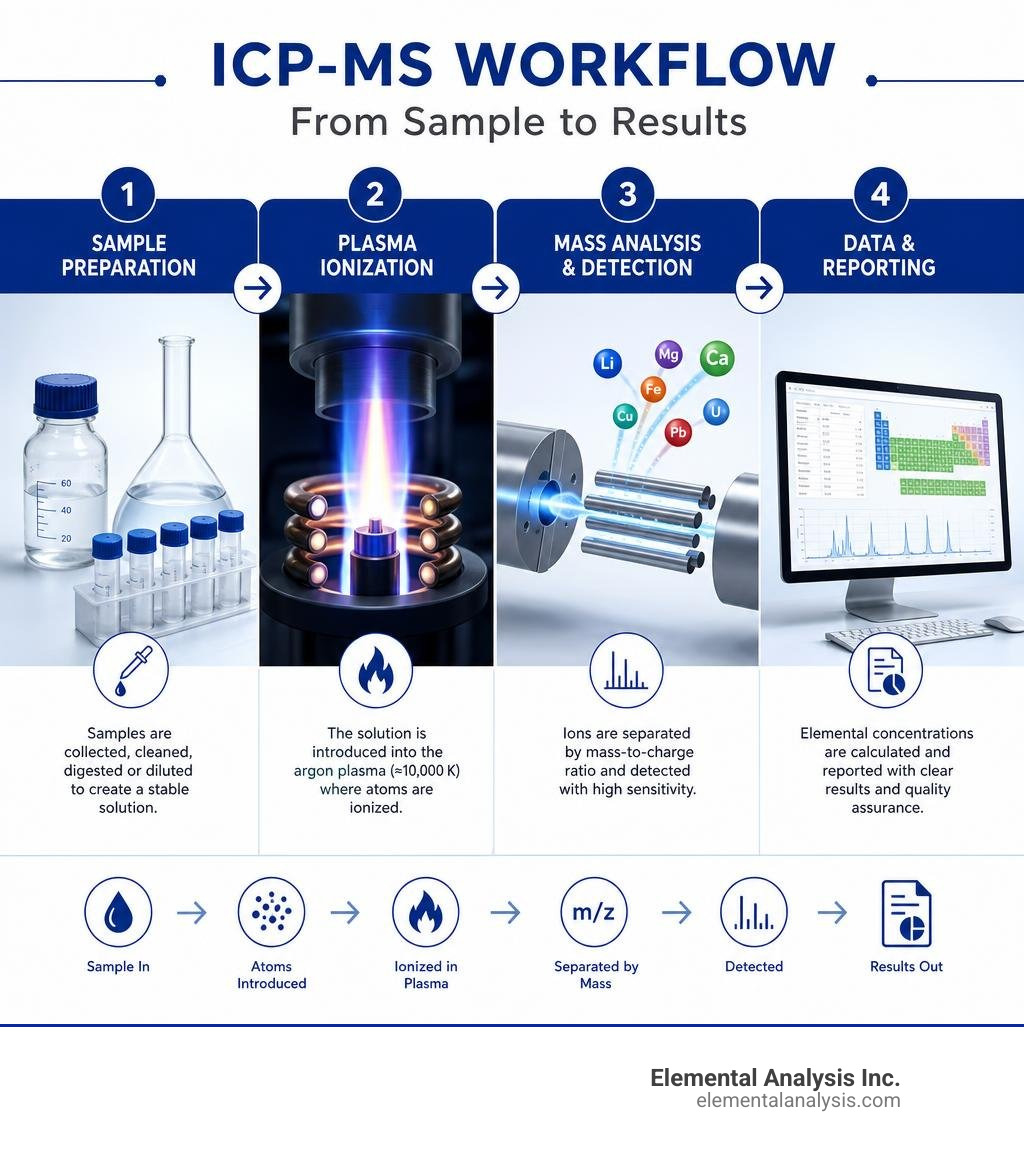
At its core, Inductively Coupled Plasma Mass Spectrometry (ICP-MS) is an analytical technique that combines a high-temperature argon plasma source with a mass spectrometer. Think of it as a two-stage process: first, we use extreme heat to break a sample down into its atomic components and turn them into ions; second, we sort and count those ions based on their weight.
The magic begins with an argon plasma torch. By applying a radiofrequency (RF) field to a flow of argon gas, we create a sustained plasma core that reaches temperatures between 6,000 K and 10,000 K. To put that in perspective, 9,000 K is significantly hotter than the surface of the sun! When a liquid sample is sprayed into this ultra-hot environment, the heat instantly dries the droplets, vaporizes the molecules, and knocks electrons off the atoms to create positively charged ions.
Once these ions are formed, they are directed into the mass spectrometer. Here, they are separated based on their mass-to-charge ratio ($m/z$). Because almost all the ions produced in the plasma carry a single positive charge ($1+$), the separation is effectively done by atomic mass. This allows us to distinguish between different elements and even individual isotopes of the same element (such as Lead-206, Lead-207, and Lead-208) with incredible speed and accuracy.
Core Components of an ICP MS Lab
To achieve this level of atomic sorting, a modern icp ms lab relies on a highly coordinated sequence of hardware components:
- The Sample Introduction System: This consists of a nebulizer and a spray chamber. The nebulizer converts the liquid sample into a fine aerosol, while the spray chamber filters out the larger droplets, ensuring only the smallest mist reaches the plasma.
- The Plasma Torch: A series of concentric quartz tubes wrapped in an RF induction coil. This is where the argon gas is ionized to form the high-temperature plasma.
- The Interface Zone: The critical bridge between the atmospheric pressure of the plasma (1 bar) and the high vacuum of the mass spectrometer ($10^{-5}$ to $10^{-6}$ mbar). It consists of two water-cooled metal cones (the sampler cone and the skimmer cone) with tiny orifices that allow a fraction of the ion beam to pass through.
- The Ion Optics: A series of electrostatic lenses that focus the positively charged ions into a tight beam while discarding neutral particles and photons (which would otherwise cause background noise at the detector).
- The Mass Analyzer: Usually a quadrupole, which acts as a fast-switching mass filter. By rapidly changing the electrical voltages applied to four parallel metal rods, the quadrupole allows only one specific mass-to-charge ratio to pass through to the detector at any given microsecond.
- The Detector: Typically an electron multiplier that counts the individual ions as they strike the active surface, translating physical impacts into electrical signals.
To learn more about how these hardware configurations support cutting-edge academic and industrial research, you can explore the ICP-MS Lab Research framework.
Understanding the Ionization and Detection Process
Let’s trace the journey of a single copper atom through the instrument.
First, our sample is drawn up by a peristaltic pump and mixed with argon gas in the nebulizer to create a fine mist. This aerosol travels through the spray chamber, where the largest 98% of the droplets are drained away. The remaining 2% of the mist enters the base of the 9,000 K argon plasma torch.
Within milliseconds, the water in the droplet evaporates, leaving a solid microscopic salt particle. This particle is vaporized into gas-phase molecules, which are then atomized (broken into individual atoms). Finally, the high-temperature excitation in the plasma strips a single outer electron from the copper atom, turning it into a $Cu^+$ ion.
Next, the copper ion is pulled through the sampler and skimmer cones into the vacuum region. The ion optics focus our copper ion while letting light pass straight through to prevent background interference.
The ion beam then enters the quadrupole mass analyzer. If we have set the quadrupole to look for copper-63, the rods will maintain a specific radiofrequency and direct-current voltage that allows only ions with a mass of 63 to maintain a stable path. All other masses spiral out of control and crash into the rods. Our copper-63 ion successfully passes through the filter and strikes the electron multiplier detector, where it is recorded as a single count.
By sweeping through different voltages millions of times per second, the instrument can detect and count ions for up to 70 different elements in under a minute.
Key Advantages and Limitations of ICP-MS
Like any analytical tool, ICP-MS has its strengths and limitations. Understanding these trade-offs is key to choosing the right testing method for your project.
Advantages of ICP-MS
- Multi-Element Detection: We can screen for up to 70 elements simultaneously from Lithium ($^6\text{Li}$) to Uranium ($^{238}\text{U}$) in a single run.
- Extreme Sensitivity: It delivers detection limits in the parts-per-billion (ppb) to sub-parts-per-trillion (ppt) range. To visualize 0.1 ppt, imagine dissolving a single drop of water (50 µL) in 200 Olympic-sized swimming pools!
- Wide Linear Dynamic Range: The detector can handle concentrations spanning up to 10 orders of magnitude, allowing us to measure major components and ultra-trace impurities in the same analytical run.
- Isotopic Analysis: Because it is a mass spectrometer, it can distinguish between different isotopes of an element, which is invaluable for geochronology, tracer studies, and isotope dilution calibration.
Limitations of ICP-MS
- Destructive Testing: The sample must be vaporized and ionized. If you have a priceless archaeological artifact or a limited-volume forensic sample, this destructive step can be a drawback. (Fortunately, as the nation’s first commercial PIXE laboratory, we also offer Proton-Induced X-ray Emission, which is completely non-destructive!)
- Total Dissolved Solids (TDS) Limits: The instrument does not like “dirty” samples. To prevent the sampler and skimmer cones from clogging, solution samples should generally have a TDS of less than 0.2% (2000 ppm).
- Time-Consuming Sample Prep: Solid samples must be completely dissolved or digested in strong acids before analysis, which requires careful handling and time.
- Elemental Exclusions: ICP-MS cannot effectively measure light elements like carbon, hydrogen, nitrogen, oxygen, fluorine, or the noble gases, as these elements either do not ionize well in argon plasma or are overwhelmed by background gases.
| Feature / Capability | ICP-MS (Mass Spectrometry) | ICP-OES (Optical Emission) |
|---|---|---|
| Detection Limits | PPT to Low PPB (Extremely Sensitive) | PPB to PPM (Moderate Sensitivity) |
| Linear Dynamic Range | 9 to 10 Orders of Magnitude | 5 to 6 Orders of Magnitude |
| Throughput | High (Multi-element in < 3 minutes) | High (Multi-element in < 2 minutes) |
| TDS Tolerance | Low (< 0.2% dissolved solids) | High (Can tolerate up to 10% or more) |
| Spectral Interferences | Polyatomic and Isobaric (Predictable) | Highly Complex Emission Lines |
| Relative Cost | Higher capital and operational costs | Moderate capital and operational costs |
ICP-MS vs. ICP-OES: Which Technique Do You Need?
If you are trying to decide between these two techniques, the choice usually comes down to your target detection limits and the nature of your sample matrix.
ICP-OES (Optical Emission Spectroscopy) measures the light emitted by excited atoms when they return to their ground state in the plasma. Because every element emits light at specific wavelengths, we can identify and quantify them by measuring this optical emission.
If your target analytes are in the parts-per-million (ppm) range—such as checking the major nutrient levels in a fertilizer or evaluating the composition of an alloy—ICP-OES is often the more cost-effective and robust option. It handles high-salt matrices far better than ICP-MS.
However, if you are looking for ultra-trace contaminants, toxic heavy metals, or need to meet strict pharmaceutical impurity standards (like USP <233> or ICH Q3D), you will need the sub-ppb sensitivity of an ICP mass spectrometer. ICP-MS is the gold standard when failure to detect a trace impurity could compromise product safety or regulatory compliance.
Sample Preparation and Requirements for an ICP MS Lab
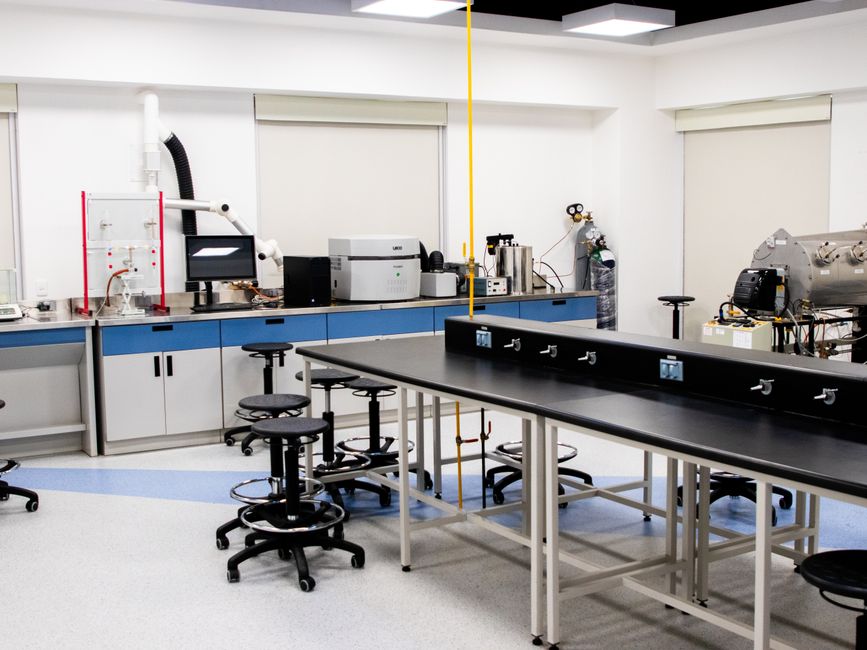
An icp ms lab is only as good as its sample preparation. Because the instrument is so sensitive, even a microscopic speck of dust can ruin your results.
Preparing Liquid and Solid Samples for Analysis
To achieve accurate trace results, we follow strict protocols depending on the physical state of your sample:
- Liquid Samples: These are the easiest to analyze. They must be completely free of suspended solids or particulates, which can clog the nebulizer. We typically dilute liquid samples in a matrix of 1% to 2% ultra-pure, double-distilled nitric acid ($\text{HNO}_3$). Nitric acid keeps the metals in solution and is friendly to the instrument’s internal components.
- Solid Samples: For bulk solid analysis, we must turn the solid into a liquid. This is typically done using microwave digestion or hot-plate acid digestion with concentrated nitric, hydrochloric, or hydrofluoric acids. Microwave digestion is highly preferred because the sealed vessels reach high temperatures and pressures, ensuring complete dissolution of difficult matrices (like plastics, geological ores, or plant tissues) without losing volatile elements.
- Direct Solid Sampling (Laser Ablation): If chemical digestion is too time-consuming or you need to see spatial distribution across a solid surface, we can couple the ICP-MS with a laser ablation (LA) system. A high-powered UV laser blasts a microscopic spot (ranging from 5 to 160 microns) on the solid sample, and a stream of helium gas sweeps the resulting aerosol directly into the plasma.
To prevent contamination during preparation, we run procedural blanks alongside every batch of samples. These blanks contain only the acids and reagents used in preparation, allowing us to subtract any background contamination from your final results. For more details on our complete preparation workflows, visit our ICP-MS Testing Lab Services page.
Common Interferences and Mitigation Strategies
No analytical technique is entirely free of interference. In ICP-MS, interferences fall into three main categories: physical, isobaric, and polyatomic.
- Physical Interferences: Differences in viscosity or surface tension between your samples and calibration standards can affect how the nebulizer creates the aerosol. We correct for this by adding an internal standard (such as Yttrium, Indium, or Bismuth) to all samples and standards.
- Isobaric Interferences: This occurs when two different elements have isotopes with the same nominal atomic mass. For example, Argon-40 ($^{40}\text{Ar}$) and Calcium-40 ($^{40}\text{Ca}$) share the same mass. We resolve this by choosing alternative isotopes (like $^{44}\text{Ca}$) or using high-resolution sector-field instruments.
- Polyatomic Interferences: These are molecular ions formed in the plasma from a combination of argon, solvent elements (hydrogen, oxygen), and matrix elements (chlorine, carbon, sulfur). The classic example is Argon Chloride ($^{40}\text{Ar}^{35}\text{Cl}^+$), which has a mass of 75—exactly the same as Arsenic ($^{75}\text{As}$). If you try to measure arsenic in a high-chloride sample (like seawater or urine) without addressing this, your results will be falsely elevated.
How a Modern ICP MS Lab Minimizes Analytical Errors
To eliminate polyatomic interferences, modern instruments use a collision/reaction cell placed just before the mass analyzer.
In helium mode (Kinetic Energy Discrimination or KED), we pump inert helium gas into the cell. Because polyatomic molecular ions (like $^{40}\text{Ar}^{35}\text{Cl}^+$) are physically larger than single-atom analyte ions (like $^{75}\text{As}^+$), they collide with the helium atoms much more frequently. Each collision robs the molecular ion of kinetic energy. By the end of the cell, the polyatomic interferences have slowed down so much that they cannot pass over an electrostatic barrier, leaving a clean path for the analyte ions to reach the detector.
For more complex interferences, we can introduce a reactive gas like hydrogen, oxygen, or ammonia into a reaction cell. These gases react chemically with the interfering molecules to neutralize them, while leaving the target analytes untouched.
In advanced research applications, such as those conducted at the Mass Spectrometry Core, these interference mitigation strategies are crucial for ensuring the absolute purity of biological and biochemical data.
Applications, Costs, and Quality Standards in Trace Testing
Because of its versatility, ICP-MS is used across a broad spectrum of industries:
- Pharmaceuticals & Cosmetics: Ensuring compliance with USP <233> and ICH Q3D elemental impurity limits for heavy metals (Arsenic, Cadmium, Mercury, Lead) in raw materials and finished drug products.
- Environmental Monitoring: Testing drinking water, wastewater, soils, and air particulates for trace contaminants.
- Geology & Mining: Quantifying rare earth elements, precious metals, and isotopic ratios in rock powders and minerals.
- Aerospace & Metallurgy: Detecting trace contaminants in high-performance alloys where even minor impurities can cause structural failure.
- Semiconductors: Verifying ultra-pure chemicals and silicon wafers where ppt-level contaminants can ruin microchip production.
Typical Costs and Fees for Commercial Testing
When outsourcing your testing to a commercial icp ms lab, pricing varies depending on the level of sample preparation required, the number of elements being analyzed, and the regulatory compliance standards needed (e.g., GMP vs. R&D).
- Standard Solution Analysis: Usually ranges from $40 to $150 per sample, depending on batch size and standard turnaround times.
- Acid Digestion Prep: Adds an additional $15 to $50 per sample due to the labor and reagents involved.
- Laser Ablation (LA-ICP-MS): Solid-phase microanalysis typically incurs a minimum session charge (often around $350 to $600) due to the specialized instrument setup and calibration required.
- Turnaround Times: Standard commercial turnaround is typically 5 to 10 business days. However, rush services (24 to 48 hours) are generally available for a surcharge.
At Elemental Analysis Inc., we understand that time is money. We balance competitive pricing with some of the fastest turnaround times in the industry to keep your projects moving forward. To request a custom quote or learn more about our testing packages, view our full suite of analytical Services.
Frequently Asked Questions about ICP-MS Testing
What detection limits can ICP-MS achieve?
For most elements in a clean liquid solution, ICP-MS can easily achieve detection limits below 0.1 parts per trillion (ppt). However, the practical reporting limit is often determined by the sample matrix and the cleanliness of the preparation environment, as high-salt samples require dilution which raises the effective detection limits.
What elements cannot be measured by ICP-MS?
We cannot measure hydrogen, helium, carbon, nitrogen, oxygen, fluorine, neon, or argon. These elements have exceptionally high ionization potentials (making them difficult to ionize in argon plasma) or are present at high background levels from the ambient air, solvent, or plasma gas itself.
What is the difference between solution ICP-MS and laser ablation ICP-MS?
Solution ICP-MS requires solid samples to be completely dissolved in acid before being sprayed into the instrument as a liquid mist. Laser ablation ICP-MS bypasses the dissolution step entirely by using a focused laser beam to vaporize a tiny spot on a solid sample, allowing us to perform high-resolution spatial mapping and microanalysis of solid surfaces.
Conclusion
When it comes to trace element testing, accuracy is non-negotiable. Selecting the right icp ms lab means finding a partner that not only has state-of-the-art instrumentation but also possesses the deep chemistry expertise to handle complex sample preparation and eliminate interferences.
At Elemental Analysis Inc., based in Lexington, Kentucky, we have spent decades helping clients solve complex analytical challenges. As the first commercial PIXE laboratory, we offer a unique blend of non-destructive testing alongside traditional destructive chemistry services like ICP-MS. Whether you need ultra-trace heavy metal quantification, raw material validation, or custom speciation analysis, our team delivers fast turnaround times and competitive pricing without compromising on quality.
Ready to get started on your next project? Contact Us today to discuss your testing requirements, or learn more about our ICP capabilities.