
Heavy Metal Analysis by ICP MS: The Ultimate Guide to Screening Toxins
When Trace Metals Can’t Be Missed: Why Heavy Metal Analysis by ICP-MS Matters
Heavy metal analysis by ICP-MS is the gold-standard method for detecting toxic trace elements — like arsenic, lead, cadmium, and mercury — at concentrations as low as one part per quadrillion (ppq) in pharmaceuticals, food, environmental samples, and biological tissues.
Here’s a quick summary of what ICP-MS heavy metal analysis delivers:
| What You Need to Know | Key Detail |
|---|---|
| Detection limit | As low as 1 ppq (parts per quadrillion) |
| Common target elements | As, Pb, Cd, Hg, Cr, Se, Tl, and 20+ more |
| Typical recovery rates | 89–102% across diverse sample matrices |
| Calibration linearity | Correlation coefficient r > 0.9999 |
| Key regulatory frameworks | USP <232>, ICH Q3D, EU contaminant limits, FDA guidelines |
| Main advantage over older tests | Objective, quantitative, multi-element — no subjective visual color comparison |
Trace metals hide in places you’d never expect — residual catalysts in drug compounds, soil uptake in rice crops, leachables from processing equipment. At low enough concentrations, they’re invisible without the right tool.
The old colorimetric wet chemistry tests prescribed by the USP, BP, JP, and EP pharmacopeias relied on a simple color change. A technician would compare a sample’s color against a standard. Visually. That method couldn’t tell you which metal was present, how much of it existed, or whether a volatile element like mercury had already evaporated during sample prep.
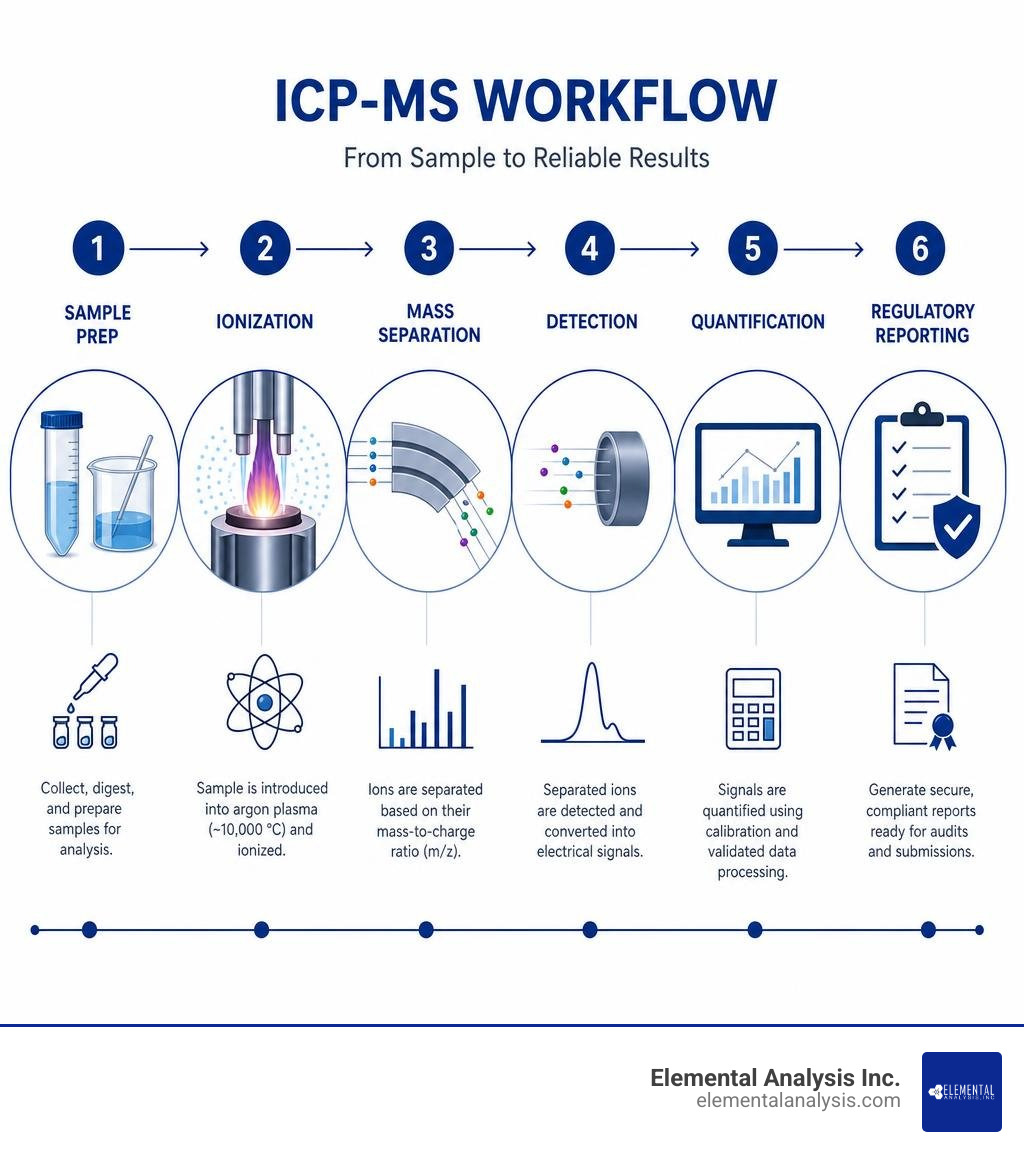
ICP-MS changes all of that. It ionizes a sample using argon plasma heated to roughly 10,000 °C, then separates ions by their mass-to-charge ratio and counts them individually. The result is a precise, element-specific concentration — not a color.
For lab supervisors managing pharmaceutical, food, or environmental testing programs, the stakes are high. Regulatory agencies now require quantitative elemental data, not qualitative color comparisons. Missing a metal contaminant at the ppb or ppt level can mean product recalls, failed audits, or — worst case — patient harm.
This guide walks you through everything: how ICP-MS works, which elements to target, how to prepare samples, how to eliminate interferences, and how to validate your method to meet cGMP and GLP standards.
Why ICP-MS Outperforms Traditional Wet Chemical Heavy Metals Tests
For more than a century, the pharmaceutical and food industries relied on compendial wet chemistry tests (such as the infamous USP <231>). These tests were simple and required little equipment, but they lacked accuracy, specificity, and safety.
Transitioning to modern ICP-MS Testing has completely transformed how we identify and quantify elemental impurities.
Limitations of Compendial Wet Chemistry (USP, BP, JP, EP)
The classical wet chemical heavy metals tests relied on sulfide precipitation. The sample was reacted with a sulfide reagent, and any heavy metals present would form colored metal sulfides. The technician then visually compared the darkness of the sample’s precipitate against a lead standard.
This approach suffered from several fatal flaws:
- Subjectivity: Visual comparison is inherently subjective. One person’s “slightly brown” is another’s “moderately amber.”
- Poor Recoveries: Many preparation protocols involved high-temperature “dry ashing” in open crucibles. This process routinely caused the loss of volatile elements. Mercury, tin, and selenium would literally go up in smoke before they could ever be measured.
- Matrix Dependencies: The chemical functionalities in different sample matrices heavily impacted individual element recoveries. If a sample didn’t dissolve or react perfectly, the test yielded a false negative.
- Lack of Specificity: The test produced a single, collective result. It could not tell you which metals were present—only that “something” precipitated.
Key Advantages of Heavy Metal Analysis by ICP MS
Inductively Coupled Plasma Mass Spectrometry (ICP-MS) completely eliminates these limitations by replacing subjective chemistry with physical, isotope-specific measurement.
- Ultra-Trace Sensitivity: ICP-MS is capable of detecting metals at concentrations as low as 1 ppq (one part per quadrillion). For perspective, that is the equivalent of a single drop of water in 20 million Olympic-sized swimming pools.
- Massive Dynamic Range: Modern instruments can measure trace levels (parts per trillion) and major components (parts per million) in a single run, reducing the need for multiple dilutions.
- High Throughput: ICP-MS can screen for over 30 elements simultaneously in less than three minutes per sample.
- Objective Quantitation: By ionizing the sample in a 10,000 °C argon plasma and measuring the resulting ions with a mass spectrometer, we get hard numbers based on the mass-to-charge ratio of each isotope. There is zero guesswork.
Regulatory Limits and Target Elements in Pharma and Food Safety
In both the pharmaceutical and food safety sectors, regulatory bodies have established strict limits for elemental impurities. These guidelines outline exactly which elements must be monitored and how much of them is permissible.
Pharmaceutical Elemental Impurities and PDE Thresholds
Under the harmonized USP <232> and ICH Q3D guidelines, elemental impurities are grouped into classes based on their toxicity and the likelihood of their occurrence in drug products:
- Class 1 (The “Big Four”): Arsenic (As), Cadmium (Cd), Lead (Pb), and Mercury (Hg). These are highly toxic across all administration routes and must be included in all risk assessments.
- Class 2A: Cobalt (Co), Nickel (Ni), and Vanadium (V). These have a high probability of introduction through manufacturing equipment.
- Class 2B: Elements like Selenium (Se), Silver (Ag), Gold (Au), Platinum (Pt), and Palladium (Pd). These are typically only tested if they are intentionally added during synthesis (e.g., as catalysts).
- Class 3: Elements with lower toxicity, such as Lithium (Li), Antimony (Sb), and Copper (Cu), which are primarily monitored for oral, parenteral, or inhalation pathways.
These regulations define limits as Permissible Daily Exposures (PDEs) in micrograms per day ($\mu\text{g/day}$). For instance, the oral PDE for lead is $5\ \mu\text{g/day}$, while its parenteral (injectable) limit drops to just $5\ \mu\text{g/day}$ due to direct systemic exposure. To see how laboratories validate these thresholds using optical emission alternatives, you can read the Analysis of Elemental Impurities in Drug Products Using the iCAP 7400 ICP-OES Duo.
Food Safety Standards and Global Contaminant Limits
In food safety, regulatory standards are driven by environmental exposure and bioaccumulation. For example, rice plants actively uptake arsenic from flooded soils, while leafy vegetables easily accumulate cadmium.
- European Union (EU) Limits: The EU enforces strict maximum levels in foods (e.g., $200\ \mu\text{g/kg}$ for inorganic arsenic in milled rice, and $50\ \mu\text{g/kg}$ for cadmium in vegetables).
- China’s National Food Safety Standard (GB 5009.268-2025): This standard outlines the official multi-element analysis method in food matrices using ICP-MS. It covers 30 specific elements—including lithium, boron, sodium, zinc, and lead—to ensure comprehensive safety. You can access the full details in the GB 5009.268-2025 English PDF.
- US FDA Guidelines: The FDA Elemental Analysis Manual (EAM) Section 4.7 provides validated procedures for trace metals in a wide array of domestic and imported foods.
Step-by-Step Sample Preparation and Its Impact on Recovery Rates
An ICP-MS instrument is only as good as the sample preparation that precedes it. Because the instrument introduces samples as a fine liquid aerosol, solid samples must be completely dissolved without losing volatile analytes or introducing contamination.
At Elemental Analysis Inc., we utilize advanced sample preparation workflows to ensure maximum recovery.
Optimizing Microwave Digestion for Diverse Matrices
The industry standard for sample preparation is closed-vessel microwave-assisted acid digestion. By combining high-purity acids with intense microwave energy, we can break down complex organic matrices in minutes.
A typical digestion protocol involves:
- Weighing: Weighing approximately $0.2$ to $0.5\text{ g}$ of homogenized sample (such as animal tissue, Chinese noodles, or raw pharmaceutical ingredients) directly into a clean PFA or quartz vessel.
- Acid Addition: Adding ultra-pure nitric acid ($\text{HNO}_3$, typically $3\text{ to }5\text{ mL}$) and hydrogen peroxide ($\text{H}_2\text{O}_2$, $1\text{ to }2\text{ mL}$). Nitric acid digests the organic matter, while hydrogen peroxide provides additional oxidizing power.
- Temperature Program: Running a controlled multi-step heating program. For closed vessels, the temperature is ramped up to $180\text{–}200\ ^\circ\text{C}$ over 12 minutes and held for 10 to 15 minutes.
- Mercury Stabilization: If mercury is a target analyte, we add a small volume of high-purity hydrochloric acid ($\text{HCl}$) or gold ($\text{Au}$) standard to keep the mercury in solution and prevent it from sticking to the plastic tubing and vessel walls.
For samples with high tin ($\text{Sn}$) content, adding $\text{HCl}$ before sealing the vessel is crucial to prevent the tin from precipitating as insoluble tin oxide.
Achieving High Recovery and Low Detection Limits in Heavy Metal Analysis by ICP MS
Once digested, the sample is diluted with ASTM Type-I reagent water to a final acid concentration of approximately 2% $\text{HNO}_3$. Keeping the dissolved solids below 0.2% (2,000 ppm) is essential to prevent salt deposition on the instrument’s nebulizer and interface cones.
When performed correctly, this method yields exceptional recovery rates and highly linear calibration curves:
- Spike Recoveries: Average recoveries for target elements across challenging food and drug matrices typically range from 89% to 102% (e.g., 91–108% in rice, 90–114% in noodles, and 88–112% in onions).
- Detection Limits: Method Detection Limits (MDLs) are incredibly low, ranging from $0.02\ \mu\text{g/kg}$ for thallium ($\text{Tl}$) to $0.4\ \mu\text{g/kg}$ for cadmium ($\text{Cd}$), and around $1.2\ \mu\text{g/kg}$ for lead ($\text{Pb}$).
- Linearity: Calibration curves established using multi-point standards regularly achieve correlation coefficients ($r$) greater than 0.9999, ensuring accurate quantification across several orders of magnitude.
To explore our complete suite of digestion and trace element testing capabilities, check out our ICP service page.
Mitigating Spectral Interferences and Enhancing Accuracy
While ICP-MS is incredibly powerful, it is not immune to interferences. In fact, because it measures mass-to-charge ratios ($m/z$), any polyatomic ion or isotope with the same nominal mass as your target analyte will cause a false positive.
Fortunately, modern technology offers brilliant ways to bypass these interferences.
Collision and Reaction Cell Modes for Interference Removal
The most common interferences are polyatomic ions formed by the combination of plasma gas (argon), solvent elements (hydrogen, oxygen), and sample matrix elements (like chlorine or sulfur).
- The Arsenic/Argon Chloride Problem: Arsenic has only one stable isotope, $^{75}\text{As}$. However, if your sample contains chloride (like table salt or physiological saline), the argon in the plasma combines with chlorine to form $^{40}\text{Ar}^{35}\text{Cl}^+$. This polyatomic ion has a mass of exactly 75, which directly overlaps with arsenic.
- Helium Collision Mode (KED): To solve this, we introduce helium gas into a collision cell. As the ions pass through, the larger, bulkier polyatomic ions ($^{40}\text{Ar}^{35}\text{Cl}^+$) collide with helium atoms much more frequently than the smaller, compact monoatomic analyte ions ($^{75}\text{As}^+$). These collisions cause the polyatomic ions to lose kinetic energy. A biased barrier at the cell exit (Kinetic Energy Discrimination) then filters out these slow-moving polyatomic ions, leaving a clean stream of analyte ions for the mass spectrometer.
- Triple Quadrupole (ICP-MS/MS) with Oxygen Mass Shift: For highly complex matrices, triple quadrupole systems introduce a reaction gas like oxygen ($\text{O}_2$). The oxygen reacts selectively with specific analytes (e.g., $^{75}\text{As}^+ \rightarrow\ ^{75}\text{As}^{16}\text{O}^+$ at $m/z\ 91$), shifting the analyte to a clean mass region while leaving the original interference behind.
To find out which interference-mitigation strategy is best suited for your specific matrix, browse our Services page.
Sulfur and Phosphorus Standardization in Biological Specimens
When analyzing trace metals in biological specimens (like cell cultures or tissue biopsies), sample size is often extremely limited. Measuring cell counts or wet weight for normalization can introduce massive errors.
To solve this, advanced workflows use endogenous sulfur ($^{32}\text{S}$) and phosphorus ($^{31}\text{P}$) as internal standards. Because sulfur is directly proportional to protein content, and phosphorus is proportional to nucleic acids and phospholipids, measuring these elements in the same run allows us to normalize trace metal concentrations (like copper, zinc, or iron) directly to the biological mass of the sample.
Using triple quadrupole ICP-MS with an oxygen mass shift, we can measure sulfur and phosphorus alongside trace metals in a single analytical run, drastically reducing sample-to-sample variability.
Quality Control and Method Validation in Regulatory Settings
To operate within cGMP, GLP, or ISO 17025 environments, an ICP-MS method must undergo rigorous validation. We monitor instrument performance continuously using structured quality control checks.
Validation Parameters and Acceptance Criteria
Validation requires demonstrating that the method is accurate, precise, specific, and robust. Below is a summary of the standard acceptance criteria we use to maintain regulatory compliance:
| QC Parameter | Acceptance Criteria | Purpose |
|---|---|---|
| Calibration Linearity ($r$) | $\ge 0.995$ (Typically $> 0.9999$) | Ensures accurate quantification across the range |
| Spike Recovery | 70% to 150% (USP) / 85% to 115% (Food) | Verifies accuracy and lack of matrix suppression |
| Repeatability (RSD%) | $\le 20\%$ (Typically $< 2.5\%$) | Measures system and preparation precision |
| Continuing Calibration Verification (CCV) | Within $\pm 12\%$ of accepted value | Monitors instrument drift during the run |
| Internal Standard Response | Within $\pm 50\%$ of the initial calibration | Confirms stable sample nebulization and ion transport |
| Positive Control Duplicate (RPD) | Relative Percent Difference $\le 20\%$ | Verifies consistency between duplicate preparations |
| Positive Control Set Acceptance | $\ge 90\%$ of monitored analytes must pass | Validates the entire analytical batch |
If any of these parameters fall outside the acceptance criteria, the system triggers an automatic recalibration, or the affected samples must be re-prepared and re-analyzed.
To learn more about how we apply these rigorous validation protocols to customized testing workflows, visit our A to Z Testing directory.
Heavy Metal Analysis by ICP MS: Contaminant Detection vs. Bioanalysis
ICP-MS is highly versatile. It serves two distinct purposes in the laboratory: identifying unwanted contaminants and tracking active metal-containing pharmaceutical ingredients.
Identifying Sources of Heavy Metal Contamination
Heavy metals do not belong in final products, but they can easily slip in during manufacturing. Common contamination pathways include:
- Residual Catalysts: Platinum, palladium, and ruthenium are frequently used to catalyze chemical reactions during drug synthesis. If not properly purified, toxic residues remain.
- Processing Equipment: Stainless steel reactors, grinding mills, and cutting blades can leach nickel, chromium, and cobalt into raw materials.
- Environmental Exposure: Crops like rice, wheat, and cannabis easily absorb lead, cadmium, and arsenic from contaminated soils and irrigation water.
- Container Closures: Rubber stoppers, glass vials, and plastic packaging can leach elements like antimony, zinc, or lead into liquid formulations over time.
Bioanalysis of Metal-Containing Therapeutics

On the flip side, some of the most powerful therapeutics are metal-based. Platinum-based drugs (like cisplatin and carboplatin) are cornerstones of modern oncology, while ruthenium and gold complexes are being actively researched for targeted therapies.
In clinical trials and pharmacokinetic studies, we use heavy metal analysis by ICP-MS to perform bioanalysis on blood, serum, and tissue samples. By coupling Size Exclusion Chromatography with ICP-MS (SEC-ICP-MS), we can separate biological proteins by size and detect exactly which metallobiomolecules are binding to the drug. This allows researchers to track how the therapeutic distributes, metabolizes, and clears from the body.
To read about how multi-laboratory comparisons validate these animal-derived tissue analyses, consult this study: Interlaboratory comparison of heavy metal testing in animal … – PMC.
Frequently Asked Questions about Heavy Metal Analysis
What is the detection limit of ICP-MS for heavy metals?
ICP-MS offers some of the lowest detection limits of any analytical technique. For most heavy metals (such as lead, cadmium, and cobalt), instrument detection limits are in the parts per trillion (ppt) or sub-ppb range. In specialized configurations, it can detect concentrations as low as 1 part per quadrillion (ppq).
How does helium collision mode eliminate spectral interferences?
Helium collision mode utilizes Kinetic Energy Discrimination (KED). Helium gas is introduced into a cell where both analyte ions and larger polyatomic interferences (like $\text{ArCl}^+$) are passing through. Because the polyatomic interferences are physically larger, they collide with the helium atoms more frequently, losing energy. A electrostatic barrier at the exit of the cell blocks these low-energy polyatomic ions while allowing the faster monoatomic analyte ions to pass into the mass spectrometer.
Why did USP replace the old <231> heavy metals test?
The old USP <231> test was a qualitative, subjective visual color comparison that lacked specificity. It routinely failed to detect volatile elements like mercury because the open-vessel heating steps caused them to evaporate. USP replaced it with <232> and <233> to mandate the use of modern, quantitative, and element-specific instrumental techniques like ICP-MS and ICP-OES.
Conclusion
When it comes to screening for toxic trace elements, heavy metal analysis by ICP-MS delivers the ultimate combination of sensitivity, speed, and regulatory compliance. Whether you are validating a pharmaceutical compound under USP <232>, testing food products for global export, or profiling metallobiomolecules in biological serum, ICP-MS provides the unambiguous data you need to protect consumers and satisfy regulators.
At Elemental Analysis Inc., based in the heart of Lexington, Kentucky, we specialize in high-precision trace element identification, quantification, and speciation. As the world’s first commercial PIXE (Proton Induced X-ray Emission) laboratory, we offer a unique blend of destructive and non-destructive testing services. We couple this deep scientific expertise with competitive pricing and rapid turnaround times to keep your operations moving forward safely.
Ready to secure your supply chain and screen out toxic impurities? Learn more About Us or contact our team of experts today to schedule your next ICP-MS Testing program.