
The Ins and Outs of Inductively Coupled Plasma Mass Spectrometry
The Analytical Technique That Can Find a Single Grain of Salt in an Olympic Swimming Pool
Inductively coupled plasma mass spectrometry is an elemental analysis technique that uses an ultra-high-temperature argon plasma to break down samples into individual atoms, ionize them, and then sort and count those ions by mass — detecting most elements on the periodic table at concentrations as low as parts per trillion.
Quick answer: What is ICP-MS?
| Feature | Detail |
|---|---|
| What it does | Detects and quantifies elements and isotopes in a sample |
| How it works | Plasma ionizes atoms → ions sorted by mass-to-charge ratio → counted by detector |
| Detection limits | Parts per trillion (ppt) to parts per quadrillion (ppq) |
| Elements covered | Most of the periodic table, lithium through uranium |
| Common sample types | Water, blood, urine, soil, rock, pharmaceutical materials |
| Key advantage | Multi-element analysis in a single run, fast and highly sensitive |
If you’re managing trace-element testing in aerospace, pharma, or environmental work, ICP-MS is likely the most powerful tool available to you today. No other routine analytical technique matches its combination of sensitivity, speed, and multi-element capability.
The plasma at the heart of an ICP-MS system reaches temperatures of up to 10,000 Kelvin — hotter than the surface of the sun. That extreme energy is exactly what makes the technique so effective: virtually any sample matrix can be broken down completely, leaving nothing but a stream of charged elemental ions ready to be measured.
In this guide, we cover everything you need to know — from how the instrument works and how samples are prepared, to managing interferences, choosing calibration strategies, and understanding where ICP-MS fits best across industries.
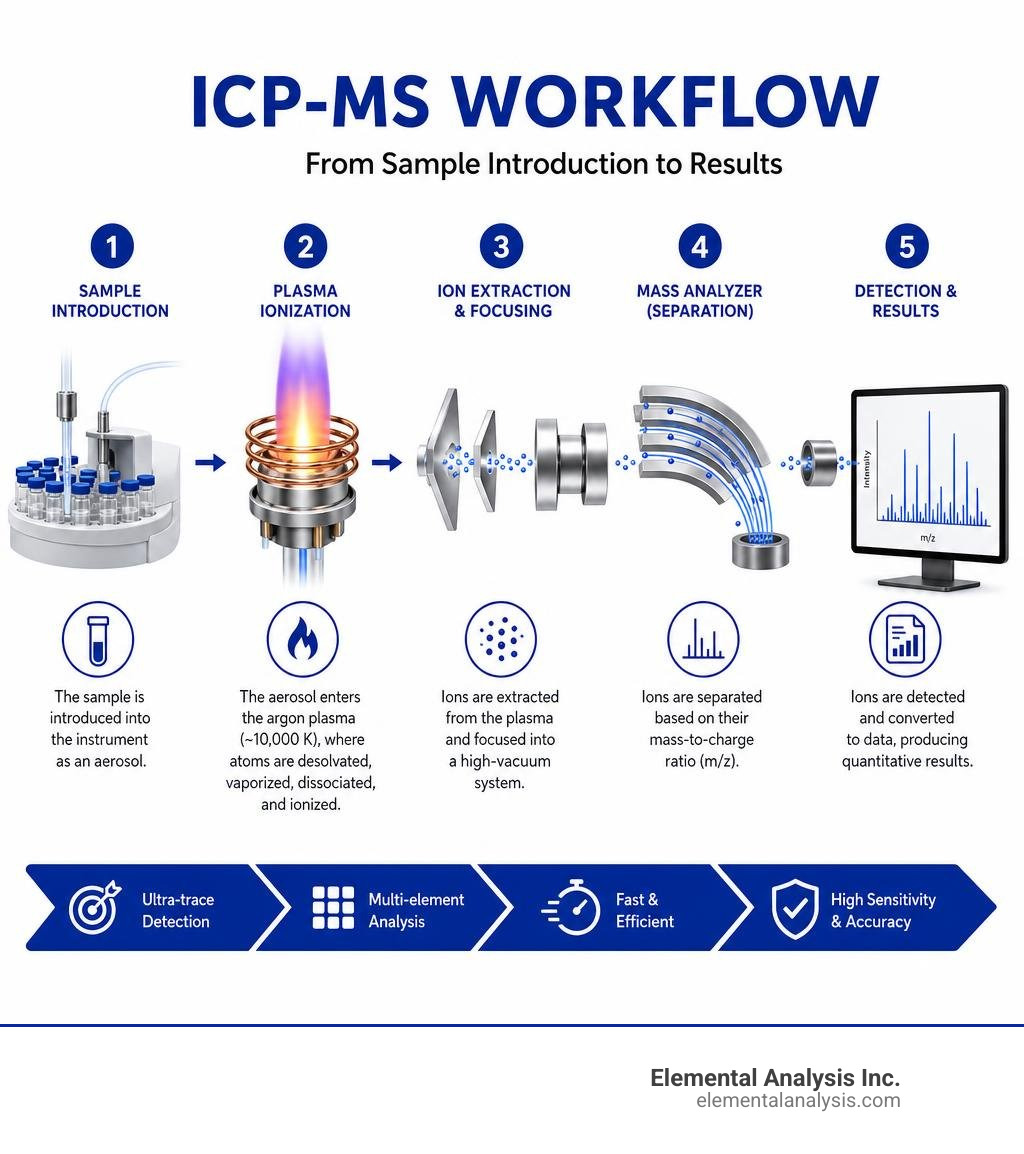
What is Inductively Coupled Plasma Mass Spectrometry?
At its core, inductively coupled plasma mass spectrometry (commonly abbreviated as ICP-MS) is a highly sophisticated form of elemental mass spectrometry. The official IUPAC definition of inductively-coupled plasma mass spectrometry describes it as a measurement method of atomic spectrometry that utilizes an inductively coupled plasma to excite and ionize atoms, which are subsequently detected by a mass spectrometer.
To understand why this technique has become the gold standard for trace metal analysis, it helps to break the name down into its two functional halves:
- Inductively Coupled Plasma (ICP): The “plasma” portion acts as the ion source. It uses argon gas flowing through a quartz torch, energized by a radiofrequency (RF) induction coil, to generate a superheated plasma. At temperatures reaching up to 10,000 Kelvin, this plasma is incredibly efficient at drying, vaporizing, atomizing, and ionizing almost any sample introduced to it.
- Mass Spectrometry (MS): The “mass spectrometry” portion is the sorting and counting mechanism. It takes the ions generated by the plasma, separates them based on their mass-to-charge ratio ($m/z$), and counts them.
By coupling these two systems, inductively coupled plasma mass spectrometry can identify and quantify nearly all elements on the periodic table—from lithium to uranium—simultaneously. For a foundational look at how this fits into the broader world of elemental analysis, explore our Guide to ICP Metal Analysis.
Fundamental Principles of Inductively Coupled Plasma Mass Spectrometry
The journey of a sample through an ICP-MS instrument is a rapid, high-temperature transformation. The fundamental steps include:
- Sample Aerosolization: The liquid sample is drawn into a nebulizer, where a high-velocity stream of argon gas breaks the liquid into a fine mist (aerosol).
- Desolvation & Vaporization: This aerosol is swept into the 10,000 K argon plasma. The extreme heat instantly evaporates the surrounding solvent, leaving behind microscopic solid dry particles (desolvation), which are then vaporized into a gas.
- Atomization: The gaseous molecules are broken apart into individual, free-floating atoms.
- Ionization: Because the first ionization potentials of most elements are lower than the ionization energy of argon (15.76 eV), the free atoms readily lose an electron. This converts them into positively charged, singly ionized ($+1$) elemental ions.
Once these ions are formed, they are drawn out of the plasma and directed into the mass spectrometer for separation and detection.
Core Components of an ICP-MS Instrument
An ICP-MS instrument is a masterpiece of modern engineering, requiring high temperatures, high vacuums, and ultra-precise electronics to work in perfect harmony.
1. The Sample Introduction System
Before a sample can meet the plasma, it must be properly prepared. The sample introduction system consists of a peristaltic pump, a nebulizer, and a spray chamber.
The type of nebulizer used depends heavily on the sample matrix. Concentric nebulizers are excellent for clean, low-viscosity liquids, while cross-flow or V-groove nebulizers are preferred for samples with higher particulate loads.
Once nebulized, the aerosol enters the spray chamber. Interestingly, only 1% to 2% of the nebulized sample actually reaches the plasma. The remaining 98% to 99% consists of droplets that are too large; these are drained away to waste to prevent the plasma from being overloaded and extinguished. To keep oxide formation to a minimum, the spray chamber is typically chilled and maintained at approximately 2°C.
2. The Plasma Torch and RF Coil
The plasma is sustained within a torch made of three concentric quartz tubes (often referred to as a Fassel or Greenfield design). Argon gas flows through these tubes at varying rates:
- Outer gas (Cool gas): Flows at 13 to 18 L/min to sustain the plasma and keep the quartz walls from melting.
- Intermediate gas (Auxiliary gas): Flows at approximately 1 L/min to adjust the height of the plasma relative to the torch.
- Central gas (Nebulizer/Carrier gas): Flows at roughly 1 L/min to carry the sample aerosol directly into the center of the plasma.
An RF coil wrapped around the end of the torch (operating at 27.12 MHz or 40 MHz) generates an intense electromagnetic field. A brief electric spark initiates ionization by freeing a few electrons, which are accelerated by the RF field, colliding with other argon atoms. This chain reaction creates a self-sustaining, highly ionized argon plasma “fireball.”
3. The Interface Region
The interface region is where the magic—and the extreme engineering—happens. The plasma operates at atmospheric pressure, while the mass spectrometer requires an ultra-high vacuum (approximately $7 \times 10^{-5}$ to $1 \times 10^{-3}$ Pa) to prevent ions from colliding with air molecules.
To bridge this pressure gap, the ions must pass through two or three concentric metal cones:
- Sampler Cone: A metal cone (usually nickel or platinum) with an orifice of about 1.0 mm.
- Skimmer Cone: Positioned directly behind the sampler cone, with a smaller orifice (typically 0.4 to 0.7 mm).
Some modern instruments feature a three-cone interface design, which provides a gentler, three-step pressure reduction. This minimizes ion beam divergence, eliminates the need for complex ion lenses, improves overall ion transmission, and reduces routine maintenance.
4. Ion Optics and the Vacuum System
As the ions emerge from the skimmer cone, they form a diverging beam. The ion optics use electrostatic fields to focus this positively charged ion stream while redirecting neutral species and light photons out of the pathway. This step is crucial for preventing background noise and protecting the mass analyzer from contamination.
Mass Analyzers and Detectors in Inductively Coupled Plasma Mass Spectrometry
Once the focused ion beam is safely inside the high-vacuum region, it enters the mass analyzer. There are three primary types of mass analyzers used in ICP-MS, each offering distinct advantages:
Quadrupole Mass Filter
The quadrupole is the most common mass analyzer, found in more than 90% of ICP-MS systems worldwide. It consists of four parallel metal rods. By applying combined radiofrequency and direct current (DC) voltages to these rods, we can create an electrostatic field that only allows ions of a specific mass-to-charge ratio ($m/z$) to travel down the center of the rods stably. All other ions collide with the rods and are pumped away.
Quadrupole analyzers usually operate at a nominal resolution of approximately 0.75 amu (atomic mass units) at 10% peak height, which translates to a resolving power ($M/\Delta M$) of about 300. They are incredibly fast, capable of scanning the entire mass range from lithium (mass 7) to uranium (mass 238) in less than 20 milliseconds.
Magnetic Sector Field
For analyses requiring extreme precision or the separation of isotopes that are very close in mass, a magnetic sector instrument is used. These systems use a combination of magnetic and electrostatic fields to bend the path of the ions. Because heavier ions bend less than lighter ones, the beam is dispersed by mass.
Magnetic sector instruments are capable of operating at a resolution of approximately 10,000 ($M/\Delta M$). This high-resolution mode is invaluable for resolving difficult isobaric and polyatomic interferences, though it does reduce overall sensitivity by about 99% when operating at its highest resolution limits.
Time-of-Flight (TOF)
TOF mass analyzers accelerate all ions into a flight tube at the exact same time. Because lighter ions travel faster than heavier ones, they reach the detector first. TOF-MS is exceptionally fast and is ideal for transient signals, such as those generated by single-particle analysis or laser ablation.
The Detector
At the end of the mass analyzer sits the detector, typically an electron multiplier. Modern systems utilize dual-mode detectors that operate in both pulse-counting (for ultra-trace concentrations) and analog modes (for higher concentrations). This dual-mode capability allows the instrument to achieve an extraordinary linear dynamic range of 8 to 12 orders of magnitude—meaning you can measure parts per quadrillion (ppq) and hundreds of parts per million (ppm) in the very same analytical run.
To dive deeper into how these components are configured for routine lab work, refer to The 30-Minute Guide to ICP-MS.
Sample Preparation and Matrix Considerations

While ICP-MS is incredibly powerful, its results are only as good as the sample preparation. Because the instrument is so sensitive, even minor contaminants from laboratory glassware, reagents, or the air can ruin an analysis.
Liquid vs. Solid Samples
Liquid samples (like water, environmental extracts, or biological fluids) are the easiest to analyze. They typically only require simple dilution with high-purity nitric acid ($HNO_3$).
Solid samples (like soils, geological rocks, plastics, or tissues) must first be converted into liquid form. This is usually achieved via closed-vessel microwave acid digestion using ultra-pure acids. For solid samples where digestion is impractical, techniques like Laser Ablation (LA-ICP-MS) can be used. LA-ICP-MS uses a high-energy laser to vaporize a tiny spot on a solid sample (requiring less than 250 nanograms of material), sweeping the resulting dry aerosol directly into the plasma.
Managing Total Dissolved Solids (TDS)
One of the primary limitations of ICP-MS is its sensitivity to high dissolved salt content. If a sample contains too many dissolved minerals, those minerals will deposit on the tiny orifices of the sampler and skimmer cones, gradually clogging them and causing signal drift.
- The TDS Rule: To prevent cone deposition and physical interferences, a total dissolved solids (TDS) content in the sample of $<0.2\%$ (2 g/L) is highly recommended.
- Biological Samples: For complex biological fluids like blood, serum, or urine, a dilution factor of 10 to 50 with a dilute acidic or alkaline diluent (often containing chelating agents like EDTA to keep proteins in solution) is usually adequate to bring the TDS down to safe levels.
To learn more about how we screen for toxic elements and prepare complex samples, check out our Ultimate Guide to Screening Toxins via Heavy Metal Analysis.
Overcoming Interferences and Optimizing Performance
In spectroscopy, an “interference” is anything that causes the instrument to report a concentration that is higher or lower than the true value. In ICP-MS, interferences fall into two major categories: spectroscopic and non-spectroscopic.
Spectroscopic Interferences
Spectroscopic interferences occur when an interfering ion has the same nominal mass-to-charge ($m/z$) ratio as the analyte you are trying to measure.
- Isobaric Overlap: This occurs when isotopes of two different elements share the same mass. For example, argon-40 ($^{40}Ar$) and calcium-40 ($^{40}Ca$) overlap. Fortunately, because natural isotope abundances are well-documented, we can easily correct for this using mathematical correction equations built into the software.
- Polyatomic Ions: These are molecular ions formed in the plasma from combinations of plasma gas, reagents, and matrix elements. A classic example is the combination of argon and chloride ($^{40}Ar^{35}Cl^+$), which has a mass of 75—directly interfering with arsenic ($^{75}As$). Another is argon oxide ($^{40}Ar^{16}O^+$), which interferes with iron ($^{56}Fe$).
Non-Spectroscopic Interferences (Matrix Effects)
These are physical interferences that affect how the sample is nebulized, transported, or ionized. High viscosity, high acid concentrations, or high salt matrices can suppress or enhance the ionization of your target analytes in the plasma.
The Modern Solution: Collision and Reaction Cells
To eliminate these pesky interferences without needing a multi-million-dollar high-resolution magnetic sector instrument, modern ICP-MS systems utilize a Collision/Reaction Cell (CRC). This is a small chamber positioned just before the mass analyzer that can be flooded with a collision or reaction gas.
| Cell Mode | Gas Used | How It Works | Best For |
|---|---|---|---|
| Collision Mode (KED) | Helium ($He$) | Uses Kinetic Energy Discrimination. Polyatomic interferences are physically larger than analyte ions. As they travel through the helium gas, they collide with helium atoms more frequently, losing kinetic energy. A small electrostatic barrier at the exit of the cell blocks these slow-moving polyatomic ions, letting the analyte ions pass through. | General multi-element screening in complex matrices (e.g., environmental samples). |
| Reaction Mode | Hydrogen ($H2$), Ammonia ($NH3$), Oxygen ($O_2$) | Relies on chemical reactions. The reaction gas chemically reacts with either the interference (to neutralize it or turn it into a different mass) or the analyte (to shift it to a clean mass), leaving the target mass interference-free. | Resolving highly challenging, specific interferences (e.g., separating $^{40}Ca$ from $^{40}Ar$, or analyzing selenium). |
In highly complex scenarios, tandem mass spectrometry (ICP-MS/MS)—often called triple quadrupole—uses two quadrupoles in series with a collision/reaction cell sandwiched in between. This setup allows for absolute control over the reaction chemistry, offering unmatched interference removal for advanced applications.
Calibration Strategies and Analytical Capabilities
To convert raw ion counts into precise concentration values, we must calibrate the instrument. There are three primary calibration strategies used in ICP-MS:
- External Calibration: We measure a series of standard solutions of known concentrations to construct a calibration curve. The concentration of the unknown sample is then calculated from this curve.
- Internal Standardization: To account for physical interferences, sample viscosity variations, and instrument drift over long analytical runs, we add a constant amount of specific elements (internal standards) to all blanks, standards, and samples. Common internal standards include $^6Li$, $^{45}Sc$, $^{89}Y$, $^{115}In$, and $^{209}Bi$. The software monitors these signals and automatically corrects the analyte data if the internal standard signal fluctuates.
- Isotope Dilution: This is the most accurate calibration method available. We “spike” the sample with a known amount of an enriched, non-natural isotope of the target element. By measuring the altered isotope ratio, we can calculate the exact concentration of the element. Because it relies on ratios rather than absolute signal intensity, it is virtually immune to physical and matrix interferences.
Performance Highlights
What makes ICP-MS the ultimate tool for trace analysis? Its raw capabilities speak for themselves:
- Detection Limits: Typical limits of detection are in the sub-parts-per-trillion (ppt) or nanomoles per liter (nmol/L) range for the majority of elements.
- Speed: A full multi-element suite analysis in solution mode takes only about 3 to 4 minutes per sample.
- Isotope Analysis: Unlike optical techniques, ICP-MS can distinguish between different isotopes of the same element, making it invaluable for radiometric dating, tracer studies, and isotope ratio analysis.
For a deeper dive into how labs implement these methods to unlock trace elements, see our article on Unlocking the Elements with ICP Laboratory Analysis.
Key Applications Across Industries

Thanks to its versatility, inductively coupled plasma mass spectrometry is utilized across a vast array of scientific disciplines:
- Environmental Monitoring: Used to measure trace metals in drinking water, wastewater, soils, and sediments. It is the primary instrument specified in standard regulatory protocols like EPA Method 6020B.
- Clinical and Forensic Toxicology: Crucial for detecting heavy metal poisoning (lead, arsenic, mercury, cadmium) in whole blood, urine, serum, or hair. For clinical research insights, explore the work being done at the University of Kentucky College of Medicine Mass Spectrometry Center in Lexington, KY.
- Pharmaceuticals: Essential for meeting the strict elemental impurity limits outlined in USP Chapters <232> and <233>.
- Geochemistry: Used for bulk rock analysis, mineral mapping, and radiometric dating (such as analyzing uranium-to-lead isotope ratios).
- Speciation Analysis: By coupling a chromatograph (like HPLC or GC) to an ICP-MS, we can separate and measure different chemical forms of an element. This is vital because some forms are highly toxic while others are harmless (for instance, separating toxic inorganic arsenite from non-toxic organic arsenobetaine found in seafood).
Frequently Asked Questions about ICP-MS
What is the difference between ICP-OES and ICP-MS?
While both techniques use an argon plasma, they detect elements differently. ICP-OES (Optical Emission Spectrometry) measures the light emitted by excited atoms, whereas ICP-MS measures the actual mass of the ions.
In short: ICP-MS offers much lower detection limits (ppt vs. ppb) and can measure isotopes, but it is more sensitive to high-TDS matrices and has a higher capital cost than ICP-OES. To help you choose the right fit for your laboratory’s needs, read our comparison on Choosing Between ICP-OES and ICP-MS and our guide on Finding the Perfect Match for Your Lab.
What are the typical detection limits of ICP-MS?
For most elements on the periodic table, ICP-MS can easily achieve detection limits in the parts-per-trillion (ppt) or even parts-per-quadrillion (ppq) range. In simple, clean liquid matrices, this equates to sub-nanogram per liter concentrations.
Why is argon used as the plasma gas in ICP-MS?
Argon is the ideal plasma gas for three main reasons:
- Abundance: It is relatively abundant and inexpensive compared to other noble gases like helium.
- Inertness: Being a noble gas, it does not chemically react with the sample analytes or torch components.
- High Ionization Potential: Argon’s first ionization potential is 15.76 eV. This is higher than the first ionization potential of almost every other element on the periodic table, meaning the argon plasma can transfer its energy to ionize almost any sample element efficiently.
Conclusion
From monitoring trace impurities in pharmaceuticals to detecting heavy metals in environmental water supplies, inductively coupled plasma mass spectrometry remains the undisputed king of elemental analysis. Its speed, sensitivity, and massive dynamic range make it an indispensable tool for modern analytical chemistry.
At Elemental Analysis Inc., located in Lexington, Kentucky, we provide world-class trace element identification, quantification, and speciation services across a wide range of industries. As the home of the first commercial PIXE (Proton-Induced X-ray Emission) laboratory, we are uniquely positioned to offer both non-destructive and destructive testing options. Whether you need ultra-trace detection via ICP-MS or rapid, non-destructive screening, our team delivers incredibly fast turnaround times and highly competitive pricing.
Ready to unlock the elemental secrets of your samples? Explore our ICP Analysis Services today or reach out to our Lexington-based team to discuss your next project.