A Beginner Guide to Industry Standard Methods
Why Industry Standard Methods Are the Backbone of Reliable Water Testing
Industry standard methods are documented, peer-reviewed procedures that laboratories use to analyze water, wastewater, and other environmental samples in a consistent, reproducible way.
Here is a quick overview of what they are and why they matter:
- What they are: Standardized analytical procedures developed by organizations like Standard Methods, ASTM International, ISO, TNI, and AOAC through a voluntary consensus process
- Who uses them: Labs, municipalities, industries, and regulators — over 50,000 water professionals worldwide rely on Standard Methods alone
- Why they matter: They ensure test results are accurate, comparable across labs, and legally defensible in regulatory settings
- Who requires them: Federal agencies like the EPA mandate approved methods for compliance under the Clean Water Act and Safe Drinking Water Act
- Where to start: Access 500+ standardized water and wastewater methods through Standard Methods for the Examination of Water and Wastewater
Think about what happens when a water sample comes back with elevated contaminant levels. Someone has to decide: Is this result real, or is it a lab error? The answer depends almost entirely on whether the lab followed a recognized, validated procedure.
That is the core problem that industry standard methods solve.
Without them, two labs could test the same water sample and report completely different results — using different equipment, different reagents, different detection limits. No regulator, court, or public health official could trust either number.
Standard methods exist so that does not happen.
Since 1905, organizations like the Standard Methods Committee have been building and refining these procedures. Today, there are hundreds of approved methods covering everything from trace metals to microbiology to whole effluent toxicity.
For lab supervisors and technical managers, understanding these standards is not optional. It is the foundation of every result you report.
What Are Industry Standard Methods and Why Do They Matter?
When we talk about water analysis and wastewater analysis, accuracy is not just a laboratory goal—it is a public health necessity. Industry standard methods provide the universal playbook that makes this accuracy possible.
Imagine trying to bake a cake where every recipe book in the world used different definitions for a “cup” or a “teaspoon.” Your kitchen would be a chaotic zone of collapsed sponges and overly salty batters. In the environmental testing world, a lack of standardized methods would mean chaos of a much more dangerous variety. If one laboratory measures lead in drinking water using an unvalidated, home-brewed technique while another uses a different, unchecked method, the community is left in the dark about whether their water is actually safe to drink.
Standardized methods establish a baseline of consistency, reliability, and data defensibility. When a laboratory adheres to these accepted protocols, it means:
- Consistency: The sample is collected, preserved, prepared, and analyzed the exact same way every single time, regardless of which technician is on shift.
- Reliability: The method has been rigorously tested by dozens of independent laboratories to prove that it consistently yields correct results.
- Defensibility: Should a municipality or industrial facility face legal scrutiny, having data generated via approved standard methods provides a solid, legally defensible foundation in a court of law.
This rigorous approach is particularly vital when dealing with toxic substances. In our comprehensive guide, Testing the Waters: A Complete Guide to the Analysis of Heavy Metals in Water, we discuss how trace levels of metals like lead, arsenic, and cadmium require incredibly sensitive, standardized chemistry to detect.
By utilizing resources like the officially recognized Standard Methods platform, laboratories access over 500 standardized methods specifically designed for examining water and wastewater. These methods are the thin blue line protecting our drinking water, safeguarding local aquatic ecosystems, and ensuring that treated industrial wastewater does not compromise public health.

Key Organizations and Regulatory Alignment
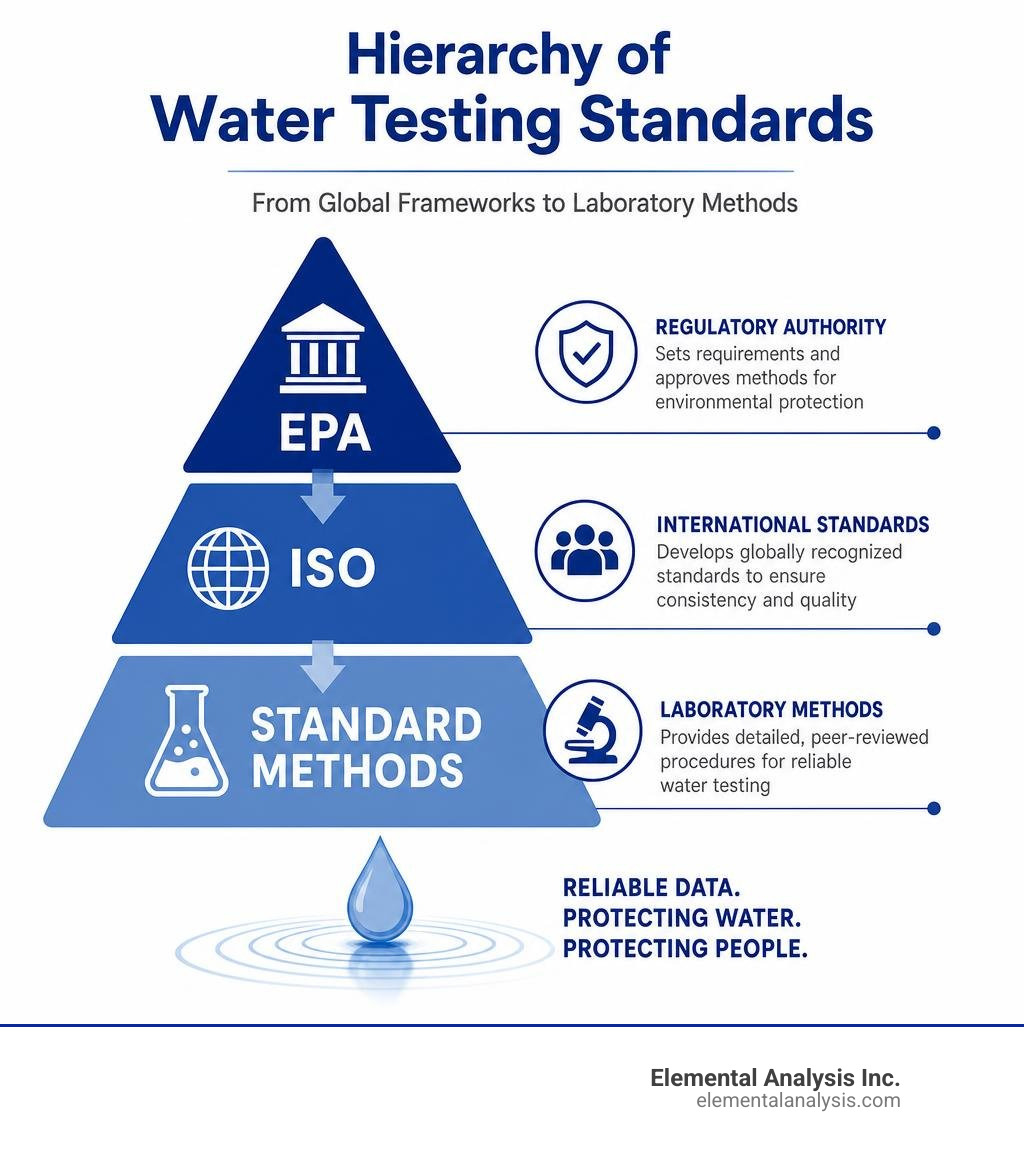
The landscape of industry standard methods is maintained by several heavy-hitting scientific and standardization organizations. Rather than working in isolation, these groups collaborate to form a robust safety net of voluntary consensus standards.
Let us look at the primary organizations responsible for keeping our water testing standards up to date:
- The Standard Methods Committee (SMC): A joint effort between the American Public Health Association (APHA), the American Water Works Association (AWWA), and the Water Environment Federation (WEF). Together, they produce Standard Methods for the Examination of Water and Wastewater, which has been the premier resource for water analysis since its first edition in 1905.
- ASTM International: Formerly known as the American Society for Testing and Materials, ASTM has published more than 12,500 standards globally, including a massive catalog of water-specific standards covering inorganic chemicals, organic compounds, metals, and microbiology.
- International Organization for Standardization (ISO): With a global footprint, ISO has published more than 1,200 standards specifically related to water quality, ensuring that environmental testing remains consistent across international borders.
- The Nelac Institute (TNI): TNI focuses heavily on laboratory accreditation, establishing the standards that laboratories must meet to prove they have the operational quality control necessary to run these methods.
- AOAC International: Renowned for food safety and agricultural standards, AOAC also plays a key role in validating analytical methods that intersect with water used in agricultural and food processing environments.
To help you visualize how these organizations differ and overlap, here is a quick comparison:
| Organization | Key Focus Area | Water-Related Catalog Size | Best Known For |
|---|---|---|---|
| Standard Methods | Comprehensive wastewater & drinking water analysis | 500+ distinct analytical methods | The “Blue Book” (Standard Methods for the Examination of Water and Wastewater), trusted by 50,000+ professionals |
| ASTM International | Broad materials and environmental testing | 12,500+ total standards (hundreds of water standards) | Highly detailed, step-by-step consensus-based testing protocols |
| ISO | Global standardization of testing and quality management | 1,200+ water quality standards | International trade compliance and worldwide methodology alignment |
Implementing Industry Standard Methods in Water Quality Testing
In the United States, voluntary consensus standards do not just sit on a dusty shelf; they are actively written into federal law. Under federal directives like OMB Circular A-119, federal agencies are required to adopt voluntary consensus standards developed by organizations like ASTM and Standard Methods rather than writing their own unique government-specific methods.
This creates a direct bridge to major environmental legislation:
- The Clean Water Act (CWA): Focuses on surface water quality and regulates discharges into our nation’s waterways. Under 40 CFR Part 136, the EPA publishes lists of approved analytical methods that industries and municipalities must use when reporting wastewater discharges.
- The Safe Drinking Water Act (SDWA): Focuses on the quality of water coming out of our kitchen taps. It mandates strict contaminant limits and requires drinking water utilities to use highly specific, approved standard methods to verify safety.
To keep pace with advancing technology, the EPA periodically issues a Methods Update Rule (such as the historic Methods Update Rule 2 issued in April 2024, and subsequent updates extending into 2026). These rules officially approve new or revised methods, allowing laboratories to utilize modern, faster, and more sensitive techniques.
For example, local businesses in Lexington must carefully manage environmental compliance. The city’s Industrial and High Risk Commercial Stormwater (IHRC) program requires strict monitoring of runoff. If a local facility is testing its runoff for heavy metals, it must use EPA-approved methods.
Many facilities turn to advanced technology like Inductively Coupled Plasma Mass Spectrometry (ICP-MS) to meet these stringent requirements. To understand how these advanced analytical instruments fit into regulatory frameworks, check out our guide, From H2O to Heavy Metals: A Guide to ICP-MS Water Analysis.
The Lifecycle and QA/QC of Standard Methods
How does a method actually become an “industry standard”? It is not a fast process, and that is entirely by design.
The lifecycle of a standard method begins within specialized joint task groups made up of volunteer scientists, instrument manufacturers, and regulatory experts. When a new environmental threat emerges or a new technology is developed, these groups draft a proposed method. This draft undergoes rigorous round-robin testing (where multiple independent laboratories test identical samples using the draft protocol to see if they get the same results).
Once the data proves the method is reliable, it goes through a strict consensus process and public review before being officially approved and published.
However, even the best method is only as good as the Quality Assurance/Quality Control (QA/QC) program backing it up in the laboratory. To ensure that data remains defensible, laboratories must establish standard operating procedures (SOPs) and track several key performance metrics:
- Method Detection Limit (MDL): The minimum concentration of a substance that can be measured and reported with 99% confidence that the analyte concentration is greater than zero.
- Precision: How close a series of measurements are to one another (reproducibility).
- Accuracy: How close the measured value is to the actual, true value (verified using certified reference materials).
- Blanks and Spikes: Analyzing clean water blanks to ensure no contamination occurred in the lab, and “spiking” samples with a known amount of contaminant to verify that the instrument is reading recovery rates correctly.
In Kentucky, the Department for Environmental Protection provides excellent resources on this topic. Their Quality Assurance & Standard Operating Procedures page outlines the exact expectations for environmental laboratories operating within the state. Adhering to these state-specific guidelines is critical for maintaining laboratory accreditation.
To see how these quality control measures are practically applied to high-tech instrumentation, you can read our ICP-MS Lab Guide: How to Get Accurate Trace Element Testing.
How Professionals Shape Industry Standard Methods
One of the most beautiful aspects of the standards community is that it is entirely democratic. The standards we rely on every day are not handed down from an ivory tower; they are built, brick by brick, by working professionals just like us.
If you are a water quality chemist, a plant operator, or an environmental engineer, getting involved in standards development is one of the most rewarding career moves you can make. Here is why:
- Direct Professional Impact: You get a seat at the table to help draft, revise, and approve the very methods that your laboratory will use for the next decade.
- Unparalleled Networking: You will collaborate directly with top-tier experts from academic institutions, federal regulatory bodies, and leading commercial laboratories.
- Staying Ahead of the Curve: By participating in joint task groups, you get an early look at upcoming methodological shifts and regulatory updates years before they are officially published.
For local professionals looking to boost their technical knowledge and get involved in safety and operational standards, local training is incredibly valuable. Programs like the Lexington Population Center Training offer local opportunities for safety, compliance, and professional development right here in Kentucky.
Frequently Asked Questions about Water Analysis Standards
Navigating standard methods can feel like learning a whole new language. To help simplify things, we have compiled answers to some of the most common questions environmental professionals ask.
What are the latest updates to Standard Methods?
Standard Methods for the Examination of Water and Wastewater has published 24 comprehensive editions since its inception in 1905. However, the committee does not make laboratories wait years for a new edition to fix minor issues. They actively publish an official errata sheet (with the most recent major updates finalized in early 2026) to correct any minor errors or clarify steps in existing methods.
Additionally, the Standard Methods organization maintains an active “Ask the Experts” portal featuring a collection of over 170 detailed answers to tricky technical questions submitted by lab analysts over the years.
How do standards support public health?
By establishing strict limits on contaminants and enforcing uniform testing protocols, standards ensure that public health officials can make rapid, confident decisions. Whether deciding if a city needs to issue a boil water advisory or confirming that a local wastewater plant is safe to discharge into a recreational river, standard methods provide the trustworthy data needed to protect communities and ecosystems.
What is the difference between EPA methods and Standard Methods?
The primary difference lies in who writes them and how they are used:
- EPA Methods are developed directly by the United States Environmental Protection Agency. They are written specifically to support regulatory compliance under federal laws like the Clean Water Act.
- Standard Methods are developed by a voluntary consensus of industry professionals, academics, and regulators.
However, the line between them is highly collaborative. The EPA frequently reviews Standard Methods and officially approves them for compliance testing, meaning laboratories can often choose between an EPA-authored method or a peer-reviewed Standard Method to achieve the exact same regulatory compliance.
Conclusion
At Elemental Analysis Inc., based right here in Lexington, Kentucky, we understand that behind every data point is a real-world decision affecting public health, corporate compliance, and environmental safety. We specialize in precision analytical chemistry, offering advanced trace element identification, quantification, and speciation services across a wide range of industries.
What sets us apart is our unique capability to provide both destructive and non-destructive testing with incredibly fast turnaround times and highly competitive pricing. As the world’s first commercial Particle-Induced X-Ray Emission (PIXE) laboratory, we bring a level of specialized scientific expertise that is hard to find anywhere else.
We are proud to operate alongside excellent local research institutions, such as the Analytical and Lab – Kentucky Geological Survey, which supports geological and water research throughout the Commonwealth of Kentucky.
Whether you need to analyze trace heavy metals in environmental water samples or require non-destructive elemental mapping for materials, our team is here to deliver defensible, high-quality data that meets the highest industry standards.
Ready to experience the precision of cutting-edge elemental testing? Explore our specialized XRF Services today to see how we can streamline your testing workflow with unmatched speed and accuracy.