
The Complete Guide to Total and Trace Sulfur Analysis
What Is a Total Sulfur Analyzer — and Why Does It Matter?
A total sulfur analyzer is an instrument that measures the combined concentration of all sulfur-containing compounds in a sample — whether that sample is a gas, liquid, or solid. It converts every form of sulfur present into a single measurable signal, giving you one reliable number for total sulfur content.
Quick answer for lab and process professionals:
| Question | Answer |
|---|---|
| What does it measure? | All sulfur species combined (H₂S, mercaptans, sulfides, SO₂, COS, etc.) |
| Common detection technologies | UV fluorescence, X-ray transmission, microcoulometry, FPD |
| Typical detection range | Low ppb to 100% sulfur by volume |
| Key standards | ASTM D5453, ASTM D7041, EPA 40CFR60 |
| Main industries | Oil & gas, refining, petrochemicals, environmental monitoring |
| Lab vs. online? | Both exist — choice depends on your process and compliance needs |
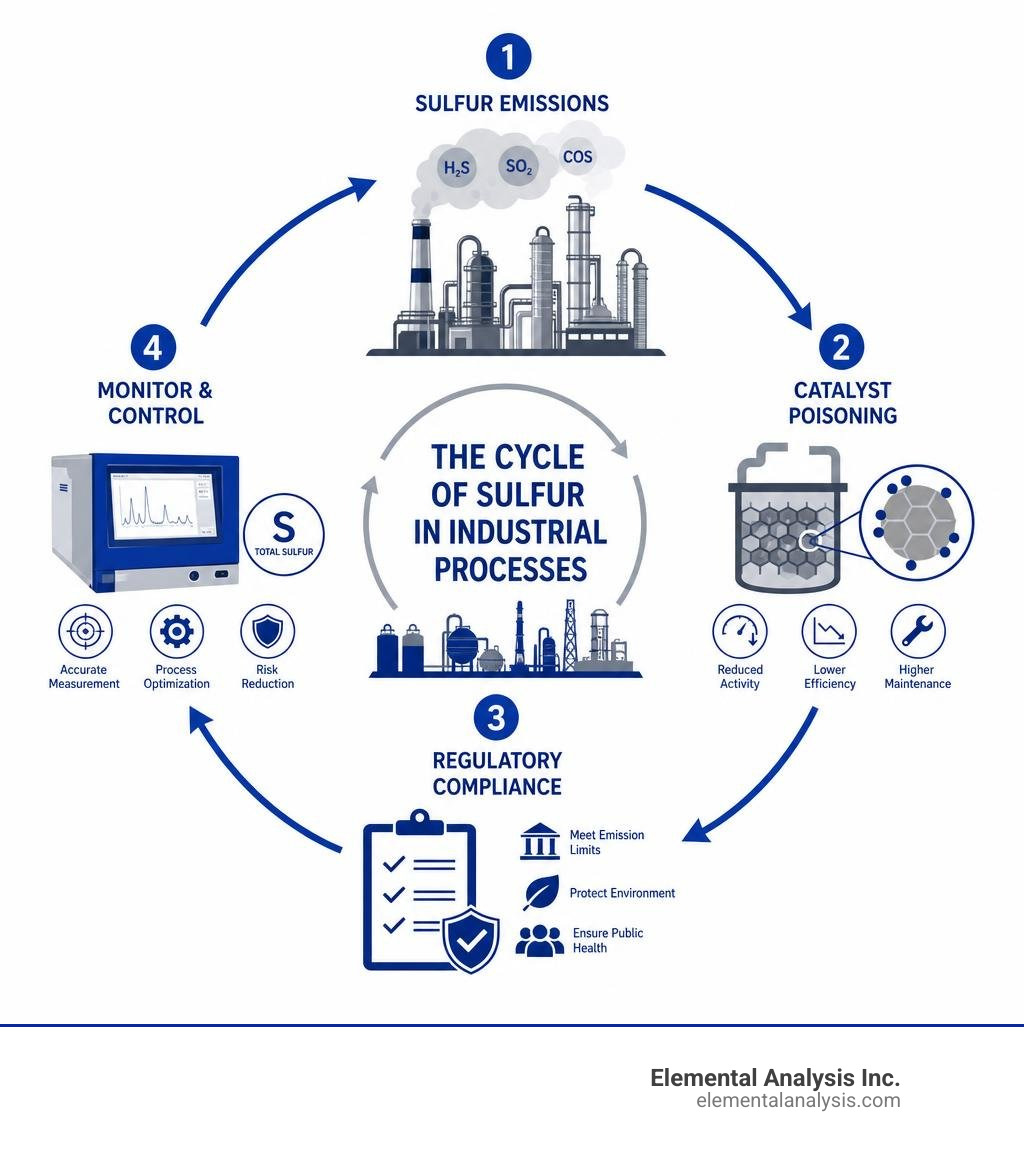
Sulfur is everywhere in hydrocarbon streams. Even at trace levels — parts per million or below — it causes serious problems. It corrodes pipelines and refinery equipment. It poisons the catalysts that refineries depend on. And when it burns, it produces sulfur dioxide, a regulated air pollutant linked to acid rain and respiratory harm.
Regulatory pressure has only grown stricter. Tier 3 gasoline standards in the U.S. now require average sulfur levels below 10 ppm. European diesel limits sit at the same threshold. Meeting these targets requires measurement tools that are fast, precise, and reliable.
That’s exactly what a modern total sulfur analyzer is designed to deliver.
Relevant articles related to total sulfur analyzer:
Why Total Sulfur Measurement is Critical in Industrial Processes
In the industrial world, sulfur is the ultimate double agent. On one hand, it is a naturally occurring element essential to many chemical compounds; on the other, it is a highly destructive contaminant that can ruin equipment, deactivate expensive catalysts, and violate environmental laws.
To understand why a total sulfur analyzer is indispensable, we must look at how sulfur behaves within industrial matrices. Whether we are analyzing coal, crude oil, or natural gas, sulfur exists in multiple chemical states. As detailed in the guide on Sulfur Forms in Coal and Hydrocarbons, sulfur can be organic (bound to carbon chains) or inorganic (such as pyritic sulfur or sulfates).
In refining and petrochemical operations, these diverse sulfur compounds present several critical challenges:
- Corrosion Prevention: Active sulfur species like hydrogen sulfide ($H_2S$) and mercaptans are highly acidic and corrosive. They attack steel pipelines, storage tanks, and distillation towers, leading to costly leaks and safety hazards.
- Catalyst Protection: Modern refining processes rely heavily on catalysts containing precious metals like platinum or palladium. Sulfur compounds bind strongly to these metal active sites, permanently “poisoning” the catalyst and halting vital chemical reactions. Replacing these catalysts costs millions of dollars in materials and unplanned downtime.
- Environmental Compliance: When sulfur-laden fuels are combusted, they release sulfur dioxide ($SO_2$). Environmental protection agencies enforce zero-tolerance and ultra-low limits on these emissions. Under the EPA Tier 3 standards, gasoline must average no more than 10 ppm of sulfur, making precise trace-level verification a daily operational requirement.
At Elemental Analysis Inc., we recognize that every matrix behaves differently. Our specialized A to Z Testing suite is designed to identify and quantify these complex sulfur matrices, ensuring that your raw materials and finished products meet all technical and regulatory specifications.
Core Technologies Behind the Modern Total Sulfur Analyzer
To measure every bit of sulfur in a sample, an analyzer must first convert the complex mix of sulfur molecules into a single, easily detectable compound—usually sulfur dioxide ($SO_2$). This is achieved through high-temperature oxidation or pyrolysis. Once converted, various optical or electrochemical detectors measure the concentration.

Different analytical techniques offer distinct advantages depending on the sample matrix, detection limits, and operating environment. The table below summarizes how the three primary technologies compare:
| Technology | Principle of Operation | Best For | Typical Detection Limits | Key Advantage |
|---|---|---|---|---|
| UV Fluorescence (UVF) | High-temp combustion converts S to $SO2$; UV light excites $SO2$, emitting detectable light. | Light hydrocarbons, diesel, gasoline, gases | 10 ppb to % levels | Highly sensitive, linear response, standard lab method |
| X-ray Transmission (XRT) / XRF | Measures the absorption of X-rays by sulfur atoms relative to the hydrocarbon matrix. | Heavy crude, bunker fuel, highly viscous streams | 200 ppm to % levels | Minimal sample prep, fast response, handles dirty matrices |
| Microcoulometry | Combustion converts S to $SO_2$, which is titrated with electrochemically generated silver or triiodide ions. | Aromatics, heavy liquids, solids, halides | Low ppb to ppm | Absolute measurement based on Faraday’s Law; no calibration required |
Ultraviolet Fluorescence in a Total Sulfur Analyzer
Ultraviolet Fluorescence (UVF) is the gold standard for trace-level sulfur detection in clean liquids and gases. In this system, the sample is injected into a high-temperature combustion furnace (typically operating between 1,000°C and 1,100°C) in an oxygen-rich environment.
The combustion reaction converts all sulfur compounds to sulfur dioxide:
$$R\text{-}S + O2 \xrightarrow{\Delta} CO2 + H2O + SO2$$
The combustion gases are then dried to remove water vapor and directed into a detection cell. Here, a pulsed zinc or xenon UV lamp exposes the $SO_2$ molecules to ultraviolet light, exciting them to a higher energy state. As these excited molecules return to their ground state, they release energy in the form of fluorescent light:
$$SO2 + h\nu1 \rightarrow SO2^* \rightarrow SO2 + h\nu_2$$
A photomultiplier tube measures this emitted light ($h\nu_2$). Because the intensity of the fluorescence is directly proportional to the concentration of sulfur in the original sample, this method delivers exceptional linearity and repeatability.
For facilities requiring precise trace elemental tracking, our comprehensive Elemental Analysis Services utilize these advanced optical pathways to deliver ultra-low detection limits down to the ppb level.
X-ray Transmission and XRF Technologies
When dealing with heavy, viscous hydrocarbons—such as crude oil, vacuum gas oil, or marine bunker fuels—combustion-based systems can struggle with incomplete burn-in or carbon buildup. This is where X-ray transmission and X-ray Fluorescence (XRF) technologies shine.
X-ray transmission analyzers measure the attenuation of X-rays passing through a sample. Because sulfur atoms have a much higher atomic number than carbon and hydrogen, they absorb X-rays far more effectively. By measuring the difference in X-ray intensity before and after passing through the sample, the system calculates the sulfur concentration.
To ensure accuracy, modern XRT systems integrate real-time temperature, pressure, and density compensation. This is critical because variations in hydrocarbon density can alter X-ray absorption independently of sulfur content.
For solid samples or complex mixtures, energy-dispersive X-ray fluorescence is an excellent non-destructive alternative. You can learn more about how we apply these techniques on our dedicated XRF technology page. Advanced systems, such as those described in the Sulfur Analyzers – Malvern Panalytical resource, demonstrate how benchtop XRF systems provide rapid, sample-prep-free analysis for industrial quality control.
Microcoulometry and Combustion Methods
Microcoulometry is an absolute analytical technique, meaning it relies on fundamental physical laws rather than calibration curves. In a microcoulometric total sulfur analyzer, the sample is combusted to produce $SO2$, which is then swept into a titration cell containing triiodide ions ($I3^-$).
The $SO_2$ reacts with the triiodide, reducing it to iodide:
$$SO2 + I3^- + 2H2O \rightarrow SO4^{2-} + 3I^- + 4H^+$$
The instrument detects this change in ion concentration and electrochemically regenerates the consumed triiodide. By measuring the exact electrical charge (in Coulombs) required to restore the cell to its original state, the system calculates the sulfur content using Faraday’s Law.
This method is highly valued because it does not require routine calibration standards. However, it requires careful management of potential interferences, particularly from halides (chlorine) and nitrogen.
To explore how elemental combustion analyzers handle these complex multi-element challenges, visit our CHNO analysis page. Additionally, specialized systems like the electrochemical setups found in CM320 Sulfur Analysis – UIC Inc. illustrate how coulometric detection remains a trusted method for carbon and sulfur speciation in industrial laboratories.
Key Performance Metrics and Regulatory Standards
Selecting the right total sulfur analyzer requires balancing key performance metrics against the regulatory standards your facility must meet.
- Detection Limits: If you are blending gasoline to meet ultra-low sulfur fuel standards, you need an instrument capable of measuring down to 10 ppb. For crude blending or flare gas monitoring, a dynamic range extending up to 100% sulfur may be more critical.
- Response Time: Online process monitors must provide rapid feedback. Some modern x-ray transmission analyzers deliver update rates as frequently as once every five seconds, allowing operators to make immediate process adjustments.
- Precision and Bias: Regulatory compliance requires high repeatability. Advanced gas chromatography methods, such as those complying with ASTM D7041, provide precision and bias data that is 2 to 5 times better than traditional laboratory methods, making them ideal for low-range (0–15 ppm) diesel compliance.
These metrics are governed by strict international standards:
- ASTM D5453: The standard test method for determining total sulfur in light hydrocarbons, spark ignition engine fuels, and diesel engine oils by ultraviolet fluorescence.
- ASTM D7041: Covers the determination of total sulfur in light hydrocarbons and motor fuels using online gas chromatography with flame photometric detection (FPD).
- EPA 40CFR60 (Subpart Ja): Regulates emissions from petroleum refineries, demanding highly reliable, continuous flare stack sulfur monitoring to prevent environmental releases.
To understand the regulatory landscape shaping these fuel requirements, you can review the official EPA Tier 3 Gasoline Sulfur Standards, which mandate strict limits to reduce vehicle emissions.
For high-throughput industrial compliance testing, tools like the XPLORER-NS Total Nitrogen and Sulfur Analyzer – HORIBA demonstrate the capabilities of modern laboratory systems. These instruments feature fast startup times (often under 15 minutes from standby) and high detector accuracy (typically better than 2% CV), allowing labs to process hundreds of samples daily.
Furthermore, advanced options highlighted in the Total Sulfur & Total Nitrogen Analyzers | ATOM INSTRUMENT documentation show how simultaneously measuring nitrogen and sulfur can streamline laboratory workflows and prevent catalyst poisoning.
Online Process Analyzers vs. Laboratory Instruments
When designing a sulfur monitoring strategy, process engineers must choose between installing online process analyzers or relying on laboratory-based testing.

Online process analyzers are installed directly in the refinery or chemical plant. They offer continuous, real-time data, allowing for immediate process control and automated adjustments. This is essential for protecting downstream catalysts and ensuring that off-spec product is diverted before it reaches storage tanks.
However, online instruments operate in harsh environments, making them susceptible to temperature swings, vibration, and sample contamination. They require specialized explosion-proof enclosures and dedicated sample conditioning systems.
Laboratory instruments, by contrast, operate in controlled environments. This allows for superior calibration stability, lower detection limits, and the ability to run multiple element analyses on a single sample.
At Elemental Analysis Inc., our laboratory operations utilize state-of-the-art methods like Inductively Coupled Plasma (ICP) spectroscopy to provide trace-level quantification across a wide array of element matrices. You can learn more about these high-precision capabilities on our ICP Laboratory Analysis page.
Optimizing Sample Conditioning for a Total Sulfur Analyzer
An analyzer is only as good as its sample conditioning system. If the sample arriving at the detector is dirty, wet, or poorly vaporized, the readings will be inaccurate—regardless of how advanced the detector is.
- High-Viscosity Hydrocarbons: Heavy oils must be heated and kept at constant pressure to prevent clogging.
- Liquefied Petroleum Gas (LPG): LPG must be completely vaporized in a controlled flash chamber to ensure a representative gaseous sample is delivered to the analyzer without fractionating the light and heavy ends.
- Flare Gas: Flare streams are notoriously dirty, containing soot, water vapor, and heavy condensable hydrocarbons. Coalescing filters, liquid membrane separators, and self-cleaning particulate filters are essential to prevent detector contamination.
Innovative analytical designs, such as those discussed in the Total Sulfur Gas Analyzers | Applied Analytics technical sheets, show how multi-component UV-Vis spectrophotometry can sometimes measure up to five sulfur compounds directly in an unaltered sample. This direct measurement bypasses the need for high-temperature combustion entirely, simplifying sample conditioning and reducing maintenance overhead.
Frequently Asked Questions About Total Sulfur Analysis
What is the difference between total sulfur and active sulfur?
Total sulfur refers to the cumulative concentration of all sulfur-bearing molecules in a sample. Active sulfur, on the other hand, refers specifically to reactive sulfur species—such as elemental sulfur, hydrogen sulfide ($H_2S$), and low-molecular-weight mercaptans—that actively react with metals to cause rapid corrosion.
While a total sulfur analyzer measures everything, identifying the specific “active” species requires advanced speciation techniques. At Elemental Analysis Inc., we specialize in non-destructive elemental identification. Our commercial PIXE (Proton Induced X-ray Emission) laboratory can identify and quantify trace elements in complex matrices without destroying the underlying sample structure.
How often should a total sulfur analyzer be calibrated?
The calibration frequency depends on the technology used and the criticality of the measurement.
- Combustion/UVF Analyzers: Typically require weekly or bi-weekly validation using certified calibration standards. Online systems often use automated “Auto-Zero” functions to compensate for daily drift.
- Microcoulometers: Because they rely on Faraday’s Law, they are absolute detectors and do not require routine calibration curves, though periodic verification with standard reference materials is highly recommended.
- XRF Analyzers: Highly stable, often requiring calibration validation only once every few months, provided the sample matrix remains consistent.
For highly specialized applications where standard reference materials are difficult to obtain, we utilize advanced techniques like NAA (Neutron Activation Analysis) to perform absolute multi-element quantification, helping calibrate and validate secondary industrial instruments.
What are the main maintenance requirements for combustion-based analyzers?
Combustion-based analyzers operate under intense heat, which makes routine maintenance essential to prevent downtime. The primary maintenance tasks include:
- Soot Prevention and Pyrolyzer Cleaning: Heavy hydrocarbon samples can leave carbon residues (soot) in the combustion tube. Regular inspection and controlled oxygen burns are required to clean the tube.
- Combustion Tube Replacement: Quartz combustion tubes degrade over time under continuous 1,000°C+ temperatures and must be replaced periodically.
- Scrubber and Filter Maintenance: Membrane dryers and acid scrubbers must be serviced regularly to prevent water vapor and corrosive combustion byproducts from reaching the optical detection cell.
To prevent carbonaceous fouling, laboratories monitor parameters like organic and elemental carbon. You can read more about how we analyze these fractions on our Oc Ec (Organic Carbon/Elemental Carbon) page.
Conclusion
Whether you are running a high-throughput refinery, managing a natural gas pipeline, or ensuring environmental compliance, having a robust sulfur monitoring strategy is no longer optional. The modern total sulfur analyzer has evolved into a highly automated, precise instrument capable of safeguarding your equipment, protecting expensive catalysts, and keeping your operations fully compliant with the latest environmental standards.
At Elemental Analysis Inc., based in Lexington, Kentucky, we combine decades of analytical expertise with cutting-edge testing capabilities. From routine quality control to complex trace elemental speciation, we deliver fast turnarounds, competitive pricing, and highly accurate results.
Ready to optimize your sulfur testing and ensure complete regulatory compliance? Contact our team of specialists today and explore our full range of chemical testing and analysis Services.