
A Guide to Measuring Sulfur in Petroleum and Marine Fuels
Why Every Petroleum Lab Needs a Reliable Sulfur Analyzer for Oil
A sulfur analyzer for oil is an analytical instrument that measures the concentration of sulfur in petroleum products — from crude oil and diesel to bunker fuel and lubricants. Getting this number right is not optional. It drives regulatory compliance, protects refinery equipment, and determines whether a fuel can legally be sold or shipped.
Quick answer — what does a sulfur analyzer for oil do?
- Measures sulfur content in petroleum products (crude, diesel, gasoline, marine fuel, lube oils)
- Detects sulfur from as low as parts-per-billion (ppb) up to several percent by weight
- Ensures compliance with regulations like MARPOL Annex VI, EPA Tier 3, and ULSD standards
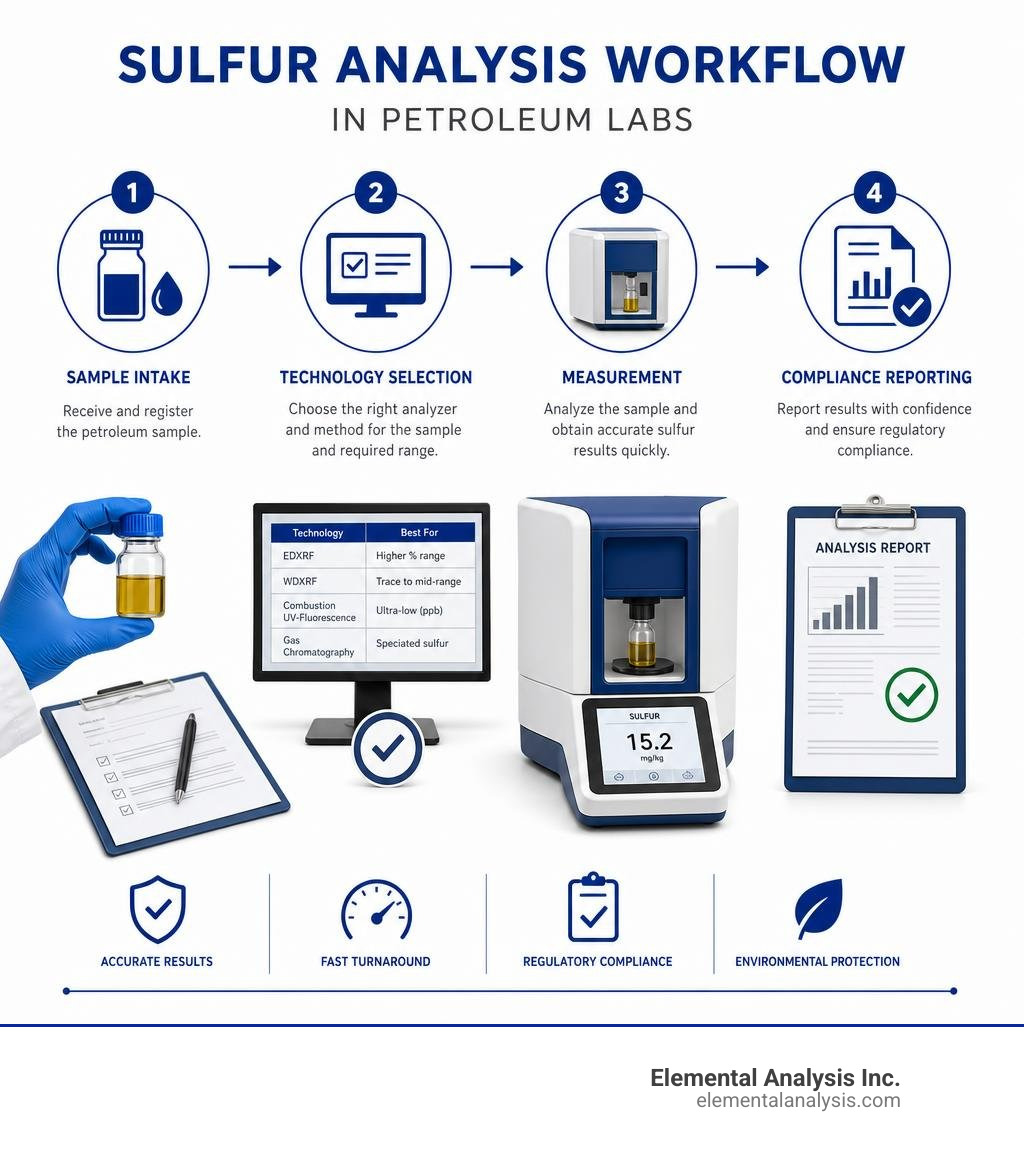
- Uses technologies including EDXRF, WDXRF, combustion UV-fluorescence, and gas chromatography
- Delivers results in seconds to minutes with minimal or no sample preparation
Sulfur is found naturally in crude oil. When it burns, it produces sulfur dioxide — a pollutant that damages the environment and human health. Even before combustion, excess sulfur corrodes refinery equipment, poisons catalysts, and degrades fuel quality. That’s why regulators around the world have steadily tightened sulfur limits in fuels over the past two decades.
For lab supervisors and technical managers, the stakes are clear: measure accurately, comply consistently, and do it fast. A wrong reading can mean a batch rejection, a regulatory fine, or worse — a catalyst bed destroyed by an unexpected sulfur spike.
This guide walks you through the main analyzer technologies, the international standards they comply with, and how to pick the right instrument for your application.
Sulfur analyzer oil vocab to learn:
Why Sulfur Analysis is Critical in the Petroleum Industry
Sulfur is one of the most common heteroatoms found in crude oil, ranging from trace amounts up to more than 5% by weight. Managing this element is a continuous battle from the oil well to the gas station pump.

Catalyst Poisoning and Refinery Efficiency
In modern refineries, crude oil undergoes various catalytic processes to reformulate hydrocarbons into high-value products like gasoline and diesel. Many of these catalysts rely on precious metals such as platinum, palladium, or cobalt-molybdenum.
Sulfur is a notorious “catalyst poison.” It chemically binds to the active sites on these catalysts, permanently reducing their efficiency or rendering them completely useless. By utilizing a high-performance sulfur analyzer oil system, refinery operators can monitor incoming feedstocks and protect multi-million dollar catalyst beds from premature deactivation.
Corrosion Control in Infrastructure
When sulfur compounds react with water or undergo combustion, they form acidic species like sulfurous and sulfuric acids. These acids are highly corrosive to steel pipelines, storage tanks, refinery distillation columns, and internal combustion engines. Regular sulfur monitoring helps engineers adjust chemical treatment rates and predict maintenance intervals before catastrophic structural failures occur.
Marine Fuel Compliance (MARPOL Annex VI)
Under the International Maritime Organization’s (IMO) MARPOL Annex VI regulations, the global limit for sulfur in marine fuel oil (bunker fuel) is capped at 0.50% by weight. In designated Emission Control Areas (ECAs), such as the Baltic Sea, North Sea, and North American coastal waters, the limit is an even stricter 0.10%.
Ship operators, bunker suppliers, and port inspectors must verify compliance quickly. Non-destructive testing using portable analyzers allows operators to screen fuel oil directly at docks, ports, barges, and aboard ships, providing immediate proof of compliance without delaying vessel departures.
Fuel Blending and Environmental Protection
Fuel blending is a precise science. Refiners blend high-sulfur and low-sulfur components to meet exact commercial specifications while maximizing profitability. Environmental regulations like the U.S. EPA’s Tier 3 program require gasoline to maintain an average sulfur content of no more than 10 ppm. Accurate sulfur testing prevents over-treating (which wastes expensive hydrogen in hydrotreaters) and under-treating (which leads to regulatory non-compliance).
Choosing the Right Sulfur Analyzer Oil Technology
Not all sulfur analyzers are created equal. Depending on your sample matrix, required detection limits, and operational environment, you will need to choose between several core analytical technologies.
| Technology | Analytical Principle | Detection Limit (LOD) | Typical Measurement Range | Key Advantage | Key Limitation |
|---|---|---|---|---|---|
| EDXRF | Energy-Dispersive X-ray Fluorescence | ~3 to 5 ppm | 10 ppm to 5.0% | Non-destructive, fast, minimal sample prep | Susceptible to matrix effects (e.g., chlorine) |
| WDXRF | Wavelength-Dispersive X-ray Fluorescence | <1 ppm | 1 ppm to 5.0% | High resolution, resolves spectral overlaps | Higher capital cost, larger physical footprint |
| Combustion UV-F | High-Temp Combustion + UV Fluorescence | ~20 to 50 ppb | 50 ppb to 1.0% | Extreme sensitivity for ultra-low sulfur | Destructive, requires carrier gases (oxygen/argon) |
| GC-FPD / GC-SCD | Gas Chromatography + Selective Detection | ~100 ppb | 100 ppb to 100 ppm | Speciation of individual sulfur compounds | Complex operation, longer analysis times |
How EDXRF Serves as a Versatile Sulfur Analyzer Oil
Energy-Dispersive X-ray Fluorescence (EDXRF) is the most widely adopted technology for routine sulfur determination in the petroleum industry.
The physical principle is elegant: the analyzer bombards the oil sample with primary X-rays. This energy knocks out inner-shell electrons from the sulfur atoms in the sample. As outer-shell electrons drop down to fill these vacancies, they emit secondary (fluorescent) X-rays at an energy level unique to sulfur (2.3 keV). The detector measures the intensity of these characteristic X-rays, which is directly proportional to the sulfur concentration.
For most laboratories, EDXRF serves as an ideal sulfur analyzer oil solution because it is entirely non-destructive. Once a sample is analyzed, it remains chemically unaltered and can be retained for future reference or audit verification.
Sample preparation is practically non-existent: the operator simply pours a few milliliters of oil into a disposable sample cup covered with a thin plastic film (such as Mylar or Prolene) and places it into the instrument. Results are typically delivered in 60 to 300 seconds.
If you are looking to streamline your laboratory workflows, Learn more about sulfur-in-oil analysis and how our testing services leverage these advanced methods.
Combustion and WDXRF Technologies for High-Precision Sulfur Analyzer Oil Systems
While EDXRF is excellent for routine screening, certain applications require higher precision and lower limits of detection.
Wavelength-Dispersive X-ray Fluorescence (WDXRF)
WDXRF differs from EDXRF in how it separates the emitted X-rays. Instead of sending all fluorescent X-rays directly to the detector, WDXRF utilizes a physical diffracting crystal to isolate the specific wavelength of sulfur before it reaches the detector.
This mechanical separation dramatically improves spectral resolution, virtually eliminating background noise and spectral overlaps from other elements like chlorine or phosphorus. WDXRF is the gold standard for measuring ultra-low sulfur in road diesel (ULSD) and gasoline, easily complying with strict sub-10 ppm regulatory limits.
Combustion UV-Fluorescence (UV-F)
For the absolute lowest detection limits—often down to the double-digit parts-per-billion (ppb) range—combustion UV-fluorescence is the technology of choice.
In this destructive method, the liquid hydrocarbon sample is injected into a high-temperature pyrolysis furnace operating at temperatures exceeding 1000°C. In the presence of pure oxygen, all sulfur compounds are quantitatively oxidized to sulfur dioxide ($SO_2$):
$$R\text{-}S + O2 \xrightarrow{\Delta} CO2 + H2O + SO2$$
The combustion gases are dried and exposed to pulsed ultraviolet light. The $SO_2$ molecules absorb this UV light and become electronically excited. As they return to their ground state, they emit a specific fluorescent light that is detected by a photomultiplier tube:
$$SO2 + h\nu1 \rightarrow SO2^* \rightarrow SO2 + h\nu_2$$
This method is highly selective and free from most physical matrix interferences, making it ideal for clean fuels, light distillates, and process gas streams. To explore how high-precision elemental testing can protect your refinery assets, Read about elemental analysis services available through our specialized laboratory.
Comparing Benchtop, Portable, and Online Analyzers
Depending on where and how often you need to run tests, sulfur analyzers are configured into three primary formats.
Benchtop Analyzers
Benchtop units are the workhorses of centralized quality control laboratories. They are designed for high throughput, often featuring multi-position autosamplers (such as 10 or 12-position carousels) that allow for unattended, overnight processing.
Many modern benchtop systems utilize advanced silicon drift detectors (SDDs) and can operate under air, vacuum, or helium atmospheres. Vacuum systems are particularly advantageous because they eliminate the need for expensive helium gas while still preventing air from absorbing weak sulfur X-rays.
Portable and Handheld Analyzers
When decisions must be made on-site—such as during marine fuel bunkering, pipeline custody transfers, or remote mining operations—portable EDXRF analyzers are indispensable.
These rugged instruments are lightweight (often under 7 to 12 kg), battery-powered, and built to withstand harsh industrial environments. They allow operators to verify MARPOL compliance directly on a vessel’s deck or at a fuel terminal within minutes, providing immediate peace of mind.
Online and Process Analyzers
In manufacturing, laboratory analysis of grab samples introduces a time delay. Online process sulfur analyzers solve this by sampling directly from pressurized refinery process streams.
Using technologies like pulsed UV-fluorescence or online gas chromatography, these systems continuously monitor sulfur levels in real time. This immediate feedback allows process control systems to optimize hydrotreater performance, manage fuel blending in real-time, and instantly detect process upsets before off-spec product reaches storage tanks.
Key International Standards and Compliance Methods
To ensure analytical consistency across global supply chains, international standards organizations have developed rigorous test methods. A compliant sulfur analyzer oil system must adhere to these specific protocols.
ASTM D4294
This is the most widely referenced standard for sulfur determination in petroleum products. It specifies the use of EDXRF to measure sulfur in hydrocarbons, including diesel, biodiesel, crude oil, jet fuel, and kerosene.
The method is applicable to concentrations ranging from 17 mg/kg (ppm) to 5.0% by weight. It is highly valued for its speed, simplicity, and minimal sample preparation requirements.
ISO 8754
The international equivalent of ASTM D4294, ISO 8754 outlines the determination of sulfur content in petroleum products using EDXRF. It is heavily utilized in Europe and global marine bunkering markets to verify compliance with marine fuel specifications.
ASTM D2622
This standard governs the determination of sulfur in petroleum products using WDXRF. Because WDXRF offers superior resolution, ASTM D2622 is approved for much lower sulfur concentrations, making it a critical method for certifying ultra-low sulfur diesel (ULSD) and gasoline.
ISO 20884
This European standard specifies a WDXRF method for determining the sulfur content of liquid fuels, such as motor gasoline (including those containing up to 10% ethanol) and diesel fuel (including those containing up to 7% fatty acid methyl esters, or FAME). It is optimized for sulfur levels between 5 mg/kg and 500 mg/kg.
ASTM D5453
The definitive standard for combustion UV-fluorescence, ASTM D5453 is used to determine total sulfur in liquid hydrocarbons, spark-ignition engine fuels, and diesel engine fuels. It covers a range from 1.0 mg/kg to 8000 mg/kg and is the primary method used to verify compliance with ultra-low sulfur gasoline and diesel regulations.
If you are navigating complex regulatory landscapes or need to cross-verify your laboratory results against these international standards, you can find More info about A to Z testing protocols on our dedicated capabilities page.
Frequently Asked Questions about Sulfur-in-Oil Analysis
What is the typical limit of detection for a sulfur-in-oil analyzer?
The limit of detection (LOD) depends heavily on the technology used:
- Standard EDXRF: Typically achieves an LOD of 3 to 5 ppm.
- High-End Benchtop EDXRF / WDXRF: Can reach LODs below 1 ppm.
- Combustion UV-Fluorescence: Reaches down to 20 to 50 ppb (parts-per-billion), making it ideal for trace analysis.
- Portable/Handheld EDXRF: Generally features an LOD around 30 ppm, which is more than sufficient for screening marine fuels against the 1000 ppm (0.10%) MARPOL limit.
How do analyzers handle matrix effects like chlorine interference?
In EDXRF analysis, matrix effects occur when other elements in the oil sample interfere with the sulfur measurement. The most notorious culprit is chlorine.
The characteristic X-ray emission peak for chlorine (2.62 keV) is very close to the sulfur peak (2.31 keV). In basic analyzers, a high concentration of chlorine can bleed into the sulfur detector channel, causing the instrument to report a falsely elevated sulfur concentration.
Modern analyzers handle this in several ways:
- Multi-Element Analysis: Advanced EDXRF systems measure both the sulfur peak and background intensity simultaneously, using mathematical algorithms to subtract the chlorine contribution.
- Diffracting Crystals (WDXRF): Physically separating the wavelengths before detection completely resolves the two peaks, eliminating the interference.
- Vacuum and Atmosphere Compensation: Built-in temperature and pressure sensors compensate for changes in air density, which can otherwise alter the background signal.
For a deeper look into how elemental composition and carbon matrices influence analytical precision, explore our guide on Carbon and sulfur analysis principles.
What are the maintenance requirements for long-term accuracy?
While modern sulfur analyzers are robust, maintaining high accuracy and a low cost of ownership requires a consistent preventative maintenance routine:
- Daily Drift Correction: X-ray tubes and detectors naturally age, which can cause minor calibration drift over time. Running a daily “drift correction” standard (often a sealed, stable glass or polymer sample) allows the software to adjust its calibration curves automatically.
- Sample Window Replacement: For liquid analyzers, the thin plastic film separating the sample from the instrument’s internal optics must be kept clean. If a sample cup leaks or dust accumulates on the window, it will attenuate the X-ray signal. Replace these protective sheets regularly using tool-free maintenance systems where available.
- Catalyst and Tube Maintenance (for Combustion Systems): Combustion-based analyzers require periodic replacement of the quartz combustion tube and the oxidation catalyst (typically every 8,000 operating hours or 12 months).
- Certified Reference Materials (CRMs): Regularly validate your calibration curves using certified oil standards that span your typical measurement range.
Conclusion
Selecting the right sulfur analyzer oil technology is a balancing act between your budget, the specific hydrocarbon matrices you test, and the regulatory limits you must meet. Whether you rely on the rapid, non-destructive screening of EDXRF or the ultra-low sensitivity of combustion UV-fluorescence, maintaining calibrated, compliant instruments is the key to operational success.
At Elemental Analysis Inc., based in Lexington, Kentucky, we understand the complexities of trace element identification and quantification. As the first commercial PIXE laboratory, we specialize in providing both destructive and non-destructive testing with fast turnaround times and highly competitive pricing.
Whether you need to verify marine fuel compliance, analyze crude oil fractions, or cross-verify your internal laboratory calibrations, our team of analytical experts is here to help. For custom testing services or technical support, access More info about elemental analysis services and let us help you keep your operations running smoothly.