
USP Elemental Impurities: What Pharma Manufacturers Need to Know
What Are USP Elemental Impurities — and Why Do They Matter?
USP elemental impurities are toxic trace metals that can end up in drug products through raw materials, manufacturing equipment, container systems, or environmental contamination. Since January 1, 2018, the United States Pharmacopeia has required pharmaceutical manufacturers to control these impurities under two enforceable chapters: USP <232> (limits) and USP <233> (analytical procedures).
Here is a quick-reference summary of what you need to know:
| Topic | Key Facts |
|---|---|
| Replaced standard | USP <231> (colorimetric heavy metals test) |
| Effective date | January 1, 2018 |
| Number of elements regulated | 24 |
| Mandatory elements (all products) | Arsenic, Cadmium, Lead, Mercury (Class 1) |
| Basis for limits | Permitted Daily Exposure (PDE), based on 50 kg adult |
| Routes covered | Oral, parenteral, inhalation |
| Aligned guideline | ICH Q3D |
| Analytical methods | ICP-OES (Procedure 1), ICP-MS (Procedure 2) |
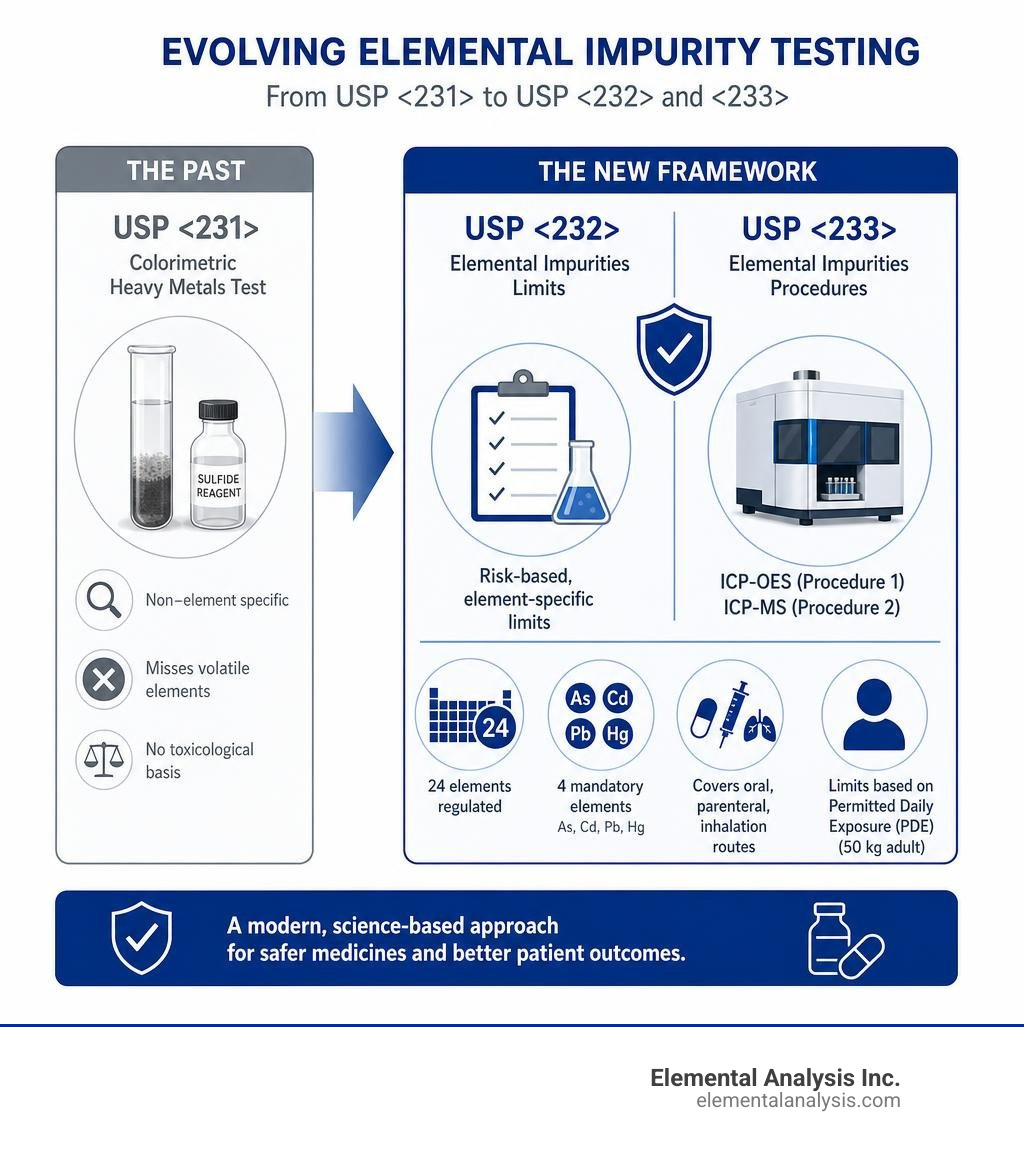
Before 2018, pharmaceutical heavy metal testing relied on a colorimetric sulfide precipitation method that had been largely unchanged for over a century. That method — USP <231> — could not reliably identify individual elements, missed volatile metals like mercury and tin, and had no real toxicological basis. USP <232> and <233> changed all of that.
The new framework is risk-based, element-specific, and route-dependent. Limits are tied to real toxicological data, and testing must be performed with modern instrumental techniques capable of detecting contaminants at parts-per-billion levels or lower.
For lab supervisors and technical managers responsible for batch release or method validation, understanding this framework is essential — both for regulatory compliance and for patient safety.
The Evolution of Pharmaceutical Heavy Metal Testing
For generations, the pharmaceutical industry relied on wet chemistry methods to detect heavy metals. While these historical tests served their purpose in a simpler era, they fell far short of modern toxicological standards. To understand why the transition to USP <232> and USP <233> was so critical, we must first look at the fundamental chemistry of how we used to test for these contaminants. You can read more about these core concepts in our Heavy Metal Chemistry: A Beginner’s Guide to Elemental Analysis of Metals.
Why USP <231> Was Replaced
The classic USP <231> method relied on sulfide precipitation. In simple terms, a sample was combusted or digested, and the remaining residue was reacted with a sulfide source to produce a colored precipitate. This color was then visually compared against a lead standard.
While elegant in its simplicity, this visual colorimetric test had massive technical flaws:
- Recovery Failures: Many elements simply did not precipitate efficiently under the test conditions, leading to false negatives.
- Loss of Volatile Elements: The high-temperature furnace preparation (often reaching 600°C or higher) caused volatile elements, such as mercury and tin, to evaporate before they could ever react.
- Lack of Specificity: The test yielded a single “heavy metals” score rather than identifying which specific toxic metals were present.
- Poor Reproducibility: Because the final assessment relied on human eyes comparing shades of brown, the results were highly subjective.
As a result, a drug product could easily pass a USP <231> test while still containing dangerous levels of highly toxic elements.
Understanding the Classification of USP Elemental Impurities
To establish a safer, more logical framework, USP <232> aligned with the international ICH Q3D guidelines to group 24 elemental impurities into four distinct classes based on their toxicity and the likelihood of their occurrence in drug products. You can review the full regulatory breakdown in the Elemental Impurities—Limits USP 2025.
The classes are defined as follows:
- Class 1 (Arsenic, Cadmium, Lead, and Mercury): These are the “big four” highly toxic elements. They have no medical benefit, are ubiquitous environmental contaminants, and must be included in all pharmaceutical risk assessments, regardless of the route of administration.
- Class 2A (Cobalt, Nickel, and Vanadium): These elements have relatively high toxicity and a moderate-to-high probability of being introduced during manufacturing (for example, through stainless steel equipment or catalysts).
- Class 2B (Gold, Selenium, Silver, Platinum, Thallium, etc.): These elements have lower toxicity and a very low probability of occurrence unless they are intentionally added as catalysts or reagents during synthesis.
- Class 3 (Lithium, Antimony, Barium, Molybdenum, Copper, Tin, and Chromium): These elements exhibit relatively low toxicity via the oral route but can present significant safety risks if administered via parenteral (injection) or inhalation routes.
Permitted Daily Exposure (PDE) and Speciation Limits
Rather than enforcing a blanket “one-size-fits-all” limit, USP <232> establishes Permitted Daily Exposure (PDE) limits. These limits represent the maximum amount of an elemental impurity a patient can safely consume per day. To understand how these limits are screened using advanced instrumentation, see our Heavy Metal Analysis by ICP-MS: The Ultimate Guide to Screening Toxins.
Route-Specific PDE Variations
A key principle of USP <232> is that toxicity depends heavily on how a drug enters the body. An element that is relatively harmless when swallowed might be incredibly toxic if inhaled directly into the lungs or injected into the bloodstream.
All PDE limits are calculated based on an arbitrary adult human body weight of 50 kg (110 lbs). The table below highlights how dramatically these limits can vary across different routes of administration:
| Element | Class | Oral PDE (µg/day) | Parenteral PDE (µg/day) | Inhalation PDE (µg/day) |
|---|---|---|---|---|
| Cadmium (Cd) | 1 | 5 | 2 | 2 |
| Lead (Pb) | 1 | 5 | 5 | 5 |
| Arsenic (As) | 1 | 15 | 15 | 2 |
| Mercury (Hg) | 1 | 30 | 3 | 1 |
| Cobalt (Co) | 2A | 50 | 5 | 3 |
| Nickel (Ni) | 2A | 200 | 20 | 5 |
For Large Volume Parenterals (LVPs)—which are injection products with daily volumes exceeding 100 mL—the concentration limits are even stricter because patients receive much larger volumes of fluid. Additionally, for cutaneous or transcutaneous routes, manufacturers must consider specific concentration limits for known sensitizers like cobalt and nickel to prevent severe skin reactions.
Elemental Speciation for Arsenic and Mercury
Toxicity is not just about which element is present; it is also about the element’s chemical form. This is where elemental speciation becomes crucial.
Arsenic and mercury are prime examples:
- Arsenic: Organic arsenic compounds (commonly found in seafood) are relatively non-toxic, whereas inorganic arsenic is highly carcinogenic and toxic. USP <232> limits are based strictly on inorganic arsenic.
- Mercury: Methyl mercury is an incredibly potent neurotoxin, while inorganic mercury (2+) has a different toxicity profile. USP <232> limits assume the mercury is in its inorganic form.
If a finished drug product or component exceeds the total arsenic or mercury limit during initial screening, manufacturers are permitted to perform speciation testing. If we can prove that the majority of the contaminant is in a non-toxic organic form, the product may still be deemed compliant.
Compliance Options for USP Elemental Impurities
Demonstrating compliance with USP <232> requires a robust risk-based control strategy. Rather than forcing manufacturers to test every single batch of finished product for all 24 elements, the USP provides three distinct compliance pathways. You can reference the official text regarding these pathways in the 〈232〉 ELEMENTAL IMPURITIES— guidelines.

Drug Product Analysis Option
Under this option, you analyze the finished, packaged drug product. This represents a “worst-case scenario” approach because it measures the cumulative elemental impurities introduced from all sources: raw materials, active pharmaceutical ingredients (APIs), manufacturing machinery, and even the container-closure system.
While this is the most direct way to prove compliance for batch release, it can be resource-intensive if performed on every batch.
The Summation Option
If you prefer to avoid testing the finished drug product continuously, you can use mathematical modeling. The Summation Option allows you to calculate the total elemental impurity level by adding together the contributions of each individual component:
$$\text{Total Impurity} = \sum (\text{Concentration of Element in Component} \times \text{Weight of Component in Dosage Unit}) \times \text{Daily Dose}$$
To use this option, you must have reliable, documented testing data for every excipient, active ingredient, and water source used in the formulation, and you must prove that the manufacturing process and packaging do not introduce any additional impurities.
Individual Component Option
For drug products with a maximum daily dose of 10 grams or less, manufacturers can use the Individual Component Option. Under this pathway, you verify that every single ingredient (excipients and drug substances) meets the specific concentration limits listed in USP <232> Table 3. If every individual component is below these limits, the finished drug product is automatically considered compliant, eliminating the need to test the final formulation.
Analytical Procedures and Validation Under USP <233>
Once you have identified which elements to test, you must turn to USP <233> to determine how to test them. This chapter outlines two default compendial procedures and defines the strict validation requirements for any alternative methods you might choose to use. For a deeper dive into these analytical concepts, explore Elemental My Dear Watson: A Guide to ICP Metal Analysis.
Calculating the J-Value for USP Elemental Impurities
Before you can run a single sample on an instrument, you must calculate the J-value. The J-value is the target concentration of the element of interest, appropriately diluted to the working range of your instrument.
The J-value is calculated using the following formula:
$$J = \frac{\text{PDE}}{\text{Total Dilution Factor} \times \text{Max Daily Dose}}$$
Let’s look at a practical example. Imagine we are testing an oral solid drug product with a maximum daily dose of 2 grams. We want to test for Lead (Pb), which has an oral PDE of 5 µg/day. During sample preparation, we dilute 0.2 grams of the sample to a final volume of 50 mL (representing a 250-fold dilution).
$$J = \frac{5\ \mu\text{g/day}}{250 \times 2\ \text{g/day}} = 0.01\ \mu\text{g/mL} = 10\ \text{ppb}$$
For this analysis, our target concentration (1J) is 10 parts per billion (ppb). USP <233> requires that our calibration curve span from 0.5J to 1.5J (in this case, 5 ppb to 15 ppb) to ensure the instrument is calibrated precisely around the target compliance limit.
Validation Requirements for Alternative Methods
USP <233> allows manufacturers to use alternative analytical procedures (such as modified ICP-MS or even advanced non-destructive methods), provided they are fully validated. The validation criteria depend on whether you are running a simple limit test (pass/fail) or a quantitative test.
The acceptance criteria are highly stringent:
- Accuracy (Spike Recovery): For quantitative procedures, you must spike the target elements into the sample matrix prior to any digestion steps. The mean recovery of three replicate preparations at each concentration (typically 0.5J, 1.0J, and 1.5J) must fall between 70% and 150%.
- Repeatability: The relative standard deviation (RSD) of six independent sample preparations spiked at 1.0J must be no more than 20% (NMT 20%).
- Intermediate Precision (Ruggedness): Testing performed on different days, by different analysts, or using different instruments must achieve an RSD of no more than 25% (NMT 25%) across twelve replicates.
- System Suitability (Drift): To ensure the instrument remains stable throughout the run, the drift between pre- and post-analysis calibration checks must be no more than 20% for each target element.
To prevent the loss of volatile elements like mercury and tin, closed-vessel microwave digestion using strong acids (such as nitric and hydrochloric acid) is highly recommended for sample preparation.
Selecting the Right Instrumentation: ICP-OES vs. ICP-MS
USP <233> defines two standard compendial procedures: Procedure 1 uses Inductively Coupled Plasma Optical Emission Spectroscopy (ICP-OES), while Procedure 2 utilizes Inductively Coupled Plasma Mass Spectroscopy (ICP-MS). Choosing the right tool for your laboratory depends on your specific drug products and their associated PDE limits. You can read our comprehensive comparison in ICP Analysis for Heavy Metals: Choosing Between ICP-OES and ICP-MS.
Here is a side-by-side comparison to help guide your decision:
| Feature | ICP-OES (Procedure 1) | ICP-MS (Procedure 2) |
|---|---|---|
| Sensitivity & Detection Limits | Parts per million (ppm) to high parts per billion (ppb) | Parts per trillion (ppt) to low parts per billion (ppb) |
| Best Suited For | Oral drug products with high PDEs and daily doses $\le$ 10g | Parenteral and inhalation drugs with incredibly low PDEs |
| Matrix Tolerance | Excellent; can handle higher levels of total dissolved solids (TDS) | Moderate; highly sensitive to salt buildup without specialized sample introduction |
| Spectral Interferences | Common (wavelength overlaps); requires careful selection of emission lines | Common (polyatomic interferences); resolved using helium collision cell modes |
| Cost & Complexity | Lower capital cost, easier to operate and maintain | Higher capital cost, requires highly skilled operators |
Generally, ICP-MS is considered the gold standard for pharmaceutical laboratories due to its unmatched sensitivity. When testing parenteral or inhalation drugs, where the J-values are incredibly small, ICP-OES simply lacks the detection power to yield reliable, validated results.
Frequently Asked Questions about USP <232> and <233>
What are the major changes in USP <232> limits across revisions?
The USP chapters are living documents that evolve alongside global toxicological research. One of the most significant historical shifts occurred with the publication of the Second Supplement to USP 35–NF 30. During this revision, several key changes were implemented to align closely with ICH Q3D:
- Manganese (Mn) was removed entirely from the USP <232> limits list.
- Chromium (Cr) limits were revised so that they are now a safety concern exclusively for inhalation drug products, substances, and excipients.
- Exposure Factor Ratios between dosage categories are no longer constant across all elements, meaning a single, universal elemental impurity standard is no longer sufficient for testing across oral, parenteral, and inhalation routes.
You can stay up-to-date with these ongoing regulatory shifts by visiting the Elemental Impurities Updates | USP portal.
Which drug products are excluded from USP <232> compliance?
While the vast majority of human drug products must comply with USP <232>, there are several notable exclusions. The chapter does not apply to:
- Vaccines
- Radiopharmaceuticals
- Cell therapies and gene therapy products
- Whole blood, cellular blood components, and blood derivatives
- Dietary supplements (which are instead governed by their own specific chapter, USP <2232>, which focuses strictly on arsenic, cadmium, lead, and mercury)
How do manufacturers handle highly insoluble excipients during sample preparation?
Some excipients—such as titanium dioxide, talc, or magnesium stearate—are notoriously difficult to dissolve. If a sample is not fully digested, the instrument cannot accurately measure the impurities locked inside the solid matrix.
To overcome this, laboratories use specialized closed-vessel microwave digestion protocols. This often involves using aggressive acid mixtures, such as aqua regia (a potent blend of hydrochloric and nitric acids) or even small amounts of hydrofluoric acid (HF) to break down silicate-based matrices. Additionally, adding at least 0.5% hydrochloric acid (HCl) to the final prep is vital for stabilizing mercury and platinum-group elements in solution.
Conclusion
Navigating the transition from outdated colorimetric tests to the highly regulated world of USP elemental impurities can feel overwhelming. Between calculating J-values, validating complex ICP-MS methods, and conducting comprehensive risk assessments, pharmaceutical manufacturers face a steep mountain of compliance.
That is where we come in. At Elemental Analysis Inc., based in Lexington, Kentucky, we specialize in helping pharmaceutical companies achieve seamless GMP compliance. As the world’s first commercial Proton Induced X-ray Emission (PIXE) laboratory, we offer a unique blend of destructive and non-destructive testing capabilities. Whether you need rapid ICP-MS quantification for parenteral batch release, advanced elemental speciation, or highly competitive pricing with fast turnaround times, our team of expert chemists is here to support you.
Don’t let elemental impurity compliance slow down your production. Learn more about our USP elemental impurities testing services today, and let us help you keep your products safe, compliant, and ready for market.