
What USP 232 Means for Elemental Impurities
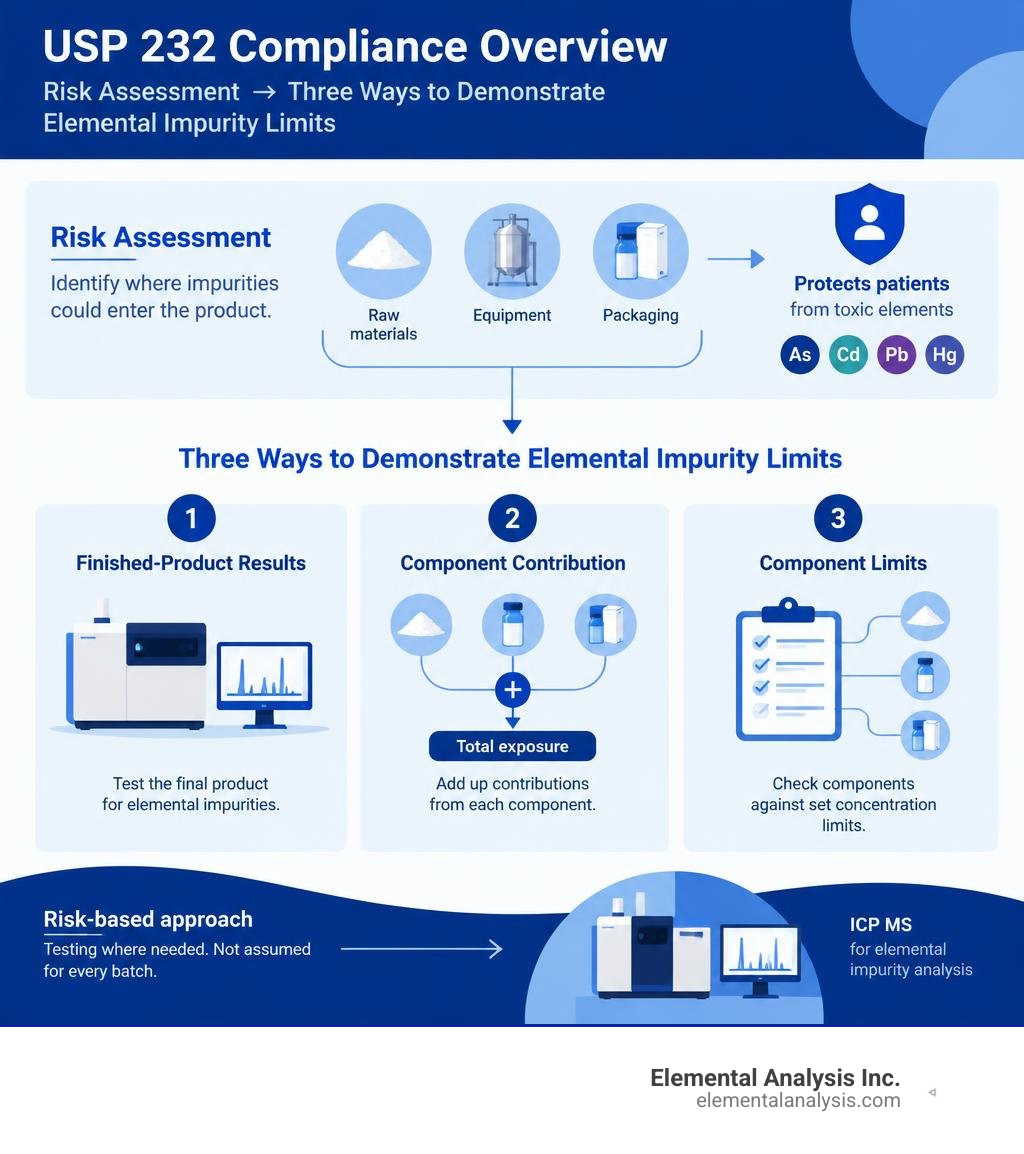
USP 232 elemental impurities are controlled through limits on how much of each element a patient may be exposed to in a day. Those limits depend on the drug product’s route of administration and maximum daily dose. To show a product meets them, pharma teams assess where impurities could enter, including raw materials, equipment, and packaging. They can then use finished-product results, add up contributions from each component, or check components against set concentration limits.
The chapter helps protect patients from toxic elements such as arsenic, cadmium, lead, and mercury. Its risk-based approach aligns with ICH Q3D: testing is used where needed to support the assessment, rather than assumed to be necessary for every batch.
USP 232 elemental impurities terminology:
- inductively coupled plasma mass spectrometry
- inductively coupled plasma mass spectrometry equipment
- ICP MS mass spectrometry
Scope, Exclusions, and Regulatory Foundation of USP <232>
Navigating pharmaceutical regulations can feel like assembling furniture without instructions, but the framework behind United States Pharmacopeia (USP) General Chapter <232> is straightforward once broken down. At its core, USP <232> establishes toxicologically derived exposure limits for elemental impurities in finished drug products. It sets clear safety boundaries to protect patients from harmful elemental exposure over short- and long-term therapeutic regimens.
The scope of USP <232> spans drug products across several primary administration routes: oral, parenteral (injections and infusions), inhalational, and cutaneous or transcutaneous pathways. Regulators like the US Food and Drug Administration evaluate these impurity profiles closely during market applications and ongoing commercial oversight, as outlined in the FDA Guidance on Elemental Impurities. For pharmaceutical quality teams, understanding core pharma compliance means knowing where your specific dosage form falls within these compendial boundaries.

Scope and Specific Exclusions
USP <232> applies broadly to finished drug products, including synthetic small molecules, purified proteins, polypeptides, polynucleotides, and recombinant biological products. However, the pharmacopeia explicitly excludes specific product classes from its mandate:
- Conventional vaccines
- Cell therapies, gene therapies, and tissue engineering products
- Whole blood, blood cellular components, and crude blood derivatives
- Radiopharmaceuticals
- Veterinary pharmaceutical articles
- Dietary supplements
Dietary supplements are governed under a separate compendial standard, USP General Chapter <2232> Elemental Contaminants in Dietary Supplements. While USP <2232> shares toxicological principles with <232>, its scope and specific testing rules are tailored to supplement ingredients and dosage forms.
Compendial Evolution and General Notices 5.60.30
To appreciate where we are today, it helps to understand what came before. For nearly a century, the pharmaceutical industry relied on USP General Chapter <231> Heavy Metals. That legacy method used a wet-chemical sulfide precipitation technique. While groundbreaking in 1905, it suffered from severe analytical limitations: poor recovery rates for key toxic metals, high subjectivity based on visual color comparisons, and zero ability to distinguish between different elemental species.
The modernization process formally culminated on January 1, 2018, when USP General Notices Section 5.60.30 took effect. This compendial update officially omitted Chapter <231> across all monographs and established mandatory compliance with General Chapters <232> and <2232>.
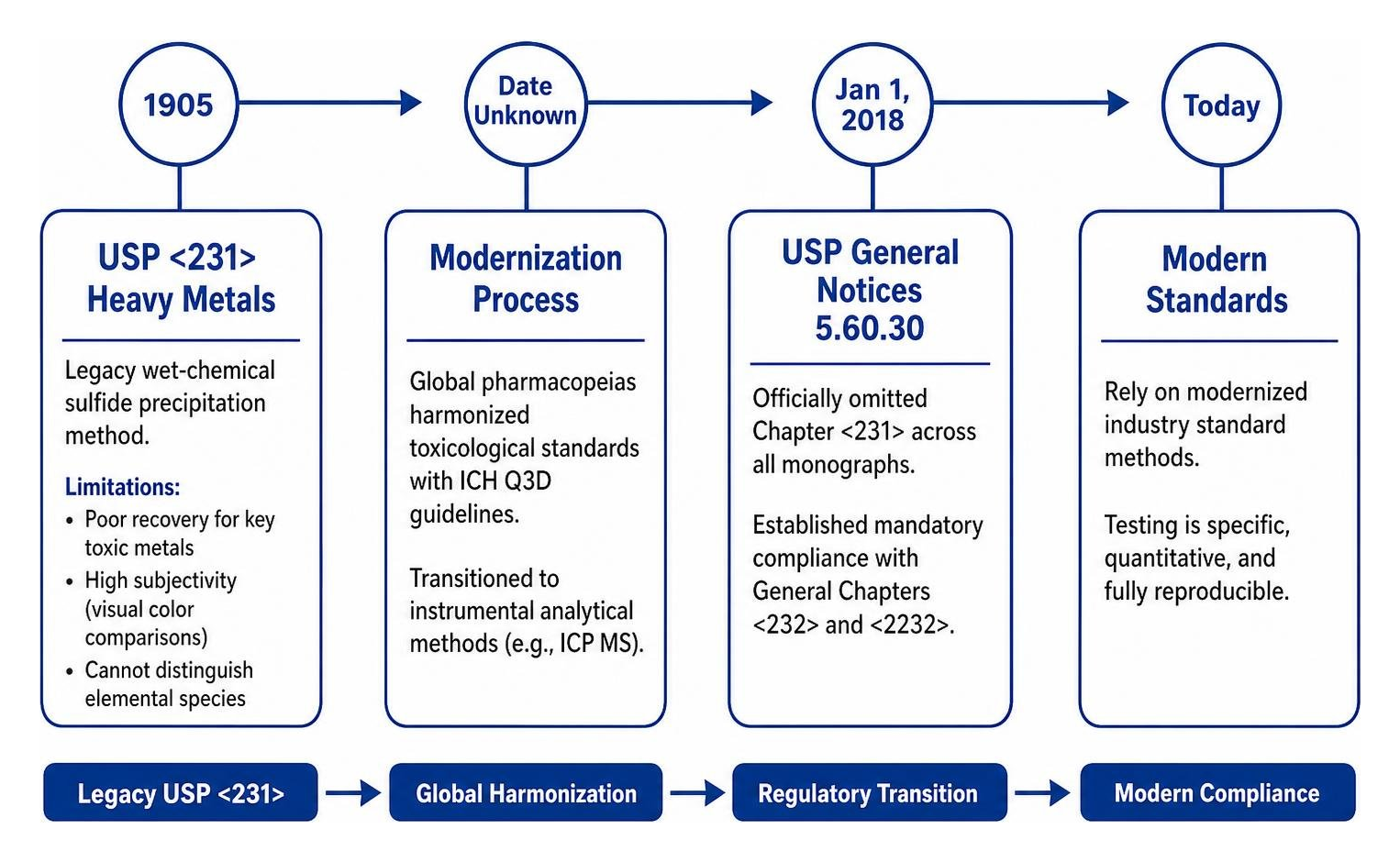
Tracking these shifts through USP compendial updates highlights how global pharmacopeias harmonized toxicological standards with ICH Q3D guidelines. Today, relying on modernized industry standard methods ensures testing is specific, quantitative, and fully reproducible.
Toxicity Classification and Limits for USP 232 Elemental Impurities
USP <232> sets limits using Permitted Daily Exposure (PDE) values, expressed in micrograms per day (µg/day). These values represent the maximum acceptable intake of an elemental impurity that presents negligible safety risk to a patient over a lifetime of chronic exposure. PDEs are calculated assuming a standard adult reference body weight of 50 kg.
Elemental impurities are organized into four distinct classes based on their inherent toxicity and the likelihood of finding them in pharmaceutical supply chains:
- Class 1: Highly toxic elements (Arsenic, Cadmium, Lead, and Mercury) that have limited or no therapeutic use. Because of their environmental prevalence, they must be evaluated in every risk assessment across all routes of administration.
- Class 2A: Elements with high probability of occurrence in drug products due to their common use in manufacturing equipment and raw material processing (Cobalt, Nickel, and Vanadium).
- Class 2B: Elements with lower probability of occurrence, typically used as synthetic catalysts (such as Platinum, Palladium, Iridium, Osmium, Rhodium, Ruthenium, Gold, and Silver). They require evaluation only if intentionally added during manufacturing.
- Class 3: Elements with low toxicity when administered orally (including Antimony, Barium, Beryllium, Chromium, Copper, Lithium, Molybdenum, and Tin), but which may require closer evaluation for parenteral or inhalational routes.
| Element | Class | Oral PDE (µg/day) | Parenteral PDE (µg/day) | Inhalation PDE (µg/day) |
|---|---|---|---|---|
| Cadmium (Cd) | Class 1 | 5 | 2 | 3 |
| Lead (Pb) | Class 1 | 5 | 5 | 5 |
| Inorganic Arsenic (As) | Class 1 | 15 | 15 | 2 |
| Inorganic Mercury (Hg) | Class 1 | 30 | 3 | 1 |
| Cobalt (Co) | Class 2A | 50 | 5 | 3 |
| Nickel (Ni) | Class 2A | 200 | 20 | 6 |
| Vanadium (V) | Class 2A | 100 | 10 | 1 |
| Palladium (Pd) | Class 2B | 100 | 10 | 1 |
| Platinum (Pt) | Class 2B | 100 | 10 | 1 |
| Gold (Au) | Class 2B | 100 | 100 | 1 |
| Silver (Ag) | Class 2B | 150 | 15 | 15 |
Target Elements and PDEs for USP 232 Elemental Impurities
The “Big Four” Class 1 contaminants—arsenic, cadmium, lead, and mercury—are ubiquitous in the environment and present significant toxicological hazards even at trace levels. For this reason, every risk assessment must account for these four elements, regardless of whether any metal-based catalysts or reagents were introduced during chemical synthesis.
Compendial limits continue to be refined as toxicological models evolve. For example, the inhalation PDE for cadmium was updated from 2 µg/day to 3 µg/day in Table 1 following safety reviews by the ICH Q3D Expert Working Group.
Special consideration is given to Large-Volume Parenterals (LVPs)—injectable products administered in daily volumes exceeding 100 mL, such as saline infusions, dextrose solutions, and peritoneal dialysis fluids. When daily administration exceeds 2 L, USP <232> applies a standardized 2-L volume cap to calculate permissible concentration limits from daily PDEs. This prevents mathematical distortions when converting daily intake limits into per-milliliter specifications. Pharma teams routinely employ robust heavy metal screening protocols to ensure these high-volume solutions stay well below toxic thresholds.
Speciation Requirements for Arsenic and Mercury
Not all forms of an element carry equal toxicological weight. In the real world, toxicity depends heavily on chemical speciation—the specific oxidation state, molecular complex, or organometallic structure of the element.
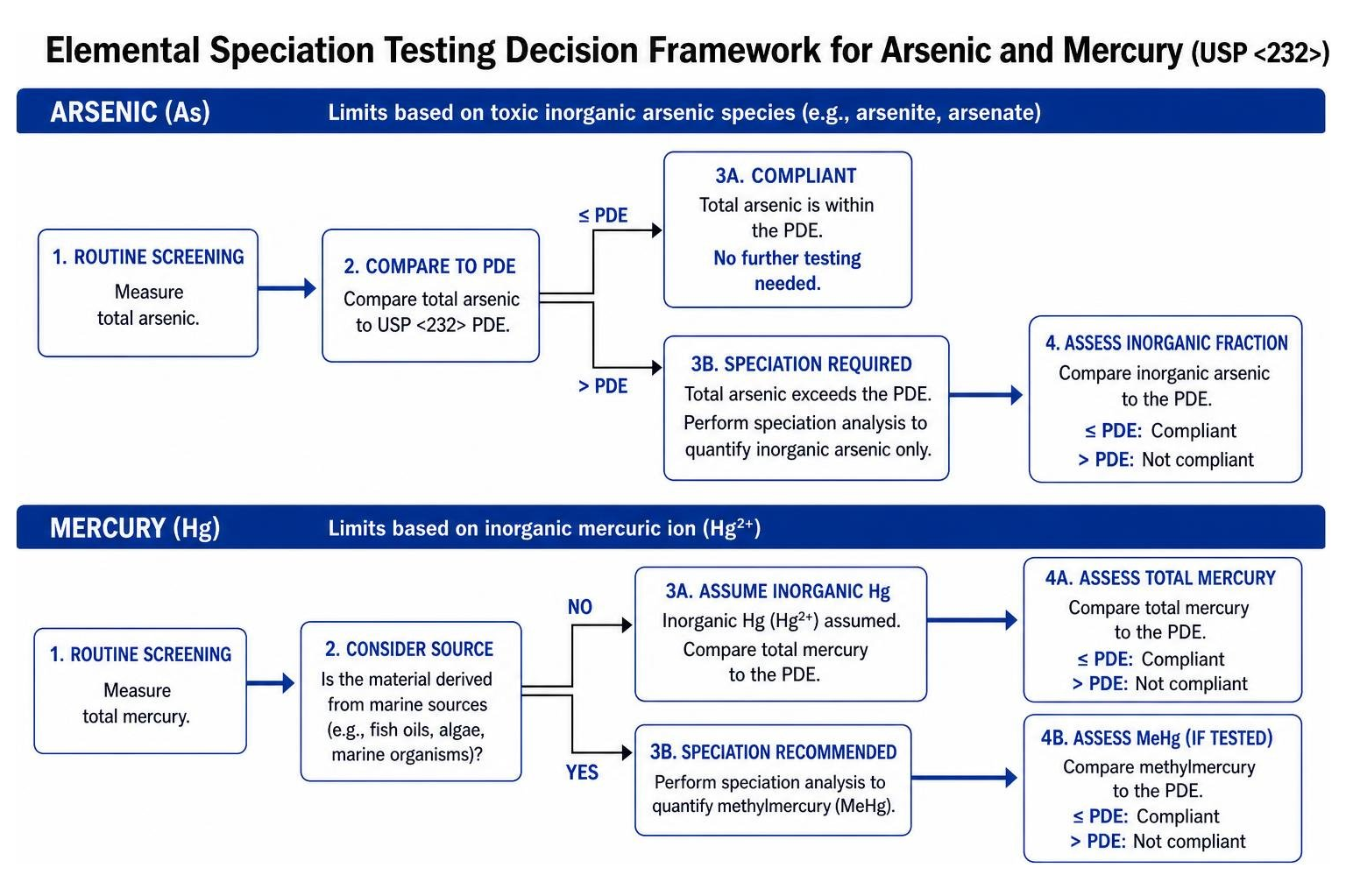
USP <232> handles speciation specifically for arsenic and mercury:
- Arsenic: Inorganic arsenic species (such as arsenite and arsenate) are far more toxic than organic complexes (such as arsenobetaine or arsenocholine, commonly found in marine organisms). USP <232> limits are set based on the toxic inorganic form. In routine screening, laboratories measure total arsenic. If total arsenic complies with the PDE, no further work is needed. If total arsenic exceeds the target limit, manufacturers can perform speciation analysis to quantify only the inorganic fraction, demonstrating compliance if the inorganic concentration remains below the daily threshold.
- Mercury: The limits in USP <232> assume the presence of the divalent inorganic mercuric ion (Hg²⁺). Highly toxic organic methylmercury is rare in pharmaceutical raw materials unless sourced from fish oils, algae, or marine origins. For marine-derived ingredients, total mercury testing may need to be paired with speciation to confirm methylmercury levels remain safe.
Employing advanced trace impurities analysis allows pharmaceutical teams to verify exact elemental oxidation states without unnecessary batch rejections.
Three Compliance Options and Risk Assessment Strategy
USP <232> is built on a risk-based philosophy rather than arbitrary testing mandates. Drug sponsors are expected to perform a comprehensive risk assessment that maps potential sources of elemental impurities throughout the manufacturing lifecycle.
As detailed in the official USP 232 standard, an effective risk assessment examines five primary vectors:
- Residual synthetic catalysts and reagents added during API production
- Naturally occurring elemental contaminants in mined excipients (such as talc, titanium dioxide, or calcium carbonate)
- Water used during formulation and cleaning
- Manufacturing process equipment surfaces (such as stainless steel or Hastelloy reaction vessels)
- Extractable and leachable elements from primary container closure systems over product shelf life

Three Pathways for Demonstrating Compliance
When demonstrating that a drug product meets USP <232> PDE limits, manufacturers can select one of three compliance pathways based on formulation complexity and supply chain data.
| Compliance Option | How It Works | Best Used For | Key Requirement / Limitation |
|---|---|---|---|
| 1. Drug Product Analysis Option | Directly analyze the finished, formulated drug product for target elemental impurities. | Complex formulations, products with variable excipient lots, or uncertain container-closure interactions. | Measured concentration (µg/g) multiplied by the maximum daily dose (g/day) must not exceed the daily PDE. |
| 2. Summation Option | Quantify elemental impurities in each raw material component (API, excipients, water) and sum their contributions. | Formulations where individual component impurity profiles are well documented and stable. | Validates that processing equipment and packaging do not introduce additional impurities above control thresholds. |
| 3. Individual Component Option | Ensure every single ingredient meets predefined default concentration limits from USP <232> Table 3. | Solid oral dosage forms with simple supply chains and established excipient quality agreements. | Applies only to drug products with a maximum daily dose of 10 g/day or less. |
Under Option 3 (the Individual Component Option) for daily doses not exceeding 10 g/day, the default oral concentration limits for Class 1 elements are:
- Cadmium: 0.5 µg/g
- Lead: 0.5 µg/g
- Inorganic Arsenic: 1.5 µg/g
- Inorganic Mercury: 3.0 µg/g
If every component in the formulation meets these individual concentration thresholds, the finished product complies automatically without requiring mathematical summation or finished product batch testing.
Managing USP 232 Elemental Impurities in Excipients and APIs
Excipients represent one of the most variable sources of elemental impurities in solid dosage forms. While synthetic active pharmaceutical ingredients (APIs) usually have well-defined catalyst profiles, mined mineral excipients (such as bentonite, talc, and kaolin) can display natural batch-to-batch variability in lead, arsenic, and cadmium levels.
Effective supplier qualification involves collecting robust certificates of analysis (CoAs) and vendor risk assessments. When raw material data is incomplete, leveraging an independent trace elemental testing guide helps establish baseline impurity ranges across multiple supplier lots.
Analytical Testing and USP <233> Verification
While Chapter <232> establishes the limits, its sister chapter—USP General Chapter <233> Elemental Impurities—Procedures—defines the analytical methods used to measure them.
USP <233> outlines standardized referee testing procedures using modern spectrometric instrumentation:
- Inductively Coupled Plasma Mass Spectrometry (ICP-MS): The gold standard for ultra-trace quantification down to parts-per-trillion (ppt) levels, suitable for low-dose parenterals and toxic Class 1 elements.
- Inductively Coupled Plasma Optical Emission Spectroscopy (ICP-OES): Ideal for higher-concentration trace metals (parts-per-billion to parts-per-million levels) and robust against high dissolved solids.
Sample preparation typically requires closed-vessel microwave acid digestion to fully break down organic matrices without losing volatile elements like mercury or arsenic. Pharmaceutical manufacturers must validate these methods against strict criteria defined in <233>, evaluating accuracy, precision (repeatability and ruggedness), specificity, range, and limit of quantitation.
When setting up your analytical workflow, review our guides on routine elemental impurities testing and ICP-MS elemental analysis to ensure your laboratory configurations meet compendial expectations.
Testing Requirements and Target Elements
A common misconception in pharma quality assurance is that every commercial batch must undergo analytical release testing for all 24 elements listed in ICH Q3D. In reality, USP <232> establishes a practical control threshold set at 30% of the established daily PDE.
If a formal risk assessment demonstrates that elemental impurity levels consistently remain below 30% of the PDE across multiple representative batches, routine batch-release testing is generally not required. Testing is mandated when:
- Impurities consistently exceed the 30% control threshold.
- Intentionally added metal catalysts or reagents are used in the synthesis of the API.
- Significant process changes, new equipment, or unvetted raw material suppliers are introduced into commercial production.
When unexpected spikes appear during method development, having systematic protocols for troubleshooting analytical methods prevents costly manufacturing delays.
Outsourcing Trace Metal Analysis to Accredited Laboratories
Maintaining specialized spectrometric equipment, cleanroom sample prep suites, and validated microwave digestion systems in-house can be capital-intensive and demanding on staff resources. Many pharmaceutical companies partner with ISO/IEC 17025-accredited and cGMP-compliant analytical testing laboratories to support their risk assessments and routine release needs.
Working with an accredited partner ensures complete data integrity, validated methods, and audit-ready documentation to satisfy regulatory reviewers. Exploring our guides on audit-ready lab testing services and outsourcing elemental analysis provides a clear roadmap for selecting the right contract analytical partner.
Frequently Asked Questions About USP 232
What is the primary difference between USP <232> and USP <233>?
USP <232> is the limits standard, defining the toxicological Permitted Daily Exposures (PDEs), classification tiers (Class 1, 2A, 2B, 3), and compliance pathways for elemental impurities. USP <233> is the analytical procedure standard, providing the instrumental methodologies (ICP-OES and ICP-MS), sample digestion protocols, and validation acceptance criteria required to measure those impurities.
How does USP <232> calculate limits for Large-Volume Parenterals?
For parenteral products with daily dosing volumes exceeding 100 mL, limits are derived from the daily PDE. When total daily administration exceeds 2 L (such as continuous electrolyte infusions or irrigation solutions), USP <232> applies a standardized 2-L volume benchmark to calculate permissible impurity concentrations, ensuring limits remain realistic and clinically protective.
When is elemental speciation testing required under USP <232>?
Speciation testing is primarily used for arsenic and mercury when total elemental screening results exceed specification limits. Because inorganic arsenic and mercuric ions carry significantly higher toxicity than organic complexes, speciation allows manufacturers to quantify the toxic inorganic fraction directly and prove safety compliance.
Conclusion
Demonstrating compliance with USP <232> does not have to be an overwhelming hurdle for pharmaceutical teams. By building a structured risk assessment, understanding the specific Permitted Daily Exposures for your administration route, and selecting the most efficient compliance pathway, you can establish robust control over elemental impurities while streamlining commercial operations.
At Elemental Analysis Inc., based in Lexington, Kentucky, we help pharmaceutical manufacturers solve their most complex trace element challenges. As the first commercial PIXE laboratory alongside our comprehensive cGMP and ISO 17025-accredited ICP-MS and ICP-OES capabilities, we provide both non-destructive and destructive trace element quantification and speciation with rapid turnarounds. Whether you are validating a new active ingredient, screening raw excipients, or preparing regulatory submission packages, explore our specialized trace elemental and ICP testing services to keep your pipeline compliant and audit-ready.