
How Trace Impurities Analysis Keeps Modern Technology Safe and Pure
Why Trace Impurities Analysis Matters in Modern Manufacturing
Trace impurities analysis identifies and measures unwanted chemicals, metals, particles, and degradation products in raw materials and finished products, often at part-per-million or part-per-billion levels. It helps laboratories find contamination before it affects product safety, performance, compliance, or batch consistency.
For a fast starting point, trace impurity testing should answer four questions:
- What is present? Examples include lead, arsenic, cadmium, mercury, nitrosamines, residual solvents, and particulate matter.
- Where did it come from? Common sources are raw materials, processing equipment, packaging, water, reagents, and chemical reactions during manufacturing.
- How much is present? The result must be measured against the product’s risk-based specification or regulatory limit.
- Could it affect the product? Even low-level contamination can change a biotherapeutic’s quality, create particulate defects, or introduce a toxicological risk.
This matters because a raw material can meet a general purity grade while still contain small, uncharacterized contaminants. In a complex process that combines dozens or even more than 100 inputs, those small amounts can add up. For pharmaceuticals, organic impurities may be controlled from 0.01% to 1.0%, while impurities with acute toxicological risk, such as certain nitrosamines, may require monitoring at ppb levels.
For lab supervisors and technical managers, the goal is simple: obtain reliable data at the right detection limit, understand the source of variability, and make defensible release decisions without creating a bottleneck in the quality workflow.
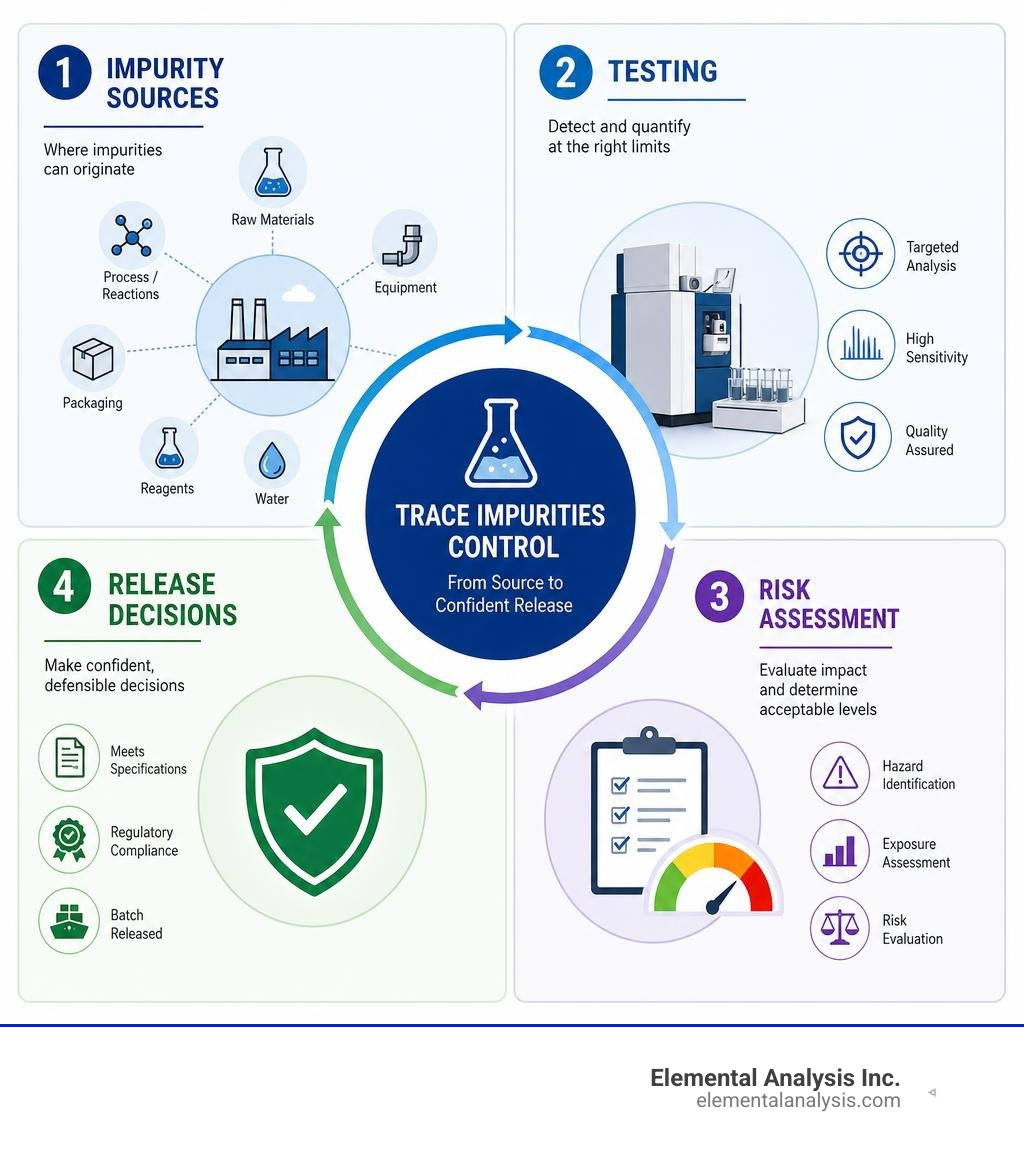
Trace impurities analysis vocab explained:
Sources and Impacts of Impurities in Raw Materials and Finished Products
When we investigate where unwanted substances originate, we quickly find that contaminants can slip into a process at nearly every stage of production. Active pharmaceutical ingredients (APIs), starting synthesis materials, industrial solvents, and even ultra-pure process water carry trace background elements.
During chemical synthesis or storage, side reactions can give rise to mutagenic nitrosamines or organic degradation products. In other cases, contact materials are the culprit—such as vulcanizing agents (like 2-mercaptobenzothiazole) leaching from rubber stoppers and reacting with trace copper ions (~1 ppm) in solution to form insoluble precipitates.
Beyond biopharmaceuticals, elemental contamination severely damages metallurgy and advanced materials. For instance, trace tellurium impurities in recycled scrap steel segregate at grain boundaries or form unwanted inclusions, causing severe micro-cracking and brittleness. To dive deeper into regulatory risk frameworks, review our guide on A Practical Guide to Elemental Impurities Testing and FDA Guidelines.
Key Sources in Organic and Elemental Trace Impurities Analysis
To control contaminants effectively, we categorize them based on their chemical nature and regulatory risk thresholds:
- Mutagenic Nitrosamines: Potent carcinogens that require strict ultratrace monitoring down to part-per-billion (ppb) levels. They often form when nitrates or nitrites react with secondary or tertiary amines during API processing or storage.
- Elemental Impurities: Toxic metals (traditionally categorized as Class 1 elements: lead, cadmium, mercury, and arsenic) defined under USP <232> and global pharmacopeias.
- Compendial Grade Limitations: Standard compendial grade raw materials (e.g., USP grade) require $\ge$ 98.5% to 99.0% purity. This leaves 1.0% to 1.5% of the material completely uncharacterized—an unmonitored gap where trace metals or organic side-products hide.
How Trace Impurities Impact Biotherapeutics and Industrial Materials
In cell culture media used for biomanufacturing monoclonal antibodies (mAbs), small trace metal fluctuations alter cell viability and enzymatic pathways. In complex chemically defined media (CDM) formulations containing over 100 distinct raw ingredients, uncharacterized impurities accumulate rapidly.
Interestingly, intentionally added metal salts don’t always drive total element concentrations. In one evaluating study, added manganese salt contributed a mere 3% to the total manganese content in a complex CDM batch—the remaining 97% came from cumulative background impurities across other raw ingredients! Conversely, copper salt additions were the primary source of total copper. Uncontrolled manganese and copper variations directly disrupt mAb glycosylation profiles, altering drug efficacy.
In parenteral injectables, foreign particulate matter presents severe physiological risks. The critical particle size range of interest spans 5 to 100 $\mu$m—bounded on the lower end by capillary blood vessel diameters (5 $\mu$m) and on the upper end by human visual detection limits (100 $\mu$m). Even a single 100-$\mu$m particulate in a 10-mL vial represents roughly 52 ppb of concentrated contamination.
Regulatory Standards and Sample Preparation Workflows
Global regulatory alignment ensures that analytical testing remains consistent across borders. Standards like USP <232> (limits) and USP <233> (procedures) are harmonized across the US, European, Japanese, and Indian pharmacopeias. Compliance hinges on choosing the correct sample preparation workflow and verifying system performance.

When dealing with complex or insoluble matrices, closed-vessel acid digestion (often using microwave heating with concentrated nitric acid or aqua regia) is mandatory. Closed vessels prevent the loss of volatile elemental impurities like arsenic or mercury while completely breaking down organic matrices. You can consult official guidelines through the © 2025 USPC – 233 ELEMENTAL IMPURITIES—PROCEDURES monograph, or read our overview on USP Elemental Impurities: What Pharma Manufacturers Need to Know.
Preparing Samples for Accurate Trace Impurities Analysis
Sample preparation is often where analytical accuracy is won or lost. We select from four core sample preparation approaches based on sample solubility and matrix compatibility:
- Neat Preparation: Direct injection used exclusively for low-viscosity, unsolvated liquids.
- Direct Aqueous Solution: Dissolving water-soluble samples directly in diluent, typically spiked with 1% to 2% ultrapure acid.
- Direct Organic Solution: Dissolving lipophilic or organic-soluble compounds in compatible organic solvents.
- Indirect Solution (Closed-Vessel Digestion): Digesting insoluble materials in concentrated ultrapure acids using high-pressure closed vessels.
Digestion and leaching parameters must be tightly controlled. For example, acidification duration alters leaching rates from insoluble particulate suspended in liquid samples; controlled short acidification times (e.g., 1.5 minutes) prevent full particle dissolution when differentiating dissolved versus particulate phases. Furthermore, analyzing volatile elements like mercury requires adding gold or specific chemical stabilizers to stock solutions to prevent loss via container surface adsorption or volatilization.
System Suitability and Validation Parameters
To validate quantitative trace impurities analysis methods under USP <233>, laboratories must meet strict performance criteria evaluated against target working concentration J (the limit concentration adjusted for sample preparation dilution factors):
- Spike Recovery (Accuracy): Mean recovery of spiked samples across 0.5 J to 1.5 J must fall between 70% and 150% across three independent preparations.
- Repeatability Precision: Relative Standard Deviation (%RSD) must not exceed 20% across six independent sample preparations.
- Intermediate Precision: %RSD must not exceed 25% when tested across different days, equipment, or analysts.
- Standardization Drift: System drift measurements must not deviate by more than 20% before and after a sample testing sequence.
- Reference Traceability: All standardizations must utilize Certified Reference Materials (CRMs) traceable to national metrology institutes like NIST.
Advanced Instrumental Techniques for Trace Impurities Analysis
Modern laboratories utilize a suite of advanced spectroscopic and mass spectrometric instruments to detect impurities down to ultratrace levels. Selecting the right tool depends on required detection limits, sample throughput, and matrix complexity.
To learn more about selecting elemental tools, consult our comprehensive guide: Heavy Metal Analysis by ICP-MS: The Ultimate Guide to Screening Toxins. Furthermore, long-term environmental and geochemical benchmark studies published in the Performance of ICP-TOF-MS for ultra-trace element analyses in ice cores – Journal of Analytical Atomic Spectrometry highlight how modern mass spectrometry techniques handle sub-part-per-trillion levels in clean matrices.
Below is a detailed comparison of primary atomic spectroscopy tools used in trace analysis:
| Analytical Technique | Dynamic Range | Limit of Detection (LoD) | Primary Application Strengths | Matrix Handling Limitations |
|---|---|---|---|---|
| ICP-OES | $10^5 – 10^6$ | 0.1 – 10 ppb ($\mu$g/L) | High sample throughput; excellent tolerance for high dissolved solids ($>1\%$) | Insufficient sensitivity for ultratrace toxic heavy metals ($<1$ ppb) |
| ICP-MS | $10^8 – 10^9$ | 0.001 – 0.1 ppb (ng/L) | Multi-element screening at ultratrace levels; isotope dilution capabilities | Requires total dissolved solids $<0.2\%$; susceptible to polyatomic interferences |
| ICP-TOF-MS | $10^6 – 10^7$ | 0.002 – 0.5 ppb (ng/L) | Simultaneous full-mass spectrum acquisition; ultra-fast single-particle characterization | Slightly lower analytical precision ($11 \pm 6\%$) compared to sector field systems ($7 \pm 4\%$) |
Ultra-Low Detection and Single-Particle Identification
Reaching ultra-low limits of detection requires cleanroom sample handling and advanced optics. In specialized applications such as ice core analysis, ICP-TOF-MS achieves limits of detection ranging from 0.002 ng/L (for $^{153}\text{Eu}$) to 470 ng/L (for $^{44}\text{Ca}$).
Beyond liquid measurements, single-particle identification is vital when troubleshooting sub-visible particle contamination in drugs. ICP-TOF-MS features millisecond acquisition speeds, capturing full mass spectra from individual particle transient plumes as they pass through the plasma torch.
For physical particle characterization, laboratories isolate non-soluble particulates onto gold-coated membrane filters. Non-destructive techniques—such as Scanning Electron Microscopy with X-ray Fluorescence (SEM/XRF), light microscopy, Raman, or FTIR spectroscopy—allow analysts to determine particle morphology and exact elemental composition down to picogram single-particle masses.
Overcoming Complex Matrix Interferences
High-matrix samples present severe spectral and polyatomic interferences during trace impurities analysis. For instance, analyzing trace tellurium in steel using single-quadrupole ICP-MS fails due to massive overlaps from xenon impurities in argon gas alongside $^{93}\text{Nb}^{16}\text{O}_2{}^1\text{H}^+$ polyatomic ions at $m/z$ 126.
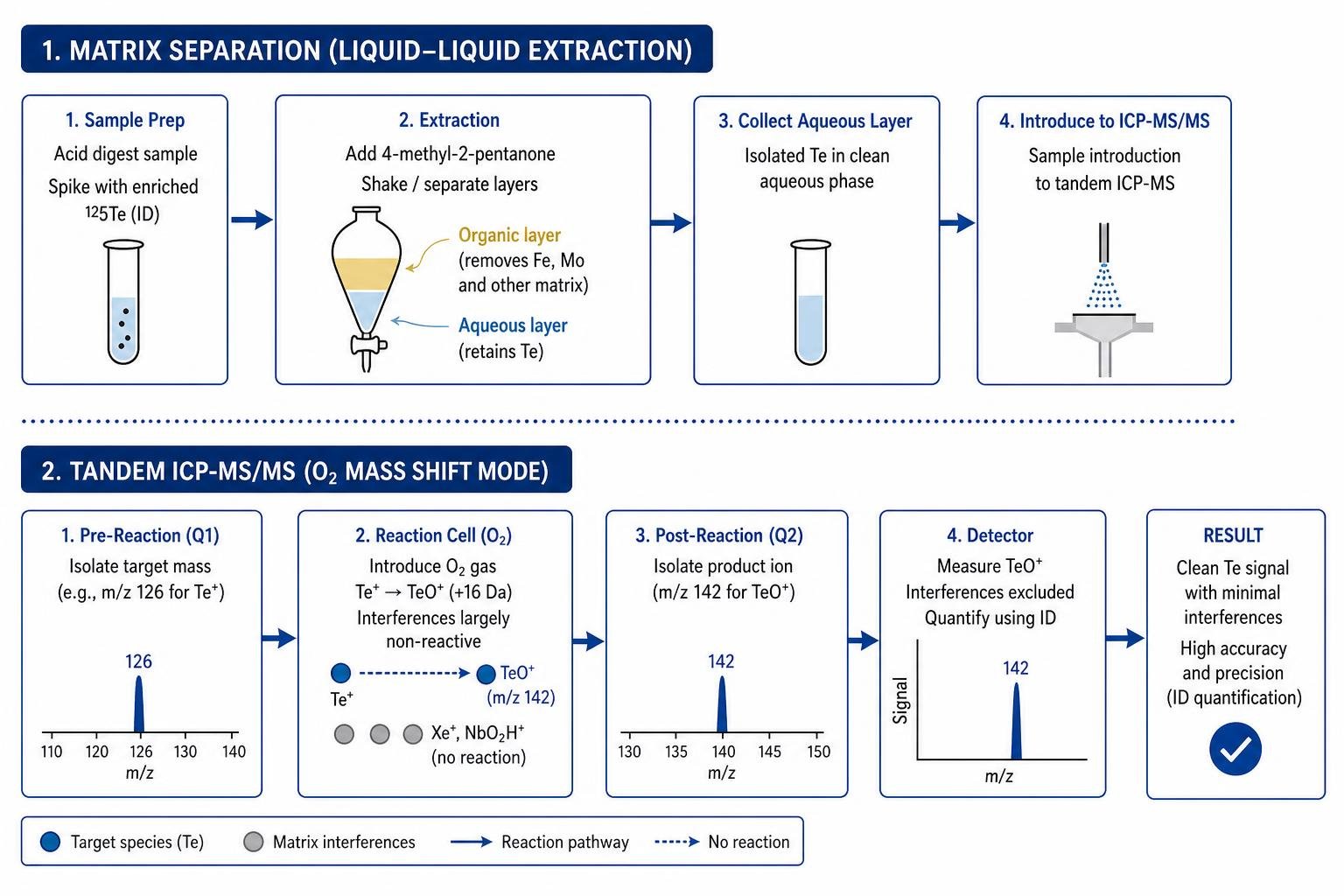
To solve these interferences, advanced laboratories use two complementary strategies:
- Tandem ICP-MS/MS in $\text{O}_2$ Mass Shift Mode: By introducing oxygen gas into a reaction cell, $\text{Te}^+$ selectively reacts to form $\text{TeO}^+$ (shifting its mass by +16 Da), while non-reactive matrix interferences like $\text{Xe}^+$ remain at their original mass, isolating the tellurium signal completely.
- Matrix Extraction: Performing liquid-liquid extraction using 4-methyl-2-pentanone isolates trace tellurium into an aqueous layer while stripping away interfering bulk iron ($\text{Fe}$) and molybdenum ($\text{Mo}$) matrix elements. Spiking samples with enriched isotope isotopes ($^{125}\text{Te}$) prior to acid digestion allows Isotope Dilution (ID) quantification, delivering precision with relative standard deviations under 1.3%.
Risk Mitigation Strategies and Predictive Process Control
Rather than relying purely on end-product testing, forward-thinking manufacturers embed trace impurity control into their Quality by Design (QbD) frameworks. Tracking incoming lot-to-lot raw material variability creates an early warning system before expensive production batches fail.
For an overview of foundational testing protocols, check out A Quick Start Guide to Elemental Analysis Methods.
Below is a structured workflow for mitigating raw material impurity risks in high-tech manufacturing:
- Build a Raw Material Trace Database: Systematically test and log full trace element profiles for all incoming raw material lots across supplier sources.
- Define Process Impurity Limits: Establish strict target ranges for trace metals based on empirical cell performance or product stability data.
- Perform Predictive Risk Modeling: Use statistical algorithms to evaluate the probability of finished-product batch compliance before compounding inputs.
- Implement Algorithmic Lot Sourcing: Select precise raw material batch combinations that balance out background trace contamination.
- Verify Finished-Goods Analytical Data: Perform final product verification using validated testing methods to confirm predictive model outputs.
Predictive Modeling and Algorithmic Sourcing
In custom cell culture media manufacturing, combining over 100 raw materials makes traditional lot selection a game of chance. By establishing a comprehensive database of tested raw material lots, manufacturers can run predictive algorithms to calculate finished media impurity levels prior to mixing.
This algorithmic lot selection process blends lots with higher trace metal background with ultra-pure lots to achieve target elemental specs every time. Real-world validation demonstrates an exceptional correlation between predicted and actual trace element concentrations in finished media ($R^2 > 0.9$), virtually eliminating batch rejections caused by raw material variability.
Seamlessly Transitioning to Modern Analytical Instrumentation
Adopting newer analytical technologies—such as transitioning from Flame Atomic Absorption (FLAAS) or ICP-OES to tandem ICP-MS/MS or Vacuum UV (VUV) spectroscopy—requires systematic validation to ensure regulatory compliance.
Under USP <1225> and equivalence guidelines, laboratories must prove that alternative methods perform equal to or better than standard compendial procedures. This involves conducting side-by-side equivalency testing, verifying limits of quantitation, and demonstrating robust spike recoveries ($70\% – 150\%$) across complex sample matrices.
Frequently Asked Questions About Trace Impurities Analysis
What are the spike recovery acceptance criteria for quantitative USP <233> testing?
For quantitative elemental impurity testing under USP <233>, the mean spike recovery must be between 70% and 150% across three independent sample preparations spiked at target concentration levels ranging from 0.5 J to 1.5 J.
Why is standard USP compendial purity insufficient for complex cell culture media?
Standard USP-grade raw materials require $\ge$ 98.5% to 99.0% purity, leaving up to 1.5% of components uncharacterized. When over 100 distinct raw ingredients are mixed to produce complex cell culture media, these uncharacterized trace background contaminants accumulate, causing severe lot-to-lot bioprocess variability.
What role does single-particle analysis play in identifying particulate contaminants?
Single-particle analysis (e.g., via ICP-TOF-MS or SEM/XRF) allows laboratories to isolate individual micro-particulate contaminants (in the critical 5–100 $\mu$m range) to determine their exact elemental makeup and origin without destructive bulk dissolution.
Conclusion
Controlling trace contaminants is essential for protecting product safety, ensuring biotherapeutic efficacy, and preventing costly batch failures in modern manufacturing. By combining rigorous sample preparation, advanced mass spectrometry, and data-driven predictive lot selection, quality control laboratories can systematically identify and eliminate contamination risks.
At Elemental Analysis Inc., located in Lexington, KY, we specialize in accurate trace element identification, quantitative screening, and element speciation across complex industrial and pharmaceutical matrices. As the first commercial Proton Induced X-ray Emission (PIXE) laboratory, we deliver non-destructive and destructive testing solutions with rapid turnaround times and industry-leading precision.
Learn more about modern trace element testing solutions and discover how our specialized testing capabilities can help safeguard your manufacturing workflows.