
A Practical Guide to Elemental Impurities Testing and FDA Guidelines
Why Elemental Impurities Testing Is Critical for Drug Product Safety
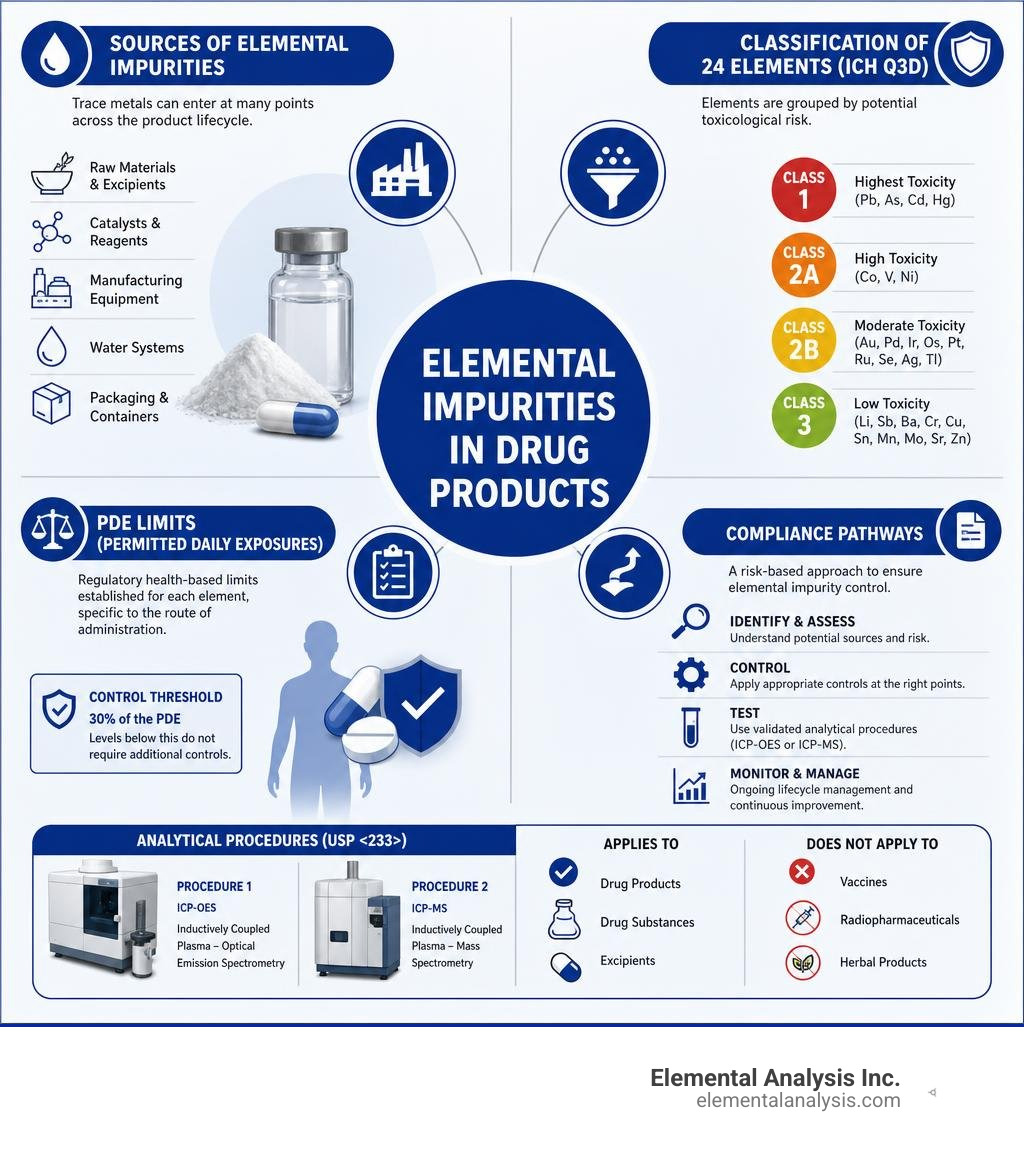
Elemental impurities testing is the process of identifying and quantifying toxic trace metals — such as lead, arsenic, cadmium, and mercury — in pharmaceutical drug products to ensure they stay within safe limits established by global regulators.
Here is a quick answer to what you need to know:
- What it covers: 24 elemental impurities classified by toxicity (Class 1, 2A, 2B, and 3)
- The governing standard: ICH Q3D(R2), implemented globally and legally effective since September 24, 2022
- The U.S. compendial framework: USP General Chapters <232> (limits) and <233> (procedures)
- The safety benchmark: Permitted Daily Exposures (PDEs) — route-specific limits for each element
- The control threshold: 30% of the established PDE; levels below this do not require additional controls
- Who it applies to: Manufacturers of drug products, drug substances, and excipients — but not vaccines, radiopharmaceuticals, or herbal products
- Key analytical methods: ICP-OES (Procedure 1) and ICP-MS (Procedure 2) under USP <233>
Elemental impurities offer zero therapeutic benefit to patients. Yet they can easily enter a drug product through raw materials, catalysts, manufacturing equipment, water, or packaging. Even at trace levels — parts per billion — some of these metals pose serious toxicological risks.
The old approach under USP <231> relied on qualitative “wet chemistry” heavy metals tests that were neither sensitive nor specific. Regulators replaced it with a modern, risk-based quantitative framework under ICH Q3D and USP <232>/<233>. The shift moved the industry away from blanket end-product testing toward a smarter system: understand your sources, assess your risk, and apply controls where they actually matter.
This guide walks through every layer of that framework — from classification and PDEs to analytical procedures and lifecycle management.
Simple elemental impurities testing word guide:
Understanding the Risk-Based Approach to Elemental Impurities Testing
When global regulators aligned under the ICH Q3D(R2) guideline, they moved the industry away from a “test everything always” mindset. Instead, they introduced a structured process of quality risk management, closely aligned with the principles of ICH Q9. This modern risk-based approach relies on a thorough scientific understanding of the formulation, manufacturing process, and packaging rather than blind, retrospective batch testing.
To help manufacturers navigate this transition, we often refer to our comprehensive overview, USP Elemental Impurities: What Pharma Manufacturers Need to Know. The core philosophy is simple: you only need to perform routine batch testing if your risk assessment shows that elemental impurity levels are likely to exceed a specific safety margin.
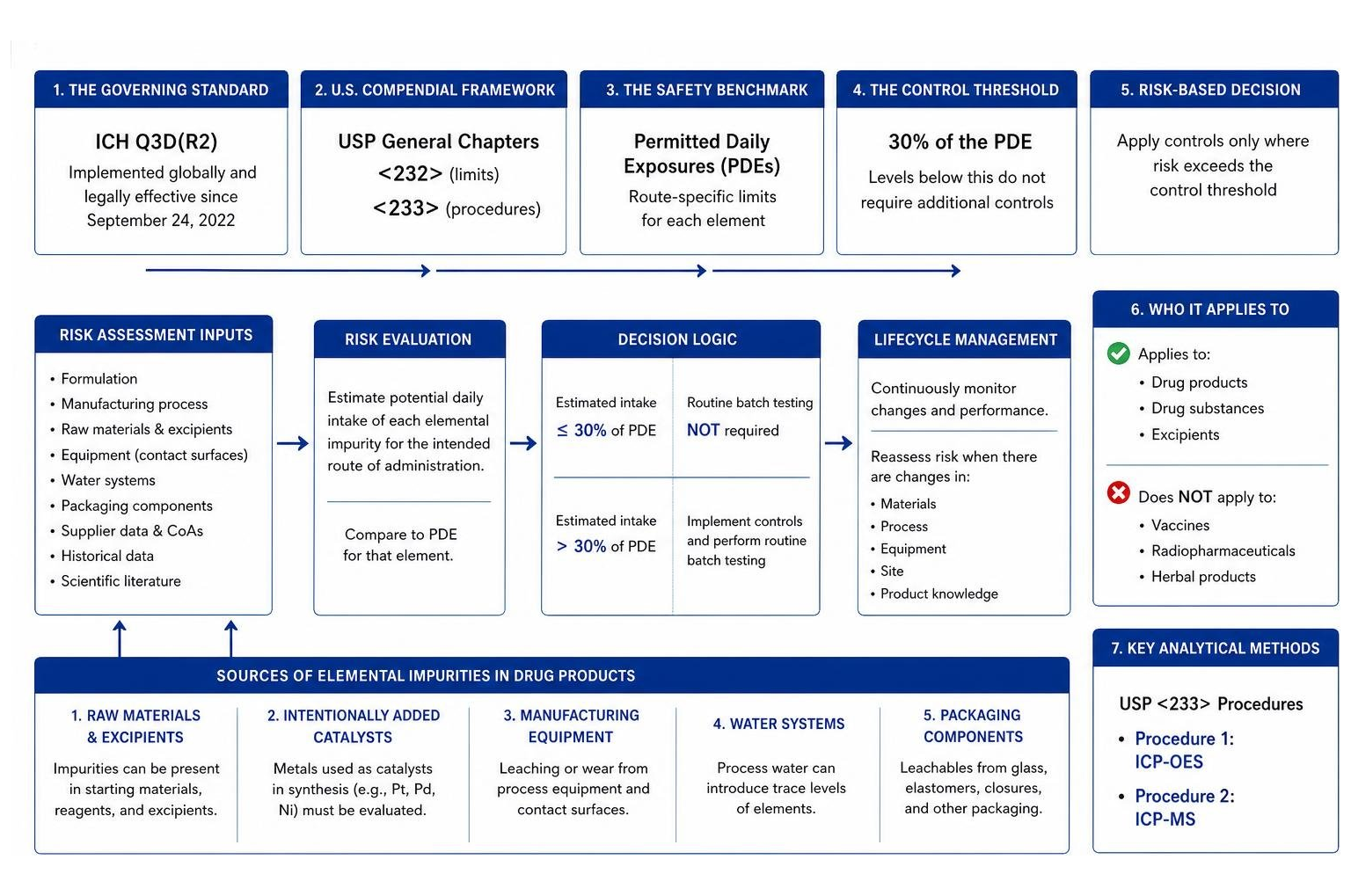
This margin is governed by the control threshold, which is defined as 30% of the established Permitted Daily Exposure (PDE) for each element in the drug product. If your risk assessment—backed by historical data, supplier documentation, and scientific literature—demonstrates that an impurity consistently remains below 30% of the PDE, routine testing for that element is generally not required. You can learn more about how these safety parameters are defined directly in the official ELEMENTAL IMPURITIES—LIMITS documentation.
Key Sources Identified During Elemental Impurities Testing
To build a solid risk assessment, we must first map out how these trace metals find their way into a drug product. In our testing experience, impurities typically originate from five primary sources:
- Intentionally Added Catalysts: Metals like platinum, palladium, or nickel that are used as catalysts during the chemical synthesis of the drug substance. Because they are deliberately introduced, they must always be evaluated.
- Drug Substances and Excipients: Raw materials, especially those derived from natural mined minerals (such as talc, clays, or calcium carbonate), are notorious for carrying natural background levels of heavy metals.
- Manufacturing Equipment: High-shear mixers, reactors, and filling needles can shed trace elements through mechanical wear or chemical corrosion, particularly when processing acidic or corrosive formulations.
- Water: The water used in manufacturing processes must meet strict compendial quality requirements to prevent the introduction of elemental contaminants.
- Container Closure Systems (CCS): Packaging components, especially glass vials or elastomeric rubber stoppers, can leach metals into liquid formulations over the product’s shelf life.

Risk Assessment of Container Closures and Manufacturing Equipment
Evaluating the risk from manufacturing equipment and container closure systems requires a deep understanding of materials science and Good Manufacturing Practice (GMP) processes. For a detailed breakdown of how laboratories set up these evaluations, check out our guide, Elemental Testing Lab 101.
When assessing manufacturing equipment, the risk of metal transfer depends heavily on the equipment’s composition (e.g., 316L stainless steel, Hastelloy), the operating temperature, the pH of the formulation, and the contact time. Fortunately, most modern GMP processes utilize highly corrosion-resistant materials, which naturally limits the risk of contamination.
For container closure systems, the primary concern is the migration of leachables. Liquid and semi-solid formulations have a much higher risk of extracting metals from glass (which can leach arsenic, antimony, or lead) or rubber stoppers (which can leach zinc or aluminum) than solid oral dosage forms. A robust risk assessment should evaluate these packaging materials under accelerated storage conditions to confirm that no harmful elements migrate into the drug product over its shelf life.
Special Considerations for Biotechnologically-Derived Products
Biotechnologically-derived products (such as therapeutic proteins, monoclonal antibodies, and recombinant vaccines) present a unique profile when it comes to elemental impurities.
On one hand, the biological expression systems (cell culture media) and purification columns used in biotech manufacturing are highly sensitive to trace metals. Some metals are actually added intentionally as essential nutrients in cell culture media. On the other hand, the extensive downstream purification processes—such as ultrafiltration, diafiltration, and chromatography—are incredibly efficient at removing small-molecule impurities, including trace metals.
Consequently, the inherent risk of elemental impurities in the final, purified biotech drug substance is typically very low. The risk assessment for these products generally focuses on the final formulation steps, the addition of excipients, and potential leaching from the primary container closure system.
Classification of Elemental Impurities and Permitted Daily Exposures (PDEs)
Not all elements are created equal in the eyes of toxicology. To help manufacturers prioritize their risk assessments, ICH Q3D and á232ñ ELEMENTAL IMPURITIES—LIMITS categorize 24 elements into four distinct toxicity classes. This classification dictates whether an element must be included in your risk assessment, or if it can be excluded based on how it is used.
| Toxicity Class | Included Elements | Risk Assessment Requirement | Toxicity Profile & Likelihood of Occurrence |
|---|---|---|---|
| Class 1 | Arsenic (As), Cadmium (Cd), Mercury (Hg), Lead (Pb) | Mandatory across all routes of administration | Highly toxic human toxicants; ubiquitous environmental contaminants with limited or no use in pharma. |
| Class 2A | Cobalt (Co), Nickel (Ni), Vanadium (V) | Mandatory across all routes of administration | High probability of occurrence due to common use in manufacturing equipment and raw materials. |
| Class 2B | Gold (Au), Palladium (Pd), Platinum (Pt), Iridium (Ir), Osmium (Os), Rhodium (Rh), Ruthenium (Ru), Selenium (Se), Silver (Ag), Thallium (Tl) | Required only if intentionally added during synthesis | Low natural abundance; reduced probability of occurrence as accidental contaminants. |
| Class 3 | Antimony (Sb), Barium (Ba), Chromium (Cr), Copper (Cu), Lithium (Li), Molybdenum (Mo), Nickel (Ni)*, Tin (Sn) | Route-dependent (typically required for parenteral/inhalation) | Relatively low toxicity via the oral route (PDEs > 500 µg/day), but higher toxicity via inhalation or parenteral routes. |
Establishing PDEs Across Different Routes of Administration
The toxicity of any substance depends entirely on how it enters the body. A metal that is relatively harmless when swallowed might be highly toxic when inhaled directly into the lungs or injected into the bloodstream. This is why regulators have established separate Permitted Daily Exposure (PDE) limits for different routes of administration.
When specific toxicological data is lacking for parenteral or inhalation routes, modifying factors are applied to the oral data. These factors are based on oral bioavailability thresholds:
- Bioavailability < 1%: Divide the oral limit by 100
- Bioavailability 1% to < 50%: Divide the oral limit by 10
- Bioavailability 50% to < 90%: Divide the oral limit by 2
- Bioavailability $\ge$ 90%: Divide the oral limit by 1
For a comprehensive compilation of these values, refer to the Elemental Impurities—Limits USP 2025 document. Let’s look at some key PDE statistics across the primary exposure routes:
- Oral Route: The oral PDE for Cadmium is 5 µg/day, for Lead is 5 µg/day, for Arsenic is 15 µg/day, and for Mercury is 30 µg/day. For less toxic elements, the oral PDE for Antimony is 1200 µg/day, for Barium is 1400 µg/day, for Copper is 3000 µg/day, and for Tin is 6000 µg/day.
- Parenteral Route: Because intravenous injection bypasses the protective barriers of the gastrointestinal tract, parenteral PDEs are much stricter. For parenteral products, the PDE for Cobalt is 5 µg/day, for Vanadium is 10 µg/day, and for Nickel is 20 µg/day. Additionally, the parenteral PDE for Silver is 15 µg/day, for Gold is 300 µg/day, and for Palladium is 10 µg/day.
- Inhalation Route: The lungs are highly sensitive to localized tissue damage and systemic absorption. For inhalation products, the PDE for Chromium is 3 µg/day, for Copper is 30 µg/day, and for Molybdenum is 10 µg/day. We also see an inhalation PDE for Selenium at 130 µg/day, Antimony at 20 µg/day, and Barium at 300 µg/day.
- Cutaneous Route: Officially integrated into recent compendial updates, the cutaneous and transcutaneous routes of administration have their own specific PDEs. For known dermal sensitizers like Cobalt and Nickel, regulators have established a Cutaneous Concentration Limit (CTCL) of 35 µg/g to prevent localized skin reactions.
Converting PDEs into Practical Concentration Limits
While PDEs are incredibly useful for toxicologists, they are expressed in micrograms per day ($\mu\text{g/day}$). An analytical chemist working in a lab cannot directly measure “micrograms per day” from a vial of powder. They need to know the allowed concentration in parts per million ($\mu\text{g/g}$) or parts per billion ($\text{ng/g}$).
To bridge this gap, we must convert the PDE into a concentration limit based on the maximum daily dose of the drug product. In our analytical work, we refer to the final target concentration of the element in the prepared sample solution as “J”.
The value of J represents the target limit concentration diluted to the working linear dynamic range of the analytical instrument. For a practical look at how we target these ultra-low levels, you can read our In-Depth Guide to Low Detection Limits.
For example, if we are analyzing an oral solid drug product with a maximum daily dose of 10 g/day, the common permitted concentration limit for Cadmium is 0.5 µg/g, for Lead is 0.5 µg/g, and for Arsenic is 1.5 µg/g. If we perform a 1:100 dilution during sample preparation to run the sample on an ICP-MS, the J value is calculated by dividing that concentration by the dilution factor, bringing our target instrument measurement range to 5 ng/mL (ppb) for Cadmium and Lead.
Options for Calculating Concentration Limits
To make compliance as flexible as possible, USP <232> and ICH Q3D offer three distinct options for converting PDEs into concentration limits for drug products and their individual components:
- Drug Product Analysis Option: This is the most straightforward approach. You test the finished, fully formulated drug product. The concentration of each element in the final dosage form must not exceed the concentration limit calculated from the PDE and the maximum daily dose.
- Summation Option: Rather than testing the final complex drug product, you calculate the elemental impurity contribution of each individual component (active pharmaceutical ingredient, excipients, and water) and sum them up. If the total is below the PDE, the drug product is compliant. This option is ideal for manufacturers who want to leverage supplier data.
- Individual Component Option: This option applies a default concentration limit to every component in the formulation. It assumes a default maximum daily drug product dose of not more than 10 grams per day. If every single excipient and drug substance meets the default concentration limits (such as 0.5 µg/g for Cadmium and Lead), then any formulation using those ingredients is automatically deemed compliant without further calculation.
For large-volume parenterals (such as saline or dextrose infusions) where the daily volume exceeds 2 liters, the permissible concentration is calculated using a default 2-liter volume limit to ensure patient safety is maintained even during high-volume hydration therapies.
Analytical Procedures and Validation Under USP <233>
When it comes to the actual laboratory work, the analytical blueprint is dictated by USP General Chapter <233>. You can review the official text in á233ñ ELEMENTAL IMPURITIES—PROCEDURES or explore our practical overview, A Beginner Guide to Industry Standard Methods.
Success in the lab starts with proper sample preparation. USP <233> outlines four primary sample preparation pathways depending on the solubility of the material:
- Neat: Direct analysis of liquid samples without dilution.
- Direct Aqueous Solution: Dissolving the sample directly in water or a dilute acid matrix.
- Direct Organic Solution: Dissolving organic-soluble samples in a suitable organic solvent.
- Indirect Solution (Closed-Vessel Digestion): For insoluble samples, we use high-pressure microwave digestion with concentrated ultra-pure acids (such as nitric acid or aqua regia). Closed-vessel digestion is critical because it prevents the loss of volatile elements like mercury during the heating process.
Compendial Procedures: ICP-OES vs. ICP-MS
USP <233> defines two default compendial procedures for elemental analysis. Deciding between them depends on your required detection limits and the complexity of your sample matrix. For a deep dive into choosing the right system, read our technical comparison, ICP Analysis for Heavy Metals: Choosing Between ICP-OES and ICP-MS, or check out ICP-MS Testing: Unleashing the Power of Plasma for Elemental Analysis.
- Procedure 1: Inductively Coupled Plasma–Optical Emission Spectroscopy (ICP-OES / ICP-AES): This technique measures the light emitted by excited atoms in an argon plasma. ICP-OES is highly robust, handles high-dissolved-solids matrices beautifully, and is excellent for elements with higher PDE limits (Class 3 elements).
- Procedure 2: Inductively Coupled Plasma–Mass Spectrometry (ICP-MS): This technique ionizes the sample in an argon plasma and then separates the ions based on their mass-to-charge ratio. ICP-MS offers unparalleled sensitivity, making it the gold standard for detecting ultra-trace Class 1 elements down to the parts-per-trillion level. It is often recommended with a cooled spray chamber and a collision/reaction cell to eliminate polyatomic interferences (such as argon chloride interfering with arsenic).
Validation Protocols for Alternative Elemental Impurities Testing Methods
While ICP-OES and ICP-MS are the default compendial methods, USP <233> explicitly allows the use of alternative analytical procedures—such as Proton-Induced X-ray Emission (PIXE)—provided they meet strict validation criteria.
As the first commercial PIXE laboratory, we frequently perform these validations. The harmonized standards outlined in © 2025 USPC – 233 ELEMENTAL IMPURITIES—PROCEDURES require alternative quantitative procedures to meet the following experimental benchmarks:
- Accuracy (Spike Recovery): The mean spike recovery must be between 70% and 150% for three replicate preparations at concentrations ranging from 50% to 150% of the target limit (0.5 J to 1.5 J).
- Repeatability (Precision): The Relative Standard Deviation (RSD) must be Not More Than (NMT) 20% for six independent sample preparations.
- Intermediate Precision (Ruggedness): The RSD must be NMT 25% when analyzed on different days, with different instruments, or by different analysts (total of 12 injections).
- System Suitability (Drift): To ensure the instrument remains stable during a run, the comparison of standard solution measurements before and after the sample sequence must show a drift of NMT 20% for each target element.

Frequently Asked Questions About Elemental Impurities Testing
When is it acceptable to have elemental impurity levels higher than the established PDE?
While PDEs are designed to protect patients over a lifetime of daily exposure, there are specific scenarios where regulators accept impurity levels higher than the established PDE:
- Short-Term or Intermittent Dosing: If a drug product is administered only once a week, once a month, or for a very short duration (e.g., a 3-day course of antibiotics), the PDE can be adjusted upward. Toxicokinetic (TK) data can be used to justify a higher limit based on the plasma half-life of the element.
- Life-Saving Therapies: For oncology treatments or other life-saving therapies with a limited life expectancy, the immediate therapeutic benefit of the drug outweighs the long-term theoretical risk of trace metal exposure.
- Low Natural Abundance: If an element has an incredibly low natural abundance (defined as less than 1 atom per $10^6$ atoms of silicon) and is not intentionally added, it can be excluded from routine testing even if its theoretical limit is exceeded in a rare raw material batch.
Why is speciation testing critical for arsenic and mercury?
Total elemental testing measures the sum of all chemical forms of an element. However, the toxicity of certain metals depends entirely on their oxidation state or molecular structure. This is where chemical speciation—separating and quantifying the individual chemical forms—becomes critical. You can learn more about this in our resource, Heavy Metal Analysis by ICP-MS: The Ultimate Guide to Screening Toxins.
- Arsenic: Inorganic arsenic (such as $As^{3+}$ and $As^{5+}$) is highly toxic and carcinogenic. Organic arsenic species (like arsenobetaine, commonly found in seafood) are virtually non-toxic and are rapidly excreted by the body. USP <232> limits are strictly based on inorganic arsenic. If a rapid, total-arsenic screening test exceeds the limit, we can perform speciation testing to prove that the arsenic present is actually a safe organic complex.
- Mercury: Mercury limits in USP <232> assume the common inorganic ($2+$) oxidation state. Methyl mercury (the highly toxic organic form that bioaccumulates in fish) is rarely an issue in pharmaceutical manufacturing unless you are formulating with fish-derived raw materials (such as fish oil or omega-3 fatty acids). In those specific cases, speciation testing is required to confirm that methyl mercury levels are safe.
How should lifecycle management and post-approval changes affect risk assessments?
A risk assessment is not a static, “one-and-done” document that you file away and forget. It is a living document that must be maintained throughout the entire lifecycle of the drug product.
Any post-approval change to the product must trigger a formal re-evaluation of your elemental impurity risk assessment. Common changes that require a risk re-evaluation include:
- Changing raw material or excipient suppliers.
- Modifying the synthesis pathway of the drug substance.
- Moving manufacturing to a different facility or using different equipment.
- Changing the primary container closure system.
If the re-evaluation shows that the risk of elemental impurities remains low, the change can typically be documented in your next annual report. However, if a change introduces a new risk (such as a new metal catalyst), you may need to establish new analytical testing protocols and submit a formal variation to regulatory authorities.
Conclusion
Navigating the complex world of global elemental impurity guidelines doesn’t have to be a regulatory headache. By adopting a scientific, risk-based approach, you can focus your testing resources where they actually matter—ensuring patient safety without adding unnecessary analytical burdens to your manufacturing process.
At Elemental Analysis Inc., based in Lexington, Kentucky, we specialize in helping pharmaceutical manufacturers achieve seamless compliance with ICH Q3D(R2) and USP <232>/<233> standards. As the world’s first commercial PIXE laboratory, we offer a unique blend of highly sensitive, non-destructive testing alongside traditional destructive techniques like ICP-MS and ICP-OES. Whether you need rapid trace element identification, method validation, or advanced speciation services, our team delivers fast turnaround times and competitive pricing.
Ensure compliance with expert testing services today by reaching out to our team of trace element specialists.