
ICP-MS Testing: Unleashing the Power of Plasma for Elemental Analysis
What Is ICP-MS Testing and Why Does It Matter for Trace Element Analysis?
ICP-MS testing — short for Inductively Coupled Plasma Mass Spectrometry — is one of the most sensitive elemental analysis techniques available today. It can detect and quantify trace and ultra-trace elements at concentrations as low as parts per trillion (ng/L) in liquids and parts per billion (ng/g) in solids.
Quick answer: What does ICP-MS testing do?
- Identifies and quantifies up to 70 elements simultaneously (lithium through uranium)
- Achieves detection limits in the ng/L to µg/L range for liquids and ng/g to µg/g for solids
- Requires as little as a few milligrams of solid sample or 1–5 mL of liquid
- Delivers results within two days of sample receipt in most cases
- Applies to industries including aerospace, pharmaceuticals, environmental monitoring, food safety, and medical devices
For lab supervisors and technical managers who need fast, reliable, low-detection-limit elemental data — often across a wide range of matrices — ICP-MS is frequently the method of choice.
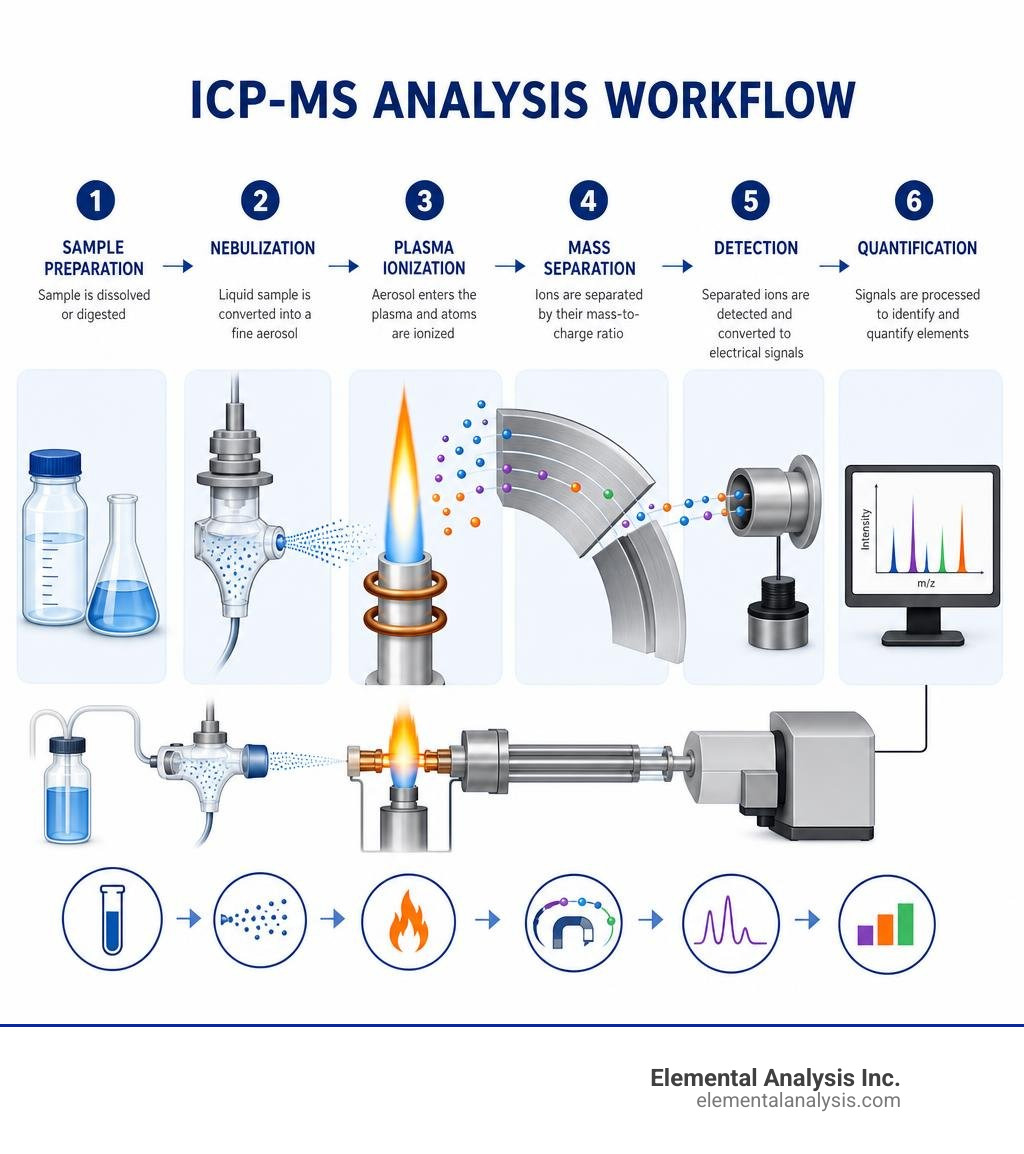
The technique works by converting your sample into a fine aerosol, ionizing it in an argon plasma burning at roughly 9,000 K, and then separating those ions by their mass-to-charge ratio. The result is a precise elemental fingerprint of your material.
It sounds complex. But the workflow is well-established, the standards are mature (EPA Method 6020B, ISO 17294-2, and many others), and the data it produces is hard to beat for trace-level work.
What is ICP-MS and How Does It Work?
To understand ICP MS testing, it helps to picture a miniature, controlled star operating inside our laboratory in Lexington, Kentucky. That star is the inductively coupled argon plasma, and it burns at temperatures reaching approximately 9,000 Kelvin—nearly twice as hot as the surface of the sun.
At its core, Inductively Coupled Plasma Mass Spectrometry is an analytical technique that combines a high-temperature plasma source with a mass spectrometer. The plasma’s job is to destroy chemical bonds and turn your sample into a stream of individual, positively charged ions. The mass spectrometer’s job is to sort and weigh those ions with incredible precision.
The process begins by feeding high-purity argon gas through a quartz torch. A radiofrequency (RF) generator applies energy to an induction coil surrounding the torch, creating an intense electromagnetic field. By introducing a spark, we ionize the argon gas, initiating a self-sustaining, high-energy plasma.
Once your sample enters this extreme environment, it undergoes a rapid-fire physical transformation:
- Desolvation: The solvent is instantly vaporized, leaving behind dry microscopic particles.
- Vaporization: The solid particles are converted into a gaseous state.
- Atomization: Chemical bonds are shattered, reducing compounds to individual atoms.
- Ionization: The intense heat strips a single electron from most elements, converting them into positively charged, single-valence ions.
These newly formed ions are then extracted from the atmospheric pressure of the plasma into the ultra-high vacuum chamber of the mass spectrometer, where they are sorted based on their mass-to-charge ratio ($m/z$). For a deeper dive into this fascinating molecular fire, you can read more about how we analyze these samples in ICP-MS Explained: How We Weigh Atoms in a Plasma Fire.
The Core Principles of ICP MS Testing
To get those ions from a 9,000 K plasma fire into a delicate detector without melting the instrument, the system relies on a series of carefully engineered steps:
- Nebulization: Because the plasma cannot ingest large chunks of material, liquid samples must be converted into a micro-fine mist. A nebulizer uses a stream of argon gas to break the liquid into an aerosol, and a spray chamber filters out any droplets that are too large to ensure smooth ionization.
- Ion Extraction: This is the bridge between fire and vacuum. The ions pass through a pair of interface cones—the sampler cone and the skimmer cone. These metal disks feature tiny central orifices (typically 0.5 to 1.0 mm in diameter) that allow a representative fraction of the ionized gas to pass through while stepping down the pressure.
- The Quadrupole Mass Analyzer: Once inside the vacuum, the ions are focused by electrostatic lenses into a quadrupole. Think of the quadrupole as a highly selective electronic filter consisting of four parallel metal rods. By applying specific radiofrequency and direct-current voltages to these rods, we can create an oscillating electrostatic field that allows only ions of a specific mass-to-charge ratio to pass through to the detector. All other ions collide with the rods and are swept away.
- The Detector: When the selected ions exit the quadrupole, they strike an electron multiplier detector. Each ion collision triggers a cascade of electrons, generating an electrical pulse. The instrument counts these pulses to determine the concentration of the element.
By rapidly scanning through different voltages, the quadrupole can measure up to 70 different elements in a single sample in under a minute. To explore the mechanical nuances of this system, check out The Ins and Outs of Inductively Coupled Plasma Mass Spectrometry.
ICP-MS vs. ICP-OES: Choosing the Right Spectroscopy Technique
When deciding on an elemental analysis method, the most common comparison is between ICP-MS and Inductively Coupled Plasma Optical Emission Spectroscopy (ICP-OES, sometimes referred to as ICP-AES). While both techniques utilize an argon plasma to excite or ionize samples, they differ fundamentally in how they detect and quantify elements.
ICP-OES is an optical technique. It measures the wavelengths of light emitted by excited atoms and ions as they return to their ground state. Because every element emits a unique set of spectral lines, the intensity of the light at a specific wavelength correlates directly to the element’s concentration.
ICP-MS, on the other hand, measures physical mass. Instead of looking at light, it counts the actual atomic ions. This fundamental difference gives ICP-MS several distinct analytical advantages, particularly when it comes to trace and ultra-trace detection.
| Capability / Feature | ICP-OES (Optical Emission) | ICP-MS (Mass Spectrometry) |
|---|---|---|
| Primary Detection Unit | Photons (Wavelengths of light) | Ions (Mass-to-charge ratio) |
| Typical Detection Limits | Parts per billion (ppb) to parts per million (ppm) | Parts per trillion (ppt) to parts per billion (ppb) |
| Linear Dynamic Range | 5 to 6 orders of magnitude | 8 to 10 orders of magnitude |
| Total Dissolved Solids (TDS) | Highly tolerant (up to 10%–30% TDS) | Sensitive (requires <0.2% TDS to prevent cone clogging) |
| Isotopic Analysis | No (cannot distinguish isotopes) | Yes (can measure individual isotopes) |
| Throughput & Speed | Very fast (excellent for major elements) | Fast (excellent for multi-element trace scans) |
If you are analyzing major components in a metal alloy, monitoring high-concentration minerals in industrial wastewater, or running samples with high salt content, ICP-OES is often the more practical and cost-effective choice. However, if your project involves detecting toxic heavy metals at ultra-low levels, certifying high-purity semiconductor materials, or performing medical device leachables testing, ICP-MS is the undisputed gold standard.
To help you decide which method aligns with your specific testing requirements, we have compiled detailed comparisons in our articles:
- ICP Analysis for Heavy Metals: Choosing Between ICP-OES and ICP-MS
- Induced Coupled Plasma: Finding the Perfect Match for Your Lab
- An Essential Guide to Inductively Coupled Plasma
- Unlocking the Elements with ICP Laboratory Analysis
- Elemental My Dear Watson: A Guide to ICP Metal Analysis
- ICP Services Hub
Sample Preparation and Requirements for ICP MS Testing

No matter how advanced a mass spectrometer is, the data it produces is only as good as the sample preparation that precedes it. Because ICP-MS is primarily a solution-based technique, solid samples must be completely dissolved and converted into a clear, particle-free liquid before analysis.
The journey from a solid material to a liquid sample requires careful handling to prevent contamination, element loss, or incomplete dissolution. At our testing facilities, we maintain strict cleanroom protocols and utilize trace-metal-grade reagents to ensure sample integrity.
For a comprehensive guide on preparing your samples and avoiding common laboratory pitfalls, refer to our ICP-MS Lab Guide: How to Get Accurate Trace Element Testing.
Digestion Methods for Solid and Liquid Matrices
Converting solid samples into a liquid matrix suitable for ICP MS testing typically involves mineral acid digestion. The choice of acid and digestion technique depends heavily on the sample’s physical and chemical properties:
- Acid Selection: High-purity nitric acid ($\text{HNO}_3$) is the primary acid of choice because it is an excellent oxidizing agent and forms highly soluble metal nitrates. For complex matrices like geological samples or certain metal alloys, we may add hydrochloric acid ($\text{HCl}$) or hydrofluoric acid ($\text{HF}$). Note: If HF is used, specialized HF-resistant sample introduction systems (such as platinum or sapphire nebulizers and spray chambers) must be installed to prevent the acid from dissolving the instrument’s quartz components.
- Closed-Vessel Microwave Digestion: This is the industry gold standard for sample prep. By sealing the sample and acid mixture inside a high-pressure Teflon vessel and heating it with microwave energy, we can achieve temperatures and pressures far exceeding normal boiling points. This process ensures complete dissolution of even the most stubborn matrices while preventing volatile elements—such as mercury, arsenic, and selenium—from escaping.
- Total Dissolved Solids (TDS) Management: Once digested, the sample must be diluted. The interface cones of an ICP-MS are highly sensitive to salt buildup. To prevent deposition on the sampler and skimmer cones, we must ensure the final solution has a TDS level below 0.2% (2,000 mg/L).
For detailed environmental digestion protocols, you can review the Guidelines for Chemical Analysis: Determination of the Elemental Content of Environmental Samples using ICP-MS.
Overcoming Interferences and Ensuring Calibration Accuracy
While ICP-MS is incredibly sensitive, it is not immune to interferences. In spectroscopy, an interference is anything that causes the instrument to misidentify or miscalculate the concentration of a target element. These interferences generally fall into two categories: spectral and non-spectral.
Spectral interferences occur when an unwanted ion shares the same nominal mass-to-charge ratio as your target analyte. The two main types are:
- Isobaric Elemental Interferences: Caused by isotopes of different elements that have the same atomic mass. For example, $^{58}\text{Fe}$ interferes with $^{58}\text{Ni}$. Because the isotopic abundances of elements are constant and well-documented, we can easily correct for these using mathematical correction equations programmed into our software.
- Polyatomic Interferences: These occur when elements from the plasma gas, reagents, or sample matrix combine to form temporary molecular ions. A classic example is when argon ($^{40}\text{Ar}$) combines with chlorine ($^{35}\text{Cl}$) from a hydrochloric acid matrix to form $^{75}\text{ArCl}^+$. This molecular ion has a mass of 75—directly interfering with arsenic ($^{75}\text{As}$), which has only one stable isotope.
To combat polyatomic interferences, modern ICP-MS instruments utilize Collision/Reaction Cell (CRC) technology. By flooding a small cell ahead of the quadrupole with an inert gas like helium, we can perform Kinetic Energy Discrimination (KED). Because polyatomic molecules (like $\text{ArCl}^+$) are physically larger than atomic ions (like $\text{As}^+$), they collide with the helium atoms more frequently, lose their kinetic energy, and are filtered out of the ion path.
To explore standard regulatory guidelines on managing these interferences, refer to SW-846 Method 6020A: Inductively Coupled Plasma-Mass Spectrometry.
Calibration and Quality Control in ICP MS Testing
Ensuring the highest level of accuracy in trace element testing requires a robust quality control and calibration framework. We do not simply turn on the instrument and start reading numbers; every analytical run is backed by a meticulous calibration process:
- NIST-Traceable Standards: We calibrate the instrument before every batch of testing using multi-element calibration standards that are directly traceable to the National Institute of Standards and Technology (NIST). This ensures that our measurements are anchored to universally recognized physical standards.
- Matrix Matching: Physical interferences can occur if the viscosity, surface tension, or acid concentration of the sample differs significantly from the calibration standards. To eliminate this bias, we carefully matrix-match our standards to the samples, ensuring they share the same acid concentrations.
- Internal Standardization: To compensate for physical interferences, sample transport variations, and minor instrument drift over time, we introduce internal standards (such as Rhodium, Indium, or Scandium) online. Because these elements are not naturally present in the samples, we can monitor their signal intensity continuously. If the internal standard signal drops or drifts, the software automatically applies a proportional correction factor to the analyte data.
For further regulatory context on quality control requirements, you can access Method 6020B: Inductively Coupled Plasma – Mass Spectrometry, part of Test Methods for Evaluating Solid Waste, Physical/Chemical Methods.
Key Applications and Industry Standards for ICP-MS
Due to its exceptional sensitivity and multi-element capabilities, ICP MS testing is utilized across a wide array of high-stakes industries where even trace-level contamination can have severe consequences.
In the aerospace and defense sectors, we use ICP-MS to verify the purity of advanced alloys, detect trace contaminants that could compromise structural integrity, and analyze process solutions and chemical baths. In the medical device industry, the technique is crucial for chemical characterization under ISO 10993-18. We perform full-scan extractables and leachables testing to identify and quantify trace metallic elements (such as heavy metals, additives, or colorants) that could leach from a device into a patient’s body.
To learn more about how this technology is applied to water quality and environmental monitoring, read From H2O to Heavy Metals: A Guide to ICP-MS Water Analysis.
Food Safety and Environmental Regulations
Global regulatory bodies enforce strict limits on heavy metals in food, drinking water, and environmental systems. ICP-MS is the primary analytical tool used to ensure compliance with these stringent laws.
In the food industry, compliance with international standards is vital. For instance, the Chinese national food safety standard GB 5009.268-2025 English PDF specifies ICP-MS as Method I for the determination of 30 different elements in food products, including toxic contaminants like lead, cadmium, arsenic, and mercury.
In environmental research, the sensitivity of ICP-MS allows scientists to track pollution patterns across vast timescales. For example, high-resolution and time-of-flight ICP-MS instruments are used to analyze ultra-trace elements in ice cores from remote glaciers, detecting pollution signatures down to the parts-per-trillion level. You can read a detailed study on this application in the Performance of ICP-TOF-MS for ultra-trace element analyses in ice cores – Journal of Analytical Atomic Spectrometry.
Frequently Asked Questions about ICP-MS
How much sample is needed for ICP MS testing?
One of the greatest advantages of ICP-MS is its ability to work with very small sample sizes.
- For liquid samples (such as water, chemical baths, or biological fluids), we typically require 1 to 100 mL, though a standard run can be performed with as little as 5 to 7 mL of prepared solution.
- For solid samples (such as plastics, metals, soils, or tissue), we typically require 0.01 to 10 grams of material. In cases where sample material is highly limited, we can perform reliable testing on just a few milligrams of dry, finely powdered material by adjusting our digestion volumes.
How long does an ICP MS test typically take?
The actual instrument run time for a single sample is incredibly fast—often completed within a few minutes. However, the overall turnaround time includes sample registration, chemical digestion, instrument calibration, quality control verification, and data reporting.
At Elemental Analysis Inc., we specialize in fast turnaround times. While the physical testing process is completed within a few hours, most samples are fully analyzed, verified, and reported within two days of receipt at our laboratory.
What elements cannot be detected by ICP MS testing?
While ICP-MS can measure up to 70 elements on the periodic table, there are a few notable exceptions:
- Organic Elements: Carbon (C), Hydrogen (H), Oxygen (O), and Nitrogen (N) cannot be measured. The high background levels of these elements from atmospheric air, water, and reagents overwhelm any sample signal.
- Noble Gases: Argon (Ar), Helium (He), and Neon (Ne) are used as plasma or collision gases and cannot be analyzed as analytes.
- Halogens: Fluorine (F) and Chlorine (Cl) have extremely high ionization potentials, meaning the argon plasma cannot effectively convert them into positive ions for mass detection.
Conclusion
When your project demands the ultimate in sensitivity, multi-element detection, and analytical accuracy, ICP MS testing is the premier choice. From identifying trace toxic impurities in medical devices to certifying high-purity alloys for aerospace engineering, this plasma-driven technology provides the definitive chemical answers you need.
At Elemental Analysis Inc., based in Lexington, Kentucky, we combine state-of-the-art mass spectrometry with a unique suite of analytical capabilities. As the first commercial PIXE (Proton Induced X-ray Emission) laboratory, we offer a powerful combination of destructive and non-destructive testing, rapid turnaround times, and competitive pricing. Whether you need a standard trace metal scan or complex elemental speciation, our team of expert chemists is here to help.
Ready to unlock the elemental secrets of your materials? Contact us today to learn more about our ICP testing services or request a customized quote for your next project.