
How ICP-MS Mass Spectrometry Measures Trace Elements
ICP-MS mass spectrometry measures very small amounts of elements in a sample. It uses a hot argon plasma to turn those elements into charged particles, then sorts and counts them by mass. A single run can measure many elements, making the method useful when a lab needs low detection limits and results across a broad range of concentrations.
The catch: sample preparation and chemical interferences can affect accuracy. This guide explains how the instrument works, where it helps, and what to check before trusting a result.
What Is ICP-MS Mass Spectrometry and How Does It Work?
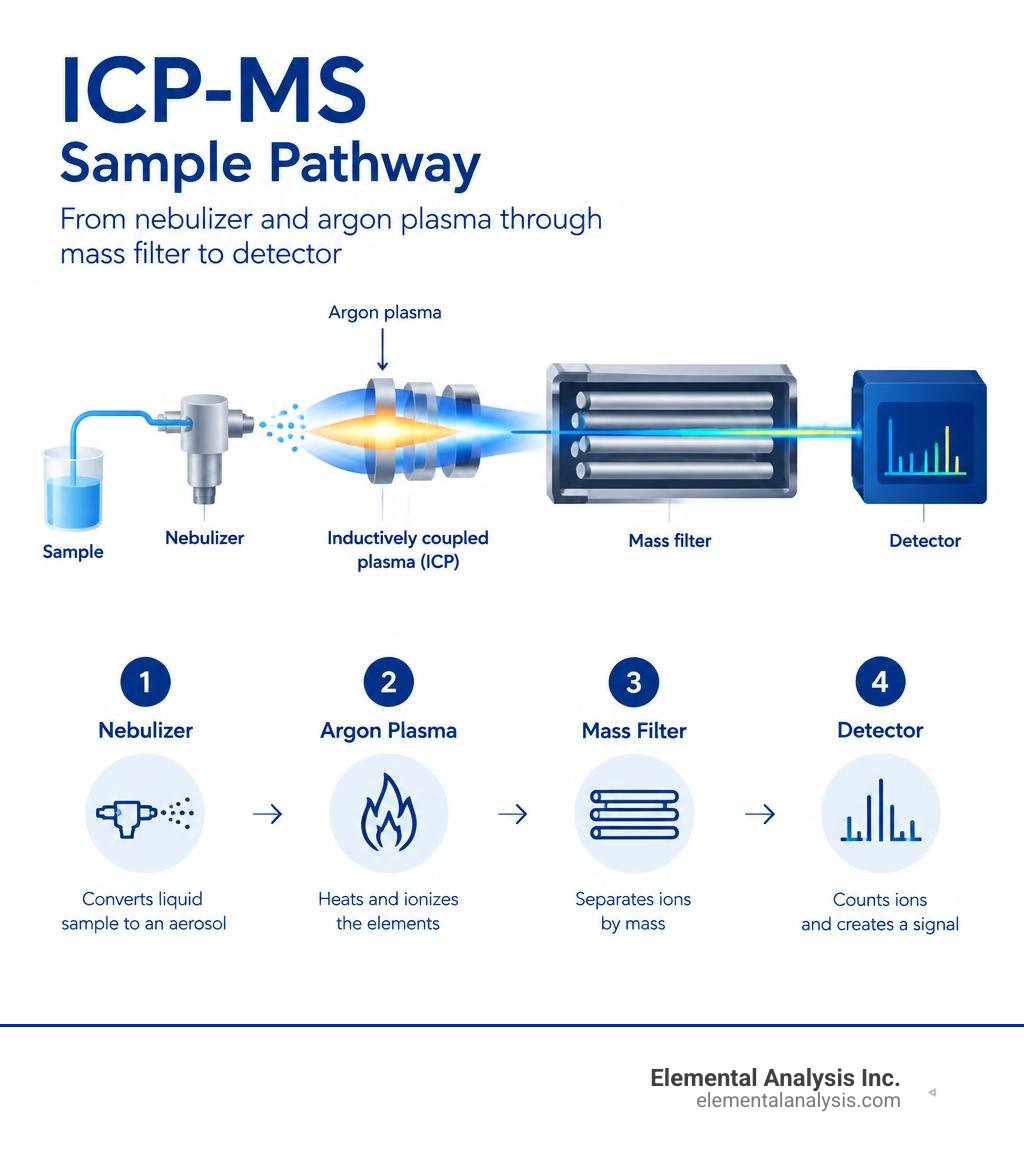
Inductively coupled plasma mass spectrometry (ICP-MS) combines an ultra-high-temperature ionization source with a mass spectrometer (Wilschefski & Baxter, 2019). First commercialized over 30 years ago, the technique operates on a simple principle: convert the atoms in a sample into positively charged ions and separate those ions based on their mass-to-charge ratio (m/z).
The process begins when a liquid sample enters a nebulizer, which transforms the fluid into a fine aerosol mist. This aerosol travels into an argon plasma torch generated by coupling radio-frequency (RF) energy into a continuous stream of argon gas. Operating at temperatures between 6,000 and 10,000 Kelvin—hotter than the surface of the Sun—this plasma instantly desolvates, vaporizes, atomizes, and ionizes the sample constituents.
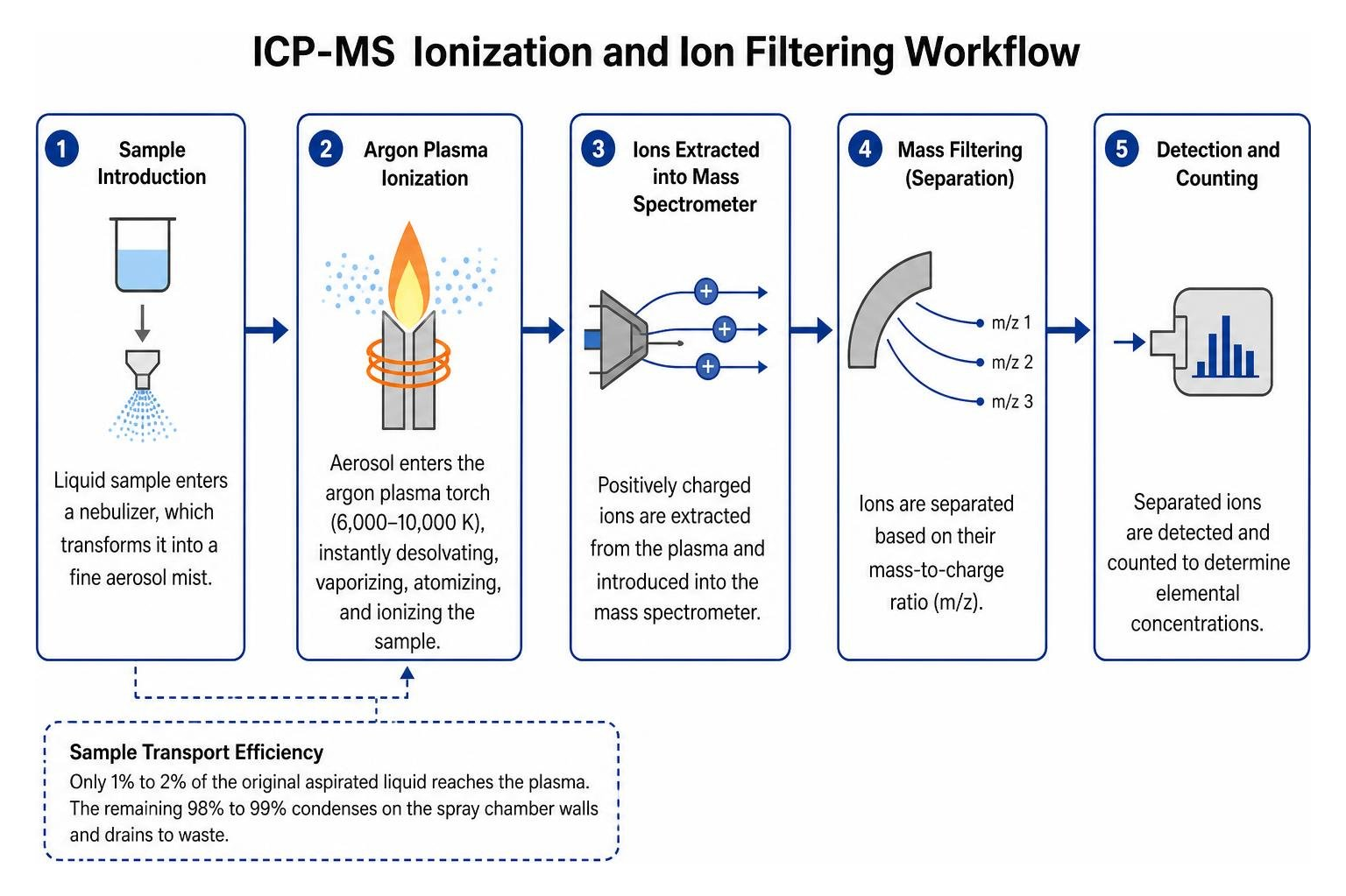
A crucial detail of sample transport dynamics is that only 1% to 2% of the original aspirated liquid ever reaches the plasma fire; the remaining 98% to 99% condenses on the spray chamber walls and drains to waste. Exploring how atoms are weighed in a plasma fire shows how this tiny fraction provides sufficient ion counts to measure analyte concentrations at parts-per-trillion (ppt) or even parts-per-quadrillion (ppq) levels (Wilschefski & Baxter, 2019). For a broader foundation on excitation mechanisms, consult standard texts on practical inductively coupled plasma spectrometry principles.
The Core Components: From Torch to Detector
An ICP-MS instrument relies on five integrated hardware sections:
- Sample Introduction System: A peristaltic pump delivers liquid into a concentric or cross-flow nebulizer, generating an aerosol inside a chilled cyclonic spray chamber (maintained near 2 °C to control water vapor and limit oxide formation).
- ICP Torch: Concentric quartz tubes carry argon gas flows (outer plasma gas, intermediate auxiliary gas, and central nebulizer carrier gas) surrounded by a copper RF induction coil that sustains the 10,000 K discharge.
- Vacuum Interface: Two metallic cones (a sampler cone with a ~1.0 mm orifice and a skimmer cone with a ~0.4 to 0.7 mm orifice) extract ions from atmospheric pressure into the intermediate vacuum stages.
- Ion Optics: A series of electrostatic lenses deflect photons and neutral species away while focusing the positive ion beam toward the mass analyzer.
- Mass Analyzer and Detector: Typically a quadrupole mass filter paired with a discrete dynode electron multiplier detector that records ion arrival events.
Understanding these torch-to-detector instrument configurations helps operators identify points of physical maintenance and sample deposition.
Plasma Ionization and Ion Extraction Dynamics
The high temperature of the argon plasma provides sufficient energy to remove an electron from most elements on the periodic table, producing singly charged positive ions (M+). The ionization efficiency depends directly on each element’s first ionization potential relative to the ionization potential of argon (15.76 eV). Elements with low ionization potentials (like sodium, lithium, and potassium) ionize at nearly 100%, whereas hard-to-ionize non-metals (such as halogens) yield lower ion fractions.
Transitioning ions from an atmospheric plasma (760 Torr) into a high-vacuum mass analyzer (under 0.00001 Torr) creates significant aerodynamic expansion. As the ion beam enters the extraction stage, mutually repulsive electrostatic charges among positive ions create “space-charge effects.” Heavy ions (like lead and uranium) stay along the central trajectory, while lighter ions (like lithium and beryllium) can be deflected outward.
Tuning the ion optics minimizes these distortions. In routine operation, quadrupole mass analyzers maintain a standard resolution of approximately 0.75 atomic mass units (amu)—equivalent to a mass resolution (M/ΔM) of about 300—and an abundance sensitivity of 10^-7, meaning a peak at mass M contributes no more than 0.0000001 of its intensity to mass M±1. Mastering these plasma mass spectrometry operations ensures clean signal extraction across the full mass spectrum.
Overcoming Spectroscopic and Matrix Interferences
While ICP-MS delivers extraordinary sensitivity, it is not immune to spectral and non-spectral interferences. Spectroscopic interferences occur when an unwanted ion shares the same nominal mass-to-charge ratio as the analyte of interest. Non-spectroscopic (matrix) interferences occur when physical sample components suppress or enhance analyte ionization.
During routine instrument tuning, labs verify performance by monitoring specific oxide and doubly charged ion ratios:
- Oxide Ion Ratio: CeO+/Ce+ must remain below 3% (and ideally <1.5%) to verify efficient plasma atomization.
- Doubly Charged Ion Ratio: Ce2+/Ce+ or Ba2+/Ba+ must remain below 2% to 3% to verify that ions are primarily singly charged.
Managing these instrument thresholds is part of handling complex sample matrices in ICP-MS.
Isobaric, Polyatomic, and Doubly Charged Ions
Spectroscopic overlaps fall into three categories:
- Isobaric Overlaps: Different elements sharing an isotope with the same atomic mass number (e.g., 58Ni overlapping 58Fe, or 114Cd overlapping 114Sn). These are resolved mathematically by monitoring a secondary isotope of the interfering element and subtracting its proportional contribution.
- Polyatomic Ions: Molecular species created by combinations of plasma gas (Ar), entrained atmospheric gases (O, N, H, C), and sample matrix ions (Cl, S, Na, P).
- Arsenic (75As) suffers interference from argon chloride (40Ar35Cl+) at nominal m/z 75. Resolving this interference without gas cells requires a mass resolution (M/ΔM) of 7,773.
- Selenium (80Se) is obscured by the argon dimer (40Ar40Ar+) at m/z 80, requiring a resolution of 9,521.
- Chromium (52Cr) is hindered by argon carbide (40Ar12C+) at m/z 52, demanding a resolution of 2,376.
- Doubly Charged Ions: Elements with low second-ionization potentials (e.g., strontium, barium, rare earth elements) can form 2+ ions in the plasma. A doubly charged ion (M2+) appears at half its true atomic weight, such as 138Ba2+ appearing at m/z 69, directly interfering with gallium (69Ga).
Collision/Reaction Cells and High-Resolution Techniques
Modern instruments eliminate polyatomic interferences using Collision/Reaction Cells (CRCs) placed before the primary mass analyzer (Wilschefski & Baxter, 2019):
- Kinetic Energy Discrimination (KED) with Helium: Inert helium gas fills the cell. Larger polyatomic ions (such as 40Ar35Cl+) collide with helium atoms more frequently than compact monatomic ions (75As+), losing kinetic energy faster. An electrostatic energy barrier at the cell exit deflects the slowed polyatomics while allowing analyte ions to pass through.
- Reactive Gases (H2, O2, NH3, CH4): Reactive cell gases target specific chemical reactions. For example, introducing oxygen converts 75As+ into 91AsO+, shifting the analyte mass away from the 40Ar35Cl+ interference at m/z 75.
- Triple-Quadrupole ICP-MS (ICP-MS/MS): Tandem mass spectrometers use a first quadrupole (Q1) to filter a specific m/z, a reaction cell (Q2) to shift the mass via gas reactions, and a third quadrupole (Q3) to isolate the newly shifted product ion, eliminating unexpected side reactions.
- High-Resolution Magnetic Sector (HR-ICP-MS): Instead of collision cells, double-focusing magnetic sector instruments achieve resolutions up to 10,000 (M/ΔM), separating polyatomic spectral lines from elemental peaks through physical mass dispersion.
These techniques broaden the scope of testing across challenging applications, as detailed in our guide to the practical field capabilities of advanced ICP systems.
Essential Protocols for Sample Preparation and Calibration

High-quality analytical results depend directly on rigorous sample preparation. Because the sample orifice on the skimmer cone is narrow, running improper matrices can cause rapid salt deposition, signal drift, and physical cone blockage.
To prevent matrix suppression and cone fouling, total dissolved solids (TDS) should remain below 0.2% (2 g/L, or 2,000 ppm) for standard introduction setups. Exceeding this threshold causes severe matrix suppression and requires frequent instrument recalibration. Understanding why sample dissolution is worth it highlights why thorough digestion yields the most reliable trace data.
Sample Dissolution and Dilution Best Practices
Solid matrices—such as biological tissues, polymers, soils, and alloys—must undergo closed-vessel microwave-assisted acid digestion using high-purity, trace-metal-grade nitric acid (HNO3), occasionally supplemented with hydrogen peroxide (H2O2), hydrochloric acid (HCl), or hydrofluoric acid (HF) for silicates.
For liquid clinical matrices (such as whole blood, serum, or urine), simple dilution is standard:
- Biological samples are typically diluted by a factor of 10 to 50 in an alkaline or dilute acid diluent containing 0.1% to 1% v/v nitric acid, 0.05% Triton X-100 (a non-ionic surfactant to prevent protein adherence), and 0.1% to 0.5% EDTA or ammonium hydroxide to stabilize volatile elements like mercury and iodine (Wilschefski & Baxter, 2019).
- Carbon content must be monitored: residual organic carbon can create up to a five-fold signal enhancement for high-ionization-potential elements like arsenic and selenium through charge-transfer reactions in the plasma.
Following established accurate trace element testing guidelines prevents matrix-related quantification errors.
Calibration Strategies in ICP-MS Mass Spectrometry
Quantifying trace metals accurately across different sample types requires selecting the correct calibration routine:
Internal standards (typically Sc, Y, In, Tb, Ho, or Bi added at 50 to 100 μg/L) normalize instrumental drift and nebulization variations across runs (Wilschefski & Baxter, 2019). For a thorough review of standard curves and calibration design, refer to our overview of trace elemental analysis fundamentals.
Key Applications: Biological Monitoring to Speciation Analysis
ICP-MS is widely applied across environmental testing, pharmaceutical quality control, semiconductor manufacturing, geological isotope dating, and clinical toxicology (Wilschefski & Baxter, 2019). Its sensitivity makes it indispensable for toxic heavy metal screening by ICP-MS.
Clinical Toxicology and Biological Monitoring
In clinical diagnostics and occupational health, ICP-MS quantifies trace exposures at sub-microgram-per-liter levels:
- Occupational Biomonitoring: Evaluates industrial exposures, such as tracking workers in indium-tin oxide manufacturing where average blood indium levels have been documented around 4.66 μg/L.
- Toxic Metal Panels: Rapid multi-element screens measure blood lead, urinary cadmium, thallium, and mercury in single, low-volume injections (Wilschefski & Baxter, 2019).
- Nutritional Assessments: Monitors essential trace elements—including zinc, copper, manganese, and selenium—in patients on total parenteral nutrition.
- Medical Imaging Clearance: Tracks the excretion kinetics of gadolinium-based contrast agents used in MRI, which normally have an elimination half-life under 2 hours but can remain elevated in patients with renal impairment.
Speciation Analysis and Hyphenated Techniques in ICP-MS Mass Spectrometry
Total elemental concentration does not always reflect biological toxicity. For instance, inorganic arsenic (As3+ and As5+) is highly toxic and carcinogenic, whereas organic arsenobetaine found in seafood passes through the human body without causing harm.
Speciation analysis couples a physical separation technique directly to the ICP-MS detector:
- HPLC-ICP-MS: High-Performance Liquid Chromatography separates chemical species (e.g., separating arsenite, arsenate, monomethylarsonic acid, dimethylarsinic acid, and arsenobetaine, or distinguishing methylmercury from inorganic mercury) before introducing the separated fractions into the plasma.
- GC-ICP-MS: Gas Chromatography separation allows detection of volatile organometallic species like tetraethyllead and organotin compounds.
- Compound-Independent Calibration (CIC): Because the ICP-MS plasma atomizes and ionizes compounds completely regardless of their molecular structure, a single elemental calibration curve can quantify newly detected or unidentified species eluting from a column (Wilschefski & Baxter, 2019).
ICP-MS vs. Alternative Spectroscopic Techniques
Selecting the right atomic spectroscopy instrument requires balancing detection limits, dynamic range, throughput, and operating budgets.
| Analytical Parameter | Flame Atomic Absorption (FAAS) | Graphite Furnace AAS (GFAAS) | Inductively Coupled Plasma Optical Emission (ICP-OES) | Inductively Coupled Plasma Mass Spectrometry (ICP-MS) |
|---|---|---|---|---|
| Detection Limits | ppm (mg/L) | ppb (μg/L) | Sub-ppb to ppm (0.1–10 μg/L) | Sub-ppt to ppb (0.001–0.1 μg/L) |
| Element Capability | Single element | Single element | Multi-element (simultaneous) | Multi-element (simultaneous) |
| Linear Dynamic Range | 2–3 orders of magnitude | 2–3 orders of magnitude | 5–6 orders of magnitude | 8–12 orders of magnitude |
| Sample Throughput | Fast per element (~15 sec) | Slow (2–4 min per element) | High (1–2 min for 60+ elements) | High (2–3 min for 70+ elements) |
| Sample Consumption | High (mL/min) | Very low (10–50 μL) | Moderate (1–2 mL/min) | Low to Moderate (0.2–1 mL/min) |
| Isotopic Analysis | No | No | No | Yes (isotope ratios & IDMS) |
| TDS Tolerance | High (up to 5%+) | Moderate (up to 1%) | High (up to 2% to 10%) | Strict (<0.2% TDS recommended) |
| Operating Gas Cost | Low (Air/Acetylene) | Low (Argon purge only) | High (15–20 L/min Argon) | High (12–18 L/min Argon) |
While FAAS and GFAAS offer lower initial capital expenditure, ICP-MS delivers higher throughput for multi-element suites and covers a dynamic range spanning up to 12 orders of magnitude in a single run (Wilschefski & Baxter, 2019). For facilities weighing these trade-offs, our breakdown on choosing between ICP-OES and ICP-MS outlines operational boundaries in detail.
Frequently Asked Questions About ICP-MS
How does ICP-MS achieve parts-per-trillion detection limits?
ICP-MS combines nearly complete atomization and ionization within a 10,000 K argon plasma torch with the high sensitivity of electron multiplier detectors operating under high vacuum. Because background electrical noise is very low and ion transmission through modern electrostatic lenses is efficient, single-ion arrival events produce measurable, distinct count signals (Wilschefski & Baxter, 2019).
What total dissolved solids (TDS) level is acceptable for routine ICP-MS runs?
A dissolved solid load below 0.2% TDS (2 g/L) is recommended for routine ICP-MS testing. Running higher salt concentrations deposits solids onto the narrow orifices of the sampler (1.0 mm) and skimmer (0.4–0.7 mm) cones, leading to rapid signal drift, suppressed ionization, and frequent clogging.
Why is triple-quadrupole (ICP-MS/MS) preferred over single-quadrupole systems?
Single-quadrupole instruments can struggle when a polyatomic ion and a target analyte share the same mass-to-charge ratio and react similarly in a standard collision cell. Triple-quadrupole systems (ICP-MS/MS) isolate the target mass in the first quadrupole (Q1), react it with specific gases in an enclosed cell (Q2) to deliberately shift the analyte’s mass (e.g., reacting As+ to AsO+), and use a third quadrupole (Q3) to measure the reaction product without background interference.
Conclusion
Inductively coupled plasma mass spectrometry remains one of the most capable tools in modern analytical chemistry, combining multi-element screening with parts-per-trillion detection limits and isotopic analysis capabilities (Wilschefski & Baxter, 2019). Achieving dependable, defensible results requires an understanding of sample introduction, matrix limits, and interference management.
At Elemental Analysis Inc., located in Lexington, Kentucky, our team applies decades of analytical chemistry experience to trace element identification, quantification, and speciation. Whether you require non-destructive surface evaluations or destructive microwave acid digestions, we deliver rapid turnaround and accurate data across every project. Contact us today through our trace element analysis services to discuss your testing needs.
References
Wilschefski SC, Baxter MR. “Inductively Coupled Plasma Mass Spectrometry: Introduction to Analytical Aspects..” The Clinical biochemist. Reviews, 2019. PMCID PMC6719745.