
The Ultimate Guide to ICP Mass Spectrometry and Elemental Analysis
What Is ICP Mass Spectrometry and How Does It Work?
To understand how this technique functions, we can look at the formal definition established by the IUPAC – inductively-coupled plasma mass spectrometry (08490) entry: it is a method of atomic spectrometry that uses an inductively coupled plasma to excite and ionize atoms, measuring the quantity and type of ions produced using a mass spectrometer.
The heart of the entire process is the argon plasma discharge. By channeling radiofrequency (RF) power into a steady flow of pure argon gas, an intense electromagnetic field is created that strips electrons from argon atoms. This generates a stable, luminescent plasma sustained at temperatures between 5500 K and 6500 K—temperatures comparable to the surface of the sun. At these extreme thermal energy states, chemical bonds break instantly, stripping away molecular identities and converting free atoms into positive, singly charged elemental ions ($M^+$).
To explore how these high-energy plasma fields are formed and sustained in analytical torches, read An Essential Guide to Inductively Coupled Plasma. You can also learn more about how thermal excitation physics drive high ionization efficiencies in our technical overview on Hot Stuff: How Inductively Coupled Argon Plasma Spectrometry Powers Modern Mass Spec.
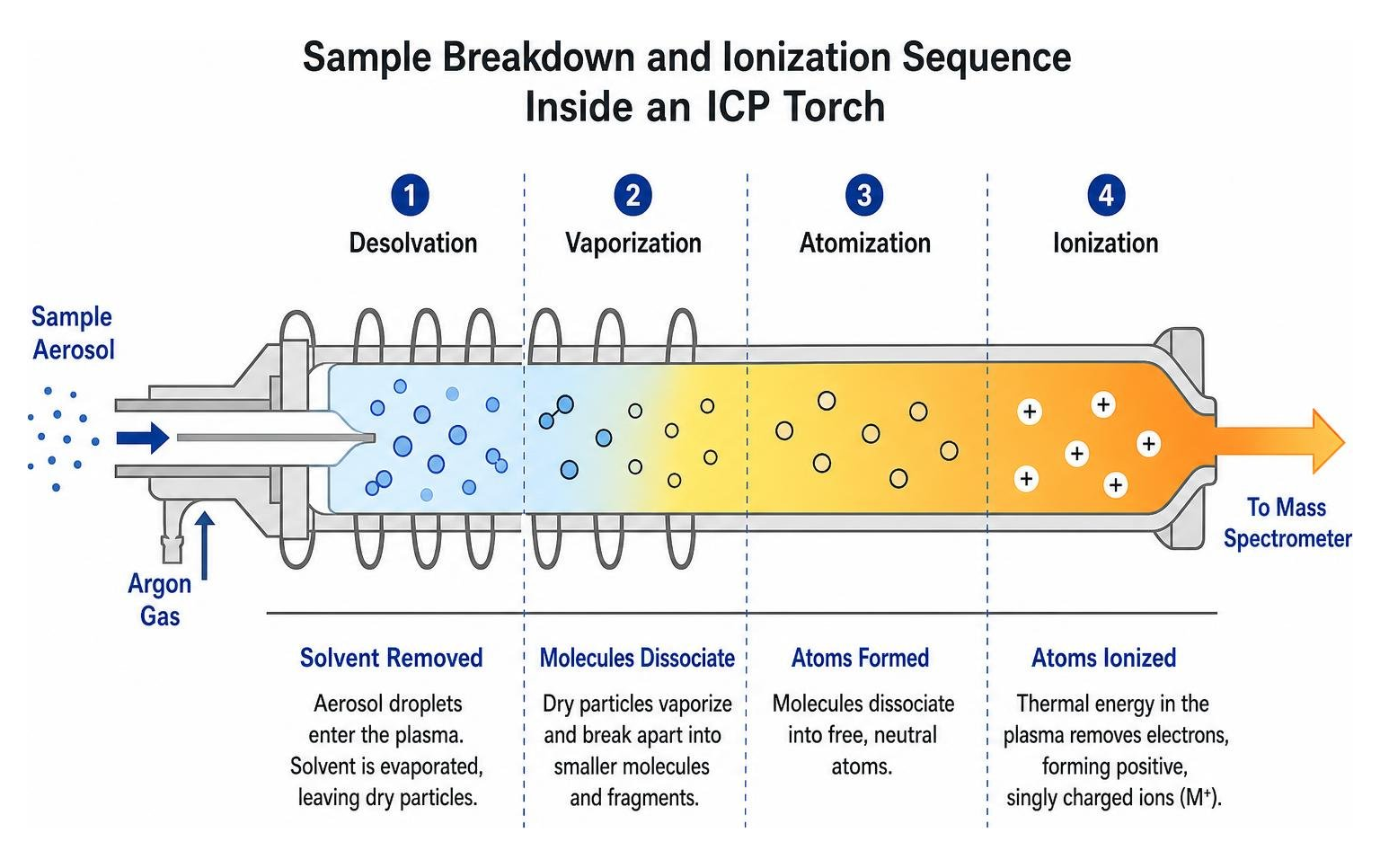
Sample Introduction and Plasma Ionization
Before any element can be weighed, it must reach the plasma torch in a finely dispersed physical state. Liquid samples are drawn up through a peristaltic pump and directed into a pneumatic nebulizer. Here, a high-velocity stream of argon gas shatters the liquid stream into a fine aerosol mist.
Because large droplets cool down the plasma and destabilize the discharge, this mist passes through a spray chamber (such as a Scott double-pass or cyclonic design). The spray chamber filters out droplets larger than roughly 5 to 10 micrometers, allowing only the finest fraction—often just 1% to 2% of the original sample volume—to travel into the central injector tube of the plasma torch. We take a closer look at these thermal mechanics in ICP-MS Explained: How We Weigh Atoms in a Plasma Fire.
As this fine aerosol enters the core of the 6000 K argon plasma, it undergoes a four-stage transformation in milliseconds:
- Desolvation: Liquid solvent evaporates, leaving dry, solid microscopic salt crystals.
- Vaporization: Solid particles vaporize into neutral gaseous molecules.
- Atomization: Molecular bonds dissociate completely into free, isolated ground-state atoms.
- Ionization: Free atoms collide with energetic argon electrons and ions, losing an electron to become positively charged mono-elemental ions.
Because the first ionization potential of argon is 15.76 eV, the plasma efficiently ionizes metals, metalloids, and non-metals with high ionization energies, including sulfur, phosphorus, and halogens.
Interface Region, Vacuum Transfer, and Ion Optics
The transition from an atmospheric pressure plasma (~760 Torr) at 6000 K to a high-vacuum mass analyzer ($10^{-5}$ to $10^{-7}$ Torr) at room temperature is one of the most remarkable engineering achievements in modern analytical chemistry. This transition happens across the interface region, which consists of two sequentially placed, water-cooled metal cones:
- The Sampler Cone: A nickel or platinum cone with a small central orifice (typically 1.0 mm in diameter) positioned right against the hot plasma discharge. A fraction of the expanding gas passes through this aperture into a rough vacuum chamber pumped down to approximately 1 to 2 Torr.
- The Skimmer Cone: Positioned directly behind the sampler cone, this cone has a sharper profile and an even narrower opening (typically 0.4 to 0.5 mm). It extracts only the central, most representative core of the supersonic ion beam as it expands into the high-vacuum transfer stage.
Once past the skimmer cone, the positively charged ions enter an electrostatic lens assembly (often called ion optics). These electrostatic lenses focus the divergent ion stream into a tight, coherent beam, accelerating the positive ions forward while repelling residual electrons.
Crucially, the plasma also produces an intense stream of photons (ultraviolet and visible light) and un-ionized neutral particles. If these hit the detector, they produce high background noise. Modern instruments incorporate off-axis ion mirrors, curved chicane lenses, or physical photon stops that steer the charged ions around a bend while letting neutral species and photons fly straight into non-reflective internal baffles.
Core Components and Mass Analyzer Technologies
After the ion beam is extracted, focused, and cleared of neutral debris, the ions enter the mass spectrometer stage, where they are sorted and quantified according to their mass-to-charge ratio ($m/z$).
A deeper look into these hardware architectures is available in our detailed review on The Ins and Outs of Inductively Coupled Plasma Mass Spectrometry, along with industry perspectives discussed in ICP-MS: Instrumentation and Analysis | Technology Networks .
Mass Analyzers Used in ICP Mass Spectrometry
Different analytical problems require different mass separation mechanisms. There are four primary analyzer configurations in common use:
Quadrupole Mass Filters (ICP-QMS): The workhorse of commercial testing. A quadrupole consists of four parallel hyperbolic or cylindrical metal rods. By applying combinations of direct current (DC) and radiofrequency (RF) voltages to opposing pairs of rods, an oscillating electrostatic field is established. Only ions of a single, specific $m/z$ maintain a stable flight trajectory to pass through the rods and hit the detector; all other ions collide with the rods or are deflected out of the path. By scanning the voltages rapidly across the mass range, a quadrupole scans from mass 1 (Hydrogen) to mass 260 (Uranium and beyond) in a fraction of a second.
High-Resolution Sector Field Analyzers (SF-ICP-MS): Sector field instruments combine an electrostatic analyzer (ESA) with an electromagnet. The magnetic field bends the paths of incoming ions based on their momentum, separating different masses along curved trajectories, while the electrostatic analyzer focuses their kinetic energies. By adjusting the entrance and exit slit widths, sector field instruments achieve high mass resolution ($m/\Delta m > 10,000$), physically resolving tiny mass differences between analytes and interfering polyatomic ions.
Multi-Collector Sector Field Systems (MC-ICP-MS): Multi-collector systems use a magnetic sector analyzer combined with an array of adjustable Faraday cups and discrete electron multipliers. This allows the instrument to detect multiple isotopes simultaneously rather than sequentially. Simultaneous detection cancels out natural plasma flicker and drift, delivering isotope ratio precision that matches traditional Thermal Ionization Mass Spectrometry (TIMS).
Time-of-Flight Analyzers (ICP-TOFMS): In a TOF analyzer, packets of ions are accelerated into a field-free drift tube by a high-voltage electrical pulse. Because all ions receive the same initial kinetic energy, lighter ions travel faster and reach the detector sooner than heavier ions ($KE = \frac{1}{2}mv^2$). TOF instruments can capture the full elemental mass spectrum virtually simultaneously at extraction frequencies exceeding 30 kHz. This makes them ideal for analyzing ultra-fast transient signals, such as single nanoparticles, single biological cells, and high-speed laser ablation pulses.
Resolving Spectral Overlaps and Isobaric Interferences
While ICP-MS provides exceptional sensitivity, it must contend with spectral interferences. These occur when an unwanted ion has the same nominal mass-to-charge ratio as the target analyte isotope. These interferences fall into three distinct classes:
- Isobaric Overlaps: Different elemental isotopes that share the same nominal atomic mass (e.g., $^{58}\text{Ni}^+$ and $^{58}\text{Fe}^+$).
- Polyatomic (Molecular) Ions: Chemical species formed in the plasma or interface region by combinations of matrix, plasma gas, and atmospheric elements (e.g., $^{40}\text{Ar}^{16}\text{O}^+$ overlapping $^{56}\text{Fe}^+$, or $^{40}\text{Ar}^{35}\text{Cl}^+$ overlapping monoisotopic $^{75}\text{As}^+$).
- Doubly Charged Ions: Ions formed when an atom loses two electrons ($M^{2+}$). These appear at half their actual atomic mass (e.g., $^{150}\text{Nd}^{2+}$ and $^{150}\text{Sm}^{2+}$ appearing at $m/z = 75$, directly interfering with $^{75}\text{As}^+$).
To eliminate these interferences, modern instruments use Collision/Reaction Cells (CRCs) and Tandem Mass Spectrometry (ICP-MS/MS or ICP-QQQ):
- Collision Mode via Kinetic Energy Discrimination (KED): The cell is pressurized with an inert gas, typically helium (He). Polyatomic interfering ions have larger physical ionic radii than single-element analyte ions of the same mass. As the mixed ion beam passes through the helium gas, the larger polyatomic ions collide more frequently with helium atoms, losing kinetic energy much faster than the compact atomic analyte ions. An electrostatic energy barrier at the exit of the cell repels the low-energy polyatomic species while letting the higher-energy elemental ions pass through to the analyzer.
Reaction Mode and Mass Shifting via ICP-MS/MS (Triple Quadrupole): For interferences that cannot be separated by collision alone, reactive gases such as oxygen ($\text{O}_2$), hydrogen ($\text{H}_2$), ammonia ($\text{NH}_3$), or methane ($\text{CH}_4$) are introduced into the cell. In a triple-quadrupole system, the first quadrupole (Q1) acts as a strict 1-amu mass filter, isolating only the mass of interest. The ions then enter the reaction cell (Q2), where the analyte or interference reacts with the gas.
For example, when measuring trace $^{75}\text{As}^+$ in a sample rich in rare earth elements (which form doubly charged $^{150}\text{Nd}^{2+}$ and $^{150}\text{Sm}^{2+}$ at $m/z = 75$), Q1 allows only $m/z = 75$ into the cell. Oxygen gas inside the cell rapidly reacts with arsenic to form $^{75}\text{As}^{16}\text{O}^+$ at $m/z = 91$, while the rare earth ions do not react. The final quadrupole (Q3) is set to pass $m/z = 91$, successfully measuring the arsenic as an oxide without rare earth or argon chloride interferences.
ICP-MS vs. Alternative Elemental Analysis Techniques
Analytical laboratories evaluate several competing spectroscopic methods when selecting testing protocols for trace and bulk elemental analysis.

For a practical guide to selecting the right method for your workflow, read ICP Analysis for Heavy Metals: Choosing Between ICP-OES and ICP-MS. You can also review laboratory matching principles in Induced Coupled Plasma: Finding the Perfect Match for Your Lab and explore detection threshold engineering in our In-Depth Guide to Low Detection Limits.
ICP-MS Compared to ICP-OES and AAS
Inductively Coupled Plasma Optical Emission Spectrometry (ICP-OES) and Flame or Graphite Furnace Atomic Absorption Spectroscopy (FAAS/GFAAS) are common alternatives. Each technique serves specific analytical needs depending on sample volume, concentration, and matrix complexity:
| Analytical Parameter | ICP-MS (Quadrupole / MS/MS) | ICP-OES | Graphite Furnace AAS (GFAAS) | Flame AAS (FAAS) |
|---|---|---|---|---|
| Typical Detection Limits | Sub-ppt to low-ppb ($<0.1\text{–}10\text{ ng/L}$) | Mid-ppb to ppm ($0.1\text{–}10\text{ }\mu\text{g/L}$) | Sub-ppb to ppb ($0.01\text{–}1\text{ }\mu\text{g/L}$) | High-ppb to ppm ($0.01\text{–}1\text{ mg/L}$) |
| Multi-Element Capability | Full suite ($>70$ elements simultaneously) | Full suite ($>70$ elements simultaneously) | Sequential single-element (slow) | Sequential single-element |
| Linear Dynamic Range | 9 to 11 orders of magnitude | 5 to 6 orders of magnitude | 2 to 3 orders of magnitude | 3 orders of magnitude |
| Total Dissolved Solids (TDS) | Typically $<0.2\%$ ($2000\text{ mg/L}$) | Up to $20\%\text{–}30\%$ ($>200,000\text{ mg/L}$) | Up to $1\%\text{–}5\%$ | Up to $1\%\text{–}5\%$ |
| Isotopic Analysis | Yes (direct isotope ratios & IDMS) | No (optical emission only) | No | No |
| Sample Throughput | High ($1\text{–}3\text{ minutes/sample}$) | Very High ($30\text{–}60\text{ seconds/sample}$) | Low ($3\text{–}5\text{ minutes/element}$) | High for single elements |
ICP-MS is the gold standard when testing requires ultra-trace quantification (parts-per-trillion or lower), isotopic characterization, or multi-element screening in small sample volumes. However, for samples with high total dissolved solids—such as saturated brines, plating baths, or metal alloys—ICP-OES is often preferred because its optical hardware can tolerate dirty matrices without cone clogging or signal suppression.
Advanced Modalities and Real-World Applications
Beyond standard liquid testing, modern ICP mass spectrometers interface with separation systems, lasers, and custom inlets to address complex analytical challenges.

Discover our specialized testing frameworks in Elemental My Dear Watson: A Guide to ICP Metal Analysis and Unlocking the Elements with ICP Laboratory Analysis. For regulatory screening and environmental testing protocols, explore From H2O to Heavy Metals: A Guide to ICP-MS Water Analysis and Heavy Metal Analysis by ICP-MS: The Ultimate Guide to Screening Toxins.
Laser Ablation and Direct Solid Bioimaging
Laser Ablation ICP-MS (LA-ICP-MS) allows direct analysis of solid samples without acid digestion. A pulsed, deep-ultraviolet laser beam (typically emitting at 193 nm or 213 nm wavelengths) is focused onto the sample surface inside an airtight ablation chamber. The laser pulse vaporizes a small volume of material, creating a fine aerosol. A carrier gas stream of helium sweeps this aerosol out of the ablation chamber and transports it into the ICP torch for ionization.
Laser spot diameters can be adjusted from below 5 micrometers up to 300 micrometers. By moving the laser across a sample in a continuous raster grid, LA-ICP-MS generates quantitative 2D and 3D elemental maps of solid materials. Key applications include:
- Geological Provenance and Chronology: Measuring intra-mineral trace element zoning and uranium-lead ($^{238}\text{U}\text{-}^{206}\text{Pb}$) ratios in zircon crystals to date rock formations.
- Biomedical Tissue Imaging: Mapping the distribution of toxic or therapeutic heavy metals (such as platinum from cisplatin chemotherapy drugs) across cancerous tumors and healthy organ sections.
- Wildlife Ecology: Tracking seasonal migration routes by ablating growth layers in fish otoliths (ear bones) or caribou teeth to measure microscale changes in strontium isotope ratios ($^{87}\text{Sr}/^{86}\text{Sr}$).
To learn more about laser parameters, optical spot sizing, and ablation cell designs, read What is Laser Ablation ICP-MS and How Does It Work?.
Single-Particle and Single-Cell ICP Mass Spectrometry
Single-Particle ICP-MS (SP-ICP-MS) and Single-Cell ICP-MS (SC-ICP-MS) count and quantify individual micro- and nano-entities suspended in liquid samples:
- Single-Particle Mode (SP-ICP-MS): When a sample containing metal or metal-oxide nanoparticles (e.g., silver, gold, titanium dioxide, or microplastics) is introduced into the plasma at high dilution, each nanoparticle is vaporized and ionized as a single, discrete packet of ions. This produces a brief ion cloud that yields a signal pulse lasting a few hundred microseconds. By operating the mass spectrometer with microsecond dwell times, each pulse is recorded as an individual event. The frequency of pulses indicates particle concentration, while the height and integrated area of each pulse correspond to the mass and size of the individual nanoparticle (detecting particles as small as 10 to 20 nm).
- Single-Cell Mass Cytometry (CyTOF): Single-cell mass spectrometry uses elemental tagging to analyze biological systems. Monoclonal antibodies are labeled with high-purity, stable rare-earth metal isotopes (such as lanthanides) and incubated with cells. As individual cells pass sequentially through the plasma, the metal tags are ionized and measured. Because the mass spectrometer easily separates distinct atomic isotopes without the spectral overlap common to fluorescent dyes, mass cytometry can quantify over 40 distinct protein biomarkers simultaneously in single cells at high throughput.
For research and biomedical perspectives on single-cell mass spectrometry applications, explore the analytical work supported by the Center for Environmental and Systems Biochemistry | Mass Spectrometry and the clinical research teams at the Mass Spectrometry | University of Kentucky College of Medicine .
Elemental Speciation and Isotopic Analysis
Standard total-element quantification cannot distinguish between different chemical or oxidation states of an element—even though toxicity often depends entirely on chemical form. For instance, while inorganic Arsenic(III) is highly toxic, organic arsenobetaine found in seafood is virtually harmless. Similarly, hexavalent Chromium(VI) is a potent carcinogen, whereas trivalent Chromium(III) is an essential nutrient.
To determine chemical speciation, an upstream chromatographic separation system—such as High-Performance Liquid Chromatography (HPLC), Gas Chromatography (GC), or Capillary Electrophoresis (CE)—is coupled directly to the ICP-MS inlet. The chromatograph separates the intact chemical species over time, and the mass spectrometer detects the elemental constituents as they elute, providing sensitive species-specific quantification.
ICP-MS is also widely used for high-precision isotope ratio analysis. Applications include verifying the geographical origin of food products, identifying industrial lead contamination sources via lead isotope ratios ($^{206}\text{Pb}, ^{207}\text{Pb}, ^{208}\text{Pb}$), and conducting Isotope Dilution Mass Spectrometry (IDMS).
In IDMS, a known quantity of an enriched, stable isotope is added directly to the sample prior to preparation. Because chemical losses, matrix suppression, and instrument drift affect both the natural and enriched isotopes equally, measuring the altered isotope ratio provides exceptionally accurate quantification.
To explore geochronological dating and isotopic fingerprinting in detail, read Unlocking Geological Secrets with Isotope Ratio ICP-MS. For calibration design and quality control practices, consult our ICP-MS Lab Guide: How to Get Accurate Trace Element Testing.
Frequently Asked Questions About ICP-MS
What detection limits can ICP-MS achieve compared to optical techniques?
ICP-MS achieves detection limits in the sub-parts-per-trillion (sub-ppt or $<0.1\text{ to }10\text{ ng/L}$) range for most elements on the periodic table. By directly counting ionized atoms rather than measuring emitted light photons (as in ICP-OES), ICP-MS provides 100 to 1,000 times higher sensitivity and better signal-to-noise ratios for ultra-trace quantification.
How does tandem mass spectrometry (ICP-MS/MS) eliminate mass interferences?
Tandem mass spectrometry uses two mass filters in series with an intermediate reaction cell (a Q1-Cell-Q2 design). Q1 filters out all ions except the specific nominal mass of interest before the beam enters the reaction cell. Inside the cell, target analyte ions or interfering species react with a gas (such as $\text{O}_2$, $\text{NH}_3$, or $\text{H}_2$) to shift masses, while the unreactive species remain unchanged. Q2 then filters for the new mass, eliminating isobaric and polyatomic spectral overlaps.
Can ICP-MS analyze solid samples without acid digestion?
Yes. Solid samples can be analyzed directly by coupling a pulsed laser ablation (LA) system to the ICP-MS. The laser uses focused ultraviolet light to vaporize micro-scale quantities of material from the sample surface. An inert helium carrier gas sweeps this ablated aerosol directly into the plasma torch, enabling non-destructive surface profiling, depth analysis, and 2D/3D chemical mapping.
Conclusion

Inductively coupled plasma mass spectrometry remains one of the most capable tools in modern analytical chemistry. By combining the high-temperature ionization of an argon plasma with the sensitivity of mass spectrometry, ICP-MS enables multi-element quantification down to the parts-per-trillion level. With modern collision/reaction cells, tandem triple-quadrupole configurations, laser ablation sampling, and single-cell detection, it continues to address complex testing challenges across environmental testing, biomedical research, advanced manufacturing, and materials science.
At Elemental Analysis Inc., based in Lexington, Kentucky, we combine high-precision destructive and non-destructive testing methodologies to solve complex analytical problems. As the first commercial laboratory to offer Proton-Induced X-ray Emission (PIXE) alongside advanced ICP testing platforms, we deliver comprehensive trace element identification, quantification, and speciation services with rapid turnaround times and competitive pricing. Contact our scientific team today to discuss your testing requirements and configure the right analytical approach for your samples.