
Unlocking Geological Secrets with Isotope Ratio ICP MS
Why Isotope Ratio ICP-MS Is a Cornerstone of Modern Elemental Analysis
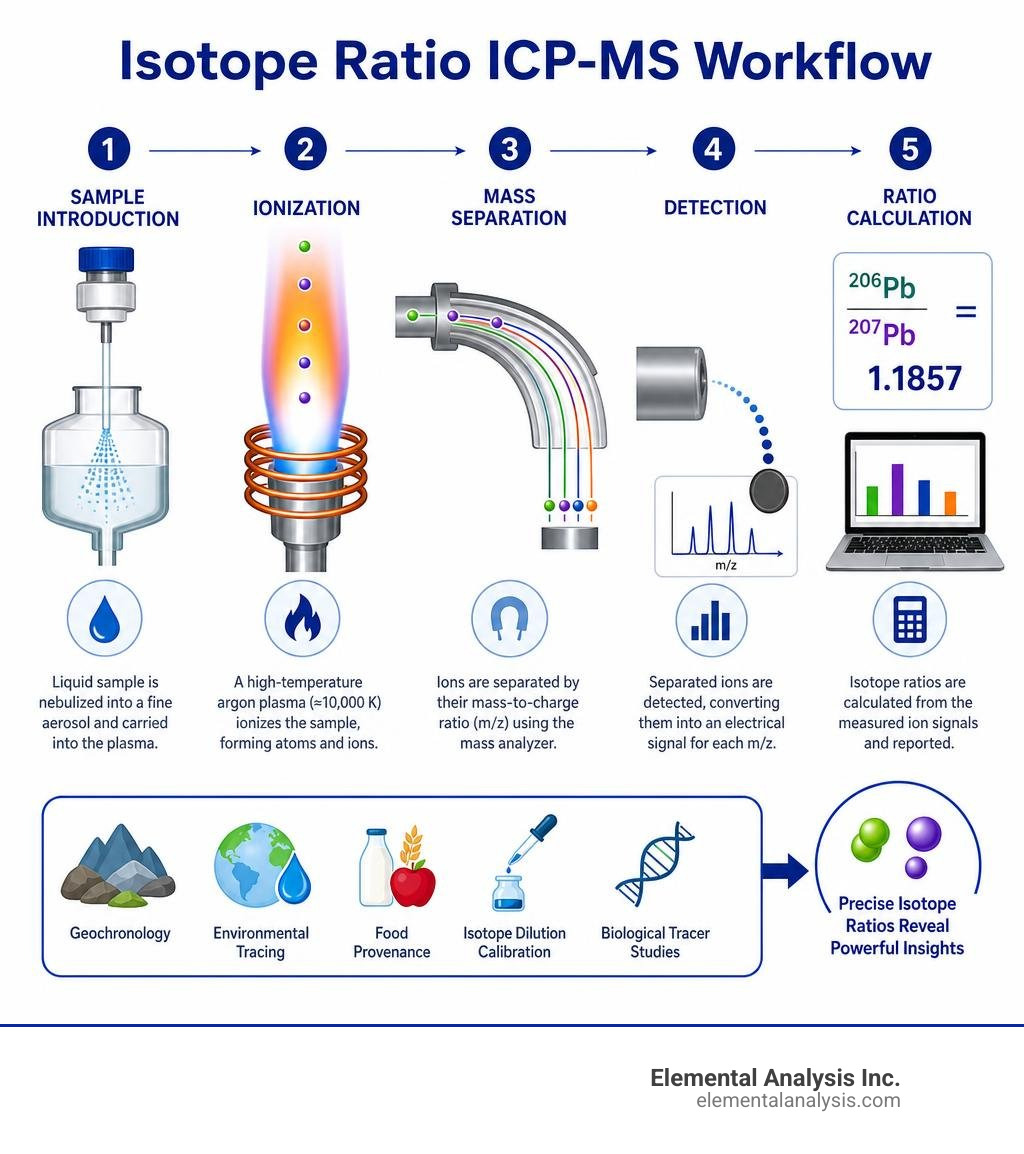
Isotope ratio ICP-MS is a technique that measures the relative abundances of different isotopes of an element within a sample — using an inductively coupled plasma source to ionize the sample and a mass spectrometer to separate and detect those ions by mass-to-charge ratio.
Here is a quick summary of what you need to know:
- What it measures: The ratio between two or more isotopes of the same element (e.g., ²⁰⁶Pb/²⁰⁷Pb)
- Why it matters: Isotope ratios reveal information that pure elemental concentrations cannot — including sample origin, age, contamination source, and metabolic pathways
- Main instrument types: Quadrupole (ICP-QMS), sector-field (ICP-SFMS), and multi-collector (MC-ICP-MS) — each offering different levels of precision
- Precision range: From ~0.1% RSD with optimized quadrupole systems to below 0.002% RSD with MC-ICP-MS
- Core applications: Geochronology, environmental tracing, food provenance, isotope dilution calibration, and biological tracer studies
ICP-MS was first introduced commercially in 1983 as an ultra-trace elemental analysis tool. But as a mass spectrometric technique, it also delivers something that atomic absorption and optical emission methods simply cannot: isotopic information on every element it detects.
That distinction turns out to be enormously powerful. A single ICP-MS run can tell you not just how much lead is in a soil sample, but where that lead came from — based on the unique fingerprint of its isotope ratios. The same principle applies whether you are dating a mineral grain, tracking magnesium transport across a cell membrane, or verifying the authenticity of a food product.
For lab supervisors managing complex analytical workflows across aerospace, pharma, or environmental testing, isotope ratio ICP-MS can consolidate multiple testing needs into a single, highly informative measurement platform.
Common isotope ratio ICP MS vocab:
Fundamental Principles of Isotope Ratio ICP MS
To understand how we unlock geological and environmental secrets, we must look at how mass spectrometry identifies individual isotopes. While basic elemental analysis counts the total number of atoms of a specific element, isotope ratio mass spectrometry separates those atoms by their precise mass.
In an inductively coupled plasma mass spectrometer (ICP-MS), the argon plasma operates at temperatures between 6,000 K and 10,000 K. This is hot enough to atomize and ionize almost every element in the periodic table. Once ionized, the isotopes of an element are directed into a mass analyzer, which filters them based on their mass-to-charge ($m/z$) ratio. To explore how this process unfolds from sample introduction to final detection, check out The Ins and Outs of Inductively Coupled Plasma Mass Spectrometry.
Understanding Stable Isotopes and Natural Variations
Isotopes of the same element share the same number of protons but differ in their neutron count. This slight mass difference leads to physical and chemical variations known as isotopic fractionation.
Isotopic fractionation occurs via two primary pathways:
- Kinetic effects: Lighter isotopes have higher vibrational velocities, allowing them to react or diffuse faster than their heavier counterparts.
- Thermodynamic equilibrium: Heavier isotopes tend to concentrate in chemical states where the binding energy is strongest, typically in more condensed phases or higher oxidation states.
These processes cause natural variations in stable isotopes (such as boron, calcium, and zinc) as well as radiogenic isotopes (such as strontium and lead) that accumulate over time from radioactive decay. By measuring these subtle variations, we can “let the isotopes do the talking” to trace environmental pollutants, map agricultural provenance, and reconstruct historical climates, as detailed in ICP-mass spectrometry: Let the isotopes do the talking!.
Key Terminology in Isotope Ratio ICP MS
To navigate isotope ratio studies, a few key terms are essential:
- Abundance Ratio ($R$): The ratio of the number of atoms of a minor isotope to a reference major isotope (e.g., $^{87}\text{Sr}/^{86}\text{Sr}$).
- Delta Notation ($\delta$): Expressed in parts per thousand (per mil, $\text{‰}$), this represents the relative deviation of a sample’s isotope ratio from an international standard: $$\delta = \left( \frac{R_{\text{sample}}}{R_{\text{standard}}} – 1 \right) \times 1000$$
- Isotopic Enrichment / Spiking: The deliberate addition of an artificially enriched stable isotope to a sample, which forms the basis of isotope dilution techniques.
For a deeper dive into the physics of how we distinguish these atomic masses, see ICP-MS Explained: How We Weigh Atoms in a Plasma Fire.
Comparing Mass Analyzers: Quadrupole, Sector-Field, and Multi-Collector Systems
Choosing the right mass analyzer is a balance of precision, speed, and budget. The table below highlights the core differences among the three primary configurations used for isotope ratio ICP MS.
| Parameter | Quadrupole (ICP-QMS) | Sector-Field (ICP-SFMS) | Multi-Collector (MC-ICP-MS) |
|---|---|---|---|
| Detection Method | Sequential | Sequential (high-speed) | Simultaneous |
| Mass Resolution | Low (~1,000) | High (up to 10,000) | Moderate to High |
| Typical Precision (RSD) | 0.1% – 0.5% | 0.02% – 0.1% | < 0.002% |
| Primary Use Case | Fast screening, tracers, IDMS | High-resolution trace analysis | Ultra-precise natural variations |
For a broader perspective on selecting the right plasma system for your laboratory, refer to An Essential Guide to Inductively Coupled Plasma.
Single-Collector Quadrupole ICP-MS (ICP-QMS)
Quadrupole systems are the workhorses of analytical chemistry. They use alternating AC and DC electrical fields to filter ions sequentially. Because a quadrupole can only measure one mass at a time, it must rapidly switch between isotopes.
While this sequential detection introduces “spectral noise” from plasma fluctuations, optimized ICP-QMS methods can deliver surprisingly high precision. For instance, researchers have demonstrated that optimized quadrupole setups can achieve relative standard deviation (RSD) values below 0.1% for $^{206}\text{Pb}/^{207}\text{Pb}$ and below 0.15% for $^{208}\text{Pb}/^{206}\text{Pb}$ ratios in NIST 1515 apple leaves reference material. Similarly, RSD values for $^{208}\text{Pb}/^{206}\text{Pb}$ ratios in CRM 482 lichen ranged below 0.15%.
These achievements, highlighted in ICP-QMS for lead isotopic analysis: Method development and key parameters – ScienceDirect, show that ICP-QMS is a highly capable and cost-effective alternative to multi-collector systems for screening and moderate-precision applications.
Sector-Field ICP-MS (ICP-SFMS)
Sector-field instruments utilize a combination of magnetic and electrostatic sectors to focus ions both by direction and energy (double focusing). This geometry eliminates energy spread and yields flat-topped peaks, making minor drifts in mass calibration inconsequential.
A key challenge in single-collector ICP-SFMS is that sequential measurement makes the system susceptible to flicker noise (source noise from the plasma). When optimizing dwell times, relying solely on Poisson (shot) noise statistics can lead to biased precision estimates if flicker noise is present. Nonetheless, sector-field instruments excel at resolving spectral interferences without chemical separation, as discussed in Isotope abundance ratio measurements by inductively coupled plasma-sector field mass spectrometry – Journal of Analytical Atomic Spectrometry (RSC Publishing).
Multi-Collector ICP-MS (MC-ICP-MS)
When the highest possible precision is required to measure natural isotopic fractionation, multi-collector systems are the gold standard. Instead of a single detector, MC-ICP-MS instruments feature an array of faraday cups or electron multipliers that detect multiple ion beams simultaneously.
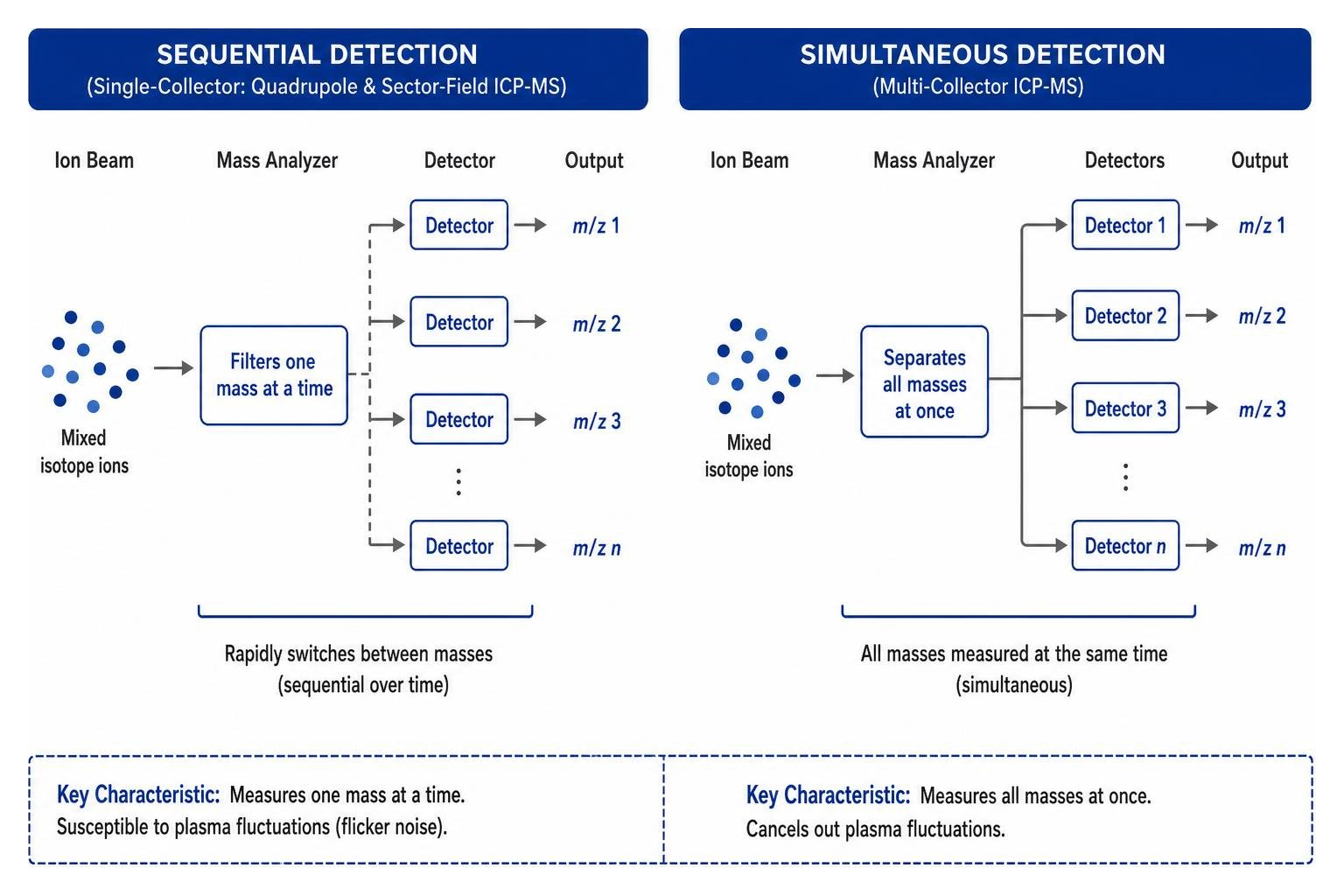
By monitoring all isotopes at the exact same instant, MC-ICP-MS completely cancels out plasma flicker noise. This simultaneous detection allows the system to achieve isotope ratio RSDs down to 0.002% and lower, enabling geochemists to resolve tiny variations in heavy elements like iron, copper, and zinc. For an in-depth comparison of single and multi-collector capabilities, consult Use of single-collector and multi-collector ICP-mass spectrometry for isotopic analysis – Journal of Analytical Atomic Spectrometry (RSC Publishing).
Minimizing Bias and Optimizing High-Precision Measurements
Achieving high-precision isotope ratios requires identifying and correcting for several physical and instrumental biases. To learn more about standard trace-level quality control, read our ICP-MS Lab Guide: How to Get Accurate Trace Element Testing.
Sources of Bias in Isotope Ratio ICP MS
Several systematic offsets can affect measurements:
- Mass Discrimination (Mass Bias): Heavy ions are transmitted through the ion optics and interface region more efficiently than lighter ions. This creates a systematic bias toward heavier isotopes.
- Detector Dead Time: After registering an ion arrival, a pulse-counting detector requires a brief recovery period (typically 10–50 ns). If not corrected, this dead time leads to undercounting of high-abundance isotopes relative to low-abundance ones.
- Abundance Sensitivity: The tail of a high-intensity peak can spill over into an adjacent mass channel, artificially elevating the count rate of a neighboring minor isotope.
- Spectral Interferences: Isobaric interferences (isotopes of different elements sharing the same mass, like $^{87}\text{Rb}$ on $^{87}\text{Sr}$) and polyatomic interferences (like $^{40}\text{Ar}^{16}\text{O}^{+}$ on $^{56}\text{Fe}^{+}$) must be resolved or mathematically corrected.
Sample Preparation and Matrix Separation
Because matrix elements can alter ionization efficiency and mass bias behavior in the plasma, high-precision work requires isolating the analyte from the sample matrix.
This is typically accomplished in a cleanroom environment using ion exchange chromatography. For example, separating strontium from rubidium is essential before measuring $^{87}\text{Sr}/^{86}\text{Sr}$ ratios. Removing the matrix ensures that the standard and sample behave identically during ionization.
Mass Bias Correction and Bracketing Standards
To correct for mass discrimination, analysts use three primary mathematical models: linear, power, and exponential laws.
The correction relies on two main strategies:
- Standard-Sample Bracketing (SSB): Measuring an isotopic reference standard (such as NIST SRM 981 for lead) before and after the sample to correct for temporal drift.
- Internal Normalization: Adding an element of known isotopic composition (e.g., adding thallium to correct for lead mass bias) and using its ratio to correct the analyte.
Standard-sample bracketing is particularly crucial for instruments like second-generation ICP-TOFMS, which can exhibit non-mass-dependent fractionation. In these systems, standard-sample bracketing corrects for both mass-dependent and mass-independent fractionation behaviors.
Key Applications: From Isotope Dilution to Single-Particle Analysis
By looking past simple elemental concentrations, we can apply isotope ratio ICP MS to solve complex challenges in geology, biology, and environmental science. Explore these capabilities in ICP-MS Testing: Unleashing the Power of Plasma for Elemental Analysis.
Isotope Dilution Mass Spectrometry (IDMS)
Isotope dilution is a highly accurate calibration method. The process is straightforward:
- A known amount of an artificially enriched isotope (the “spike”) is added to the sample.
- The sample and spike are allowed to equilibrate chemically.
- The altered isotope ratio is measured.
Because you are measuring a ratio rather than an absolute intensity, any loss of analyte during subsequent sample preparation or matrix separation does not affect the final concentration calculation. This makes IDMS an invaluable tool for certifying reference materials and performing high-accuracy assays.
Stable Isotope Tracers in Biological and Environmental Systems
Stable isotope tracers allow us to track elements through complex systems without using radioactive materials.
- Biological Transport: Researchers use stable magnesium or zinc tracers to study uptake pathways in aquatic organisms or nutrient transport across cell membranes.
- Biomarkers: Measuring isotopic shifts in clinical samples can serve as early diagnostic biomarkers for metabolic disorders.
- Environmental Tracing: Natural variations in boron isotopes help monitor seawater acidity, while calcium isotope ratios in milk can be tracked using specialized instrumentation to verify agricultural origins.
Radiogenic Isotopes in Provenance and Geochronology
Radiogenic isotopes act as natural clocks and geographic fingerprints. Because strontium isotopes ($^{87}\text{Sr}/^{86}\text{Sr}$) vary depending on local bedrock age and composition, comparing these ratios in tooth enamel (which records childhood diet) versus dentine (which records later life) helps archaeologists reconstruct ancient human migration patterns.
In geochronology, laser ablation ICP-MS (LA-ICP-MS) allows us to measure uranium, thorium, and lead isotopes directly within microscopic mineral grains like zircon. For more on how laser systems couple with mass spectrometers, see What is Laser Ablation ICP-MS and How Does it Work?.
Single-Particle Analysis via spICP-TOFMS
A major advance in mass spectrometry is single-particle ICP-time-of-flight mass spectrometry (spICP-TOFMS). This technique allows us to measure the multi-isotopic signature of individual sub-micron particles suspended in liquid.
Recent research has shown that:
- For Sm isotopes in monazite particles (containing 0.04 to 4 fg of Sm), spICP-TOFMS achieved isotope-ratio precision (RSD) ranging from 43% down to 5%.
- For lead isotopes ($^{208}\text{Pb}/^{206}\text{Pb}$) in galena particles (containing 1.4 to 80 fg of Pb), the RSD ranged from 32% down to 2%.
This level of single-particle precision is governed by Poisson statistics, meaning precision improves with larger particles and higher ion counts. This high-throughput method is opening new doors in geochronology, environmental source tracking, and nuclear forensics, as detailed in Isotopic ratio analysis of individual sub-micron particles via spICP-TOFMS – Journal of Analytical Atomic Spectrometry (RSC Publishing) DOI:10.1039/D4JA00121D.
Frequently Asked Questions about Isotope Ratio Analysis
What is the difference between single-collector and multi-collector ICP-MS for isotope ratios?
Single-collector systems (like quadrupole and sector-field instruments) measure isotopes sequentially by rapidly switching between masses. This is highly flexible and cost-effective, but it limits precision to around 0.1%–0.05% RSD due to plasma source noise. Multi-collector systems measure all isotopes simultaneously, canceling out plasma noise and pushing precision down to $<0.002\%$ RSD.
Why is matrix separation necessary for high-precision isotope ratio measurements?
The sample matrix (dissolved salts, acids, and co-existing elements) can alter mass discrimination behavior in the plasma and cause spectral interferences. Separating the analyte from the matrix using ion chromatography ensures that standards and samples behave identically in the instrument, maintaining stable mass bias corrections.
How does isotope dilution improve calibration accuracy in ICP-MS?
Isotope dilution relies on measuring isotope ratios rather than absolute signal intensities. Once the sample and the enriched isotopic spike are fully equilibrated, any physical drift, signal suppression, or physical loss of sample during clean-up steps will affect both isotopes equally, leaving the measured ratio—and the calculated concentration—undisturbed.
Conclusion
At Elemental Analysis Inc., located in Lexington, Kentucky, we leverage advanced mass spectrometry to deliver trace element identification, quantification, and speciation services across a wide range of industries. As the first commercial PIXE laboratory, our unique selling proposition is providing high-quality testing with fast turnaround times and competitive pricing.
Whether you need to verify material provenance, perform absolute quantification via isotope dilution, or characterize geological samples, our team is equipped to support your analytical goals. Explore our ICP testing services to learn how we can help you unlock the details hidden within your samples.