
Choosing ICP-MS Equipment for Demanding Samples
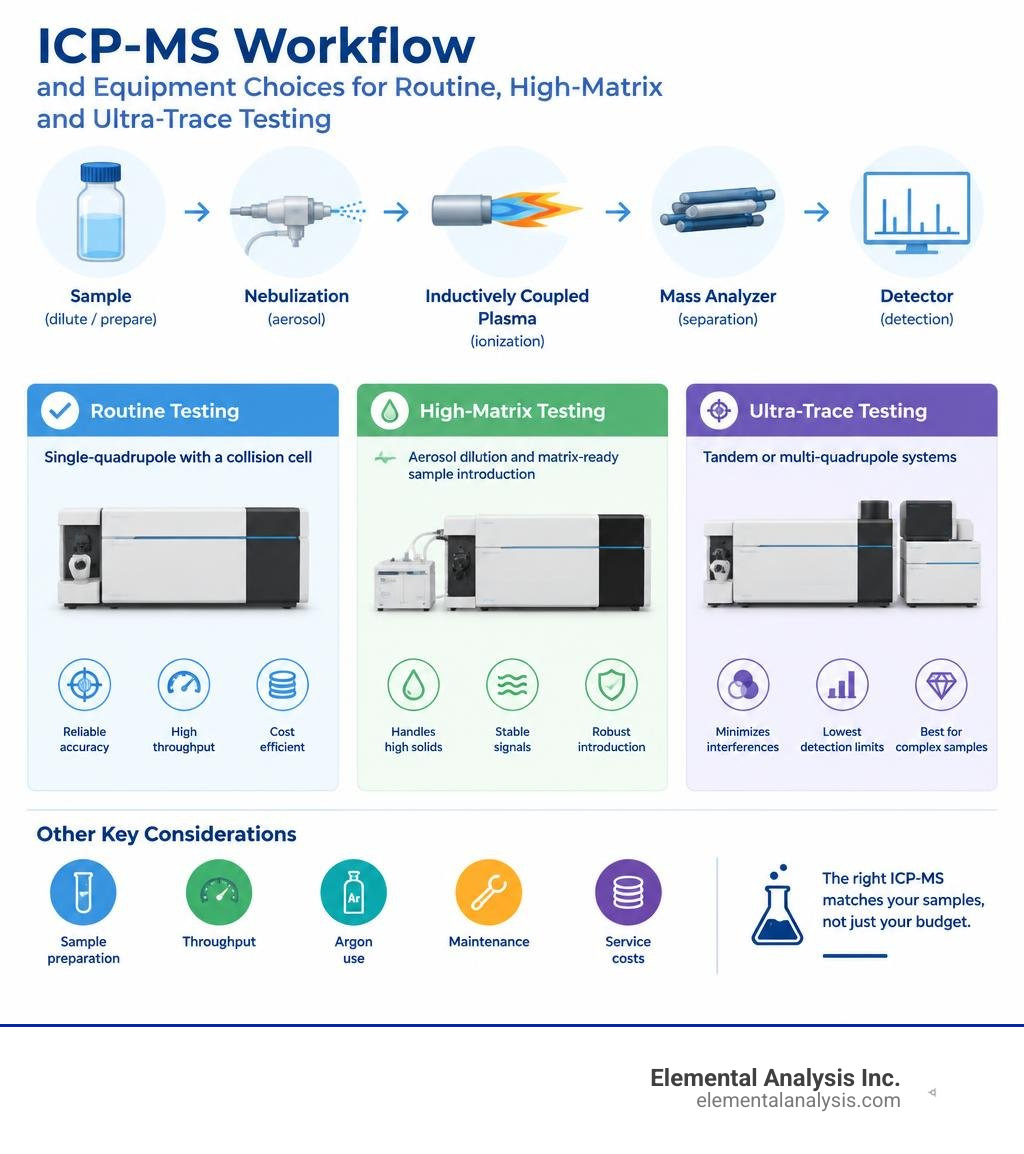
Start with your sample, not the instrument brochure. For routine trace-element testing, a single-quadrupole ICP-MS with a collision cell may be enough. If your samples contain high levels of dissolved solids, look for aerosol dilution and a sample introduction system built for that matrix. If spectral overlaps threaten very low detection limits, compare tandem or multi-quadrupole systems.
ICP-MS measures many elements in one run, often at parts-per-trillion levels. But the best choice also depends on sample preparation, throughput, argon use, maintenance, and service costs. This comparison will help you weigh those trade-offs before you request a demonstration.
Inductively coupled plasma mass spectrometry equipment word list:
- laser ablation ICP MS
- isotope ratio ICP MS
- inductively coupled plasma mass spectrometry disadvantages
Core Architecture of Inductively Coupled Plasma Mass Spectrometry Equipment
To evaluate how different instruments handle tough matrices, it helps to understand the hardware chain from the liquid inlet to the ion detector. Exploring the ins and outs of inductively coupled plasma mass spectrometry reveals six main hardware compartments:
- Sample Introduction System: Liquid samples are drawn through a peristaltic pump into a nebulizer, where a high-velocity argon stream converts the liquid into a fine mist. This aerosol travels through a spray chamber to filter out oversized droplets.
- Inductively Coupled Plasma Torch: The fine aerosol enters a quartz torch surrounded by a copper radio-frequency (RF) load coil. Powered by an RF generator (typically 27 to 40 MHz), high-purity argon gas is ignited into an energetic plasma reaching temperatures between 6,000 and 10,000 Kelvin. At these solar temperatures, sample droplets are desolvated, vaporized, atomized, and stripped of electrons to form positively charged ions.
- Interface Region: Transitioning ions from atmospheric pressure plasma (760 Torr) into a high-vacuum mass analyzer (under 10 to the minus 5 Torr) requires a differential pumping interface. This step utilizes two water-cooled metallic orifices: the sample cone (typical aperture ~1.0 mm) and the skimmer cone (typical aperture ~0.4 to 0.5 mm).
- Ion Optics: After the skimmer cone, electrostatic lenses focus the positively charged ion beam while deflecting photons, neutral species, and particulates away from the mass analyzer path to reduce baseline noise.
- Mass Analyzer: A mass filter separates ions based on their specific mass-to-charge ratio. Quadrupole mass filters, built from four parallel hyperbolic or cylindrical molybdenum/stainless-steel rods, are the industry standard.
- Detector: Ions exiting the mass filter strike an electron multiplier detector. Operating in simultaneous pulse-counting and analog modes, the detector converts ion impacts into measurable electrical pulses across a dynamic range of 8 to 12 orders of magnitude.
Ionization and Sample Transport Dynamics
A surprising truth about conventional liquid nebulization is its low transport efficiency: only about 1% to 2% of the aspirated sample ever reaches the plasma. The remaining 98% to 99% drains out of the spray chamber as liquid waste. Large droplets carry excess solvent load that can destabilize the plasma flame and cause temperature drops.
To keep the plasma stable, laboratories configure specialized sample introduction setups. Learn about how spectrometers manage ions from torch to detector using components like:
- Pneumatic Nebulizers: Concentric glass or perfluoroalkoxy (PFA) nebulizers deliver steady aerosol generation for clean aqueous samples.
- Peltier-Cooled Spray Chambers: Double-pass or cyclonic spray chambers chilled to 2 degrees Celsius actively condense out solvent vapors, lowering oxide formation ratios (like cerium oxide to cerium) below 1.5% to 2.0%.
- Desolvating Nebulizers & Ultrasonic Introduction: For applications requiring elevated sensitivity without matrix loading, desolvating systems strip away solvent before the aerosol reaches the torch, improving analyte delivery rates while suppressing solvent-derived polyatomic interferences.
Interference Mitigation: Collision Cells and Triple-Quad Systems
Spectral interferences have historically been the main challenge in trace elemental analysis. These fall into two groups: isobaric overlaps (different elements sharing the identical nominal atomic mass, such as nickel-58 and iron-58) and polyatomic interferences (plasma or solvent ions binding together, such as argon-40 plus oxygen-16 interfering with iron-56, or argon-40 plus chlorine-35 interfering with arsenic-75).
Modern instruments use collision/reaction cells (CRC) located between the ion optics and the mass analyzer. Understanding how to unlock ultra-trace elemental detection involves two primary cell mechanisms (Wilschefski & Baxter, 2019):
- Kinetic Energy Discrimination (KED) with Helium: An inert gas (Helium) fills the cell. Polyatomic ions, having larger ionic radii than monatomic analyte ions, collide with helium atoms more frequently. They lose kinetic energy rapidly, allowing an exit potential barrier to block the slower polyatomics while letting energetic analyte ions pass through to the detector.
- Reaction Gas Shifts (Hydrogen, Oxygen, Ammonia): Reactive gases selectively interact with either the interfering ion or the analyte ion. For example, oxygen gas reacts rapidly with arsenic-75 to form arsenic oxide at mass 91, moving the measurement away from the argon-chloride interference at mass 75.
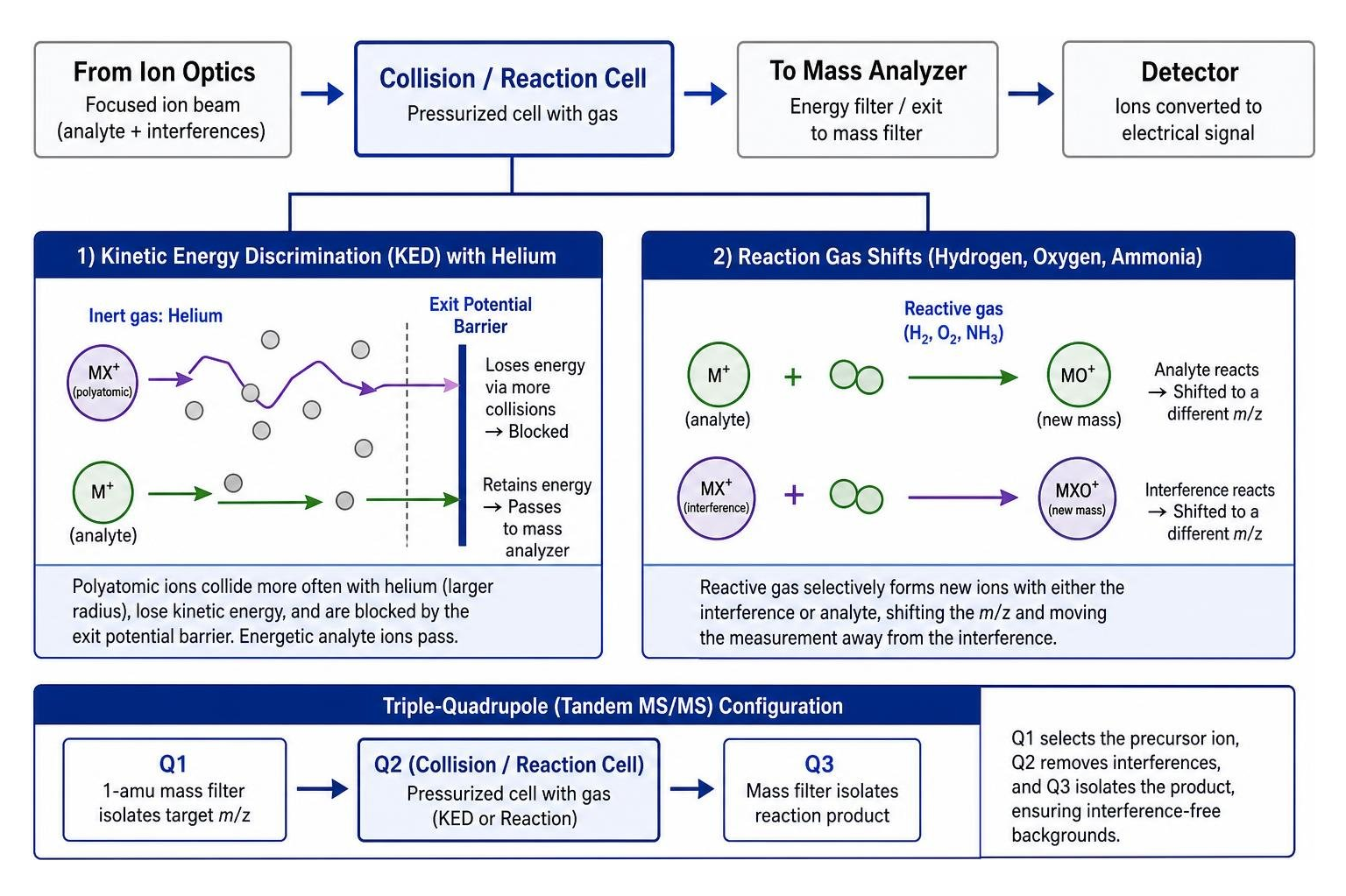
In single-quadrupole systems, unexpected side reactions in the cell can create new polyatomic interferences. Triple-quadrupole (tandem MS/MS) systems eliminate this issue. The first quadrupole (Q1) acts as a strict 1-amu mass filter, the second quadrupole (Q2) serves as the pressurized collision/reaction cell, and the third quadrupole (Q3) isolates the reaction product, ensuring interference-free backgrounds.
Comparing the Top Instrument Platforms for Complex Matrices
Selecting the right instrument requires balancing performance limits against daily operational demands. Below is a comparison of single-quadrupole, high-matrix, and multi-quadrupole instrument configurations available in 2026.
| Instrument Platform Architecture | Collision/Reaction Cell Type | Argon Consumption Rate | Matrix Tolerance (TDS Limit) | Sensitivity & Resolution | Typical Applications |
|---|---|---|---|---|---|
| High-Matrix Single Quadrupole | Collision/Reaction Cell | Standard (~15–20 L/min) | Up to ~10%–25% TDS with automated gas dilution | ~10–11 orders dynamic range; < 0.7 amu resolution | High-throughput environmental testing, industrial screening |
| Compact Low-Gas Single Quadrupole | Mini-Torch Cell Design | Reduced (11 L/min running / 6 L/min Eco mode) | Standard aqueous / moderate matrix (< 0.2% without accessory) | High sensitivity; ~8–10 orders dynamic range | Routine agricultural screening, food testing |
| Automated Dilution Single Quadrupole | Advanced Collision Cell | Standard (~15–18 L/min) | Up to 25% TDS with inline aerosol dilution | Sub-ppt detection for heavy masses; automated dilution | High-salinity brines, biological fluids, geochemical digests |
| High-Sensitivity Single Quadrupole | Reflecting Ion Optics | Standard (~14–18 L/min) | Moderate matrix (< 0.5% standard introduction) | Gigahertz sensitivity (> 1.5 billion cps/ppm In); < 1 cps background | Advanced materials, isotope research, clean industrial applications |
| Multi-Quadrupole (Tandem MS/MS) | 4-Quadrupole / Triple-Quad MS/MS | Standard (~16–20 L/min) | High matrix compatible with aerosol dilution | Sub-ppt detection; variable resolution (< 0.3 amu custom, 0.7 amu standard) | Semiconductor ultra-pure reagents, advanced speciation, clinical trials |
Single Quadrupole Systems for High-Throughput Routine Testing
Single-quadrupole platforms remain the standard for high-volume analytical laboratories running standard environmental waters, consumer goods testing, and agricultural samples. If you are reviewing introductory guides to ICP-MS techniques, you will find that these instruments offer straightforward operation and faster method development.
Hardware features like automated argon gas dilution allow these systems to handle samples containing up to 10% or even 25% total dissolved solids (TDS). Rather than running time-consuming manual dilutions that introduce pipetting errors, the system injects an auxiliary stream of argon gas into the aerosol path after the spray chamber. This thins the aerosol droplet density while maintaining plasma temperature, keeping the interface cones clean and drift-free over long analytical sequences.
Triple and Multi-Quadrupole Systems for Ultra-Trace Speciation
When background interferences cannot be resolved using simple helium collision modes, multi-quadrupole systems are the tool of choice. Multi-quadrupole instruments use tandem quadrupoles to filter, channel, react, and resolve target ions, achieving sub-part-per-trillion (ppt) and parts-per-quadrillion (ppq) limits of detection.
Facilities supporting advanced research and academic centers—such as the Mass Spectrometry and Proteomics Equipment core facilities at the University of Kentucky—rely on these architectures for demanding workflows. They are widely used for screening toxic heavy metals in biological tissues, monitoring trace contaminants in semiconductor manufacturing, and running chromatographic speciation (coupling HPLC or GC to ICP-MS to separate toxic inorganic arsenic from non-toxic organic forms).
Key Selection Criteria for Demanding Sample Workflows
Choosing analytical hardware means matching instrument specifications to your daily sample matrices, chemical reagents, and lab infrastructure. Reviewing the full scope of ICP mass spectrometry capabilities highlights several key configuration options:
- Hydrofluoric Acid (HF) Inert Kits: Digesting geological silicates, mining cores, or advanced ceramic materials requires hydrofluoric acid. Standard quartz torches, glass spray chambers, and glass nebulizers will dissolve in contact with HF. For these applications, equip the instrument with inert fluoropolymer (PFA/PTFE) spray chambers, sapphire injector tubes, and platinum interface cones.
- Organic Solvent Injection Kits: Introducing volatile organic solvents (such as petrochemicals, naphtha, or aromatic solvents from extraction workflows) will quickly destabilize a standard plasma. To prevent carbon soot build-up on the interface cones, you will need a chilled spray chamber (minus 10 to minus 20 degrees Celsius), narrow-bore torch injectors, and an auxiliary oxygen gas addition kit to burn organic carbon into carbon dioxide gas.
- Software Automation and Smart Quality Control: Software that automatically checks for polyatomic interferences, monitors internal standard recovery drift in real time, and triggers automated on-line re-dilutions helps keep high-throughput operations running smoothly.
Evaluating Equipment for High-TDS Samples
Running samples with high dissolved solids—such as ocean seawater, wastewater, lithium battery leachates, or concentrated acid digests—places heavy demands on the instrument interface. Reviewing an ICP-MS laboratory testing guide provides practical benchmarks:
- The 0.2% TDS Rule: Under standard liquid introduction conditions, total dissolved solids should remain below 0.2% (2 grams per liter). Exceeding this threshold causes salts to precipitate around the skimmer cone orifice, degrading sensitivity and causing calibration drift.
- Aerosol Dilution Systems: If your lab regularly processes undiluted brines or samples with up to 10% to 25% TDS, look for an instrument with integrated aerosol dilution. Adding dry argon gas into the aerosol flow protects interface components and helps maintain stable plasma conditions.
- Internal Standard Monitoring: Heavy matrices cause non-spectroscopic space-charge effects where heavier ions displace lighter analyte ions within the ion beam. Using matched internal standards (such as lithium-6, scandium-45, yttrium-89, indium-115, and bismuth-209) helps correct for physical matrix suppression and signal drift.
Operating Costs and Maintenance
The purchase price of an ICP-MS is only the first part of your investment. Operating an elemental analysis lab involves steady consumable and utility costs. As detailed in our guide to plasma mass spectrometry for modern laboratories, you should budget for the following operational needs:
- Argon Gas Consumption: A standard torch running at 15 to 18 liters per minute consumes a standard liquid argon dewar every 5 to 7 operational days. Systems equipped with mini-torch technology (running at approximately 11 liters per minute during analysis and 6 liters per minute in standby mode) can cut annual gas expenditures by roughly 30% to 45%.
- Interface Cone Replacement: Interface cones require routine inspection and ultrasonic cleaning. Platinum-tipped cones cost substantially more than nickel cones upfront, but they offer greater corrosion resistance when running concentrated acids and aggressive chemical reagents.
- Vacuum Pump Maintenance: The roughing rotary vane pump requires regular oil changes and exhaust filter inspections every 3 to 6 months to protect the internal turbomolecular vacuum pumps.
- Recirculating Chiller and Electrical Demands: The system requires stable electrical service (single-phase 200 to 240 volts, 30 amps) alongside a recirculating chiller to cool the RF generator and interface housing.
Frequently Asked Questions About ICP-MS Instrumentation
What is the maximum dissolved solids content typical ICP-MS hardware can handle?
A standard ICP-MS sample introduction system performs best with samples containing less than 0.2% total dissolved solids (2 grams per liter). Exceeding this baseline can cause salt deposition on the nebulizer tip and skimmer cone orifice. However, modern instruments equipped with automated argon gas dilution systems can process high-matrix samples containing between 10% and 25% TDS without manual pre-dilution.
How does tandem mass spectrometry eliminate spectral interferences?
Tandem mass spectrometry (MS/MS or triple-quadrupole) eliminates spectral interferences by sandwiching a collision/reaction cell between two independent quadrupole mass filters. The first quadrupole (Q1) isolates only the exact mass of interest while discarding all other sample matrix ions. The target ion enters the cell (Q2), where a reaction gas (such as oxygen or ammonia) chemically shifts the analyte mass or neutralizes the interferent. The third quadrupole (Q3) then transmits only the target reaction product to the detector, keeping baseline backgrounds low.
What are the ongoing utility requirements for running an ICP-MS laboratory?
Operating an ICP-MS requires high-purity argon gas (at least 99.99% purity) supplied at 80 to 100 psi, a dedicated 200 to 240 volt (30 amp) single-phase electrical supply, a water-cooling recirculating chiller, an exhaust ventilation duct to safely vent plasma heat and sample vapors, and clean laboratory climate control (maintaining 15 to 25 degrees Celsius with minimal humidity fluctuations).
Conclusion
Choosing the right inductively coupled plasma mass spectrometry equipment comes down to matching instrument architecture to your sample types, analytical limits, and long-term operating budget. For high-volume water, agricultural, and routine consumer product screening, single-quadrupole instruments with aerosol dilution offer strong reliability and high daily throughput. When research programs require parts-per-quadrillion purity verification, complex speciation, or challenging clinical testing, multi-quadrupole MS/MS systems provide the interference removal necessary for trace measurements.
At Elemental Analysis Inc., based in Lexington, Kentucky, our team combines extensive testing experience with advanced trace-level analytical capabilities. Whether you are running complex industrial matrices or validating high-purity materials, explore our comprehensive elemental testing and ICP analysis services to discover how we can support your testing needs.
Reference List
Wilschefski SC, Baxter MR. “Inductively Coupled Plasma Mass Spectrometry: Introduction to Analytical Aspects..” The Clinical biochemist. Reviews, 2019. PMCID PMC6719745.