
A Practical Field Guide to Laser Ablation ICP MS Capabilities
What Laser Ablation ICP MS Can Reveal From Solid Samples
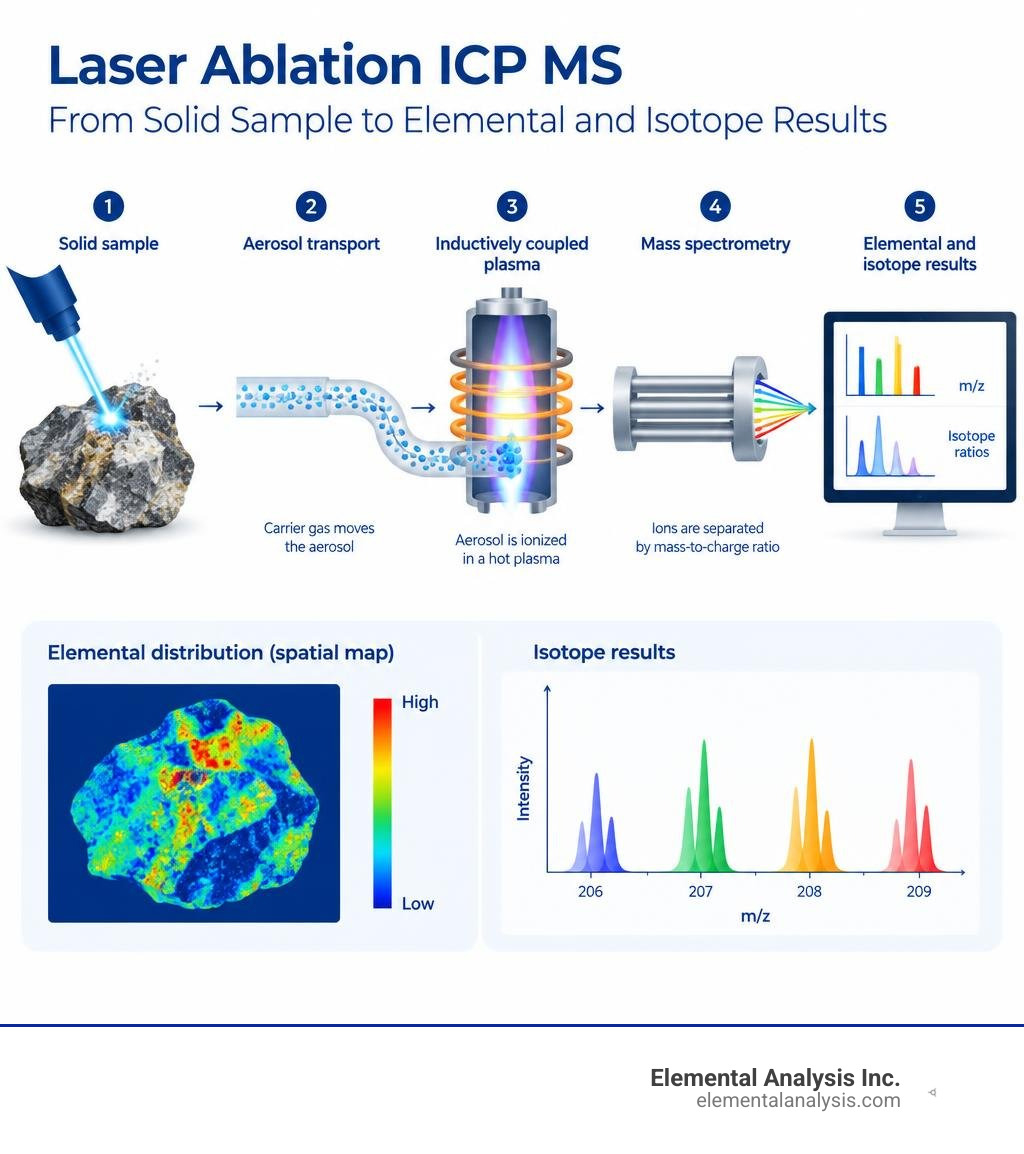
Laser ablation ICP MS is a direct solid-sample method for measuring trace elements and isotopes at microscopic locations. A pulsed laser removes a tiny amount of material from a chosen spot. Carrier gas moves that aerosol into an inductively coupled plasma, where it is ionized and measured by mass spectrometry.
For a lab that needs fast, low-level elemental data without dissolving the whole sample, it can provide:
- Spatially resolved results from spots as small as about 5 micrometers
- Multi-element detection across a wide range, often from ppt to ppm levels
- Minimal sample loss, often below 1 microgram per measurement
- Direct analysis of solids such as metals, minerals, glass, tissue sections, coatings, and thin films
That makes laser ablation ICP-MS useful when where an element occurs matters as much as how much is present. It can map contamination in an aerospace alloy, distinguish trace-element patterns in forensic glass, or show iron and copper distributions in tissue.
The technique is not simply “laser sampling plus ICP-MS.” Laser pulse duration, particle size, transport efficiency, plasma conditions, and calibration strategy all affect accuracy. This guide explains what the method can do, where its limits are, and how to plan a reliable workflow.
Laser ablation ICP MS basics:
- inductively coupled mass spectrometry
- inductively coupled plasma mass spectrometry
- isotope ratio ICP MS
Fundamentals of Laser Ablation ICP MS and Aerosol Generation

To truly grasp solid sampling with this platform, understanding what laser ablation ICP-MS is and how it functions requires examining the interaction between photons and matter. A high-energy pulsed laser beam focuses onto a solid specimen enclosed within a sealed ablation chamber. The target absorbs the photon energy, generating rapid heating, bond breaking, and vaporization.
This violent phase transition converts a minute volume of solid target into an aerosol mixture composed of vapor, nanometer-scale clusters, and liquid droplets. A continuous stream of carrier gas flushes the ablation cell, sweeping this aerosol into the high-temperature (6,000 to 10,000 K) argon plasma torch of the mass spectrometer.
Within the plasma, the aerosol particles are vaporized, atomized, and converted into positive ions before entering the vacuum interface of the mass analyzer. Because we avoid wet chemical digestion, the technique achieves an analytical dynamic range spanning parts per trillion (ppt) to parts per million (ppm) directly in solid matrices, offering micro-destructive sampling with total ablated masses typically under 1 µg.
Principles of Direct Solid Sampling and Spatial Resolution
The spatial fidelity of the laser platform is one of its most remarkable assets. Variable optical apertures allow modern ultraviolet (UV) and deep-UV laser systems to tune beam diameters from <5 µm up to 300 µm depending on the analytical goal.
Single-spot ablation typically excavates a volume approximately 10 to 100 µm in diameter and roughly 1 µm in depth per burst sequence. By pulsing the laser on a stationary spot, we can achieve submicron depth profiling, stripping individual layers to evaluate coating thicknesses or surface contamination without lateral mixing.
When rastering the sample beneath a pulsing beam, researchers can preserve sample integrity while mapping elemental distributions with high spatial resolution. Keeping the crater aspect ratio (depth-to-diameter ratio) low prevents severe aerosol trapping, ensuring that the sub-microgram consumption leaves forensic or gemological specimens visually and structurally intact.
Laser Pulse Physics: Femtosecond vs. Nanosecond Ablation Dynamics
The duration of the laser pulse plays a central role in particle generation mechanisms and analytical accuracy. Traditional nanosecond (ns) excimer (193 nm) or Nd:YAG (213 nm) lasers deliver pulses that last longer than the lattice thermal vibration timescale (~1 picosecond). This allows thermal energy to dissipate into the surrounding matrix, creating a noticeable heat-affected zone (HAZ), localized melting, and preferential boiling of volatile components.
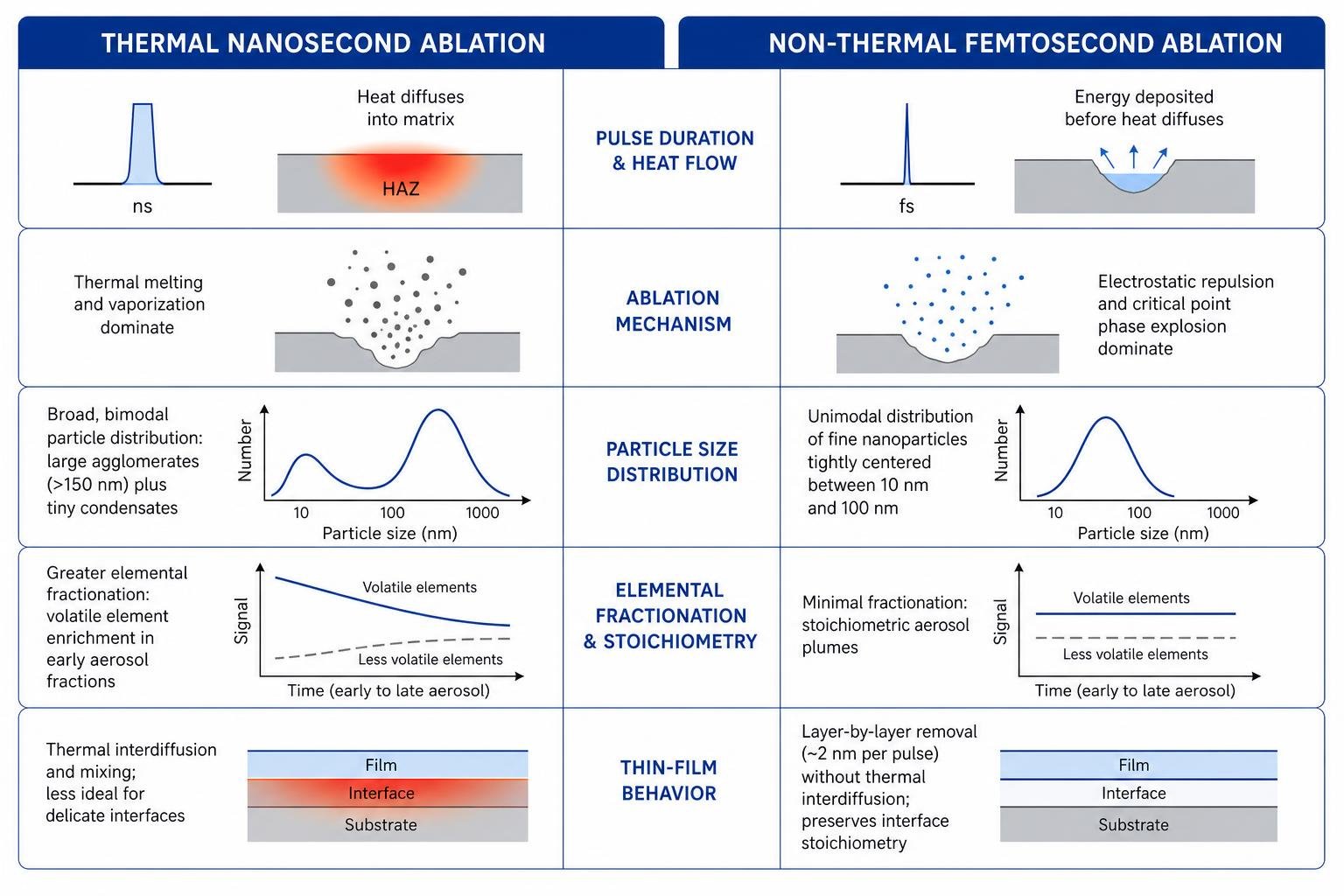
In contrast, research on laser pulse duration and energy in fs-LA-ICP-MS (Diwakar et al., 2013) demonstrates that ultrafast femtosecond (fs) lasers (pulse width <500 fs) complete their energy delivery before lattice phonons can distribute heat. This establishes a "non-thermal" ablation regime governed by electrostatic repulsion and critical point phase explosion:
- Particle Size Distribution: Nanosecond ablation generates a broad, bimodal particle distribution featuring large agglomerates (>150 nm) alongside tiny condensates. Femtosecond ablation yields a unimodal distribution of fine nanoparticles tightly centered between 10 nm and 100 nm.
- Elemental Fractionation: Shorter pulses significantly diminish differential melting. While nanosecond systems often suffer from volatile element enrichment in early aerosol fractions, optimized fs pulses (typically 400 to 600 fs pulse width) produce stoichiometric aerosol plumes.
- Thin-Film Stoichiometry: As demonstrated in thin-film stoichiometric analysis using femtosecond ablation, ultrafast pulses strip material layer-by-layer (~2 nm per pulse) without thermal interdiffusion, preserving stoichiometric fidelity even across delicate electronic interfaces.
Aerosol Transport Dynamics, Fractionation, and Calibration Protocols
Once the aerosol is generated, getting it cleanly into the plasma torch without element-selective losses is critical. Knowing the fundamental operations of inductively coupled plasma mass spectrometry helps us understand why transport cell design matters.
A helium carrier gas stream is maintained inside the sample chamber because helium possesses higher thermal conductivity and lower density than argon, yielding smaller initial particle sizes, less crater redeposition, and rapid washout times. A coaxial make-up flow of argon is introduced downstream to ensure optimal plasma stability and ion extraction.
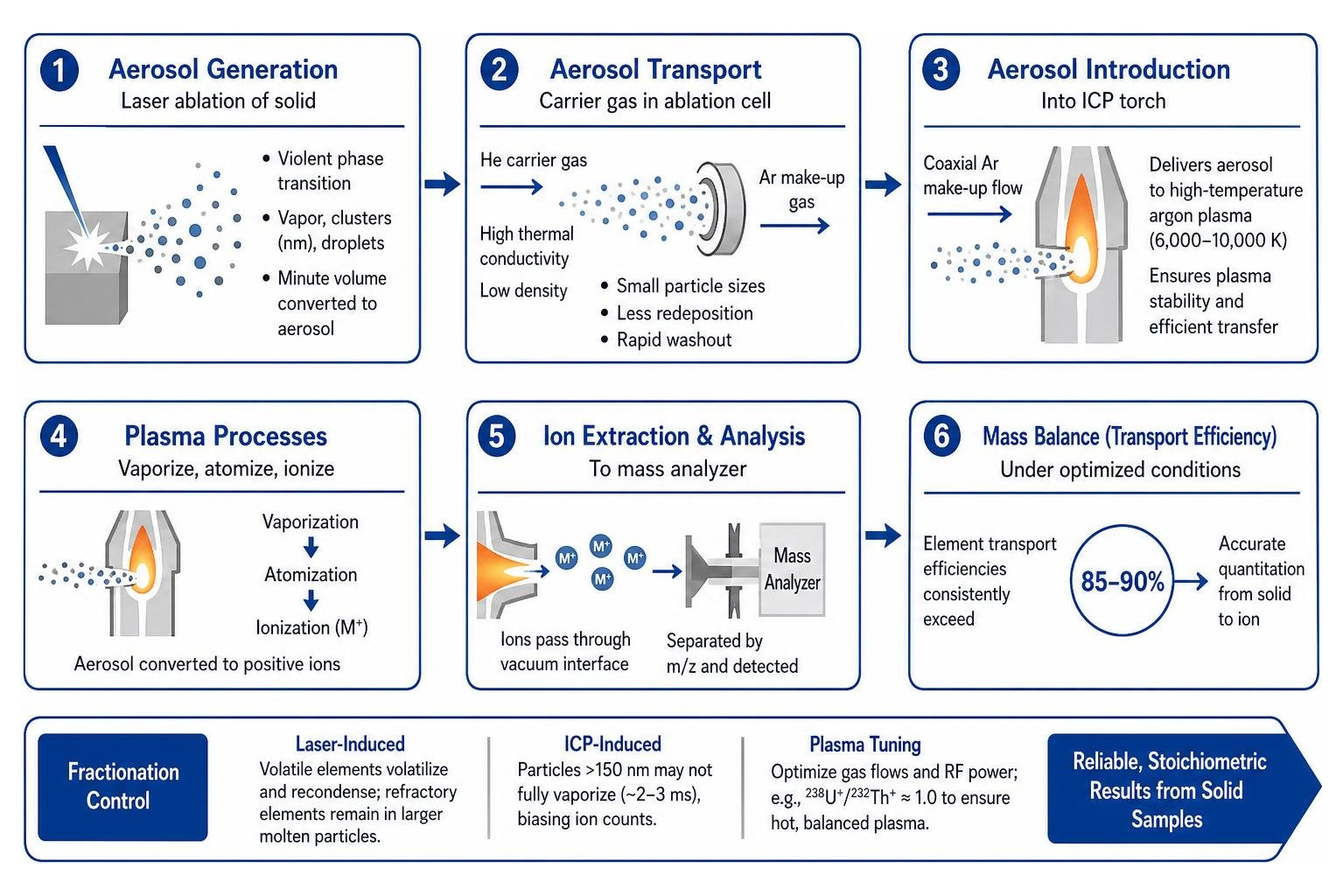
When evaluating aerosol integrity, rigorous studies focus on evaluating laser-induced and ICP-induced fractionation mechanisms (Käser et al., 2025). Fractionation can occur both at the ablation site (laser-induced) and within the plasma (ICP-induced):
- Laser-Induced Fractionation: Volatile elements (such as Pb and Zn) preferentially evaporate and recondense around the crater rim, whereas refractory elements (such as Th and Zr) stay confined to larger molten particles.
- ICP-Induced Fractionation: If particles exceed ~150 nm, they fail to completely vaporize within the plasma residence time (~2–3 ms), biasing ion counts toward volatile surface coatings.
- Plasma Tuning: Operators monitor key elemental intensity ratios—such as tuning carrier gas flows and RF power until the $^{238}\text{U}^+/^{232}\text{Th}^+$ ratio is near 1.0—to ensure the plasma is running hot and balanced. Mass-balance models indicate that under optimized conditions, element transport efficiencies consistently exceed 85% to 90%.
Calibration Strategies and Matrix-Matched Standards
Because laser-solid coupling efficiency varies widely based on sample hardness, color, and thermal diffusivity, non-matrix-matched quantitative routines can introduce significant systematic bias. Following established best practices for trace element testing accuracy is essential.
Quantification relies on standard-sample bracketing using certified reference materials (CRMs) such as the synthetic silicate glasses NIST SRM 610, 612, and 614, or mineral-specific references (e.g., USGS basalt glasses). To account for shot-to-shot pulse energy fluctuations and aerosol transport drift, internal standardization is applied:
- In geological minerals, a major element oxide measured via electron probe microanalysis (e.g., $^{29}\text{Si}$, $^{43}\text{Ca}$) serves as the internal standard.
- In organic polymers and biological sections, carbon ($^{13}\text{C}$) provides internal normalization.
- In non-matrix-matched routines with femtosecond systems, transient signal integration combined with total mass normalization can yield semi-quantitative and fully quantitative results without specialized solid standards.
High-Time-Resolution Detection and Fast Washout Cells
Recent hardware developments have focused on resolving individual ablation events. Integrating low-dispersion, fast-washout ablation cells (such as two-volume chambers and tube cells) has reduced single-pulse washout durations from seconds down to <1 millisecond.
When coupled with Time-of-Flight (ICP-TOFMS) or multi-collector mass analyzers, analysts achieve quasi-simultaneous detection across the full elemental periodic table. High-time-resolution data collection using dwell times as short as 20 µs prevents signal overlap and allows researchers to characterize individual aerosol particles.
As highlighted in single-particle fractionation studies using high-time-resolution MC-ICP-MS, monitoring isotopic pairs like $^{208}\text{Pb}/^{232}\text{Th}$ in single particles confirms the coexistence of vapor-condensed and molten-rim aerosol populations. For high-speed imaging, these fast cells allow pixel acquisition rates exceeding 100–200 Hz without cross-pixel image blurring.
Laser Ablation ICP MS Performance Considerations
Selecting the right microanalytical tool involves balancing spatial resolution, elemental coverage, detection limits, and matrix sensitivities. Here is how laser ablation ICP-MS compares against other common solid-state techniques, cross-referenced with our comprehensive elemental analysis methods guide:
| Analytical Technique | Spatial Resolution (Lateral) | Typical Detection Limits | Sample Preparation | Matrix Dependency | Primary Strengths & Trade-offs |
|---|---|---|---|---|---|
| LA-ICP-MS (ns / fs) | 5 – 100 µm | Sub-ppb to ppm (<1 µg/g) | Minimal (flat solid, polished section) | Moderate (mitigated by fs lasers & CRMs) | Rapid multi-element & isotope screening; micro-destructive (~µg ablated). |
| SIMS (Secondary Ion MS) | 0.05 – 2 µm | Sub-ppb to ppm | High (ultra-flat polish, conductive coating) | High (extreme matrix-dependent ionization) | Superior submicron resolution and light isotope precision; very high cost. |
| LIBS (Laser Induced Breakdown) | 10 – 100 µm | Low ppm to % levels | Minimal (direct solid) | Moderate to high (optical emission self-absorption) | Fast, highly portable, simultaneous light element detection; lower sensitivity. |
| EPMA / SEM-EDS | 0.1 – 2 µm | 100 ppm – 0.1% (major/minor) | High (carbon-coated flat polish) | Low to moderate (well-characterized matrix corrections) | Quantitative major element mapping; poor trace-element sensitivity. |
| Solution ICP-MS | Bulk only (no spatial resolution) | Sub-ppt to ppb | Extensive (complete acid digestion) | Low (matrix diluted out) | Ultimate bulk quantitative accuracy; destroys spatial and textural context. |
Advanced Applications Across Scientific Disciplines
Because this platform combines parts-per-billion sensitivity with microscopic spatial resolution, it has become indispensable for trace element identification across industrial applications. Researchers no longer have to choose between sensitivity and spatial context.
Advancing Geochronology and Provenance via Laser Ablation ICP MS
In geoscience and cosmochemistry, coupling laser sampling to geological isotope ratio determination has transformed U-Th-Pb geochronology. Targeting core-to-rim growth zoning in accessory minerals (such as zircon, monazite, and titanite) reveals multi-million-year metamorphic pulses in a single 20 µm mineral grain.
In planetary science, multi-collector systems (LA-MC-ICP-MS) measure radiogenic and stable isotope variations ($^{87}\text{Sr}/^{86}\text{Sr}$, $^{143}\text{Nd}/^{144}\text{Nd}$, Mg, Si) across chondrules, apatites, and hibonites in meteorites.
Furthermore, cryogenic laser ablation in ice core paleoclimate research permits direct frozen-state profiling of ice cores at –30 °C. Sampling with 200–1000 µm resolution preserves seasonal deposition horizons of lead, zinc, and dust markers over 250,000-year records without melting artifacts.
High-Throughput Bioimaging and Tissue Profiling with Laser Ablation ICP MS
In the life sciences, quantitative bioimaging reveals the architecture of elemental dyshomeostasis. Modern laboratories utilize biomedical tissue imaging and metallomic workflows to quantify metals directly on 3–5 µm thick formalin-fixed paraffin-embedded (FFPE) or cryosectioned biopsy specimens.
Key clinical and toxicological findings include:
- Hepatology: Quantifying copper and iron accumulation in human liver biopsies affected by genetic hemochromatosis or Wilson’s disease. Studies confirm detection limits below 1 µg/g and lateral resolutions down to 5 µm, uncovering iron-free preneoplastic foci with elevated copper levels.
- Oncology: Tracking intra-tumoral penetration of platinum-based metallodrugs (e.g., cisplatin) relative to vascularized tumor margins.
- Toxicology: Conducting heavy metal toxicity screening across neurological, renal, and bone tissues to locate localized burdens of lead, cadmium, and arsenic.
Forensics, Gemology, and Semiconductor Characterization
Because the consumed mass is sub-microgram, the technique preserves precious evidence across several sensitive fields:
- Forensic Science: Shards of automotive glass (<0.5 mm) recovered from hit-and-run scenes are matched to vehicle sources by measuring suites of rare earth elements and transition metals (Sr, Ba, Ce, Nd) against NIST 612 standards. Ballpoint ink strokes, multi-layer automotive paint fragments, and adhesive tapes are similarly fingerprinted without altering physical evidence.
- Gemology: Trace element fingerprinting distinguishes natural from synthetic gems, pinpoints the geographic provenance of emeralds and rubies, and detects heat/diffusion treatments—such as identifying light beryllium diffusion in corundum that cannot be detected with standard optical tools.
- Semiconductors & Materials: Thin-film multilayer architectures, solar cells, and high-purity wafers are profiled to identify nanometer-level dopant gradients, interfacial cross-diffusion, and trace contamination, playing an integral role when characterizing semiconductor thin films and advanced materials and during reverse engineering and material deconstruction.
Frequently Asked Questions About Solid-State Elemental Analysis
How does laser spot size affect analytical sensitivity and spatial resolution?
The spot diameter dictates the absolute mass of aerosol removed per shot. When tuning spot sizes between <5 µm and 300 µm, the mass sampled scales with the crater area ($\pi r^2$).
While smaller spot sizes (<10 µm) deliver the highest spatial resolution for fine mineral zoning or cell-level mapping, they produce less aerosol, reducing signal-to-noise ratios and elevating detection limits. Larger spot sizes (50 to 150 µm) improve trace-level sensitivity down to ultra-trace ppt concentrations, making them ideal for bulk homogeneity checks where micron-scale features are not the primary target.
Why do femtosecond lasers reduce elemental fractionation compared to nanosecond systems?
Femtosecond lasers pulse at sub-picosecond speeds (<500 fs), which is faster than thermal diffusion times within crystal lattices. This non-thermal ablation process bypasses traditional liquid boiling, vaporizing the sample via rapid electrostatic and hydrodynamic breakdown.
Because fractional distillation and deep melt zones are eliminated, the ablated aerosol consists of uniformly small nanoparticles (10–100 nm) with stoichiometric element ratios. Nanosecond pulses, by contrast, maintain an extended thermal phase that preferentially distills volatile elements into fine aerosols while leaving refractory elements in coarse melt droplets.
What makes matrix-matched calibration essential for quantitative accuracy?
Solid materials vary widely in their optical absorption coefficients, thermal conductivities, and crystal structures. A laser pulse striking a dark, friable shale excavates a significantly larger volume than the same pulse hitting a clear, hard sapphire or reflective metallic alloy.
If calibration is performed against an unmatched matrix, the difference in ablation yield directly skews the calculated concentration. Matrix-matched reference standards—or the combination of internal standardization with well-characterized certified materials—ensure that laser-matter coupling, particle sizes, and aerosol transport rates remain consistent between standards and unknown samples.
Conclusion
Laser ablation ICP MS bridges the gap between bulk wet-chemical analysis and high-resolution electron microscopy. By ionizing solids directly at the microscale, it delivers trace-element sensitivity and isotopic precision while preserving original sample morphology. Whether you are using nanosecond UV lasers for routine mineral dating and forensic fingerprinting, or adopting ultrafast femtosecond systems to minimize elemental fractionation in advanced thin films, optimizing every step from aerosol transport to mass calibration is essential for high-fidelity data.
At Elemental Analysis Inc., located in Lexington, KY, our analytical chemistry specialists combine decades of expertise in non-destructive and micro-destructive testing to help you solve complex trace element challenges with fast turnaround and uncompromised accuracy. Explore our comprehensive trace elemental analysis solutions to discover how solid-state mass spectrometry can elevate your research and industrial quality programs.
References
Diwakar PK, Harilal SS, LaHaye NL, Hassanein A, Kulkarni P. “The influence of laser pulse duration and energy on ICP-MS signal intensity, elemental fractionation, and particle size distribution in NIR fs-LA-ICP-MS..” Journal of analytical atomic spectrometry, 2013. PMCID PMC4673001. D. Käser, T. Van Acker, J. Koch, B. Hattendorf, D. Günther. “Evaluation of laser-induced and ICP-induced elemental fractionation using laser ablation-ICP-TOFMS.” Journal of Analytical Atomic Spectrometry, 2025. DOI 10.1039/d5ja00173k.