
The Main Disadvantages of ICP-MS
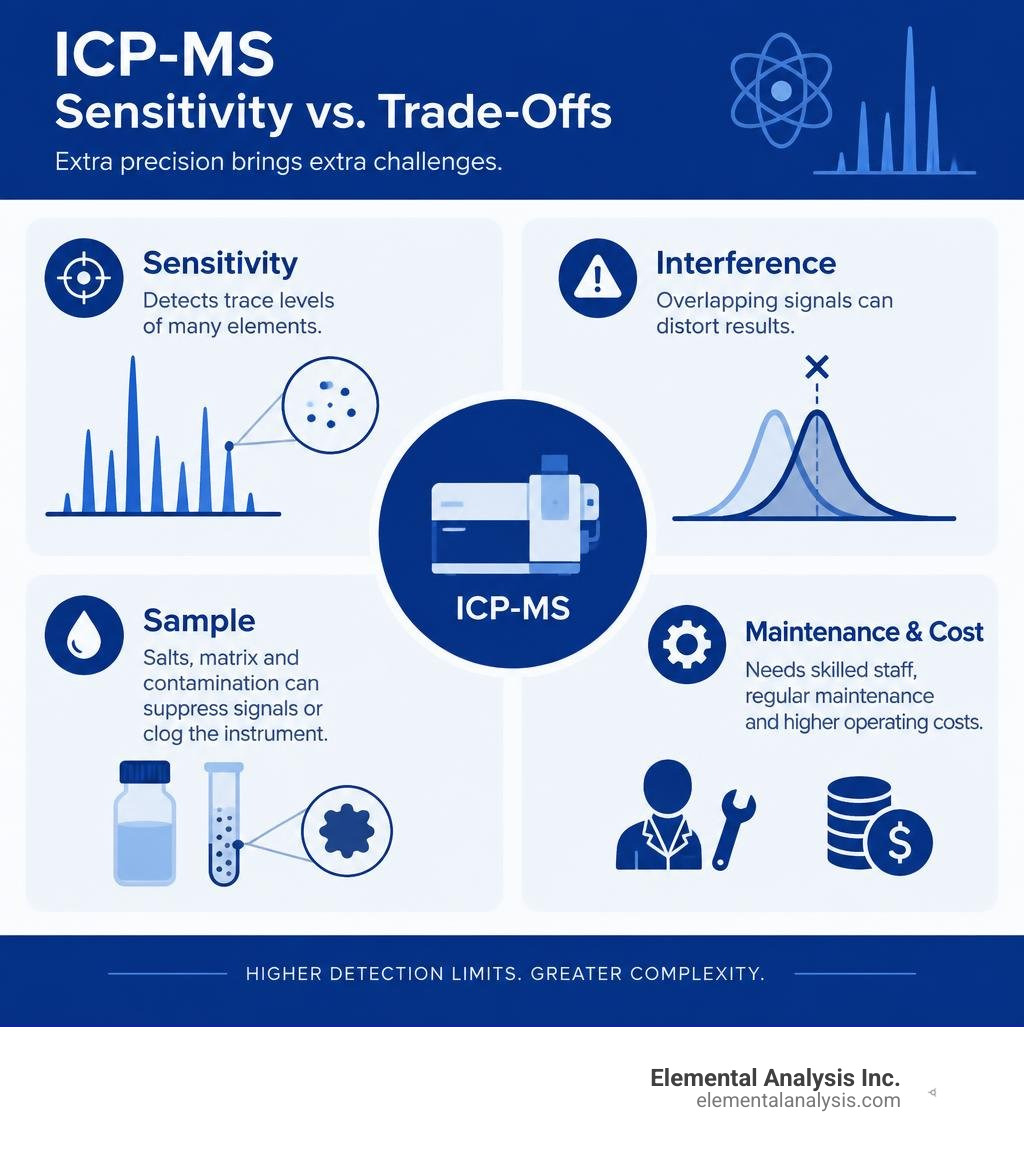
ICP-MS can measure many elements at very low levels, but that sensitivity comes with trade-offs. Overlapping ion signals can distort results. Salts and other sample components can suppress signals or clog the instrument. Trace contamination and carryover can raise detection limits. The equipment is also costly to run and needs skilled staff.
For routine testing, the question is whether those costs and controls are worth the lower detection limits. When a project does not require ultra-trace multi-element detection, a less complex testing approach may be more practical. The list below shows where ICP-MS creates the most work and when its sensitivity earns its place.
Important inductively coupled plasma mass spectrometry disadvantages terms:
Primary Inductively Coupled Plasma Mass Spectrometry Disadvantages in Routine Testing

When laboratories evaluate trace element testing platforms, understanding inductively coupled plasma mass spectrometry disadvantages is critical for making cost-effective choices. The instrument operates by generating an argon plasma that reaches temperatures between 6,000 K and 10,000 K—hotter than the surface of the sun. While this extreme heat efficiently atomizes and ionizes samples, translating that ionized plasma stream into clean analytical data presents persistent physical and chemical obstacles.
In routine testing environments, false positives from spectral overlaps, matrix suppression, and physical ion transmission inefficiencies create significant operational drag. According to scientific research on quantitative ICP-MS challenges and solutions, managing these baseline interferences requires ongoing method development, strict calibration strategies, and specialized cell technologies.
Spectral and Mass Interference Inductively Coupled Plasma Mass Spectrometry Disadvantages
Mass spectrometers separate ions based on their mass-to-charge ratio ($m/z$). However, standard quadrupole mass analyzers typically offer nominal unit mass resolution (~0.6 to 0.8 amu bandpass), yielding only about 386 resolvable mass slots across the periodic table. As a result, any background ion sharing the same nominal mass as an analyte creates a spectral interference.
- Isobaric Overlaps: Different elemental isotopes share identical nominal atomic masses. For instance, $^{58}\text{Ni}$ overlaps directly with $^{58}\text{Fe}$, and $^{114}\text{Cd}$ overlaps with $^{114}\text{Sn}$.
- Polyatomic (Molecular) Ions: Plasma gas species (argon, oxygen, nitrogen, hydrogen) combine with matrix elements (carbon, chlorine, sulfur) to create polyatomic species. Classic examples include $^{40}\text{Ar}^{16}\text{O}^{+}$ overlapping with $^{56}\text{Fe}^{+}$, $^{35}\text{Cl}^{16}\text{O}^{+}$ overlapping with $^{51}\text{V}^{+}$, and $^{40}\text{Ar}^{35}\text{Cl}^{+}$ masking monoisotopic $^{75}\text{As}^{+}$.
- Oxides and Hydroxides: Refractory elements easily form stable monoxide species in the plasma tail ($\text{M}\text{O}^{+}$). These add 16 mass units to the parent element, such as $^{48}\text{Ti}^{16}\text{O}^{+}$ interfering with $^{64}\text{Zn}^{+}$.
- Doubly Charged Ions: Elements with low second ionization potentials (such as barium, strontium, and rare earth elements) form $\text{M}^{2+}$ species, which appear at half their nominal mass. For example, $^{138}\text{Ba}^{2+}$ registers at $m/z\ 69$, directly interfering with $^{69}\text{Ga}^{+}$.
Resolving these interferences requires collision/reaction cells (CRC) operating in helium kinetic energy discrimination (KED) mode, reactive gas modes ($\text{H}_2, \text{O}_2, \text{NH}_3$), or moving to triple-quadrupole (ICP-QQQ) and high-resolution magnetic sector instruments. Understanding how mass spectrometers analyze plasma ions helps clarify why unresolved polyatomic ions create substantial baseline distortion.
Non-Spectral Matrix Effects and Physical Transport Losses
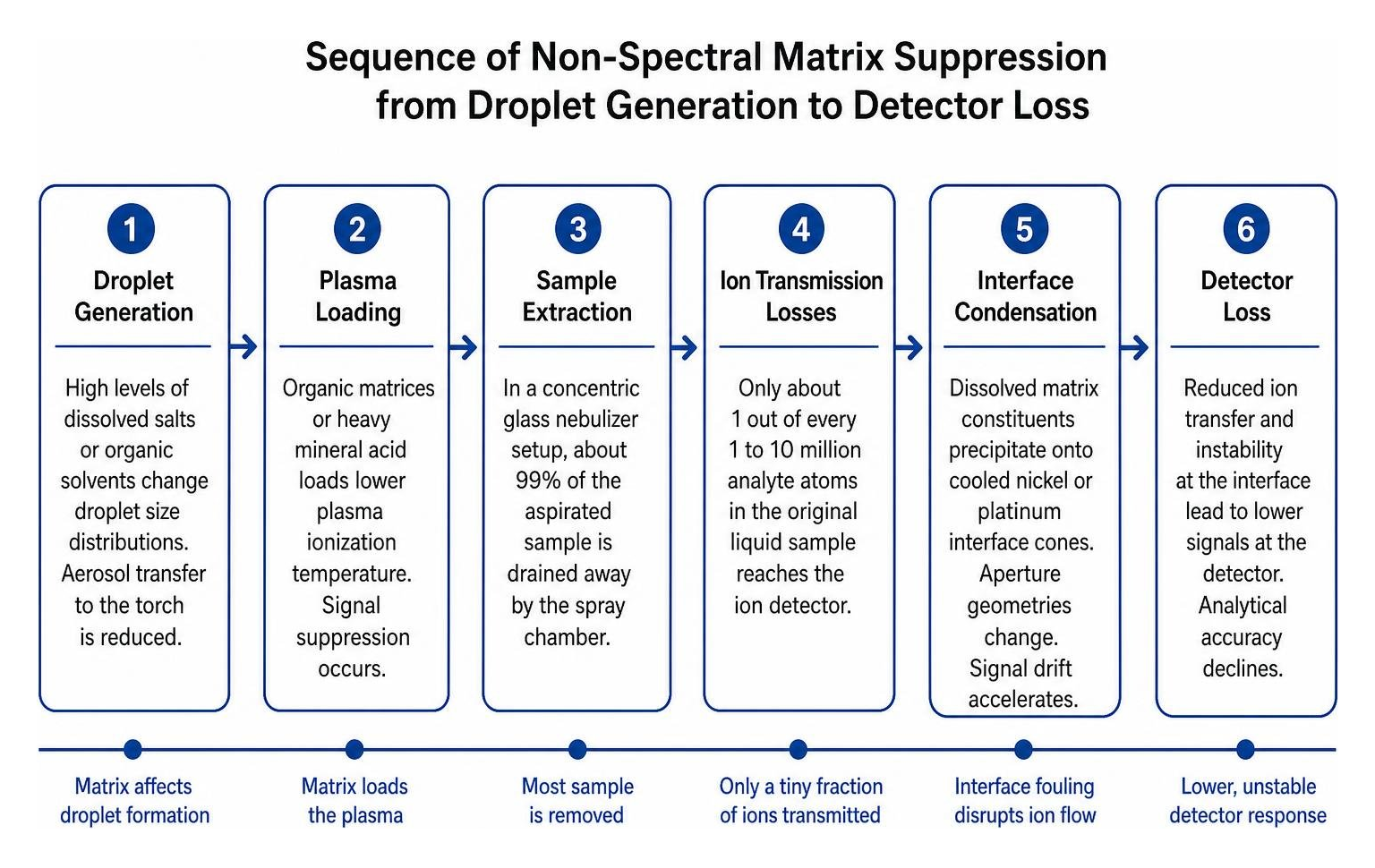
Non-spectral matrix interferences alter sample delivery, plasma temperature, and ion transfer efficiency without contributing direct mass counts at the target channel.
- Aerosol Transport Inefficiencies: High levels of dissolved salts or organic solvents change droplet size distributions, reducing aerosol transfer to the torch.
- Plasma Thermal Loading: Organic matrices or heavy mineral acid loads lower plasma ionization temperature, leading to signal suppression.
- Extraction and Transmission Losses: In a conventional concentric glass nebulizer setup, about 99% of the aspirated liquid sample is drained away by the spray chamber. Only about 1 out of every 1 to 10 million analyte atoms in the original liquid sample ever reaches the ion detector.
- Interface Condensation: Dissolved matrix constituents precipitate onto cooled nickel or platinum interface cones, altering aperture geometries and accelerating signal drift.
To minimize these errors, analysts rely on internal standards (such as Sc, Y, In, Tb, or Bi) matching the mass and ionization profiles of target analytes, as outlined in our accurate trace element testing procedures.
Sample Introduction and Matrix Tolerance Limitations
A major mechanical drawback of ICP-MS is its sensitivity to sample solids. A comprehensive study on elemental analysis limitations in biological matrices notes that dissolved sample constituents degrade plasma robustness and accelerate interface fouling far more rapidly than in optical emission systems.
Dissolved Solids Thresholds and Interface Fouling
Unlike optical emission systems that can tolerate moderate salt loads, conventional ICP-MS instruments require total dissolved solids (TDS) to stay strictly below 0.2% (w/v), with a standard recommendation of less than 0.1% (1,000 ppm) for long analytical runs.
When samples exceed these thresholds, dissolved solids condense on the cold surfaces of the sampler cone (~1.0 mm orifice) and skimmer cone (~0.4 mm orifice). This build-up causes orifice narrowing, ion optic defocusing, and rapid sensitivity loss within hours. Mitigating this issue requires aggressive upfront dilution, clean acid digestion, or aerosol dilution accessories, all of which dilute the target analytes and counteract the instrument’s sensitivity advantages. These preparation steps are essential when executing standardized heavy metal screening protocols.
Elemental Incompatibilities: Halogens and Negative Ions
Standard ICP-MS systems are optimized strictly to produce and extract positive ions ($\text{M}^+$). This design creates fundamental limitations for elements with high first ionization potentials:
- Halogens (Fluorine, Chlorine, Bromine, Iodine): Fluorine (17.42 eV) and chlorine (12.97 eV) have ionization potentials close to or exceeding that of the argon plasma support gas (15.76 eV). Consequently, they ionize poorly into positive ions and prefer negative ionic states ($\text{F}^-$, $\text{Cl}^-$).
- Poor Positive Ion Yield: The positive ionization efficiency of chlorine is below 1%, resulting in elevated detection limits compared to metals.
- Volatilization and Memory Carryover: Iodine and bromine volatilize readily in acidic matrices, causing carryover and memory effects across sample batches.
Physical Constraints: Space-Charge and Mass Discrimination
Inside the interface region, ions transition from atmospheric plasma pressure (760 Torr) into a high vacuum ($10^{-5}$ to $10^{-7}$ Torr). Once electrons diffuse away from the positive ion beam, mutual electrostatic repulsion—known as the space-charge effect—causes the beam to diverge.
According to Technology Networks research on ICP-MS instrumentation and limitations, space-charge repulsion pushes lighter ions toward the periphery of the ion beam, causing them to be deflected away while heavy ions remain focused along the central axis.
Ion Beam Repulsion and Light Isotope Suppression
Space-charge repulsion introduces mass discrimination, which varies across the mass range:
- Low Masses (<10 Da): Mass discrimination factors can reach ~10% per Da.
- Mid Masses (20–150 Da): Mass discrimination typically ranges between 1% and 5% per Da.
- High Masses (>150 Da): Mass discrimination drops to <1% per Da.
When analyzing trace light analytes (such as $^{6}\text{Li}$, $^{7}\text{Li}$, $^{9}\text{Be}$, or $^{11}\text{B}$) within a dense, high-mass matrix (such as uranium, lead, or thallium), the heavy matrix ions dominate the core of the beam. This deflects the light ions into the vacuum extraction walls, causing severe signal suppression. Correcting for these shifts requires specialized internal standards, careful ion lens tuning, and matrix-matched standards, especially when achieving ultra-low detection limits.
Hyphenated Interface Complexity in Speciation Analysis
Coupling separation techniques like liquid chromatography (LC), gas chromatography (GC), or capillary electrophoresis (CE) to an ICP-MS allows for chemical speciation, but adds distinct interface challenges:
- Organic Solvent Loads: Reversed-phase HPLC mobile phases (acetonitrile, methanol) cool the plasma and cause carbon soot buildup on the cones. Labs must add oxygen auxiliary gas to burn off carbon, which accelerates cone wear.
- Capillary Electrophoresis (CE) Grounding: CE-ICP-MS requires maintaining electrical connection at the nebulizer tip without disturbing the low-flow capillary stream, which is prone to suction-induced laminar flow and bubble formation.
- Thermal Condensation in GC Interfaces: GC-ICP-MS transfer lines must be heated consistently above 300 °C to prevent high-boiling organometallic species from condensing before reaching the plasma.
Operational Overhead: Cost, Training, and Maintenance Demands
Running an ICP-MS laboratory requires significant ongoing capital, facilities, and personnel investments.
Operational and Financial Inductively Coupled Plasma Mass Spectrometry Disadvantages
- Capital Investment: A standard single-quadrupole ICP-MS costs between $180,000 and $300,000, while triple-quadrupole (ICP-QQQ) and high-resolution magnetic sector (HR-ICP-MS) platforms range from $350,000 to over $750,000.
- Argon Gas Consumption: Torches consume 14 to 18 liters of high-purity argon gas per minute of operation, requiring dedicated bulk liquid argon tanks.
- Cleanroom Infrastructure: Because the system detects parts-per-trillion (ppt) concentrations, common elements like sodium, calcium, iron, and zinc are easily contaminated by ambient dust, glassware leaching, or low-purity acids.
- Specialized Operator Skill: Running methods, managing mass interferences, tuning collision gases, and maintaining vacuum systems require experienced analytical chemists.
Routine Maintenance and Memory Effects
- Interface Cone Maintenance: Sampler and skimmer cones require weekly disassembly, acid-bath cleaning, and microscopic orifice inspection.
- Pump and Oil Servicing: Roughing vacuum pumps need regular oil changes, and turbomolecular pumps require clean operational environments to prevent premature rotor failure.
- Memory Carryover: Elements such as mercury ($\text{Hg}$), boron ($\text{B}$), gold ($\text{Au}$), iodine ($\text{I}$), and osmium ($\text{Os}$) stick to spray chamber walls and sample tubing. Clearing these elements requires extended rinse cycles using complex wash solutions (e.g., gold-spiked hydrochloric acid, ammonia, or Triton X-100), which slows overall sample throughput.
Choosing When ICP-MS Is Appropriate
Selecting an elemental analysis approach starts with the required detection limit, sample matrix, number of target elements, turnaround needs, and the amount of preparation the sample can tolerate. ICP-MS is most useful when a project requires multi-element measurements at very low concentrations and the laboratory can control contamination, dissolved solids, and spectral interferences.
Questions to Ask Before Selecting ICP-MS
- What detection limit is required? ICP-MS can be appropriate when the method needs trace or ultra-trace measurements across several elements.
- How complex is the sample matrix? Samples with high salt, acid, or organic content may require dilution, digestion, or additional controls before analysis.
- Is isotopic information needed? Some projects require isotope-ratio measurements in addition to elemental concentrations.
- Can the project support the operational controls? Reliable results depend on suitable sample preparation, calibration, interference management, and routine instrument maintenance.
Frequently Asked Questions About ICP-MS Limitations
Why are halogens difficult to analyze by ICP-MS?
Halogens (F, Cl, Br, I) have high first ionization energies—fluorine at 17.42 eV and chlorine at 12.97 eV—close to or above the 15.76 eV ionization potential of argon plasma. Because the plasma predominantly produces positive ions, halogens remain largely neutral or form negative ions. This results in very low positive ion yields and poorer detection limits compared to metals.
How do collision and reaction cells resolve polyatomic interferences?
Collision/reaction cells sit before the primary mass analyzer. In collision mode, an inert gas (helium) slows down polyatomic ions more than single-atom ions of the same mass because polyatomics have larger cross-sectional diameters. Kinetic energy discrimination (KED) then filters out these lower-energy polyatomics. In reaction mode, reactive gases ($\text{H}_2, \text{O}_2, \text{NH}_3, \text{CH}_4$) react selectively with either the interference or the analyte, shifting one of them to a different mass channel.
What total dissolved solids level causes cone plugging?
Total dissolved solids (TDS) levels exceeding 0.2% (2,000 ppm) cause rapid cone deposition, while levels above 0.1% (1,000 ppm) lead to salt accumulation over extended runs. As salts condense on the cooled sampler and skimmer cone orifices, the openings narrow, which distorts ion transmission and leads to signal drift. For long analytical sequences, keeping TDS below 0.05% to 0.1% helps maintain stability.
Conclusion
Inductively coupled plasma mass spectrometry provides remarkable multi-element sensitivity, but its operational trade-offs—such as spectral interferences, space-charge effects, low solids tolerance, and significant upkeep—require careful evaluation. For high-matrix samples where parts-per-billion detection is sufficient, a less complex testing approach may be more practical.
Navigating these trade-offs requires matching each project’s analytical requirements with the appropriate testing platform. At Elemental Analysis Inc. in Lexington, KY, our team helps clients evaluate trace-element testing requirements and interpret results in the context of their sample matrices. Explore our comprehensive ICP testing solutions to determine the right analytical strategy for your testing needs.