
What Is Plasma Mass Spectrometry?
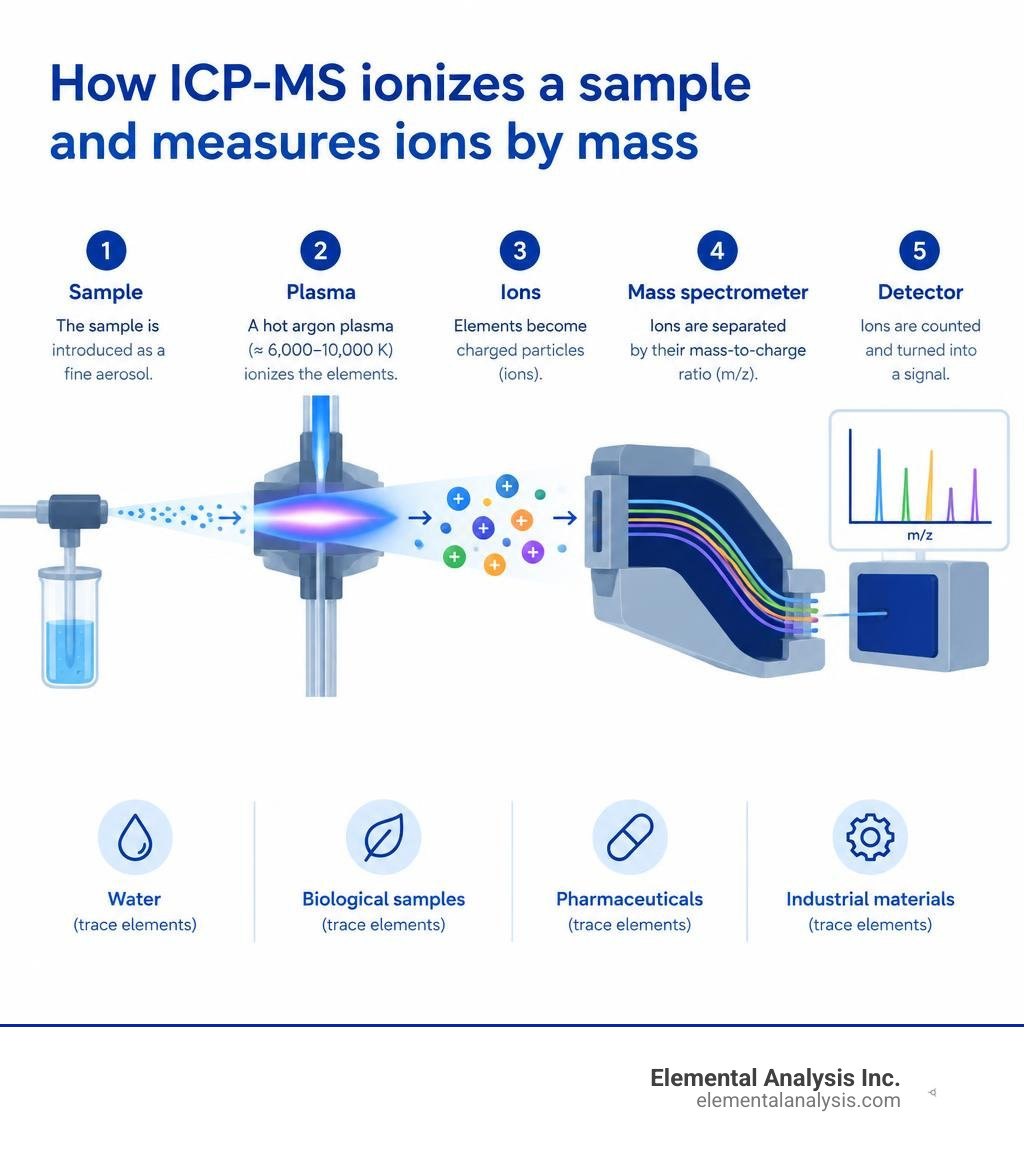
Plasma mass spectrometry, usually called inductively coupled plasma mass spectrometry (ICP-MS), measures trace elements in a sample. It uses a hot argon plasma to turn elements into charged particles, then a mass spectrometer separates and counts them. Labs use ICP-MS to test many elements at low concentrations in water, biological samples, pharmaceuticals, and industrial materials.
Its value is the combination of high sensitivity and multi-element testing. The plasma runs at atmospheric pressure while the detector operates under vacuum, allowing a steady stream of sample to be measured. Accurate results still depend on careful sample preparation, calibration, and control of signals that can overlap.
Simple plasma mass spectrometry glossary:
- inductively coupled plasma
- inductively coupled plasma emission
- inductively coupled argon plasma spectrometry
Fundamentals and Mechanisms of Plasma Mass Spectrometry
At its core, the technique relies on generating an ionized gas stream known as a plasma to break down complex sample matrices into their elemental constituents. This process converts the atoms into positive ions that can be directed into an analyzer. Understanding how inductively coupled argon plasma spectrometry operates requires examining both the thermal physics of the discharge and the mechanical transition from atmospheric pressure to ultra-high vacuum.
The heart of this ionization source is sustained by high-purity argon gas passing through an induction coil powered by a radio-frequency (RF) generator. Typically running at frequencies of 27.12 MHz or 40 MHz, this RF coil induces an oscillating magnetic field. When a high-voltage spark initiates seeding electrons into the argon stream, these electrons accelerate within the field, colliding with neutral argon atoms in an avalanche cascade.
This sustained electrical breakdown creates a plasma that reaches temperatures of approximately 10,000 K—hotter than the surface of the Sun. At these temperatures, aerosolized liquid samples undergo immediate desolvation, vaporization, atomization, and ionization within milliseconds.
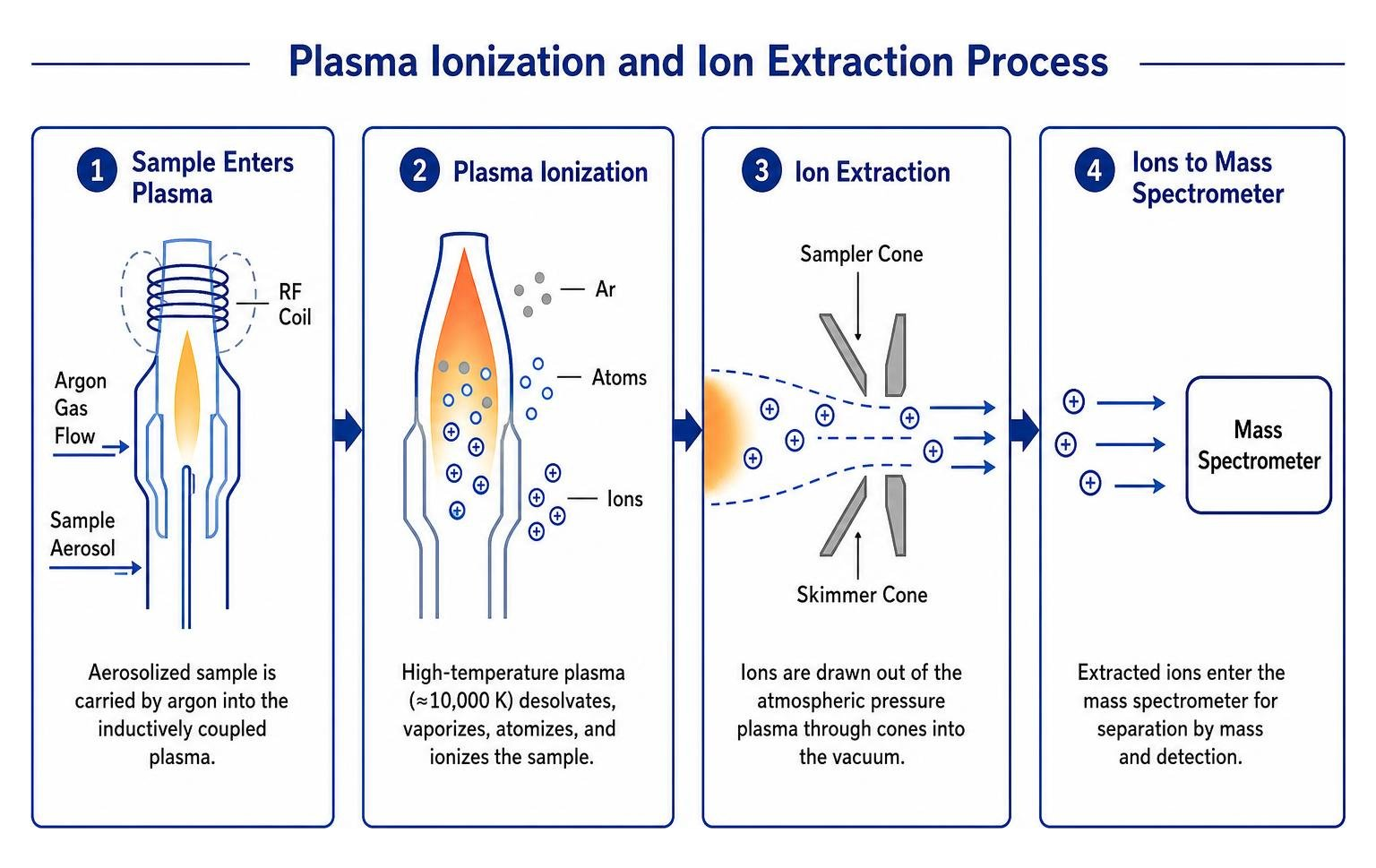
Inductively Coupled Plasma Generation and Ionization
The physical architecture that creates and stabilizes this thermal discharge is the plasma torch assembly. Constructed from three concentric quartz tubes, the torch controls distinct flows of argon gas to isolate the intense heat from the outer hardware and efficiently introduce the sample:
- Outer Gas Flow (Coolant Flow): Typically set between 13 and 18 liters per minute, this high-volume tangential flow shields the quartz tube walls from melting and forms the main body of the plasma.
- Intermediate Gas Flow (Auxiliary Flow): Flowing at around 0.5 to 1.5 L/min, this gas stream lifts the base of the discharge away from the injector tip to prevent thermal erosion.
- Central Gas Flow (Nebulizer/Carrier Flow): Operating at roughly 0.8 to 1.2 L/min, this stream punches a cooler central channel directly through the core of the plasma doughnut, carrying the sample aerosol.

Sample introduction begins with liquid uptake into a nebulizer, which disperses the solution into a fine mist. The mist travels through a chilled spray chamber designed to remove oversized droplets, allowing only droplets smaller than 10 micrometers to reach the central channel.
As established across scientific research on inductively coupled plasma mass spectrometry, this selective filtering minimizes solvent loading, preserving plasma stability and ensuring high first-stage ionization efficiency for elements with ionization energies below that of argon (15.76 eV).
Hardware Architecture from Torch to Detector
Extracting positively charged ions from an atmospheric pressure plasma (760 Torr) into a high-vacuum mass analyzer ($10^{-6}$ to $10^{-8}$ Torr) presents an engineering challenge solved by the interface region. This interface contains two water-cooled metal cones, typically fabricated from nickel or platinum:
- Sampler Cone: Positioned directly adjacent to the plasma tail flame, featuring an orifice of approximately 1.0 mm that extracts a representative slice of the central channel gas.
- Skimmer Cone: Situated a few millimeters downstream in a rough-pumped vacuum zone, with a narrower orifice (around 0.4 to 0.5 mm) that skims the supersonic expansion jet created behind the sampler cone.
Once through the skimmer cone, the extracted beam enters an electrostatic ion optics assembly. These lenses deflect and focus positively charged ions into a tight beam while rejecting neutral particles, photons, and electrons to keep instrument background noise minimal.
In standard inductively coupled plasma mass spectrometry systems, the focused ion beam enters a quadrupole mass filter. By applying oscillating RF and direct-current (DC) voltages across four parallel hyperbolic rods, the analyzer selectively transmits ions based on their specific mass-to-charge ratio ($m/z$).
Modern quadrupoles scan across a mass range of 7 to 250 atomic mass units (amu)—from lithium to uranium—in less than a quarter of a second. Filtered ions then hit a discrete-dynode electron multiplier detector, operating in simultaneous pulse-counting and analog modes to accurately track ion strikes.
Managing Spectral Interferences and Instrumental Advancements
While plasma mass spectrometry provides ultra-trace detection capabilities, spectral overlaps remain a core consideration during analysis. These interferences occur when an unwanted ion shares the identical nominal mass-to-charge ratio as the target analyte.
| Interference Mitigation Technology | Operating Principle | Primary Advantages | Practical Limitations |
|---|---|---|---|
| Helium Collision Mode (KED) | Kinetic energy discrimination via non-reactive collisions in an octopole/hexapole cell. | Universal mitigation of diverse polyatomic species without prior matrix knowledge. | Slightly reduces overall analyte transmission and sensitivity for lighter elements. |
| Reactive Cell Mode ($H2, NH3, O_2$) | Controlled chemical gas reactions creating mass shifts or neutralizing interferents. | Complete baseline resolution of severe overlaps (e.g., $^{40}\text{Ar}^{16}\text{O}^+$ on $^{56}\text{Fe}^+$). | Can form unexpected secondary reaction product ions if matrix is uncharacterized. |
| High-Resolution Sector Field (HR-ICP-MS) | Magnetic and electrostatic sector deflection yielding resolving power ($m/\Delta m$) up to 10,000+. | Physical separation of isobaric and polyatomic peaks without reaction gases. | Higher capital expenditure and reduced signal intensity in high-resolution modes. |
Polyatomic and Isobaric Interference Challenges
Spectral interferences in plasma mass spectrometry generally fall into two categories:
- Isobaric Overlaps: Occur when isotopes of two distinct stable elements share the exact same atomic mass, such as $^{40}\text{Ar}$ overlapping $^{40}\text{Ca}$, or $^{58}\text{Fe}$ overlapping $^{58}\text{Ni}$. These are resolved by monitoring alternative unhindered isotopes (e.g., measuring $^{44}\text{Ca}$ or $^{60}\text{Ni}$) or applying mathematical correction equations.
- Polyatomic Ion Interferences: Formed by the combination of plasma gas atoms, entrained atmospheric gases, and matrix solvents. Common examples include:
- Argon Oxide ($^{40}\text{Ar}^{16}\text{O}^+$) interfering with the primary iron isotope ($^{56}\text{Fe}^+$) at $m/z\ 56$.
- Argon Chloride ($^{40}\text{Ar}^{35}\text{Cl}^+$) overlapping the monoisotopic trace analyte arsenic ($^{75}\text{As}^+$) at $m/z\ 75$.
- Argon Dimer ($^{40}\text{Ar}^{40}\text{Ar}^+$) masking major selenium isotopes ($^{80}\text{Se}^+$) at $m/z\ 80$.
Additionally, doubly charged ions ($M^{2+}$), which appear at half their true atomic mass, can produce subtle interferences if plasma ionization conditions are not properly tuned.
Collision and Reaction Cell Innovations
Modern instruments overcome these polyatomic interferences using Collision/Reaction Cells (CRCs) placed directly before the mass analyzer. In collision mode, inert helium gas enters the pressurized cell. Polyatomic ions—having larger physical cross-sections than monatomic analyte ions of the same mass—collide more frequently with helium atoms, losing kinetic energy at a faster rate. A potential barrier at the cell exit (Kinetic Energy Discrimination, or KED) then filters out these slowed polyatomic ions, letting the higher-energy analyte ions pass freely to the detector.
For more challenging spectral overlaps, reaction cell modes introduce specific gases like hydrogen, ammonia, or oxygen. In dynamic reaction mode, the gas reacts with the interferent to neutralize it or forms a cluster with the analyte to shift it to a clean mass window.
When labs require reliable trace quantification, utilizing advanced plasma testing for elemental analysis ensures these complex cell chemistries are tuned to eliminate false positives.
Modern Applications Across Critical Industries
Because plasma mass spectrometry handles high sample throughput while achieving parts-per-trillion (ppt) and parts-per-quadrillion (ppq) detection limits, it serves as a workhorse technique across commercial and scientific sectors.
Environmental Monitoring and Industrial Toxicology
Environmental testing laboratories face strict regulatory demands to track toxic inorganic pollutants in soil, drinking reservoirs, and wastewater streams. Modern instruments allow running heavy metal analysis by ICP-MS across hundreds of samples daily, testing for toxic elements like lead, cadmium, mercury, and arsenic in a single rapid run. For municipal water suppliers, trace metal water analysis provides the data needed to verify compliance with global safety thresholds.
In industrial hygiene and clinical toxicology, the technique evaluates occupational exposure by testing whole blood, serum, and urine. Its high sensitivity allows medical professionals to monitor subtle increases in toxic metals among industrial workers well before clinical symptoms appear.
Furthermore, emerging interdisciplinary fields explore these methods; for instance, a recent study on biomolecular mass spectrometry in plasma medicine highlights how elemental and molecular mass spectrometry characterize reactive biochemical changes induced by medical plasma therapies.
Forensic Analysis and Pharmaceutical Impurity Testing
In forensic science, Laser Ablation (LA-ICP-MS) pairs a pulsed ultraviolet laser with plasma mass spectrometry to analyze solid samples without wet chemical digestion. A microscopic laser pulse ablates glass fragments weighing less than 250 nanograms, generating an aerosol swept into the plasma torch. Comparing trace elemental ratios allows forensic specialists to link glass shards from a hit-and-run scene to a specific vehicle window with high statistical certainty.
In pharmaceutical manufacturing, the technology ensures products meet elemental impurity limits outlined in guidelines like USP <232>/<233> and ICH Q3D. Laboratories screen drug substances, raw materials, and finished formulations for toxic catalyst residues and heavy metals, confirming batch quality and patient safety.
Hyphenation, Speciation, and Quantitative Methodologies
Quantifying elemental concentrations accurately requires robust calibration strategies tailored to matrix complexity and instrument performance.
| Calibration Methodology | Working Mechanism | Best Use Case | Operational Trade-off |
|---|---|---|---|
| External Calibration with Internal Standardization | Measures a multi-point calibration curve alongside non-interfering reference elements (e.g., $^{115}\text{In}$, $^{89}\text{Y}$, $^{159}\text{Tb}$). | Routine, high-throughput liquid testing with matched acid backgrounds. | Requires careful selection of internal standards that match analyte mass and ionization energy. |
| Standard Additions Method | Spikes increasing standard concentrations directly into multiple aliquots of the unknown sample. | Complex or variable matrices where blank matrix matching is impractical. | Multiplies the total analytical run time and sample consumption per sample. |
| Isotope Dilution (ID-ICP-MS) | Adds an enriched stable isotope of the analyte to the sample, measuring the altered isotope ratio. | Primary reference material certification and metrology-grade analyses. | Highest accuracy; requires elements with multiple stable isotopes and expensive enriched spikes. |
Quantitative Analysis and Calibration in Plasma Mass Spectrometry
External calibration backed by internal standardization is the most common quantification method in routine labs. Modern instruments provide a wide linear dynamic range spanning up to 12 orders of magnitude (from 1 ppq up to 100 ppm). This broad range allows trace-level contaminants and major matrix components to be measured in the same analytical run without multiple serial dilutions.
Internal standards compensate for physical matrix interferences, such as changes in viscosity or surface tension that affect nebulization efficiency, as well as minor instrument drift. By following verified accurate trace element testing guidelines, labs maintain quantitative accuracy even when processing variable matrices.
Advanced Hyphenated Techniques and Speciation in Plasma Mass Spectrometry
Total elemental concentration often tells only part of the story. Toxicity, bioavailability, and chemical mobility depend heavily on an element’s specific oxidation state or molecular structure. To evaluate these factors, labs connect front-end separation systems to the plasma torch:
- LC-ICP-MS (Liquid Chromatography): Separates chemical species like inorganic arsenic ($As^{III}$ and $As^V$, which are toxic) from organic dietary forms like arsenobetaine (which is non-toxic). It similarly differentiates hexavalent chromium ($Cr^{VI}$) from trivalent chromium ($Cr^{III}$).
- GC-ICP-MS (Gas Chromatography): Analyzes volatile organometallic species, such as methylmercury or organotin compounds.
- Single-Particle / Single-Cell ICP-MS: Uses high-speed, time-resolved data acquisition to analyze engineered nanoparticles or individual biological cells at rates up to 1,000 cells per second.
In bioanalysis, elemental mass spectrometry supports advanced proteomics. Using metal-coded affinity tags (MeCAT), researchers label biomolecules with lanthanides to quantify proteins down to low attomole levels—achieving 2 to 3 orders of magnitude greater sensitivity than many conventional molecular techniques, as noted in foundational work on proteome analysis via mass spectrometry.
Sample Preparation and Routine Instrument Maintenance
Reliable measurements in plasma mass spectrometry rely directly on proper sample preparation and routine preventative maintenance. Because the instrument measures down to parts-per-trillion levels, managing laboratory contamination is just as critical as maintaining the instrument hardware itself.
Digestion Protocols and Matrix Preparation
Most solid samples require chemical conversion into a clean, stable aqueous solution prior to introduction:
- Microwave-Assisted Acid Digestion: Closed-vessel microwave digestion using high-purity nitric acid ($HNO_3$) breaks down complex organic materials while containing volatile elements such as mercury, arsenic, and selenium.
- Silicate Dissolution: Geochemical and ceramic samples typically require hydrofluoric acid ($HF$) to break silicon-oxygen bonds, paired with specialized inert sample introduction systems made of PFA or PTFE.
- Total Dissolved Solids (TDS) Management: Standard nebulizers and interface cones perform reliably when dissolved solids remain below 0.2% (2,000 ppm). Running solutions with higher salt content can cause matrix deposition on cone orifices, leading to signal drift. Samples with high solids should undergo automated in-line aerosol dilution or chemical dilution prior to injection.
Preventative Maintenance for Core Components
A consistent daily and weekly maintenance schedule prevents unexpected instrument downtime:
- Interface Cones: Inspect the sampler and skimmer cone orifices regularly for salt buildup or physical pitting. Cones should be cleaned using ultra-pure water and mild polishing agents in an ultrasonic bath.
- Nebulizer and Spray Chamber: Monitor uptake lines for blockages. Regularly flush the sample path with dilute acid and inspect peristaltic pump tubing for flattening, replacing lines as needed to maintain stable fluid flow.
- Torch and RF Load Coil: Check the quartz torch periodically for devitrification or carbon deposits. Confirm proper mechanical alignment relative to the interface cone entrance.
- Vacuum System: Check rotary vane roughing pump oil levels monthly and monitor turbo-molecular pump bearing hours to ensure proper vacuum performance.
Frequently Asked Questions About Trace Elemental Analysis
What makes argon the ideal gas for plasma generation?
Argon is well-suited for high-temperature plasma generation for two reasons: its first ionization potential is 15.76 eV, which is high enough to ionize over 90% of the elements in the periodic table while remaining lower than elements like helium. Additionally, as a noble gas, argon is chemically inert, plentiful, and cost-effective compared to other inert carrier alternatives.
How does plasma mass spectrometry differ from atomic absorption spectroscopy?
Atomic Absorption Spectroscopy (AAS) measures light absorption from free ground-state atoms, generally analyzing one element at a time across a narrow dynamic range. In contrast, plasma mass spectrometry detects positive ions directly across multiple elements simultaneously, provides isotopic resolution, delivers detection limits that are 3 to 4 orders of magnitude lower, and covers a broader linear dynamic range.
What is the dynamic range and detection limit of modern instruments?
Modern systems feature a linear dynamic working range spanning up to 12 orders of magnitude within a single acquisition. Detection limits for non-interfered, easily ionized heavy elements (such as uranium, lead, and bismuth) routinely reach parts-per-quadrillion (ppq) or sub-ppt levels, while elements with higher ionization potentials typically achieve sub-ppb detection limits.
Conclusion
Plasma mass spectrometry remains an essential analytical tool for trace elemental quantification, isotope ratio determination, and chemical speciation. By combining a 10,000 K atmospheric argon plasma with high-vacuum mass filtering, the technology provides high sensitivity, rapid scanning, and wide multi-element coverage across modern laboratories.
Achieving reproducible, metrology-grade data requires careful matrix preparation, systematic interference control using collision/reaction cells, and regular instrument maintenance. At Elemental Analysis Inc., based in Lexington, Kentucky, our team applies decades of experience across elemental testing, characterization, and speciation to support demanding industrial, environmental, and research projects. To discuss your laboratory’s testing requirements or explore our specialized testing workflows, learn more about our custom elemental analysis services and connect with our analytical team today.