
Going Liquid: A Deep Dive into Liquid Elemental Analysis
When Every Part Per Trillion Counts: An Introduction to ICP-MS Elemental Analysis
ICP-MS elemental analysis is the gold standard for detecting trace and ultra-trace elements in liquid samples — and for good reason.
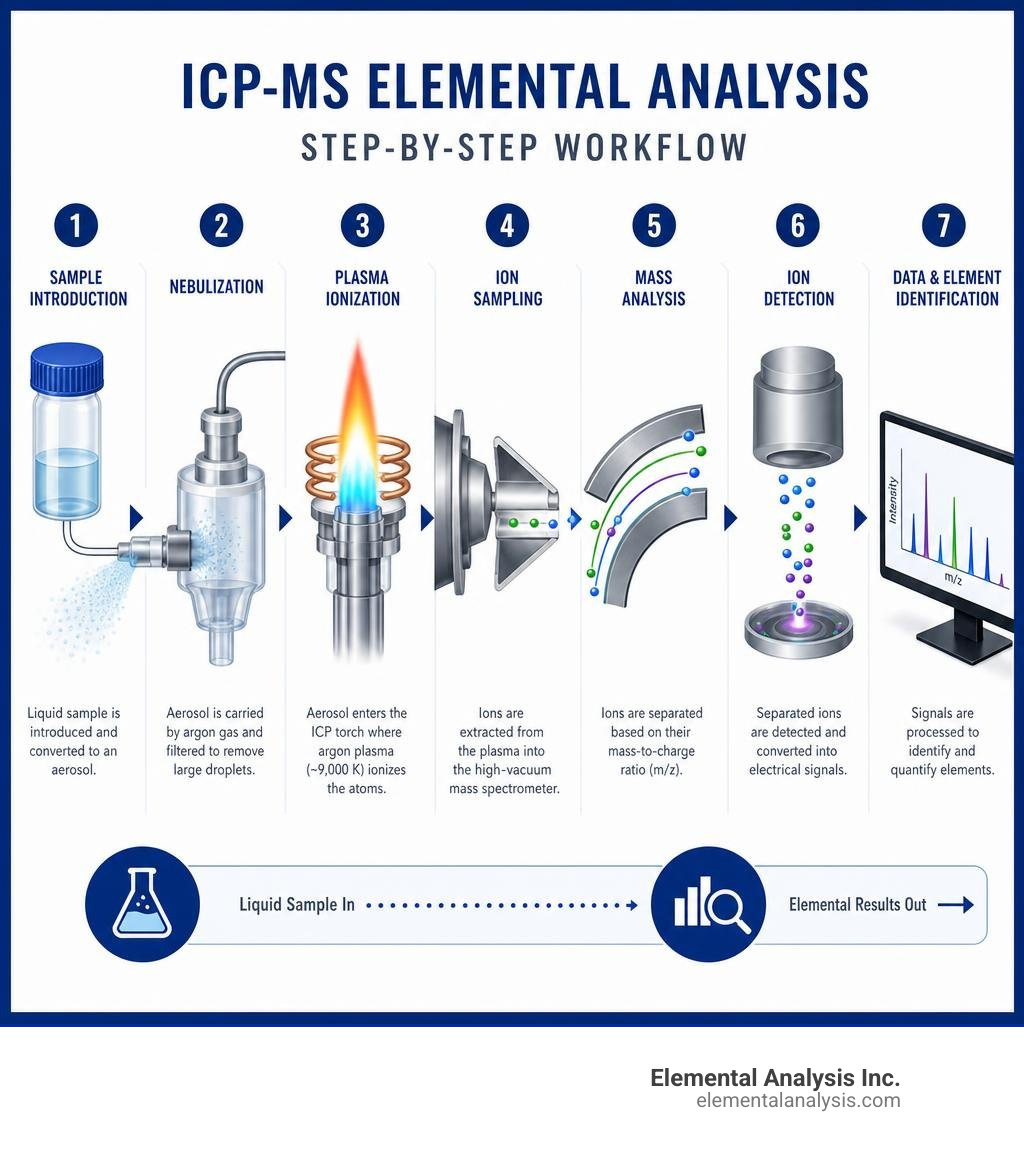
Quick answer: ICP-MS (Inductively Coupled Plasma Mass Spectrometry) works by converting a liquid sample into an aerosol, ionizing it in an argon plasma at roughly 9,000 K, then separating the resulting ions by their mass-to-charge ratio to identify and quantify up to 70 elements simultaneously — down to parts-per-trillion (ppt) concentrations.
Here’s what makes it stand out at a glance:
| Feature | ICP-MS Performance |
|---|---|
| Detection limits | Parts per trillion (ppt) to parts per billion (ppb) |
| Elements measurable | Up to 70 in a single run (Li to U) |
| Sample type | Primarily liquids; solids after digestion |
| Analysis speed | Multi-element in one pass |
| Destructive? | Yes |
If you’re managing trace-element testing in aerospace, pharmaceutical, or environmental work, you already know the pain: tight detection limits, complex matrices, multiple regulatory frameworks, and the pressure to get it right the first time.
ICP-MS was built for exactly that environment.
It’s not the only tool in the elemental analysis toolkit — ICP-OES, atomic absorption, and XRF all have their place — but when you need ultra-low detection limits and simultaneous multi-element data from a liquid sample, ICP-MS is consistently the technique labs reach for first.
This guide breaks down how it works, where it excels, where it has limits, and how to get the most out of it for your specific application.
ICP MS elemental analysis definitions:
What is ICP MS Elemental Analysis and How Does It Work?
To truly appreciate the power of ICP MS elemental analysis, it helps to understand what is happening inside the instrument. We aren’t just looking at the color of a flame or measuring how much light a sample absorbs. Instead, we are physically weighing individual atoms.
To do this, the instrument combines two incredibly powerful tools: an inductively coupled plasma (ICP) torch, which acts as an ultra-high-temperature ionization source, and a mass spectrometer (MS), which acts as an exceptionally precise scale. For a deep dive into this atomic scale, check out our guide on ICP-MS Explained: How We Weigh Atoms in a Plasma Fire.
The Core Principles of ICP MS Elemental Analysis
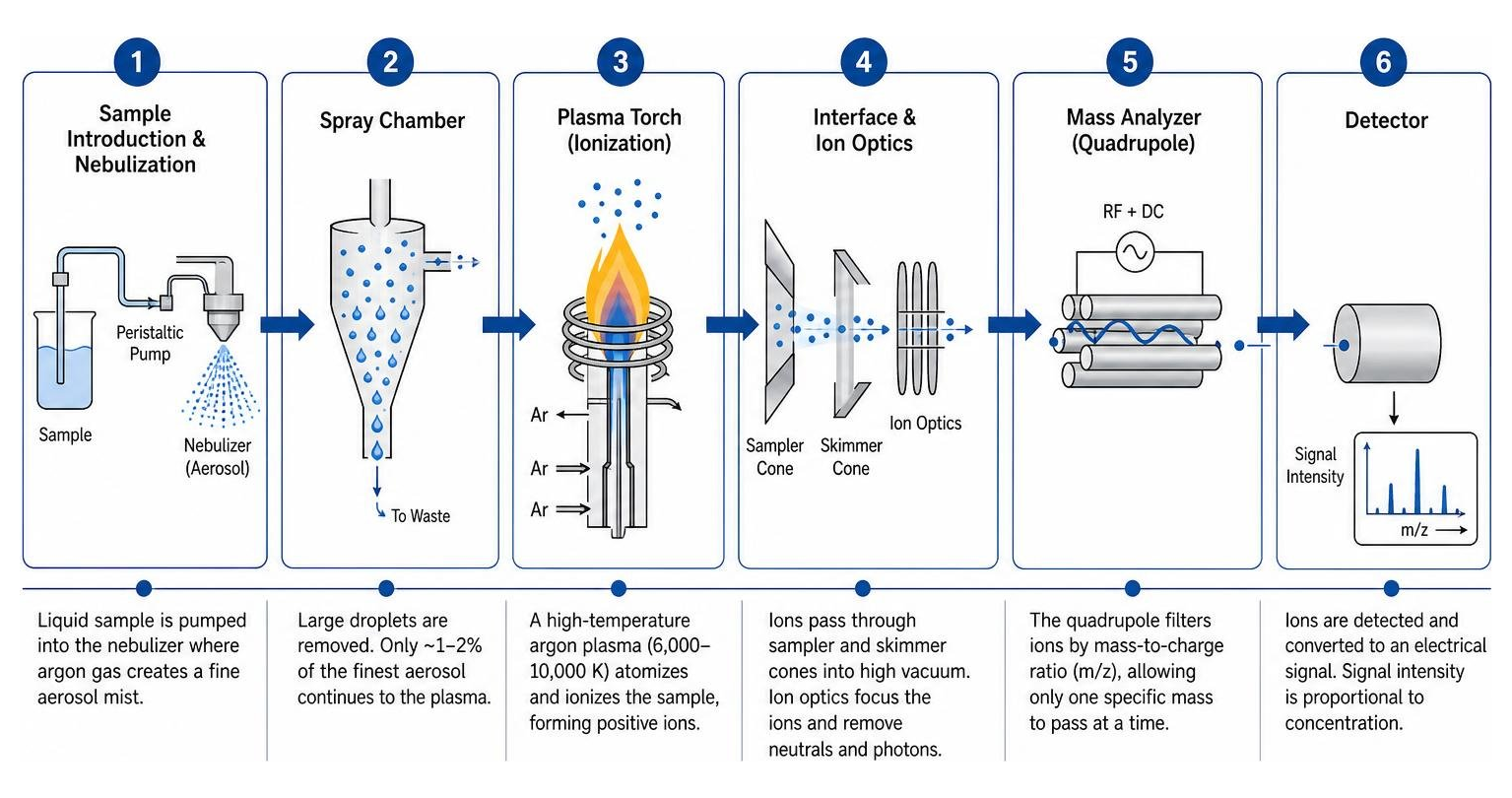
The journey of a sample through an ICP-MS instrument is a highly controlled physical and chemical transformation:
- Sample Introduction and Nebulization: The liquid sample is drawn into the system using a peristaltic pump. It passes into a nebulizer, where a high-velocity stream of argon gas breaks the liquid into a fine aerosol mist.
- The Spray Chamber: Because the plasma cannot handle large droplets, the aerosol passes through a temperature-controlled spray chamber (often kept at a cool 2 °C to minimize water vapor and oxide formation). Here, only the smallest droplets (typically about 1% to 2% of the original nebulized sample) are allowed to proceed to the plasma torch. The rest is drained away.
- The Plasma Torch (Ionization): The remaining fine mist enters the heart of the instrument—the argon plasma. This plasma is generated by wrapping an induction coil powered by a radiofrequency (RF) generator (usually operating at 27 MHz) around a quartz torch. The argon gas is ionized, forming a stable, donut-shaped plasma core. Temperatures in this core reach an astonishing 6,000 K to 10,000 K—with typical operating temperatures around 9,000 K. This is hotter than the surface of the sun! At these temperatures, the sample is completely dried, vaporized, atomized, and stripped of electrons to form single-charged positive ions.
- The Interface and Ion Optics: The newly formed ions must transition from the atmospheric pressure of the plasma into the ultra-high vacuum of the mass spectrometer. They pass through a pair of water-cooled metal cones—the sampler cone and the skimmer cone. Once inside the vacuum chamber, a series of electrostatic lenses (ion optics) focuses the positive ions into a tight beam while discarding neutral particles and light photons to keep background noise to an absolute minimum.
- The Mass Analyzer (The Scale): The ion beam enters the mass analyzer, which is most commonly a quadrupole. A quadrupole consists of four parallel metal rods that apply combined radiofrequency and direct current voltages. By rapidly scanning these voltages, the quadrupole acts as a mass-to-charge ratio (m/z) filter. It allows only one specific mass to pass through to the detector at any given microsecond.
- The Detector: The filtered ions strike a dual-mode detector (pulse/analog), which translates the physical impact of the ions into electrical pulses. Because the signal intensity is directly proportional to the concentration of the element in the sample, we can determine exactly how much of each element is present by comparing the signal to known calibration standards.
Standardized protocols, such as Method 6020B: Inductively Coupled Plasma – Mass Spectrometry, part of Test Methods for Evaluating Solid Waste, Physical/Chemical Methods, outline the rigorous operational parameters required to ensure this complex process remains highly accurate and repeatable across different laboratories.
Overcoming Interferences in Spectrometry
While ICP MS elemental analysis is incredibly powerful, it is not magic. Like any spectroscopic technique, it has to contend with physical and chemical interferences. These interferences fall into two primary categories:
- Isobaric Overlaps: This occurs when two different elements have isotopes with the same nominal mass. For example, argon ($^{40}\text{Ar}$) and calcium ($^{40}\text{Ca}$) both share a mass of 40. Fortunately, because we know the natural abundance of isotopes, we can resolve this by measuring an alternative isotope of the analyte or by applying mathematical correction equations.
- Polyatomic Interferences: These are molecular “ghosts” created when elements from the sample matrix, plasma gas, or acids combine in the plasma to form molecules with the same mass as an analyte. A classic example is when chlorine in a sample combines with argon from the plasma to form argon chloride ($^{40}\text{Ar}^{35}\text{Cl}$). This molecule has a mass-to-charge ratio of 75—which is the exact mass of arsenic ($^{75}\text{As}$), the only stable isotope of arsenic.
To overcome these polyatomic interferences, modern ICP-MS instruments utilize advanced collision and reaction cells:
- Kinetic Energy Discrimination (KED): In KED mode, an inert gas like helium is introduced into a cell positioned before the mass analyzer. Because polyatomic molecules (like $\text{ArCl}$) are physically larger than single-atom ions (like $\text{As}$), they collide with the helium atoms far more frequently. Each collision strips away kinetic energy. By the time they reach the exit of the cell, the polyatomic molecules have lost too much energy to overcome a small potential barrier, leaving a clean beam of elemental analyte ions to enter the quadrupole.
- Triple Quadrupole (ICP-MS/MS): For the most challenging matrices, triple quadrupole systems use reactive gases like oxygen ($\text{O}_2$), ammonia ($\text{NH}_3$), or hydrogen ($\text{H}_2$). The first quadrupole filters out everything except the mass of interest. The target ion then enters the reaction cell, where it selectively reacts with the gas to shift to a new mass (for example, converting $^{75}\text{As}$ to $^{75}\text{As}^{16}\text{O}$ at mass 91), while the interfering species does not react, allowing the second quadrupole to measure the analyte completely free of interference.
The Analytical Advantages of ICP-MS Over Other Techniques
When designing an analytical testing program, you have several spectroscopic methods to choose from. However, when it comes to trace and ultra-trace detection, ICP-MS is unmatched. To understand why, read our breakdown on ICP Analysis for Heavy Metals: Choosing Between ICP-OES and ICP-MS.
Let’s look at how ICP-MS compares to older, more traditional methods:
ICP-MS vs. ICP-OES and ICP-AES
First, a quick point of clarification: ICP-OES (Optical Emission Spectroscopy) and ICP-AES (Atomic Emission Spectroscopy) are two names for the exact same technique. They rely on measuring the light emitted by excited atoms as they cool down after leaving the plasma.
While both ICP-OES and ICP-MS use an argon plasma to prepare the sample, they differ dramatically in how they detect the elements, which leads to distinct analytical profiles:
- Sensitivity and Detection Limits: ICP-MS is orders of magnitude more sensitive. While ICP-OES can comfortably measure elements in the parts-per-billion (ppb) to parts-per-million (ppm) range, ICP-MS routinely achieves detection limits in the parts-per-trillion (ppt) range. For some low-ionization-potential metals, detection limits can even reach the parts-per-quadrillion (ppq) level.
- Linear Dynamic Range: Thanks to modern dual-mode detectors, ICP-MS boasts an incredibly wide linear dynamic range spanning 8 to 12 orders of magnitude. This means a laboratory can measure ultra-trace contaminants and major components of a sample in a single analytical run without needing to perform multiple dilutions.
- Multi-Element Capability: ICP-MS can analyze up to 70 elements simultaneously from lithium to uranium in under three minutes per sample. While ICP-OES is also a multi-element technique, its spectral lines can become incredibly crowded and complex, leading to spectral overlaps that are difficult to resolve.
- Sample Volume and Matrix Tolerance: ICP-OES has a distinct advantage when it comes to dirty samples; it can tolerate samples with up to 30% total dissolved solids (TDS). By contrast, standard ICP-MS systems prefer samples with less than 0.2% TDS to prevent salt buildup on the interface cones. However, ICP-MS requires much smaller sample volumes (often less than 1 mL), making it ideal when sample quantities are limited.
For a broader perspective on selecting the right spectroscopic setup for your laboratory’s specific goals, explore our resource on Inductively Coupled Plasma: Finding the Perfect Match for Your Lab as well as The Ins and Outs of Inductively Coupled Plasma Mass Spectrometry.
Sample Preparation and Matrix Management for Liquid Analysis
The old analytical chemistry adage “garbage in, garbage out” is incredibly true for ICP MS elemental analysis. Because the instrument is so sensitive, even minor contaminants introduced during sample preparation can ruin your data. To avoid these common pitfalls, consult our comprehensive ICP-MS Lab Guide: How to Get Accurate Trace Element Testing.
Key Steps in Sample Preparation
Most samples analyzed by ICP-MS must start as clean, low-viscosity liquids. Achieving this requires careful chemical processing:
- Acid Digestion: Solid samples (like soils, plastics, or tissues) must be broken down. We typically use closed-vessel microwave digestion or hot-plate digestion with high-purity, trace-metal-grade nitric acid ($\text{HNO}_3$). Nitric acid is the preferred matrix because its decomposition products ($\text{N}_2$, $\text{O}_2$, and $\text{H}_2\text{O}$) do not form complex polyatomic interferences with argon. For materials with high organic content or complex mineral structures, we may add hydrogen peroxide ($\text{H}_2\text{O}_2$) or hydrochloric acid ($\text{HCl}$).
- Managing Total Dissolved Solids (TDS): To prevent physical blockages of the nebulizer and deposition on the sampler and skimmer cones, the total dissolved solids in the final liquid solution should be kept below 0.2% (2,000 mg/L). This typically requires a 10-fold to 50-fold dilution of digested samples with ultrapure water (resistivity of 18.2 $\text{M}\Omega\cdot\text{cm}$).
- Direct Solid Analysis (Laser Ablation): When sample digestion is impractical or when spatial distribution of elements is required, we can bypass liquid preparation entirely using Laser Ablation ICP-MS (LA-ICP-MS). In this setup, a high-energy laser beam vaporizes a tiny spot on the solid sample inside a sealed chamber, and an argon or helium carrier gas sweeps the resulting micro-particulate aerosol directly into the plasma torch.
Key Applications of ICP MS Elemental Analysis in Industry
Because of its unmatched sensitivity and multi-element capabilities, ICP-MS is a critical tool across a massive range of modern industries:
- Environmental Monitoring: ICP-MS is the primary technique for tracking heavy metal contaminants in soil, sludge, and water systems. It is used to monitor toxic elements like arsenic, cadmium, lead, and mercury at sub-ppb levels. For more information on environmental water testing, see our guide From H2O to Heavy Metals: A Guide to ICP-MS Water Analysis. For environmental solid matrices, laboratories often follow standardized guidelines such as the Fraunhofer Guidelines for Environmental ICP-MS.
- Pharmaceutical Impurities: Pharmaceutical manufacturers must comply with strict regulatory standards (such as USP Chapters <232> and <233> and ICH Q3D) governing elemental impurities in active pharmaceutical ingredients (APIs) and finished drug products. ICP-MS is the preferred method for verifying that toxic catalysts and heavy metals are well below safety thresholds.
- Food Safety and Regulatory Compliance: Ensuring that food products are free from heavy metals is a global priority. For example, exporters and testing labs targeting international markets must comply with standards like China’s GB 5009.268-2025 Food Safety Standard, which outlines specific ICP-MS protocols for determining multi-element concentrations in agricultural and food products.
- Consumer Products and RoHS: Manufacturers must prove their products comply with environmental directives like the Restriction of Hazardous Substances (RoHS), which limits lead, mercury, cadmium, and hexavalent chromium in electrical and electronic equipment.
To learn more about how we use this technology to identify and mitigate environmental and biological hazards, read our article Heavy Metal Analysis by ICP-MS: The Ultimate Guide to Screening Toxins.
Quality Assurance and Laboratory Accreditation
To ensure that analytical results are legally defensible and scientifically robust, testing laboratories must operate under strict quality management systems:
- ISO/IEC 17025 Accreditation: This international standard specifies the general requirements for the competence, impartiality, and consistent operation of testing and calibration laboratories. Working with an accredited laboratory ensures that the equipment is calibrated, the staff is trained, and the methods are fully validated. For an overview of laboratory standards, see Elemental Testing Lab 101.
- Internal Standardization: To compensate for physical interferences (like viscosity differences), sample transport variations, and long-term instrument drift, we add a known concentration of internal standard elements (such as $^{6}\text{Li}$, $^{45}\text{Sc}$, $^{89}\text{Y}$, $^{103}\text{Rh}$, $^{115}\text{In}$, $^{159}\text{Tb}$, $^{165}\text{Ho}$, or $^{209}\text{Bi}$) online to every sample, blank, and standard. The instrument normalizes the analyte signals against these internal standards in real time.
- Calibration and Method Validation: We construct calibration curves using high-purity, multi-element standards with a correlation coefficient ($r$) of at least 0.995. We regularly analyze method blanks, calibration verification standards, and certified reference materials (CRMs) to confirm that the instrument remains accurate throughout the analytical run.
Frequently Asked Questions About ICP-MS
What is the typical detection limit for ICP-MS?
For most elements in simple liquid matrices, the detection limits for ICP-MS range from low parts-per-billion (ppb) down to single-digit parts-per-trillion (ppt). This translates to detecting a single drop of a contaminant dissolved in an entire Olympic-sized swimming pool.
Can ICP-MS analyze solid samples directly?
Yes, solid samples can be analyzed directly using Laser Ablation ICP-MS (LA-ICP-MS). However, because solid standards can be difficult to match to the sample matrix, the most accurate quantitative results are still achieved by digesting the solid sample into a liquid state using acid digestion before nebulization.
Is ICP-MS a destructive testing method?
Yes. Because the sample must be nebulized and completely atomized in a 9,000 K plasma fire, the portion of the sample introduced into the instrument is completely destroyed. If preserving a rare or valuable sample is critical, alternative non-destructive methods (such as Proton Induced X-ray Emission, or PIXE) should be considered.
Conclusion
When your project demands the highest level of sensitivity, speed, and multi-element capability, ICP MS elemental analysis is the undisputed industry standard. Whether you are proving regulatory compliance, screening for toxic heavy metals, or certifying material purity, this technology provides the atomic-level clarity you need.
At Elemental Analysis Inc., located in Lexington, Kentucky, we combine this advanced ICP-MS capability with our unique history as the first commercial Proton Induced X-ray Emission (PIXE) laboratory. This allows us to offer both destructive and non-destructive testing services, providing fast turnaround times and competitive pricing tailored to your specific analytical challenges.
Ready to take a closer look at what is in your liquid samples? Reach out to our team of experts today to discuss your testing needs, or explore our full suite of ICP Analysis Services.