
Understanding ICP Chemistry and Why It Matters
What Is ICP in Chemistry? A Quick-Start Guide for Analytical Professionals
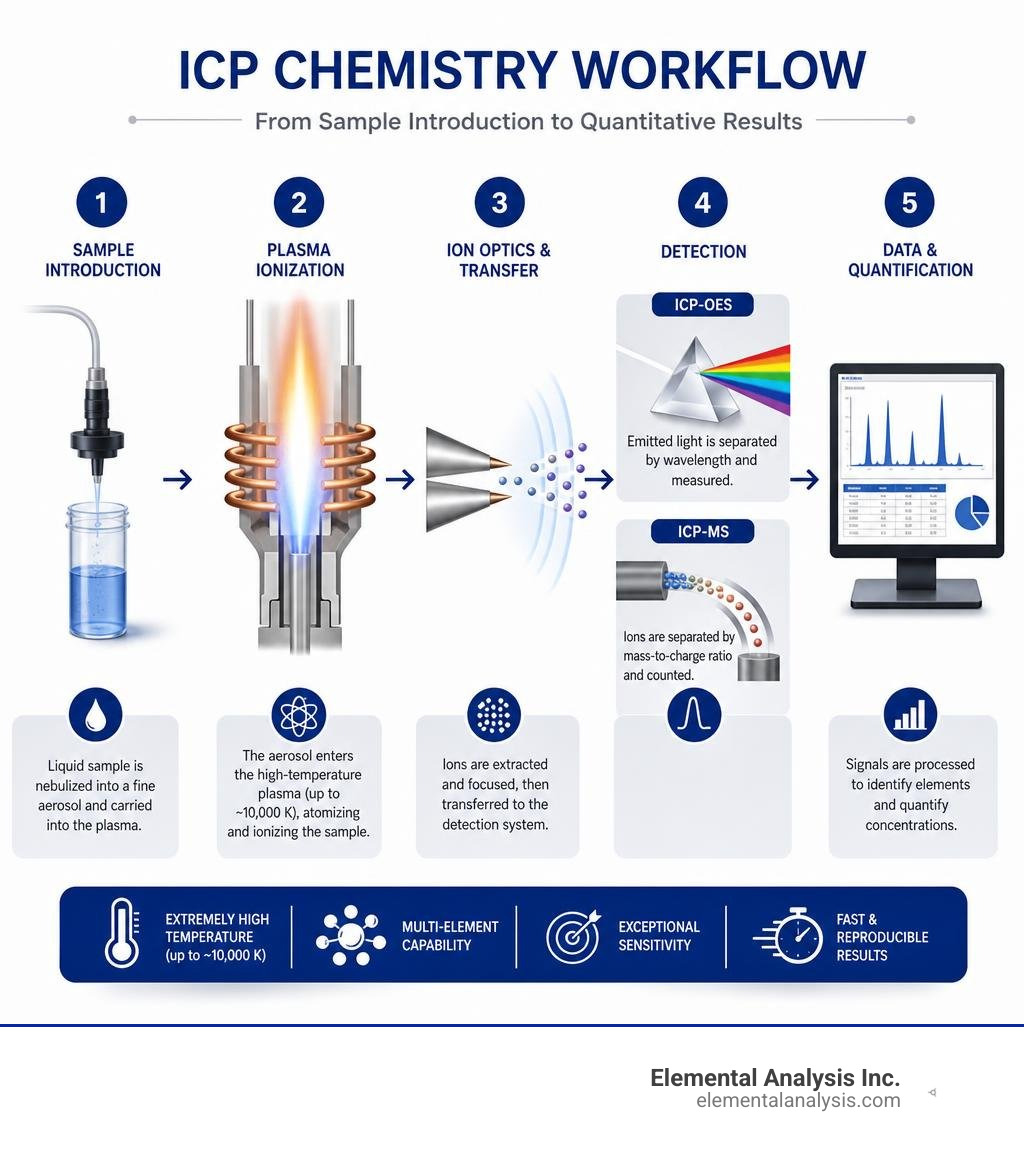
What is ICP in chemistry refers to Inductively Coupled Plasma — an extremely high-temperature ionization source used to break down any sample into its individual atoms and ions for precise elemental analysis.
Here is the fast answer:
| Term | Meaning |
|---|---|
| ICP | Inductively Coupled Plasma — a plasma source reaching up to 10,000 K, hotter than the surface of the sun |
| ICP-OES | ICP paired with Optical Emission Spectroscopy — measures light emitted by excited atoms |
| ICP-MS | ICP paired with Mass Spectrometry — separates and counts ions by mass, achieving detection limits in the nmol/L range |
| What it does | Atomizes and ionizes any sample so individual elements can be identified and quantified with exceptional precision |
Imagine a flame hotter than the surface of the sun, capable of stripping any molecule down to its bare elemental components in milliseconds. That is exactly what an ICP source does — and it is why ICP-based techniques have become the gold standard for trace element analysis across aerospace, pharmaceutical, environmental, and clinical laboratories.
Whether you need to detect toxic heavy metals like lead or arsenic in biological fluids, verify elemental purity in a pharmaceutical batch, or confirm compliance with environmental regulations, ICP chemistry gives you the sensitivity, speed, and multi-element capability that older techniques simply cannot match.
This guide walks you through how ICP works, what the instrumentation looks like, how samples are prepared, and how interferences are controlled — so you can make informed decisions about your analytical workflow.
What Is ICP in Chemistry? Definition and Core Techniques
To understand what is icp in chemistry, we have to look at the official definitions established by the scientific community. According to the IUPAC – inductively-coupled plasma spectrometry (08489) definition, it is a measurement method of atomic spectroscopy that utilizes an inductively-coupled plasma to excite and ionize atoms.
At its core, “plasma” is the fourth state of matter—an ionized gas containing a significant concentration of free electrons and positive ions. In an analytical laboratory, we generate this plasma using argon gas and radiofrequency (RF) energy.
Once we have this high-energy plasma fire, we can use it in two primary analytical techniques, which are classified based on how we detect the elements:
- Inductively Coupled Plasma Optical Emission Spectroscopy (ICP-OES): Also historically referred to as ICP-AES (Atomic Emission Spectroscopy), this technique measures the characteristic light emitted by excited atoms and ions as they return to their ground state. Because every element emits light at specific, unique wavelengths, we can identify and quantify multiple elements simultaneously.
- Inductively Coupled Plasma Mass Spectrometry (ICP-MS): Instead of looking at light, ICP-MS physically extracts the ions generated in the plasma and directs them into a mass spectrometer. The mass spectrometer separates these ions based on their mass-to-charge ratio ($m/z$).
While both methods rely on the same incredibly hot plasma source, ICP-MS is widely favored for trace and ultra-trace analysis due to its exceptional sensitivity. For a deeper dive into the fundamental physics of plasma, check out An Essential Guide to Inductively Coupled Plasma.
How Inductively Coupled Plasma Generates Ions
How does a stream of room-temperature argon gas transform into a superheated plasma fire that can reach temperatures of up to 10,000 Kelvin? The process is a masterpiece of electromagnetic engineering.
It begins with an ICP torch, which consists of three concentric quartz tubes. Argon gas flows through these tubes. At the open end of the torch sits a water-cooled copper coil—the load coil—which is connected to a radiofrequency (RF) generator. When RF power is applied to the coil, it creates an intense, rapidly oscillating electromagnetic field.
To initiate the plasma, a brief high-voltage spark (from a Tesla coil) is applied to the argon gas. This spark strips a few electrons from the argon atoms. These free electrons are accelerated by the oscillating electromagnetic field, colliding with other argon atoms in a domino effect known as a “Tesla discharge.” Within microseconds, this self-sustaining, highly ionized argon plasma is formed.
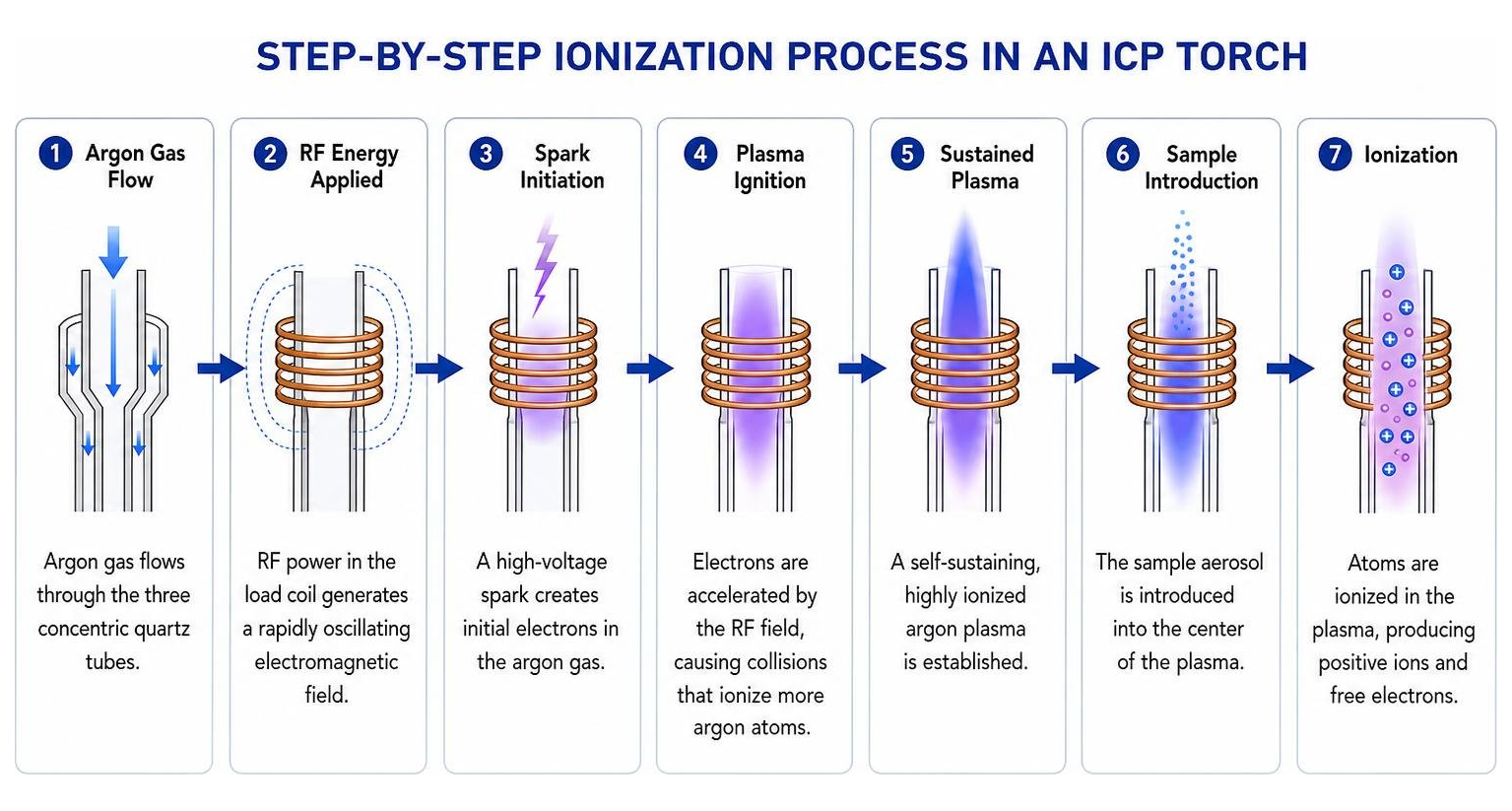
Once the plasma is established, the sample is introduced as a fine aerosol directly into the center of the discharge. As the aerosol droplets travel through the plasma, they experience a rapid series of physical and chemical transformations:
- Desolvation: The solvent is evaporated instantly, leaving behind solid microscopic particles.
- Vaporization: The solid particles are vaporized into a gaseous state.
- Atomization: The molecules are completely broken down into individual ground-state atoms.
- Ionization: The ground-state atoms collide with high-energy electrons and argon ions, stripping away an electron to form singly charged positive ions ($M^+$).
The efficiency of this ionization process is governed by the Saha equation, which describes the ratio of ions to neutral atoms as a function of temperature and the element’s first ionization potential. Because argon has a relatively high first ionization potential of 15.76 electron volts (eV), and because most elements on the periodic table have a first ionization potential much lower than argon, the plasma is incredibly efficient. It successfully ionizes nearly all elements in the periodic table, making it a truly universal ionization source.
To learn more about how this intense thermal energy powers modern mass spectrometers, read Hot Stuff: How Inductively Coupled Argon Plasma Spectrometry Powers Modern Mass Spec.
Anatomy of an ICP-MS Instrument
An ICP-MS instrument is a marvel of engineering, seamlessly bridging an atmospheric pressure plasma environment (760 Torr) with the ultra-high vacuum environment ($10^{-5}$ to $10^{-8}$ Torr) required for mass spectrometry.
To understand how this works, let’s break down the physical compartments of the instrument from sample introduction to final detection. For an in-depth component-by-component analysis, you can also read The Ins and Outs of Inductively Coupled Plasma Mass Spectrometry.
| Component | Primary Function | Key Operating Parameters & Insights |
|---|---|---|
| Nebulizer & Spray Chamber | Converts liquid sample into a fine aerosol; filters out large droplets. | Only 1% to 2% of the sample reaches the plasma; the rest is drained to waste. The spray chamber is kept at ~2 °C to limit solvent vapor. |
| ICP Torch | Generates the 10,000 K argon plasma to atomize and ionize the sample. | Powered by an RF generator; argon gas flow must be carefully controlled. |
| Interface Region | Transitions ions from atmospheric pressure to high vacuum. | Consists of sampler and skimmer cones. The pressure here is maintained at ~150 to 300 Pa. |
| Ion Optics | Electrostatically focuses the positive ions while rejecting neutral species and photons. | Uses a “photon stop” or off-axis lens design to prevent noise from ultraviolet light. |
| Mass Analyzer | Separates ions based on their mass-to-charge ($m/z$) ratio. | Usually a quadrupole mass filter operating under high vacuum (~$7 \times 10^{-5}$ to $1 \times 10^{-3}$ Pa). |
| Detector | Converts the physical ion impact into an electrical signal. | Electron multiplier detectors operating in both pulse and analogue modes to handle massive concentration ranges. |
Understanding the Role of Mass Analyzers: Quadrupole vs. High-Resolution Systems
Once the ions successfully pass through the electrostatic ion optics, they must be separated by mass. In commercial ICP-MS, this is primarily achieved using one of two mass analyzer designs:
Quadrupole Mass Filters
The quadrupole is the workhorse of the industry. It consists of four parallel cylindrical metal rods. By applying a combination of radiofrequency (RF) and direct current (DC) voltages to these rods, we can create an electrostatic field that only allows ions of a specific mass-to-charge ratio ($m/z$) to travel down the center of the rods to reach the detector. All other ions become unstable, fly off course, and hit the rods.
Quadrupoles typically operate at a nominal resolution of approximately 0.75 atomic mass units (amu), which is represented by an $M/\Delta M$ ratio of ~300. They have an abundance sensitivity of about $10^{-7}$, meaning that a massive peak at one mass will have minimal spillover into adjacent mass channels.
High-Resolution (Magnetic Sector) Systems
When nominal resolution is not enough to separate analytes from difficult polyatomic interferences, high-resolution ICP-MS (HR-ICP-MS) is used. These instruments utilize a magnetic sector combined with an electrostatic analyzer (double-focusing design).
By physically bending the path of the ions in a magnetic field, HR-ICP-MS can achieve resolutions ($M/\Delta M$) exceeding 10,000. This allows the instrument to easily distinguish between isotopes that have almost identical nominal masses but slightly different exact masses. To understand how we weigh these individual atoms in a plasma fire, see ICP-MS Explained: How We Weigh Atoms in a Plasma Fire.
Sample Types, Preparation, and Speciation in ICP Chemistry

One of the greatest strengths of ICP chemistry is its versatility. We can analyze almost any sample type—including biological fluids (blood, urine, serum), environmental waters, soils, geological minerals, high-purity chemicals, and consumer products. However, because the sample introduction system relies on nebulization, samples must generally be converted into a liquid form before analysis.
Proper sample preparation is critical for obtaining accurate trace element data. To prevent nebulizer clogging and minimize sample-specific matrix effects, a total dissolved solids (TDS) content of less than 0.2% (2 g/L) is highly recommended.
Here are the key strategies we use in the laboratory to prepare samples:
- Acid Digestion: Solid samples are typically broken down using concentrated, high-purity acids (such as nitric acid, $HNO_3$, or hydrochloric acid, $HCl$) in closed-vessel microwave digestion systems. This completely destroys the organic matrix and solubilizes the metals.
- Dilution: Liquid samples like biological fluids are diluted by a factor of 10 to 50 using acidic or alkaline diluents. Pure deionized water is rarely used because elements can easily adsorb to the walls of the sample tubes without a stabilizing agent.
- Alkaline Extraction: For certain elements like iodine or selenium, alkaline diluents (such as ammonium hydroxide or tetramethylammonium hydroxide) are preferred. When working with highly proteinaceous samples like blood, we must be careful: the isoelectric point of many proteins is approximately 5 to 6. Adding acidic diluents can cause rapid protein precipitation, which clogs the instrument.
- Stabilizing Additives: We often incorporate chelating agents like EDTA in alkaline diluents to maintain element solubility, and we add mild surfactants like Triton-X100 to help disperse lipids and membrane proteins.
For a comprehensive guide on how to prepare samples and avoid contamination, read our ICP-MS Lab Guide: How to Get Accurate Trace Element Testing.
What Is ICP in Chemistry Used For? Elemental Speciation and Chromatography
Standard ICP-MS is “element-blind” in terms of chemical structure; it will tell you the total concentration of arsenic in a sample, but it cannot tell you what chemical form that arsenic is in. This is a major limitation because different chemical forms (species) of the same element can have wildly different toxicity profiles.
For example, inorganic arsenite ($As^{3+}$) is highly toxic, whereas organic arsenobetaine (commonly found in seafood) is completely non-toxic and passes through the human body harmlessly.
To solve this, we use elemental speciation, which couples a high-performance separation technique with the detection power of ICP-MS. The most common hyphenated setup is High-Performance Liquid Chromatography coupled to ICP-MS (HPLC-ICP-MS).
In this setup, we use techniques like IUPAC – ion-pair chromatography (09893) to separate the different chemical species on a chromatographic column based on their unique chemical properties before they enter the plasma. According to the standard literature on liquid chromatography, such as Introduction to Modern Liquid Chromatography, Third Edition , these separations occur due to differences in the distribution coefficients of the analytes between the mobile and stationary phases.
As the separated species elute from the column, they flow directly into the ICP-MS, which acts as a highly sensitive element-specific detector. This allows us to quantify the exact concentration of each individual species.
Overcoming Interferences and Calibrating for Accuracy
While ICP-MS is incredibly powerful, it is not immune to analytical challenges. Interferences can compromise data quality if they are not carefully controlled. These interferences fall into two main categories: spectroscopic and non-spectroscopic. For an overview of how we navigate these challenges, see ICP-MS Testing: Unleashing the Power of Plasma for Elemental Analysis.
Mitigating Polyatomic Interferences with Collision and Reaction Cells
Spectroscopic interferences occur when an interfering ion has the same nominal mass-to-charge ($m/z$) ratio as the analyte of interest. These can be:
- Isobaric Interferences: Two different elements having isotopes at the same mass (e.g., $^{40}Ar^+$ and $^{40}Ca^+$).
- Doubly Charged Ions: Ions that lose two electrons instead of one, appearing at half their actual mass (e.g., $^{136}Ba^{2+}$ interfering on $^{68}Zn^+$).
- Polyatomic Interferences: Recombination products of plasma gases, reagents, and matrix elements (e.g., $^{40}Ar^{16}O^+$ interfering on $^{56}Fe^+$, or $^{40}Ar^{35}Cl^+$ interfering on $^{75}As^+$).
To eliminate polyatomic interferences, modern ICP-MS instruments utilize Collision/Reaction Cell (CRC) technology. The cell is placed between the ion optics and the mass analyzer.
By introducing a gas into this cell, we can selectively remove interferences:
- Collision Mode (Kinetic Energy Discrimination – KED): We fill the cell with an inert gas, typically helium. Polyatomic interfering ions (like $ArCl^+$) have a larger cross-sectional area than analyte ions of the same mass (like $As^+$). As a result, the polyatomic ions collide more frequently with the helium atoms, losing more kinetic energy. By applying a small electrostatic barrier at the exit of the cell, we can block these low-energy polyatomic ions while allowing the analyte ions to pass through to the mass analyzer.
- Reaction Mode: We introduce a reactive gas (such as hydrogen, oxygen, or ammonia) into the cell. This gas chemically reacts with either the interference or the analyte to shift its mass. For example, oxygen will react rapidly with phosphorus ($P^+$) to form phosphorus oxide ($PO^+$ at $m/z$ 47), leaving the original interference behind at $m/z$ 31.
What Is ICP in Chemistry Calibration? External Standards and Isotope Dilution
Non-spectroscopic interferences, also known as matrix effects, are physical or chemical interferences that suppress or enhance the analyte signal. To correct for these and ensure absolute accuracy, we employ several calibration strategies:
External Calibration
We prepare a series of calibration standards containing known concentrations of the target elements. We measure their signals and plot a calibration curve. To account for physical drift during the analytical run, we use internal standardization. This involves adding a constant amount of non-interfering elements (like scandium, yttrium, or indium) to all blanks, standards, and samples. The instrument normalizes the analyte signals to these internal standards to correct for physical sample transport variations.
Compound-Independent Calibration (CIC)
In chromatographic hyphenated setups, we can use CIC to quantify unknown chemical peaks. Because the plasma completely atomizes the sample, the response of a specific element is independent of the molecular structure it was originally bound to. This allows us to quantify an unknown compound using a different, well-characterized chemical species of the same element as a calibrant.
Isotope Dilution
The absolute gold standard for calibration accuracy is isotope dilution. We add a known amount of an enriched, stable isotope of the analyte element to the sample before preparation. Because the chemical and physical behavior of the added isotope is virtually identical to the natural isotope, any loss during sample preparation or matrix suppression during analysis affects both isotopes equally. By measuring the altered isotopic ratio, we can calculate the original concentration with unmatched precision.
These rigorous calibrations align with standard thermodynamic definitions of chemical activity and concentration, as defined in Standard quantities in chemical thermodynamics. Fugacities, activities and equilibrium constants for pure and mixed phases (IUPAC Recommendations 1994) .
Frequently Asked Questions about ICP Chemistry
Why is ICP-MS preferred over atomic absorption spectroscopy (AAS)?
While Atomic Absorption Spectroscopy (AAS) is an excellent, cost-effective technique for analyzing single elements, ICP-MS has largely replaced it in modern high-throughput laboratories due to several key advantages:
- Multi-Element Capability: AAS is typically a single-element technique, requiring a different lamp for each element. ICP-MS can measure nearly the entire periodic table simultaneously in a single run.
- Detection Limits: ICP-MS offers detection limits in the nmol/L (parts-per-trillion) range, which is up to 1,000 times more sensitive than flame AAS.
- Linear Dynamic Range: ICP-MS detectors feature a linear dynamic range extending over 8 to 12 orders of magnitude. This allows us to measure trace elements and major minerals in the same sample without tedious dilutions.
- Sample Throughput: Because it measures elements simultaneously, ICP-MS can analyze a sample in under three minutes, compared to the hours it would take to analyze multiple elements via AAS.
For a detailed comparison of OES vs. MS detection options, see ICP Analysis for Heavy Metals: Choosing Between ICP-OES and ICP-MS.
What is the recommended limit for total dissolved solids (TDS) in ICP-MS?
A total dissolved solids (TDS) content of less than 0.2% (2 g/L) is highly recommended in ICP-MS. Exceeding this threshold can lead to:
- Physical deposition of salts on the sampler and skimmer cone orifices, which restricts ion flow and causes signal drift.
- Severe matrix-induced signal suppression.
- Nebulizer clogging and sample delivery instability.
How efficient is the sample introduction process in ICP-MS?
The sample introduction process in ICP-MS is surprisingly inefficient. Only 1% to 2% of the nebulized sample actually reaches the plasma. The remaining 98% to 99% consists of larger droplets that cannot be efficiently vaporized; these are filtered out by the spray chamber and drained away to waste.
While this seems wasteful, it is necessary to prevent overloading the plasma and to ensure complete atomization of the aerosol that does enter the torch.
Conclusion
Understanding what is icp in chemistry reveals why these advanced analytical techniques are indispensable for modern science. From detecting parts-per-trillion heavy metals in clinical toxicology to performing complex elemental speciation via HPLC-ICP-MS, the power of inductively coupled plasma lies in its unmatched temperature, speed, and precision.
When your research, clinical trials, or manufacturing quality control demand absolute accuracy, partner with us at Elemental Analysis Inc.
Located in Lexington, Kentucky, we are pioneers in advanced analytical chemistry. As the first commercial Proton Induced X-ray Emission (PIXE) laboratory, we offer a unique suite of both destructive and non-destructive testing options. Whether you need high-throughput trace element quantification, advanced speciation services, or specialized material characterization, we deliver rapid turnaround times and competitive pricing without compromising on scientific rigor.
Ready to unlock the elemental secrets of your samples? Explore our ICP Laboratory Services today and let our team of experts guide your analytical journey.