
When Is Destructive Testing with ICP-MS Worth It?
Destructive testing with ICP-MS dissolves a sample, or a measured portion of it, so the lab can measure trace elements in the resulting liquid. Choose it when you need low detection limits and reliable concentrations across the material, rather than measurements from a few spots on its surface.
The trade-off is permanent: digestion changes the material being tested. If the sample may be needed for a repeat test, regulatory archive, or court review, set aside an untouched portion before preparation. The right choice depends on both the result you need and what you must preserve.
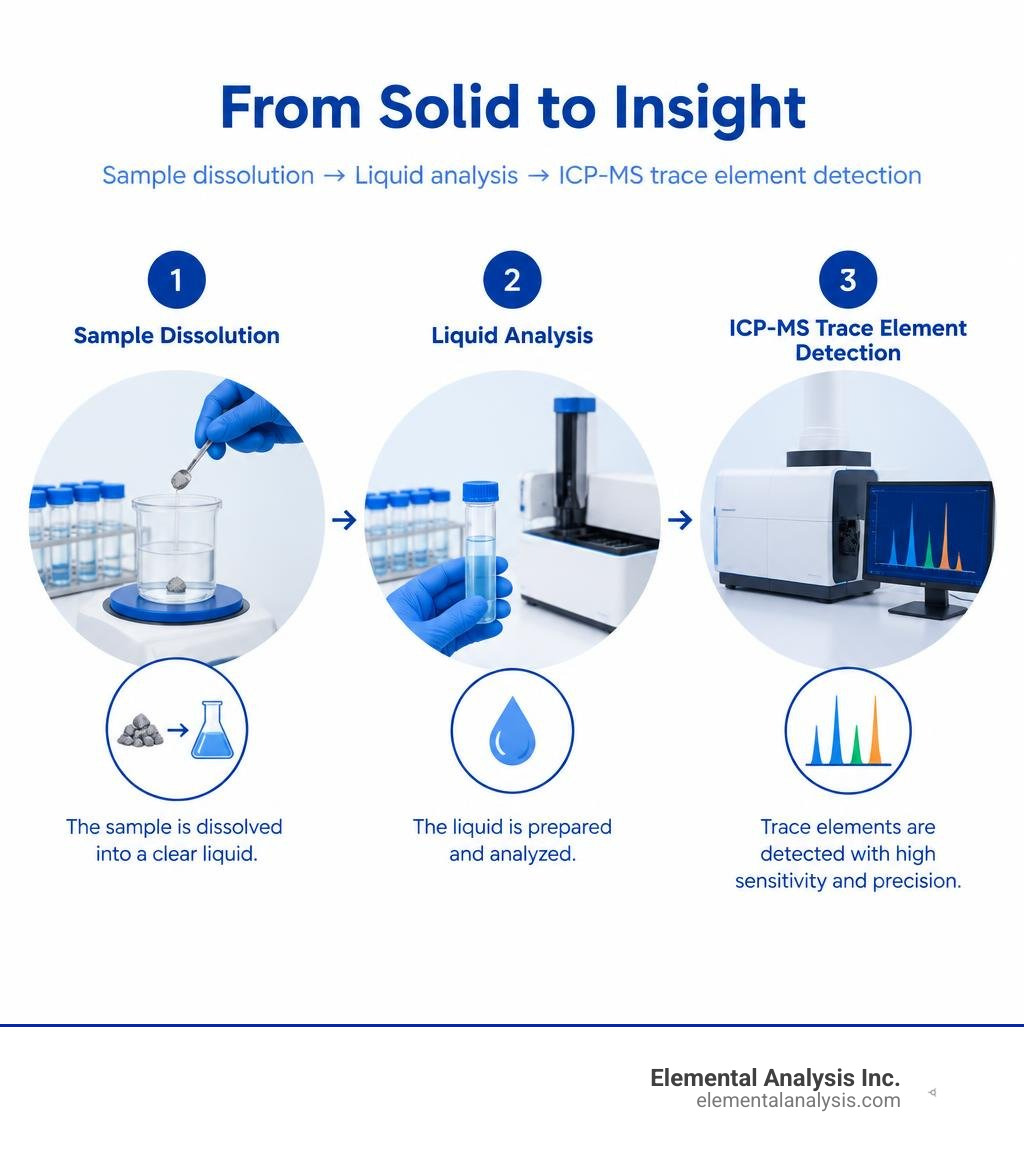
Destructive testing icp ms terms at a glance:
Understanding Destructive Testing with ICP-MS
When we talk about trace analysis, precision often requires a trade-off. Inductively Coupled Plasma Mass Spectrometry (ICP-MS) is renowned for its extraordinary analytical power, yet the standard method of getting a sample into the instrument involves turning solid materials into an ultra-clean aqueous solution. This process—solution nebulization ICP-MS (SN-ICP-MS)—completely consumes the prepared aliquot.
Why sacrifice a physical specimen? Because solid samples frequently suffer from internal micro-heterogeneity, crystallographic variations, and physical matrix effects. In contrast, dissolving a sample ensures complete homogenization. By converting the entire matrix into a liquid phase, every atom within that sample has an equal probability of entering the plasma, giving you true representative bulk quantification.
This contrasts directly with micro-destructive surface techniques. For example, laser ablation ICP-MS vaporizes minute volumes (consuming only nanograms of material), which is invaluable for works of art or spatial mapping. However, if your goal is an absolute bulk measurement down to parts-per-trillion levels without standard-matrix mismatch errors, complete chemical dissolution remains the gold standard. To truly unlock ultratrace elemental detection, wet chemical breakdown is often indispensable.
| Analytical Parameter | Complete Acid Dissolution (Destructive) | Partial Leach / Surface Extraction | Solid Sampling (e.g., Micro-Ablation) |
|---|---|---|---|
| Sample Integrity | Completely destroyed / converted to liquid | Substrate altered; surface stripped | Micro-cratered (nanograms removed) |
| Matrix Homogeneity | 100% homogeneous liquid phase | Selective to surface-leachable ions | Heterogeneity preserved (spot-specific) |
| Calibration Standards | Simple, matrix-matched aqueous standards | Aqueous standards (variable recoveries) | Requires certified solid matrix standards |
| Detection Limits | Sub-ppt to low-ppb across 70+ elements | Variable (depends on extraction efficiency) | ppb to ppm (element & spot-size dependent) |
| Risk of Incomplete Recovery | Negligible with proper acid chemistry | High for refractory or encapsulated phases | High for unrepresentative single spots |
Fundamentals of Complete Sample Dissolution
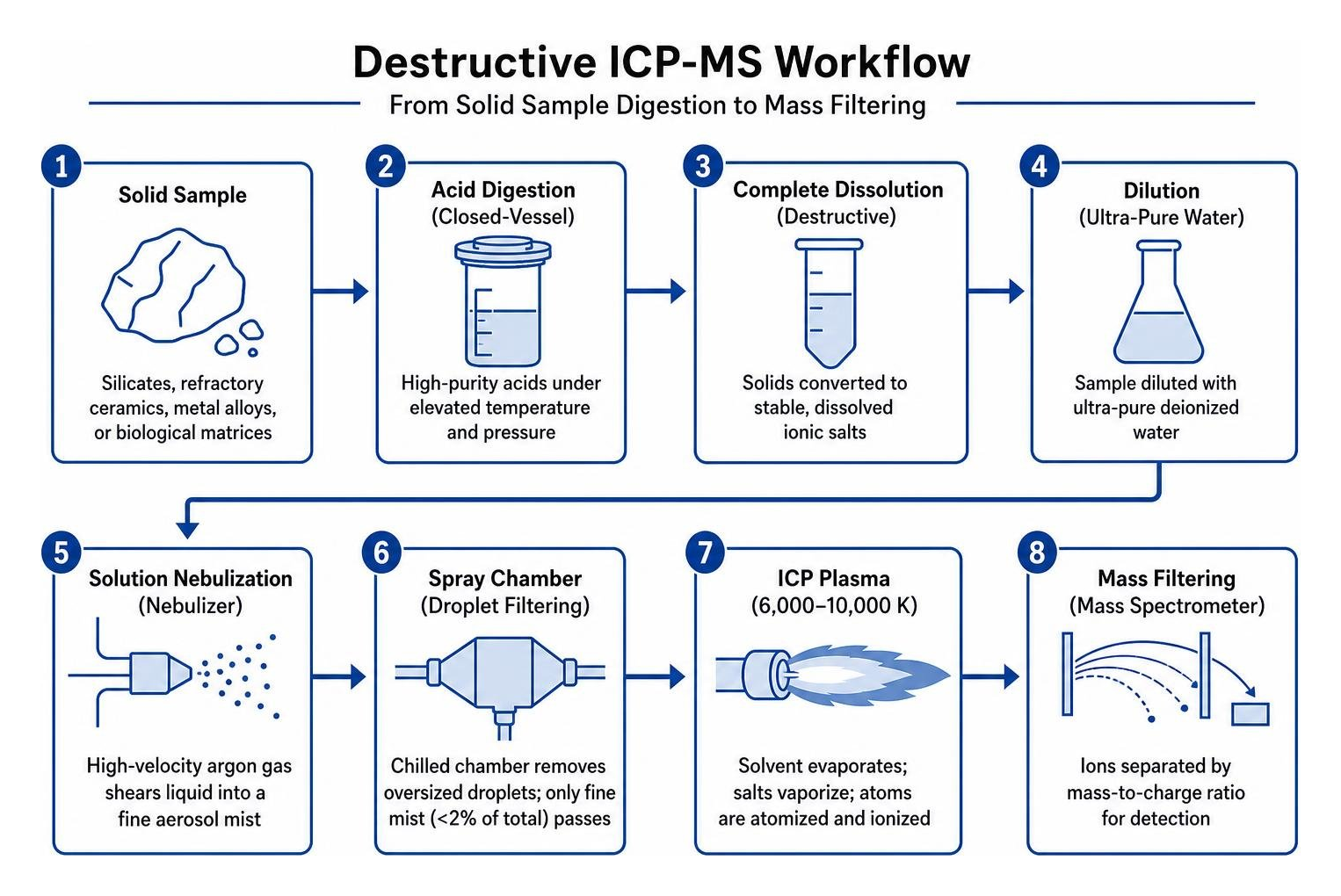
Achieving a clean, total decomposition requires selecting the right acid chemistry to break down resilient chemical bonds. Silicates, refractory ceramics, metal alloys, and biological matrices all demand customized digestion strategies.
We typically combine high-purity, double-distilled acids (such as nitric acid, hydrochloric acid, and hydrofluoric acid for silicate breakdown) inside closed-vessel microwave digestion systems. Under elevated temperature and pressure, these acids cleave organic frameworks, dissolve complex crystalline structures, and break down mineral lattices. This process transforms complicated solids into stable, dissolved ionic salts, as outlined in our guide to plasma mass spectrometry.
Sample Dissolution and Solution Nebulization
Once digestion is complete, the sample is diluted with ultra-pure deionized water and introduced into the ICP-MS. An autosampler pumps the liquid into a nebulizer, where high-velocity argon gas shears the liquid into a fine aerosol mist.
This aerosol passes through a chilled spray chamber that filters out oversized droplets, allowing only a fine mist (typically less than 2% of the total liquid) to enter the core of an argon plasma operating at 6,000 to 10,000 Kelvin. In this intense thermal environment, the solvent instantly evaporates, the remaining salts vaporize, and the target atoms are atomized and ionized into positively charged ions for mass separation.
Step-by-Step Protocol for Destructive Testing with ICP-MS
Executing accurate destructive testing requires rigorous quality control at every phase of wet chemistry and instrument operation.
Step 1: Sample Preparation and Acid Digestion
The journey begins in an ultra-clean preparation laboratory. Because modern ICP-MS instruments detect elements at parts-per-trillion (ppt) and parts-per-quadrillion (ppq) concentrations, airborne dust or trace residues on plasticware can compromise results.
- Mass Measurement: We precisely weigh an aliquot of the sample (typically 0.1 to 0.5 grams) using a calibrated microbalance.
- Acid Addition: We add ultra-pure Optima-grade acids (such as nitric acid, hydrochloric acid, or hydrofluoric acid) inside cleanroom hoods (Class 100 environments).
- Microwave Decomposition: We seal the digestion vessels and run computer-controlled thermal ramps reaching over 200 degrees Celsius and several hundred pounds per square inch of pressure.
- Vessel Leaching & Dilution: Once cooled, samples are vented, diluted with 18.2 megohm-centimeter water, and spiked with internal standards (such as scandium, indium, and terbium). Following this step ensures total sample dissolution without losing volatile elements, which is a core tenet of how to get accurate trace element testing.
Step 2: Overcoming Matrix Interferences and Collision Cell Tuning
Once the sample is in solution, we must prevent spectral interferences from compromising quantification. For example, argon from the plasma combines with chlorine from hydrochloric acid or biological fluids to form argon chloride ions, which share the exact nominal mass (mass-to-charge ratio 75) as arsenic.
To overcome this, modern instruments utilize collision/reaction cells (CRCs). By pressurizing the cell with an inert collision gas (like helium), polyatomic interferences collide more frequently with gas molecules due to their larger cross-sectional area, losing kinetic energy. Kinetic Energy Discrimination (KED) then filters out these slowed polyatomic ions, allowing only the analyte ions to pass through to the detector. Selecting the appropriate collision cell parameters is vital when choosing ICP-MS equipment for demanding matrices.
Step 3: Calibration, Quality Control, and Trace Quantification
With interferences minimized, we calibrate the system using Certified Reference Materials (CRMs) traceable to national metrology institutes like NIST.
- Calibration Curves: Multi-element calibration curves are constructed across several orders of magnitude.
- Drift Correction: Continuously aspirated internal standards correct for physical matrix suppression and minor plasma fluctuations.
- Quality Control Checks: Continuing Calibration Verification (CCV) standards, digestion blanks, matrix spikes, and laboratory control samples run periodically throughout the analytical sequence ensure absolute data defensibility, adhering to strict heavy metal screening protocols.
Why Complete Dissolution Delivers Superior Quantitative Accuracy
Why choose total sample dissolution over solid sampling techniques? The answer comes down to calibration accuracy and matrix homogeneity.
When you introduce a solid directly into an analytical beam or spark, differences in hardness, crystalline orientation, and thermal conductivity can cause elemental fractionation—where some elements vaporize faster than others. Complete chemical digestion eliminates these matrix disparities by converting every sample into a uniform aqueous state, allowing for precise atom quantification in an ICP-MS plasma fire.
| Technique | Sample State | Typical Detection Limits | Multi-Element Speed | Matrix Effects Calibration Risk |
|---|---|---|---|---|
| Solution ICP-MS | Liquid (Digested) | 0.1 to 10 parts per trillion (ppt) | High (70+ elements in under 3 minutes) | Low (Aqueous matrix-matched standards) |
| ICP-OES | Liquid (Digested) | 0.5 to 10 parts per billion (ppb) | High (Simultaneous optical capture) | Low (Liquid standards) |
| LA-ICP-MS | Solid | 10 to 1000 parts per billion (ppb) | High (Point or map scanning) | High (Requires solid CRMs matching matrix) |
| GFAA (AAS) | Liquid (Digested) | 0.01 to 1 parts per billion (ppb) | Low (Single element per run) | Moderate (Chemical modifiers needed) |
Eliminating Calibration Biases in Destructive Testing ICP-MS
Direct solid sampling often requires solid reference materials that match the sample’s physical and chemical composition down to the exact mineral or alloy grade. Finding such standards is frequently impossible for novel materials, unique industrial slags, or specialized biological tissues.
In destructive solution testing, we sidestep this problem. Because the physical structure is eliminated during digestion, we can calibrate using simple, stable aqueous standards prepared from high-purity single-element stocks. This makes it straightforward when selecting heavy metals testing options across diverse matrix types.
Understanding Sensitivity in ICP-MS
Solution nebulization ICP-MS provides exceptional dynamic range and low detection limits. While direct solid techniques can lose sensitivity due to variable ablation yields, liquid sample introduction delivers a steady stream of analyte ions to the mass spectrometer.
Modern instruments easily measure concentrations from below 1 part per trillion up to hundreds of parts per million in a single run. This broad linear range enables simultaneous quantification of major matrix constituents alongside ultra-trace impurities without requiring separate instrument setups.
Critical Real-World Applications and Regulatory Compliance

Destructive testing with ICP-MS is widely applied across environmental monitoring, legal forensics, and materials manufacturing.
Managing Evidence Preservation in Forensic Destructive Testing ICP-MS
Forensic laboratories frequently analyze microscopic trace evidence such as glass shards, paint chips, and gunshot residue (GSR). While non-destructive methods like micro-XRF provide initial screening, solution ICP-MS delivers the trace and isotope-ratio precision needed to distinguish two chemically similar materials.
For example, measuring trace concentrations of elements like strontium, barium, and rare earth elements allows forensic scientists to match a glass fragment from a suspect’s clothing to a broken window using standardized protocols like ASTM E2927.
To maintain legal admissibility and protect the chain of custody when an analytical method consumes evidence, laboratories establish split-sample protocols:
- Photographic & Microscopic Documentation: Preserving the physical morphology, color, and dimensions of the item before any chemical treatment.
- Sample Sub-Sampling: Dividing the recovered evidence into aliquots, preserving an archive portion for defense re-testing or courtroom presentation.
- Trace Impurity Profiling: Documenting how trace impurities analysis provides the statistical power needed to link evidentiary materials to their source.
EPA Air Filter Archiving Requirements and Destructive Pb FEM Testing
In environmental monitoring, regulatory frameworks must account for the destructive nature of solution ICP-MS. Under Clean Air Act guidelines, such as 40 CFR Part 58.16, ambient air monitoring networks use low-volume air samplers to collect particulate matter onto Teflon filters. Regulators often require these filters to be archived for at least one year for historical retrospective studies.
However, determining lead (Pb) concentrations using the EPA-approved Federal Equivalent Method (FEM) requires total acid digestion of the Teflon filter, which destroys the physical matrix.
The EPA accommodates this destructive testing: under the EPA technical memorandum on filter archiving compliance, using an approved destructive FEM ICP-MS procedure is recognized as an authorized use that supersedes standard 1-year physical filter archiving requirements. This approach ensures public health agencies obtain defensible heavy metal data while maintaining regulatory compliance, as seen throughout our water and environmental elemental analysis workflows.
Frequently Asked Questions about Destructive Testing with ICP-MS
Why choose destructive ICP-MS over non-destructive techniques?
Destructive ICP-MS via complete acid digestion converts solid materials into a homogeneous liquid phase. This eliminates physical matrix effects, ensures that unevenly distributed elements are fully accounted for, and enables direct calibration using certified aqueous standards, yielding superior quantitative accuracy and parts-per-trillion detection limits.
How do laboratories balance sample destruction with evidence preservation?
Laboratories preserve evidence through careful sample splitting, non-destructive preliminary screening, detailed micro-photography, and thorough documentation. By reserving a portion of the original sample prior to acid digestion, laboratories retain physical material for defense review or secondary verification.
Can air monitoring filters be archived after destructive ICP-MS lead analysis?
No, the Teflon filter is consumed during the acid extraction and digestion process. However, environmental regulations (such as 40 CFR Part 58.16 guidance) recognize that obtaining high-precision lead data via approved Federal Equivalent Methods (FEM) is an authorized use that satisfies air monitoring requirements in place of physical filter archiving.
Conclusion
Destructive testing with ICP-MS remains one of the most reliable and sensitive techniques for bulk elemental quantification. While the process permanently alters the tested specimen, it provides unmatched quantitative accuracy, eliminates mineralogical and structural matrix biases, and delivers low parts-per-trillion detection limits.
At Elemental Analysis Inc., located in Lexington, KY, we help laboratories, manufacturers, and legal teams design analytical workflows that balance trace sensitivity with sample preservation requirements. Whether you require non-destructive preliminary screening or complete acid decomposition, explore our comprehensive ICP analytical testing services to discover how we deliver precise, defensible data for your most demanding analytical challenges.