
Accredited Testing Laboratory Services That Keep You Audit-Ready
What Are Accredited Testing Laboratory Services and Why Do They Matter?
When you submit materials or products for testing, you are relying on the analytical data to satisfy compliance requirements, verify product quality, or protect human health. Accredited testing laboratory services deliver data generated under a strict, third-party evaluated quality system.
At its core, laboratory accreditation is the formal recognition of technical competence. It proves that a facility operates under robust standard operating procedures (SOPs), maintains equipment calibration with measurement traceability to recognized international standards, and uses validated methods. Using non-accredited services leaves your data open to challenge during regulatory audits.
Understanding the foundational requirements of analytical testing helps clarify how accreditation safeguards your sample integrity and mitigates regulatory risk. To dive deeper into testing fundamentals, review our guide on Elemental Testing Lab 101.
How ISO/IEC 17025 Standards Empower Accredited Testing Laboratory Services
The primary international benchmark for testing and calibration laboratories is ISO/IEC 17025 (currently ISO/IEC 17025:2017). Unlike ISO 9001 certification, which focuses broadly on general quality management systems, ISO/IEC 17025 evaluates both the quality management system and the technical competence of the facility to produce valid results.
To achieve and retain ISO/IEC 17025 accreditation, a laboratory undergoes rigorous third-party assessments by an independent accrediting body. Key structural elements include:
- Method Validation: Demonstrating that analytical techniques (such as ICP-MS or X-ray emission) yield accurate, reproducible results for specific sample matrices.
- Proficiency Testing: Regularly analyzing blind interlaboratory samples to prove ongoing analytical accuracy against global peer facilities.
- Measurement Traceability: Ensuring all measuring instruments are calibrated against certified reference materials (CRMs) traceable to National Institute of Standards and Technology (NIST) or equivalent bodies.
Adhering to recognized standards ensures that the laboratory follows clear, repeatable protocols. For a foundational overview of these procedures, explore A Beginner Guide to Industry Standard Methods.
Comparing Regulatory Designations: NRTLs, CPSC Acceptance, and ISO 17025
Navigating laboratory designations can be confusing. While ISO/IEC 17025 forms the foundation for laboratory technical competence, specific government bodies enforce distinct regulatory oversight frameworks depending on the product type.
Here is how common regulatory designations compare:
| Regulatory Designation | Governing Body | Primary Focus | Regulatory Scope & Examples |
|---|---|---|---|
| ISO/IEC 17025 Accredited | Independent ILAC Signatories (A2LA, ANAB) | Technical competence and quality management systems for testing & calibration | Broad analytical chemistry, trace metals, environmental media, pharmaceuticals |
| Nationally Recognized Testing Laboratory (NRTL) | OSHA (Occupational Safety and Health Administration) | Electrical and mechanical safety of equipment used in workplaces | Industrial machinery, electrical appliances, workplace safety gear |
| CPSC-Accepted Laboratory | CPSC (Consumer Product Safety Commission) | Safety rules for children’s products and consumer goods | Toy safety (ASTM F963), lead paint (16 CFR Part 1303), phthalates |
For workplace safety compliance in the United States, OSHA maintains a dedicated directory listing 22 Nationally Recognized Testing Laboratories (NRTLs). Meanwhile, Section 14(a)(3)(E) of the Consumer Product Safety Act mandates that the CPSC maintain an active database of over 100 CPSC-accepted testing laboratories authorized to verify compliance with children’s safety rules.
While an NRTL or CPSC-accepted facility must maintain ISO/IEC 17025 accreditation, ISO accreditation alone does not automatically grant acceptance into specialized government programs without specific agency approval.
Regulatory Accreditation Bodies and Finding Verified Laboratory Directories

Confirming a testing facility’s credentials requires understanding who grants the accreditation and where to search official government registries.
Accreditation Bodies: Understanding A2LA, ANAB, and Global Recognized Entities
In the United States, independent accrediting bodies evaluate facilities to international standards. Prominent non-governmental accrediting bodies include:
- A2LA (American Association for Laboratory Accreditation)
- ANAB (ANSI National Accreditation Board)
Both organizations are signatories to the International Laboratory Accreditation Cooperation (ILAC) Mutual Recognition Arrangement (MRA). This global alignment ensures that test reports issued by an A2LA- or ANAB-accredited laboratory holding ISO/IEC 17025 status are recognized by regulatory authorities worldwide.
When examining an accreditation certificate, always request the accompanying Scope of Accreditation. The certificate indicates that a quality system is active, but the scope document details the exact test methods, target analytes, sample matrices, and measurement capabilities approved by the accrediting body.
Locating Verified Directories for OSHA, CPSC, CRRC, and State Programs
To locate a compliant testing partner for specific statutory mandates, consult these official registries:
- CPSC-Accepted Testing Laboratories Directory: Maintained by the CPSC for consumer and children’s product safety testing (covering flammability, lead, and phthalates).
- OSHA NRTL Directory: The official list of safety testing facilities approved to certify electrical and mechanical workplace equipment.
- Cool Roof Rating Council (CRRC) Directories: Lists 7 Accredited Independent Testing Laboratories (AITLs) for the Roof Program and 4 for the Wall Program, along with approved manufacturer testing facilities.
- State Environmental Programs: State-level agencies maintain specialized databases for local environmental compliance. For instance, state environmental departments oversee environmental testing criteria, such as the Kentucky Energy and Environment Cabinet Laboratory Certification Program.
Scope of Testing Disciplines and Calibration Support
Accredited testing spans diverse technical disciplines, ranging from elemental chemistry to air quality monitoring and precision calibration.
Material, Environmental, Air Quality, and Pharmaceutical Testing Scopes
High-precision laboratory testing relies on standardized methodologies tailored to specific sample matrices:
- Chemical and Material Testing: Evaluating alloys, polymers, and raw materials for trace heavy metals and elemental composition using ASTM standards.
- Air Quality Testing: Utilizing specialized whole-air sampling media (such as Summa canisters) and thermal desorption techniques under EPA TO-15, TO-3, and EPA TO-17/325B protocols to monitor volatile organic compounds (VOCs) and industrial emissions.
- Pharmaceutical Impurities: Analyzing active pharmaceutical ingredients (APIs) and finished products for heavy metal contamination.
In pharmaceutical manufacturing, meeting regulatory guidelines for toxic metals is critical. To understand regulatory expectations surrounding drug safety, consult our detailed overview on USP Elemental Impurities: What Pharma Manufacturers Need to Know. For additional regulatory context on compliance guidelines, see our article on A Practical Guide to Elemental Impurities Testing and FDA Guidelines.
The Critical Role of Accredited Calibration Labs in Testing Accuracy
Analytical testing accuracy depends entirely on the accuracy of the underlying laboratory instrumentation. This is where accredited calibration laboratories provide vital support.
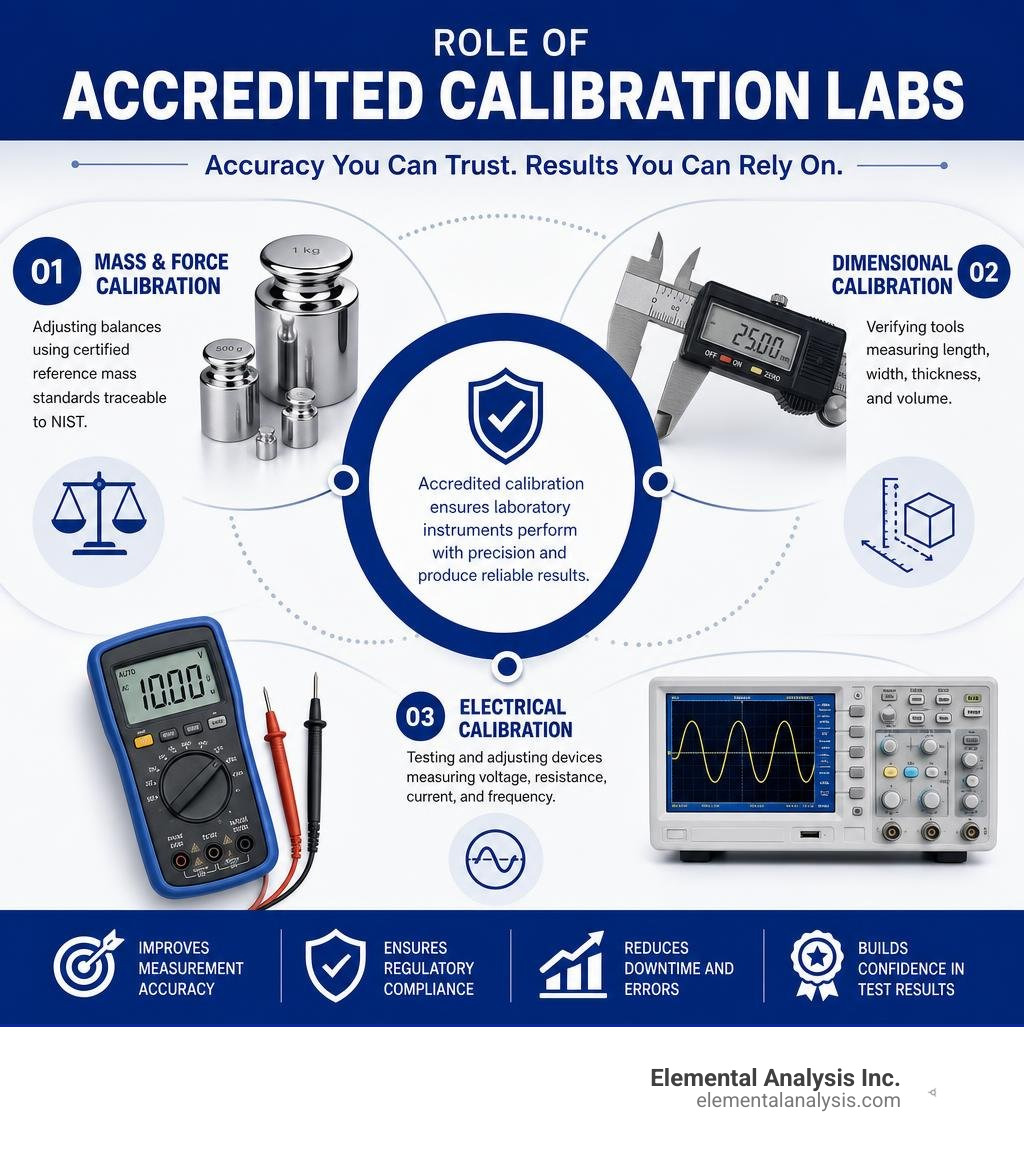
Accredited calibration facilities maintain ISO/IEC 17025 accreditation across dozens of physical disciplines, including:
- Mass and Force Calibration: Adjusting balances using certified reference mass standards traceable to NIST.
- Dimensional Calibration: Verifying tools measuring length, width, thickness, and volume.
- Electrical Calibration: Testing and adjusting devices measuring voltage, resistance, current, and frequency.
Routine calibration eliminates instrument drift, protects testing data integrity, and ensures that when an analytical balance or spectrometer reports a value, that measurement is defendable during an audit.
Best Practices for Selecting Accredited Testing Laboratory Services

Choosing the wrong laboratory can result in invalid test data, unexpected costs, and project delays. Implementing a clear selection process ensures your analytical needs match the lab’s formal capabilities.
Selecting the Right Accredited Testing Partner
When evaluating commercial testing partners, follow these best practices:
- Verify Matrix and Analyte Alignment: Do not assume a lab accredited for heavy metals in soil can perform heavy metal analysis in food, polymers, or pharmaceuticals. Confirm that the exact sample matrix is listed on their Scope of Accreditation.
- Review Instrumentation Capabilities: High-level trace element analysis requires advanced analytical tools such as Inductively Coupled Plasma Mass Spectrometry (ICP-MS) or LC-MS/MS.
- Evaluate Turnaround Times and Project Flexibility: Confirm whether the lab can meet your commercial schedules without sacrificing quality control protocols.
For practical advice on choosing specialized testing services, read our guide on How to Find Specialized Analytical Chemistry Services Without Losing Your Sanity.
If your team requires heavy metals determination or alloy verification, explore our dedicated guides on How to Choose the Right Heavy Metal Testing Laboratory for Your Needs and How to Choose the Best Alloy Verification Laboratory for Your Projects.
Consequences of Using Non-Accredited Laboratories for Regulatory Submissions
Submitting test data from a non-accredited facility or a lab working outside its defined scope carries serious operational and financial risks:
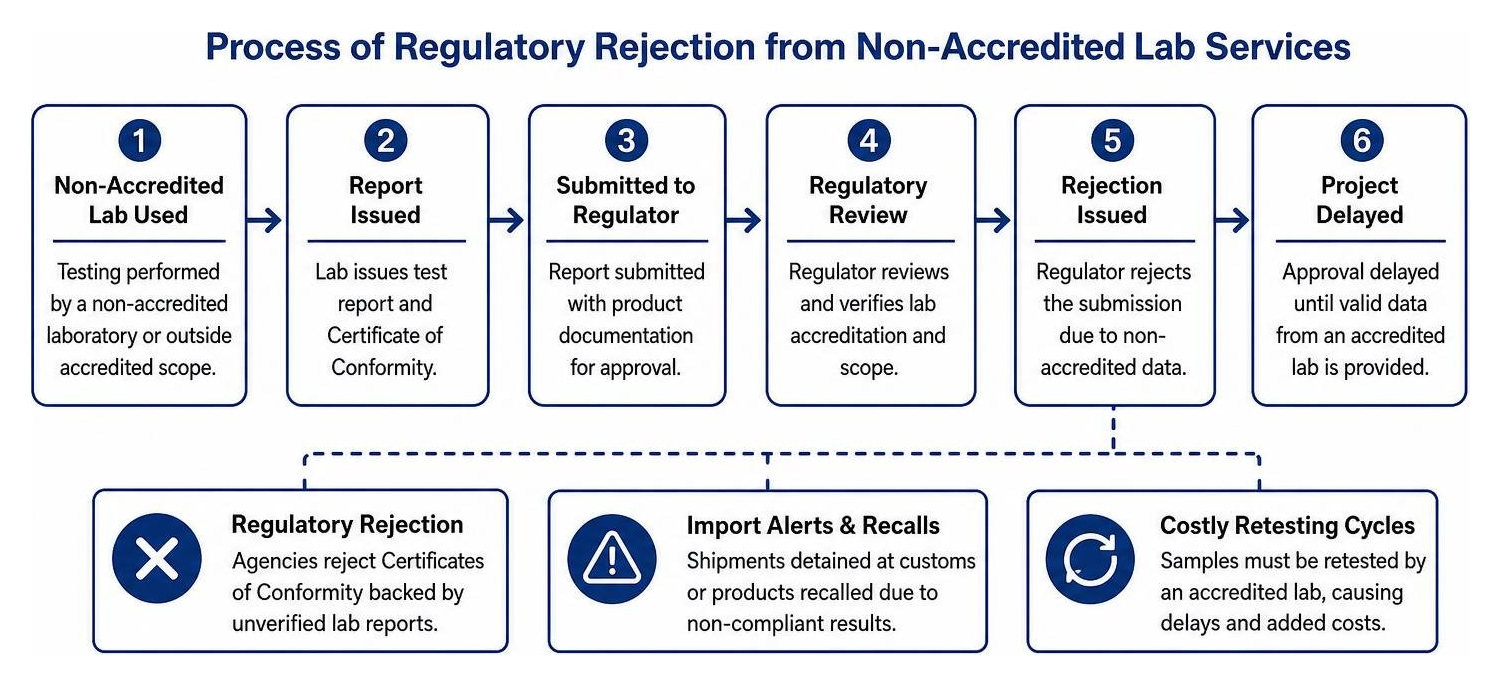
- Regulatory Rejection: Agencies like the CPSC or FDA will reject Certificates of Conformity backed by unverified lab reports, triggering regulatory delays.
- Import Alerts and Product Recalls: Non-compliant test results can result in detained shipments at customs or mandatory commercial product recalls.
- Costly Retesting Cycles: Projects are placed on hold while samples are re-submitted to a qualified, accredited facility, resulting in lost revenue and missed deadlines.
Key Steps to Achieving and Maintaining Laboratory Accreditation
Maintaining accredited status requires ongoing investment in quality controls, standard operating procedures, and technical proficiency.
Technical Infrastructure, Traceability, and Interlaboratory Comparisons
To earn ISO/IEC 17025 accreditation, facilities must build an infrastructure focused on analytical rigor:
- Documented SOPs: Operating protocols detailing sample handling, preparation, instrument settings, and data reduction.
- Certified Reference Materials (CRMs): Testing unknown samples against verified standards to validate accuracy.
- Interlaboratory Comparison Studies: Participating in proficiency testing schemes. For example, facilities approved under building product rating systems must complete biannual interlaboratory studies to maintain approval.
Maintaining Audit Readiness and Continuous Improvement Programs
Audit readiness is an ongoing operational commitment. Accredited laboratories maintain audit readiness by:
- Enforcing Data Integrity Protocols: Implementing Laboratory Information Management Systems (LIMS) featuring Computerized System Validation (CSV) and audit trails to prevent unauthorized data alterations.
- Tracking Corrective and Preventive Actions (CAPA): Documenting analytical anomalies, conducting root-cause analyses, and implementing corrective steps.
- Conducting Regular Internal Audits: Running internal checks to verify that technicians adhere strictly to SOPs prior to external accrediting body assessments.
Frequently Asked Questions About Accredited Laboratories
How do I verify if a laboratory’s accreditation scope covers my specific product standard?
Request the laboratory’s official Scope of Accreditation document or search for the laboratory by name or certificate number on its accrediting body’s website (such as A2LA or ANAB). Review the document’s tables to verify that your required test standard (e.g., ASTM, EPA, USP), target analytes, and sample matrix are explicitly listed.
What is the difference between an Accredited Independent Testing Laboratory (AITL) and an Approved Manufacturer Testing Laboratory (AMTL)?
An Accredited Independent Testing Laboratory (AITL) is a third-party facility completely independent of any product manufacturer, seller, or distributor. An Approved Manufacturer Testing Laboratory (AMTL) is an in-house testing facility operated by a product manufacturer. While AMTLs can perform compliance testing for their own products under programs like the CRRC, they must maintain strict quality systems and participate in mandatory interlaboratory comparison studies.
Can a lab be ISO 17025 accredited but still fail to meet CPSC or OSHA compliance needs?
Yes. ISO/IEC 17025 confirms general technical competence for specific listed tests, but specific regulatory programs require separate registration. For example, a lab may hold ISO 17025 accreditation for industrial chemical testing, but unless it has formally applied to and been accepted by the CPSC for children’s product safety rules (16 CFR standards), its test reports cannot be used to support a CPSC Children’s Product Certificate (CPC).
Ensure Compliance with Expert Testing Services
Selecting the right testing facility is essential for protecting your products, satisfying regulatory audits, and maintaining customer trust. Partnering with a proven analytical team ensures your test reports withstand the scrutiny of auditors and regulatory agencies.
At Elemental Analysis Inc., located in Lexington, KY, we deliver accurate elemental identification, quantification, and trace speciation services. As the first commercial laboratory to offer Particle-Induced X-ray Emission (PIXE) analysis, we provide non-destructive and destructive analytical techniques, fast turnaround times, and competitive pricing to keep your business audit-ready.
Ready to secure traceable analytical data for your next project? Explore our full range of ICP Analysis Services or contact our team today.