
No Stone Unturned: What Happens to Your Sample During a Trace Minerals Test
What a Trace Elements Lab Actually Does (And How to Find the Right One)
A trace elements lab measures the concentration of metals and minerals in samples — often at levels as low as parts per trillion — to support environmental compliance, pharmaceutical quality control, aerospace material verification, and biomonitoring programs.
Looking for a trace elements lab? Here’s what to know at a glance:
| What You Need | What to Look For |
|---|---|
| Fast turnaround | Labs offering 3–5 business day reporting or expedited options |
| Low detection limits | ICP-MS capability down to parts per trillion (ppt) |
| Multiple sample types | Acceptance of water, soil, biological fluids, tissue, and solid materials |
| Consolidated billing | Single-source labs handling multi-matrix projects under one invoice |
| Accreditation | NELAP, CLIA, ISO/IEC 17025, or EPA certification depending on your industry |
| Speciation analysis | HPLC-ICP-MS capability for arsenic, mercury, or chromium fractionation |
These labs are not general-purpose chemistry labs. They are purpose-built environments — often running positive-pressure, HEPA-filtered clean rooms — because the elements being measured are present in such tiny amounts that a single fingerprint or rubber stopper can ruin a result.
The detection limits for many trace elements are calculated in parts per billion or lower. That level of sensitivity demands a completely different approach to sample handling, instrument selection, and quality control than standard analytical chemistry.
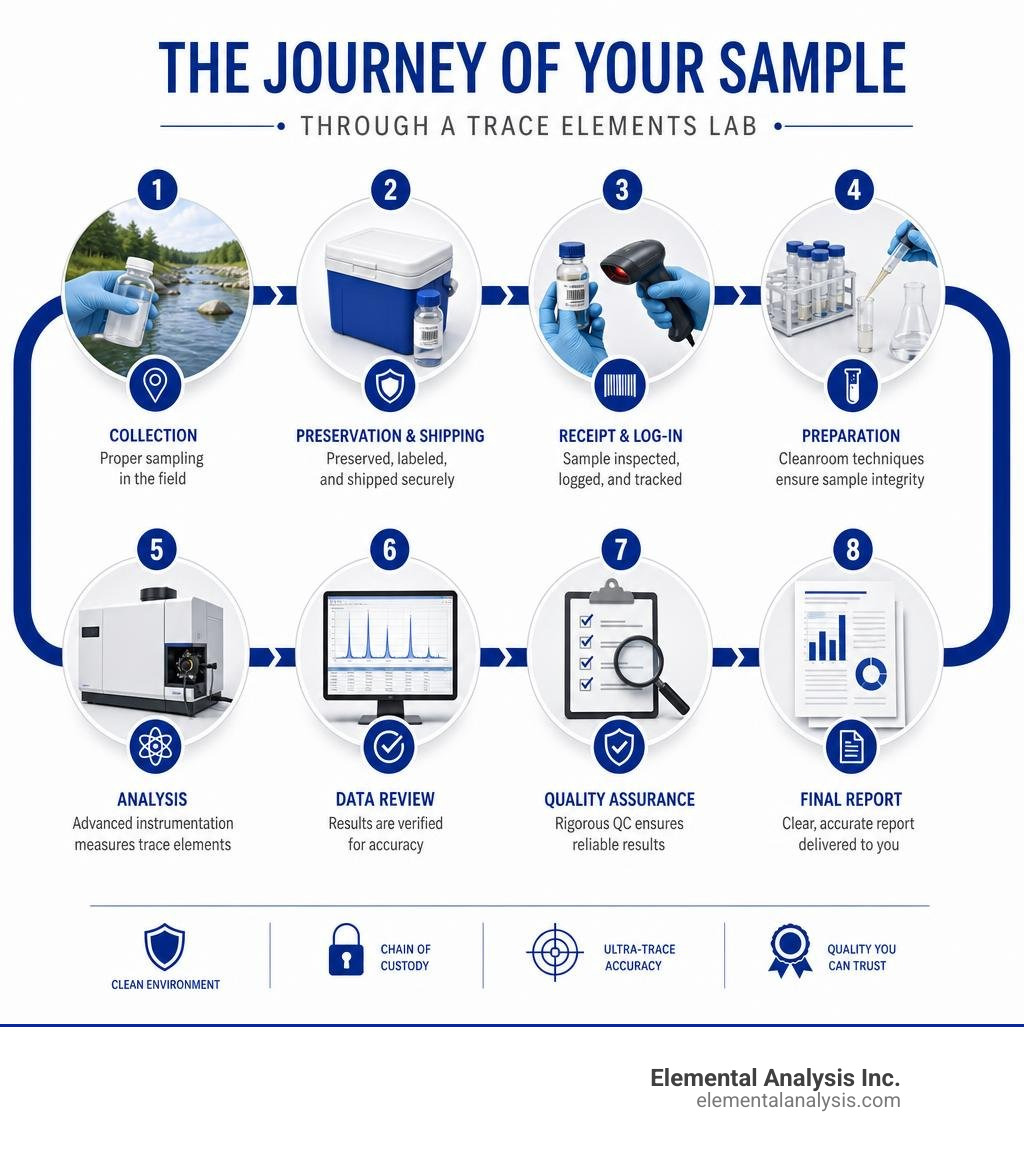
Whether you’re verifying metal content in a pharmaceutical excipient, monitoring arsenic in a watershed, or screening aerospace alloys for elemental composition, the path your sample takes through a trace elements lab — from collection to final report — determines everything about the reliability of your data.
Here’s exactly what that journey looks like.
What is a Trace Elements Lab and Why Does It Matter?
At its core, a trace elements lab is a highly specialized facility dedicated to identifying and quantifying chemical elements that exist in minute concentrations within a larger matrix. When we say “trace,” we are generally referring to concentrations ranging from 10 to 10,000 micrograms per liter ($\mu$g/L) or micrograms per gram ($\mu$g/g). “Ultra-trace” analysis goes even further, dealing with concentrations below 10 $\mu$g/L—often dipping into the parts per billion (ppb) or parts per trillion (ppt) realm.
To put that in perspective, finding a part per trillion is equivalent to finding a single specific postage stamp in a pile that covers the entire state of Kentucky!
The Role of a Specialized Trace Elements Lab in Modern Industry and Research
In modern industry, these laboratories act as the ultimate gatekeepers of safety, quality, and purity. In materials science and manufacturing, even a microscopic amount of an unwanted element can alter the structural integrity of an aerospace alloy or short-circuit a semiconductor.
Conversely, in biological and nutritional fields, tracking essential minerals like zinc, copper, selenium, and manganese is vital for understanding metabolic pathways. Because both essential minerals and toxic metals (such as lead, cadmium, and mercury) exert powerful biological effects at incredibly low thresholds, standard testing methods simply cannot cut it. A specialized laboratory utilizes ultra-sensitive instrumentation to map these elemental compositions with absolute certainty.
Environmental and Research Applications of Trace Analysis
From an environmental standpoint, trace element analysis is our primary defense against contamination. Municipalities and industrial facilities rely on trace testing to monitor water quality and prevent heavy metals from leaching into public drinking supplies. Soil contamination surveys map out industrial hygiene risks, ensuring that agricultural lands remain safe for food production.
In academic research, scientists study the transport of trace metals through ecosystems to understand the long-term impacts of industrialization. For a deeper dive into the methods used to investigate these environmental matrices, explore our comprehensive Category: ICP Laboratory Analysis resources.
The Journey of Your Sample: Collection to Analysis
The journey of a sample through a trace elements lab is a masterclass in clean-room discipline. Because we are looking for atoms in a haystack, the physical sample must be protected from the surrounding environment at every single stage.
Preventing Contamination in a Trace Elements Lab Environment
Contamination control begins long before the sample ever reaches our instruments. The air inside a high-performing trace elements lab is continuously scrubbed using High-Efficiency Particulate Air (HEPA) filters, and the rooms are kept under positive pressure. This ensures that when a door opens, clean air rushes out, preventing airborne dust—which is loaded with trace metals like iron, zinc, and aluminum—from entering.
To prevent contamination during the collection phase, field technicians and clinicians must follow strict sampling protocols. For example:
- Avoid standard glass: Glass containers can leach elements like boron, silica, and sodium into liquid samples. High-density polyethylene (HDPE) or Teflon (PTFE) containers are preferred.
- Avoid rubber stoppers: Standard rubber stoppers in blood collection tubes contain zinc and other vulcanizing agents. Specialized royal blue-top tubes must be used instead.
- Eliminate metallic tools: Stainless steel needles, colored plastic caps, and powdered gloves are all notorious sources of pre-analytical contamination.
For a step-by-step breakdown of how to prepare your specimens correctly, consult our ICP-MS Lab Guide: How to Get Accurate Trace Element Testing.
Sample Preparation and Digestion Techniques
Once a sample safely arrives at our facility in Lexington, KY, it must be converted into a form that our instruments can read. For most liquid samples, this might only require a simple dilution with high-purity nitric acid. However, solid samples—such as soils, plastics, or organic tissues—require a process called “wet digestion.”
Using advanced microwave digestion systems, we seal the sample in a heavy-duty vessel with concentrated, high-purity acids and subject it to extreme heat and pressure. This completely breaks down the organic or mineral matrix, leaving behind a perfectly clear, liquid acidic solution containing only the free elemental ions. To understand how these prepared liquid samples behave when introduced to analytical plasma, check out An Essential Guide to Inductively Coupled Plasma.
Analytical Technologies: How Labs Measure Atoms
Once the sample is prepared, it is introduced to the analytical instruments. Modern trace element laboratories rely on a suite of sophisticated tools, each with its own unique strengths.
ICP-MS vs. ICP-OES for Heavy Metal Analysis
Inductively Coupled Plasma Mass Spectrometry (ICP-MS) and Inductively Coupled Plasma Optical Emission Spectrometry (ICP-OES) are the twin workhorses of trace analysis. Both rely on a superheated “plasma fire” (argon gas heated to a blistering 10,000 Kelvin—hotter than the surface of the sun) to atomize and ionize the sample.
However, they detect these elements in completely different ways:
- ICP-OES measures the light emitted by excited atoms as they pass through the plasma. Each element emits light at a highly specific wavelength. It is excellent for analyzing major and minor elements in complex mixtures but has higher detection limits (typically in the parts per billion range).
- ICP-MS takes the ions generated in the plasma and funnels them into a mass spectrometer, where they are separated and weighed based on their mass-to-charge ratio. This allows us to literally count individual atoms.
For a detailed look at how we weigh these atoms in a plasma fire, see ICP-MS Explained: How We Weigh Atoms in a Plasma Fire. If you are trying to decide which method is right for your specific project, our detailed comparison guide, ICP Analysis for Heavy Metals: Choosing Between ICP-OES and ICP-MS, breaks down the technical nuances. If you want a quick primer on the technology itself, you can also read our summary on ICP.
Speciation Analysis and Isotope Metallomics
Simply knowing the total concentration of an element is sometimes not enough. For example, inorganic arsenic is highly toxic, whereas organic arsenic (found naturally in seafood) is virtually harmless.
To solve this, we couple high-performance liquid chromatography (HPLC) with our mass spectrometers. The HPLC separates the different chemical forms (species) of the element before they enter the plasma, allowing us to perform highly sensitive speciation analysis. This technique is critical for screening toxins in food, water, and biological tissues. You can read more about how this works in our resource, Heavy Metal Analysis by ICP-MS: The Ultimate Guide to Screening Toxins.
Comparing Sample Matrices: Environmental, Industrial, and Biological Samples
Different sample types present entirely different analytical hurdles. A trace elements lab must adapt its preparation, calibration, and quality control steps based on the matrix of the sample.
Below is a comparative breakdown of how different matrices are handled:
| Matrix Type | Common Examples | Primary Analytical Focus | Typical Digestion Method | Key Contamination Risk |
|---|---|---|---|---|
| Liquid (Environmental) | Drinking water, groundwater, industrial effluent | Heavy metals (Pb, Cd, As, Hg), runoff minerals | Direct dilution or mild acid digestion | Airborne dust, container leaching |
| Solid (Industrial) | Polymers, electronic components, catalysts | Catalyst residues, restricted substances (RoHS) | High-pressure microwave acid digestion | Cross-contamination from grinding tools |
| Biological (Clinical / Research) | Urine, blood, hair, animal tissue | Toxic exposure monitoring, nutritional status | Dilution with alkaline diluents or nitric acid digestion | Standard collection tube stoppers, skin oils |
For those looking into clinical or biomonitoring applications, analyzing biological matrices like hair, blood, or urine remains a popular screening tool for long-term mineral patterns and toxic exposure monitoring. These biological profiles help researchers and clinicians map out nutritional status and identify acute or chronic heavy metal exposure with high precision.
Frequently Asked Questions About Trace Element Testing
How long does it take to get results from a trace elements lab?
For standard commercial testing, turnaround times typically range from 3 to 5 business days. However, this depends heavily on the complexity of the sample matrix and the amount of preparation required. Solid samples requiring multi-stage microwave digestion or advanced speciation analysis may take slightly longer, while urgent industrial or environmental monitoring projects can often be expedited for faster reporting.
What is the difference between essential trace minerals and toxic heavy metals?
Essential trace minerals (such as copper, zinc, selenium, iron, and manganese) are required by biological systems to sustain life, regulate enzymes, and maintain metabolic pathways. However, even essential minerals have a “toxicity threshold” – meaning too much of a good thing can still be harmful.
On the other hand, non-essential toxic heavy metals (like lead, cadmium, mercury, and arsenic) have no known beneficial physiological function in the human body or environment. They interfere with cellular processes even at extremely low concentrations, which is why monitoring their presence in food, water, and consumer goods is so heavily regulated.
How do laboratories ensure the accuracy of ultra-trace measurements?
Ensuring accuracy at the parts-per-billion level requires a rigorous quality management system. Trace elements labs run continuous quality control checks, which include:
- Method Blanks: Analyzing pure acid solutions alongside samples to ensure no contamination was introduced during preparation.
- Certified Reference Materials (CRMs): Testing standardized samples with known, certified elemental concentrations to verify instrument calibration. Many laboratories use traceable reference materials, such as NIST Standard Reference Materials, as part of their measurement assurance programs.
- Matrix Spikes: Adding a known quantity of an element to a sample to verify that the matrix isn’t suppressing or falsely elevating the signal.
To understand the internal physics and mechanics that make these ultra-sensitive calibrations possible, read our deep dive into The Ins and Outs of Inductively Coupled Plasma Mass Spectrometry.
Conclusion
When you send a sample to a trace elements lab, you are asking for answers at the atomic level. It is a process that leaves no stone unturned, relying on extreme environmental controls, advanced chemistry, and state-of-the-art physics to deliver data you can trust.
At Elemental Analysis Inc., located in Lexington, Kentucky, we combine this scientific precision with industry-leading versatility. As the first commercial PIXE (Particle-Induced X-ray Emission) laboratory, we offer unique, non-destructive testing capabilities alongside our destructive testing suites. This allows us to provide rapid turnaround times and highly competitive pricing for clients across the aerospace, environmental, pharmaceutical, and manufacturing sectors.
Ready to get started? If you have questions about sample collection protocols or need to request a quote for your next project, explore our comprehensive Elemental Analysis Services or reach out directly to our team to discuss your testing needs.