
All About Elemental Analyzer Options: A Comparison Guide
Fundamentals of the Elemental Analyzer and How It Works
At its core, an elemental analyzer operates by breaking down a sample into its foundational atomic constituents and quantifying the resulting signal. While spectroscopy instruments excite atoms with light or plasma, organic combustion elemental analyzers utilize high-temperature chemistry to turn solid or liquid matrices into clean, measurable gases.
The standard process relies on rapid high-temperature oxidation or pyrolysis. When a sample enters the system, an high purity oxygen stream triggers an instantaneous exothermic reaction. Carrier gases, typically helium or argon, sweep these newly formed combustion products through a series of chemical scrubbers, catalyst beds, and a specialized separation column. Finally, a high-precision sensor processes the electrical signal, which software translates into exact percentage concentrations of elements like carbon, hydrogen, nitrogen, and sulfur. To learn more about standard laboratory setups, read our guide on Elemental Testing Lab 101.
Primary Components of an Elemental Analyzer
Every high-performance organic elemental analyzer consists of several crucial hardware zones designed to convert complex matter into quantifiable gas pulses:
- Sample Introduction System: Autosamplers drop encapsulated samples via zero-blank ball valves or air-tight carousel chambers, preventing ambient atmospheric nitrogen and oxygen from contaminating the system.
- Combustion Reactor: Operating between 900 °C and 1,200 °C (and reaching localized temperatures up to 1,800 °C during tin foil flash combustion), this reactor fully oxidizes organic compounds into carbon dioxide ($CO2$), water ($H2O$), sulfur dioxide ($SO2$), and nitrogen oxides ($NOx$).
- Oxidation Catalyst and Reduction Furnace: Oxidation catalysts (such as platinum or copper oxide) complete combustion. The stream then enters a reduction furnace held around 600 °C to 650 °C filled with metallic copper, which strips excess oxygen and reduces $NOx$ gases strictly into elemental dinitrogen ($N2$).
- Moisture Traps and Gas Scrubbers: Chemical traps using compounds like magnesium perchlorate strip water vapor or unwanted halogens that could degrade detector sensitivity.
- Separation and Detection: Combustion gases pass through dynamic separation systems like Temperature Programmed Desorption (TPD) or Advanced Purge and Trap (APT) columns before reaching a Thermal Conductivity Detector (TCD) or Infrared (IR) cell.
Core Methodologies in Quantitative Chemical Analysis
Different matrix types call for tailored quantitative methods. Flash combustion dominates organic CHNS testing, leveraging localized exothermic spikes to digest difficult substances like rubber or coal in seconds. High-temperature pyrolysis, running up to 1,500 °C without oxygen, converts oxygen in the matrix directly into carbon monoxide ($CO$) for precision oxygen determination.
Dynamic desorption technologies ensure that elemental gases elute sequentially into the detector with zero baseline overlap, even when dealing with wide elemental ratios. To compare testing strategies across commercial standards, review A Beginner Guide to Industry Standard Methods.
Major Analytical Technologies and Instrument Price Ranges
Selecting an elemental analyzer requires balancing detection limits, sample mass capabilities, and overall capital investment. Equipment options span from compact benchtop organic combustors to ultra-trace mass spectrometers.
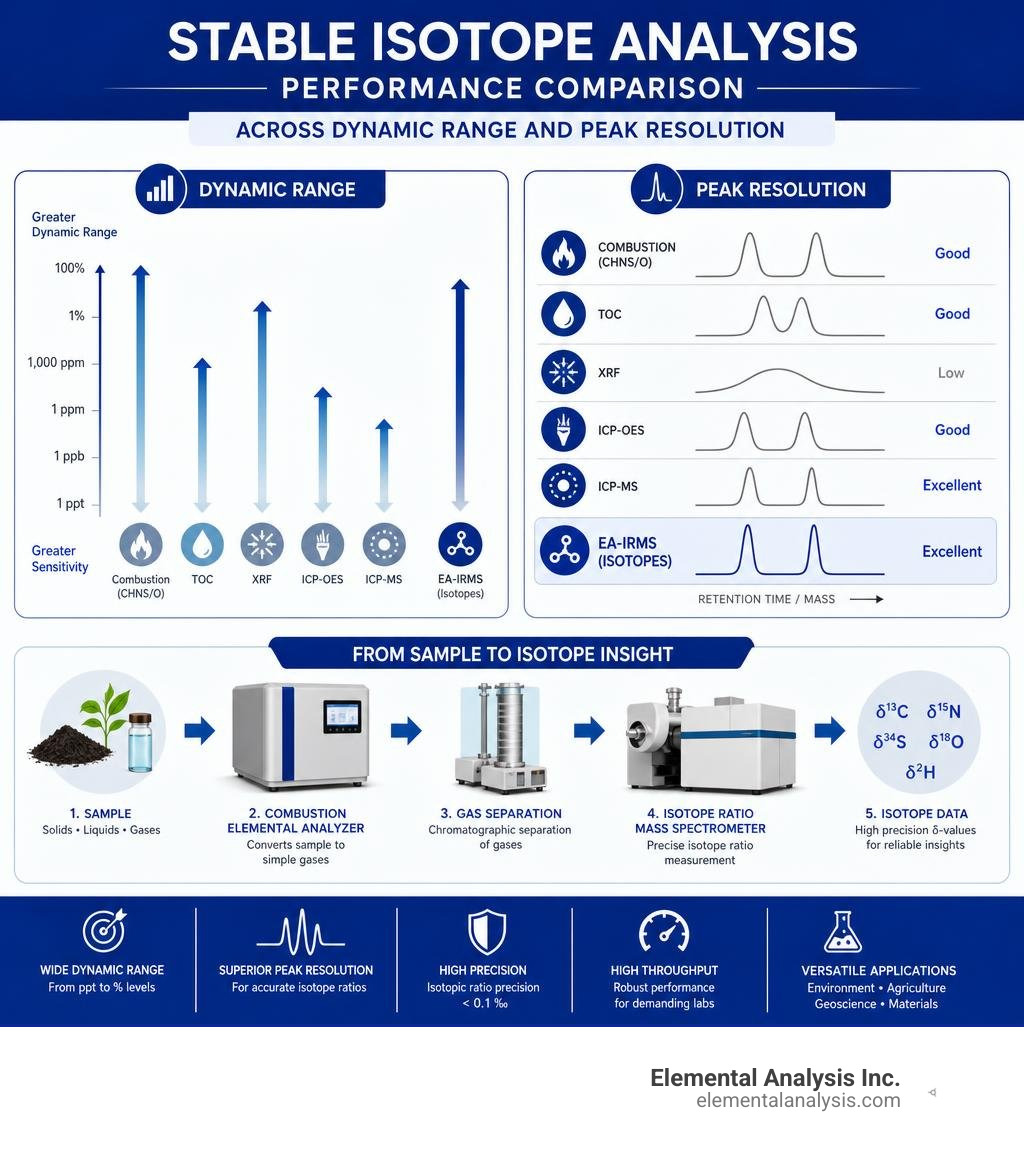
| Analyzer Technology | Target Elements | Typical Detection Limits | Sample Matrix Types | Estimated Price Range (USD) |
|---|---|---|---|---|
| Combustion (CHNS/O) | C, H, N, S, O | < 100 ppm to 100% | Solids, liquids, powders | $40,000 – $100,000+ |
| Total Organic Carbon (TOC) | TOC, TIC, TC, TN | < 10 ppb to ppm levels | Water, liquids, slurries | $10,000 – $100,000 |
| X-Ray Fluorescence (XRF) | Na to U | ~1 ppm to 100% | Solids, liquids, films | $3,000 (handheld) – $300,000+ |
| ICP-OES | Metals & non-metals | Sub-ppm to ppb | Liquids, digested solids | $50,000 – $200,000+ |
| ICP-MS | Metals & heavy elements | Sub-ppt to ppt | Liquids, ultra-pure chemicals | $200,000 – $1,000,000+ |
| EA-IRMS | $\delta^{13}C, \delta^{15}N, \delta^{34}S, \delta^{18}O, \delta^2H$ | Isotopic ratio precision (<0.1‰) | Gases, solids, liquids | $150,000 – $500,000 |
Modern Macro Elemental Analyzer Configurations
Inhomogeneous matrices — such as agricultural soils, coarse coals, or plant biomass — pose significant sampling challenges. Traditional micro-analyzers require samples under 1 mg, requiring extensive milling and grinding. Modern macro systems solve this by processing sample volumes up to 1.5 g (1,500 mg).
By handling larger sample masses, systems like the Organic elemental analyzer vario MACRO cube – Elementar allow labs to achieve accurate simultaneous CHNS readings without time-consuming pre-grinding. High thermal capacity furnaces and jet oxygen injection ensure 100% digestion even in large, non-uniform samples. For more details on commercial macro carbon and sulfur analyzers, check out our guide on Carbon and Sulfur Analysis Principles and Prices.
Spectroscopy Systems: XRF, ICP-OES, and ICP-MS
When your analytical needs expand beyond organic elements to heavy metals and trace minerals, inorganic spectroscopic techniques come into play:
- X-Ray Fluorescence (XRF): Uses high-energy X-rays to excite sample atoms, causing them to emit secondary fluorescent X-rays characteristic of specific elements. It provides rapid, non-destructive screening across solid and liquid matrices.
- Inductively Coupled Plasma Optical Emission Spectroscopy (ICP-OES): Uses an argon plasma sustained at 6,000 K to 10,000 K to excite atoms, measuring the wavelengths of emitted light. Ideal for multi-element routine metal screening down to ppb levels.
- Inductively Coupled Plasma Mass Spectrometry (ICP-MS): Pairs argon plasma atomization with mass spectrometer isolation. ICP-MS delivers ultra-trace sub-ppt detection limits and isotopic discrimination, making it essential for high-purity testing and stringent regulatory work.
Isotope Ratio Instrumentation for Isotopic Analysis
Coupling a combustion elemental analyzer with an Isotope Ratio Mass Spectrometer (EA-IRMS) enables researchers to measure stable isotopes ($\delta^{13}C, \delta^{15}N, \delta^{34}S, \delta^{18}O, \delta^2H$) alongside elemental percentages.
Advanced systems resolve traditional technical hurdles like isobaric interference between $N_2$ and $CO$ during oxygen isotope testing. Analyzers like the Elemental analyzer inlet vario PYRO cube for EA-IRMS – Elementar utilize high-temperature pyrolysis up to 1,500 °C and automated backflushing to completely separate gas peaks.
For high-throughput stable isotope facilities, instruments like the Elemental analyzer inlet vario ISOTOPE select for EA-IRMS – Elementar offer zero-blank sample introduction and low nitrogen detection limits (< 100 ppm), while the versatile Elemental analyzer inlet vario ISOTOPE cube for EA-IRMS – Elementar routinely handles difficult $C:N$ ratios up to 7,000:1 and $C:S$ ratios up to 5,000:1.
Key Applications Across Industrial and Scientific Fields
Quantifying chemical composition is vital across manufacturing, regulatory verification, and advanced scientific research.
Environmental and Agronomic Soil Testing
Understanding soil quality hinges on precise carbon and nitrogen quantification. Total Organic Carbon (TOC) and Total Nitrogen (TN) metrics allow agronomy researchers to evaluate soil organic matter, fertilizer runoff potential, and carbon sequestration performance.
Sulfur analysis is equally critical in atmospheric and environmental monitoring. The ability to measure total and trace sulfur in plant materials, sediments, and fossil fuel residues helps researchers evaluate environmental risk factors. Dive deeper into sulfur testing principles in The Complete Guide to Total and Trace Sulfur Analysis.
Pharmaceutical and Regulatory Impurities Testing
In pharmaceutical manufacturing, elemental quality control is strictly mandated by regulatory bodies like the FDA and ICH guidelines (such as ICH Q3D). Active Pharmaceutical Ingredients (APIs) and excipients must be routinely screened for elemental impurities, heavy metals (like lead, arsenic, cadmium, and mercury), and residual catalysts.
Organic CHNO analysis verifies the purity and chemical identity of newly synthesized therapeutic molecules. Read our breakdown on A Practical Guide to Elemental Impurities Testing and FDA Guidelines to navigate compliance, or explore dedicated CHNO characterization routines.
Key Considerations for Instrument Selection and Quality Control
Acquiring or outsourcing to an elemental analyzer setup involves several practical workflow considerations:
- Matrix State and Homogeneity: Are your samples fine liquids, volatile solvents, or heterogeneous solids? Inhomogeneous solids favor macro combustion analyzers, while liquid samples work best with autosampler-driven ICP or TOC systems.
- Destructive vs. Non-Destructive Requirements: Combustion, ICP-OES, and ICP-MS permanently consume the sample during ionization or flash oxidation. If sample preservation is critical — such as in forensic analysis, precious gems, or historical artifacts — non-destructive methods like X-Ray Fluorescence or Particle-Induced X-ray Emission (PIXE) are required.
- Throughput and Automation: Facilities running hundreds of samples daily require high-capacity autosamplers (up to 120 or 240 carousel positions), rapid cycle times (under 3 minutes per run), and automated sleep/wake-up modes to minimize carrier gas consumption overnight.
- Quality Control and Standard Calibration: Accurate quantification relies on matrix-matched calibration standards (such as acetanilide, glutamic acid, or certified soil reference materials). Regular blank runs, drift controls, and routine maintenance of oxidation tubes prevent baseline drift and maintain high precision.

Frequently Asked Questions About Elemental Analysis
What is the difference between destructive and non-destructive elemental analysis?
Destructive elemental analysis techniques — such as organic combustion, ICP-OES, and ICP-MS — chemically oxidize, dissolve, or vaporize the sample during testing, meaning the original material cannot be recovered.
Non-destructive techniques preserve the physical structure and chemical state of the sample. Methodologies like XRF and Particle-Induced X-ray Emission (PIXE) bombard the material with X-rays or charged particles, reading the secondary radiation emitted without causing chemical destruction. At Elemental Analysis Inc., operating in Lexington, KY, we specialize in offering high-throughput PIXE alongside conventional destructive testing.
How does combustion analysis compare to ICP-MS detection capabilities?
Combustion analysis is designed for macro- and micro-quantification of primary organic constituents (carbon, hydrogen, nitrogen, sulfur, oxygen) at major and minor concentration levels (from ~100 ppm up to 100%). ICP-MS is tailored for inorganic elemental screening across the periodic table at trace and ultra-trace concentrations (ranging from sub-ppm down to parts-per-trillion levels), primarily operating on acid-digested liquid solutions.
What sample preparation steps ensure accurate analytical measurement?
For solid combustion analysis, sample preparation centers on thorough homogenization. Non-uniform solids must be finely milled or processed in macro-capable furnaces. Solid samples are weighed on microbalances directly into tin or aluminum foil capsules, which are tightly folded with dedicated sealing presses to eliminate trapped ambient air before loading into the autosampler. Liquid samples require gas-tight capsule seals or dedicated liquid injection syringes to prevent volatilization before ignition.
Conclusion
Selecting the right elemental analyzer technology comes down to understanding your target elements, sample matrices, required throughput, and sensitivity targets. Whether your facility relies on rapid macro CHNS combustion, trace ICP-MS metal screening, non-destructive PIXE testing, or high-precision isotope ratio mass spectrometry, aligning your instrument selection with regulatory and operational goals is key to long-term laboratory success.
At Elemental Analysis Inc. in Lexington, KY, we deliver fast turnaround times, competitive pricing, and certified precision across both non-destructive and destructive elemental testing applications. Explore our comprehensive testing capabilities and talk with our analytical chemistry experts today by visiting our Services page.