Don’t Overpay for Your Next Nitrogen Combustion Analyzer
How Much Does a Nitrogen Analyzer Actually Cost?
The nitrogen analyzer price range is wide enough to surprise most lab managers — spanning from under $700 for a handheld gas purity meter to well over $150,000 for a high-end elemental combustion system. Before you commit to a capital purchase, it helps to know exactly where your application falls on that spectrum.
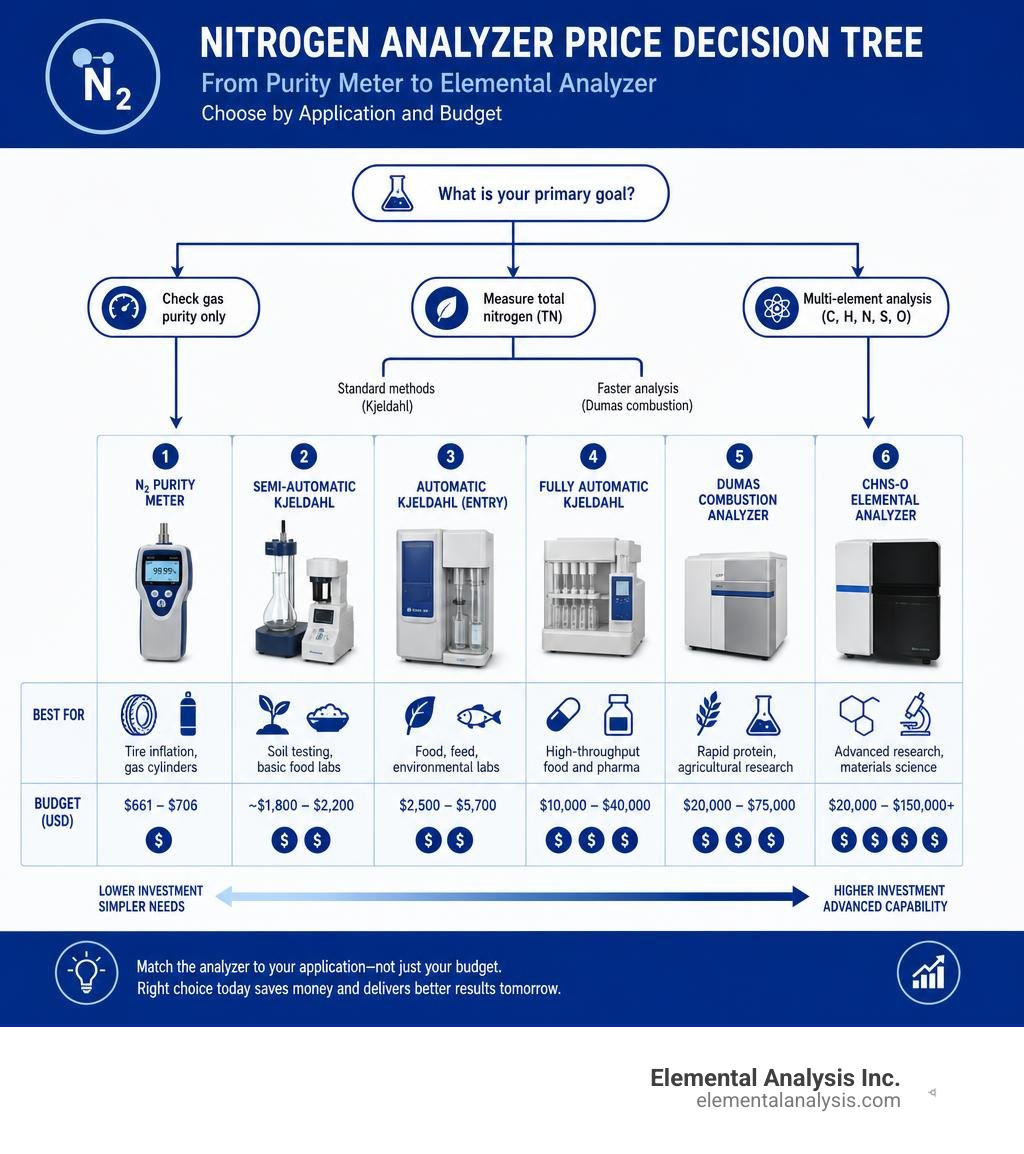
Here is a quick breakdown of typical price ranges by analyzer type:
| Analyzer Type | Typical Price Range | Best For |
|---|---|---|
| Handheld N₂ purity meter | $661 – $706 USD / ₹26,000 – ₹58,000 INR | Tire inflation, gas cylinders |
| Semi-automatic Kjeldahl | ₹1,49,000 – ₹1,80,000 INR (~$1,800 – $2,200 USD) | Soil testing, basic food labs |
| Automatic Kjeldahl (entry) | $2,500 – $5,700 USD | Food, feed, environmental labs |
| Fully automatic Kjeldahl | $10,000 – $40,000 USD | High-throughput food and pharma |
| Dumas combustion analyzer | $20,000 – $75,000 USD (refurbished from ~$18,900) | Rapid protein, agricultural research |
| CHNS-O elemental analyzer | $20,000 – $150,000 USD / up to ₹45,00,000 INR | Advanced research, materials science |
The type of measurement method you need is the single biggest driver of cost. A simple electrochemical purity sensor costs a fraction of what a dual-furnace combustion system does — and they do very different jobs.
For lab supervisors managing tight budgets and strict compliance requirements, understanding this cost landscape upfront prevents overspending on capability you don’t need — or underspending on a system that can’t meet your detection limits.
Key Factors That Determine a Nitrogen Analyzer Price
When evaluating the market for nitrogen determination hardware, the initial sticker price is only the tip of the analytical iceberg. To make a sound investment for your laboratory, you must distinguish between immediate capital expenditure (CAPEX) and long-term total cost of ownership (TCO).
Several primary variables dictate where an instrument lands on the pricing spectrum:
- Measurement Methodology: The physics and chemistry behind how the nitrogen is detected. Wet chemistry (Kjeldahl) systems have lower upfront costs but higher labor overhead, whereas dry combustion (Dumas) systems demand a higher initial investment but offer lightning-fast, automated run times.
- Automation Grade: Manual sample prep and monitoring keep costs down upfront, but fully automatic autosequencing systems with autosamplers dramatically reduce human error and labor costs over time.
- Application and Sensitivity: Checking if a nitrogen tire-inflation cylinder is at 98% purity requires a simple electrochemical sensor. Detecting trace nitrogen levels down to parts-per-million (ppm) in steel, polymers, or wastewater requires sophisticated optical detectors or thermal conductivity cells, driving up the price.
- Build Quality and Brand Reputation: High-end instruments designed for continuous industrial throughput incorporate high-temperature furnaces (up to 1,200°C), corrosion-resistant diaphragm pumps, and robust software. These premium components naturally command a higher price point.
To understand how to design and budget a modern analytical space, you can explore our comprehensive guide on setting up your facility in Elemental Testing Lab 101.
How Technology and Method Impact the Nitrogen Analyzer Price
The underlying technology of your analyzer is the primary driver of its price tag. If you are performing elemental analysis, you are likely choosing between two dominant chemical methodologies: the Dumas combustion method and the Kjeldahl digestion method.
The Dumas method is a dry combustion technique. The sample is burned in a high-temperature furnace (typically 900°C to 1,200°C) in the presence of pure oxygen. The resulting gases are reduced, purified, and measured using a Thermal Conductivity Detector (TCD). This sophisticated process is highly automated and extremely fast, but the advanced furnace engineering, gas flow controllers, and detection systems raise the baseline price of new systems to anywhere from $20,000 to $150,000. For a closer look at a high-performance combustion setup, see the Combustion Analyzer for Nitrogen and Protein Determination | ysi.com.
In contrast, the Kjeldahl method relies on wet chemical digestion. The sample is heated with concentrated sulfuric acid in the presence of a catalyst to convert organic nitrogen into ammonium sulfate. It is then alkalized, distilled, and titrated. Because this method relies on standard laboratory glassware, heating blocks, and wet reagents rather than high-temperature combustion furnaces and mass flow controllers, entry-level systems are significantly cheaper.
Understanding these core chemical methodologies is crucial. You can read more about how these principles fit into broader laboratory testing protocols in A Beginner Guide to Industry Standard Methods.
How Automation and Throughput Affect the Nitrogen Analyzer Price
If you’ve decided on an analytical method, your next major financial decision is the level of automation. In the laboratory world, convenience and throughput carry a premium.
- Manual and Semi-Automatic Systems: A semi-automatic Kjeldahl system (such as those priced around ₹1,49,000 INR or $1,800 USD) requires a technician to manually transfer digested samples, add reagents, and perform the final titration. These systems are ideal for low-throughput operations (e.g., 5 to 10 samples per day) where labor costs are not a primary bottleneck.
- Fully Automatic Systems: Fully automatic systems handle reagent addition, steam distillation, titration, and waste discharge with a single button press. High-end systems feature integrated autosamplers (or autofeeders) that can process 20, 40, or even 60 samples overnight without human intervention.
Adding an autosampler and advanced robotics can easily double or triple the price of an instrument. For example, a basic automatic Kjeldahl distiller might cost $3,000, while a high-capacity, fully automated system like the NB2000 Kjeldahl Nitrogen Analyzer With Autofeeder / Autosampler , Kjeldahl Distiller of nanbeilab can range from $32,000 to $40,000 USD.
Comparing Analytical Methods: Kjeldahl vs. Dumas Combustion
To help you decide which system justifies its capital cost, let’s look at how these two classic methods stack up in daily laboratory operations.
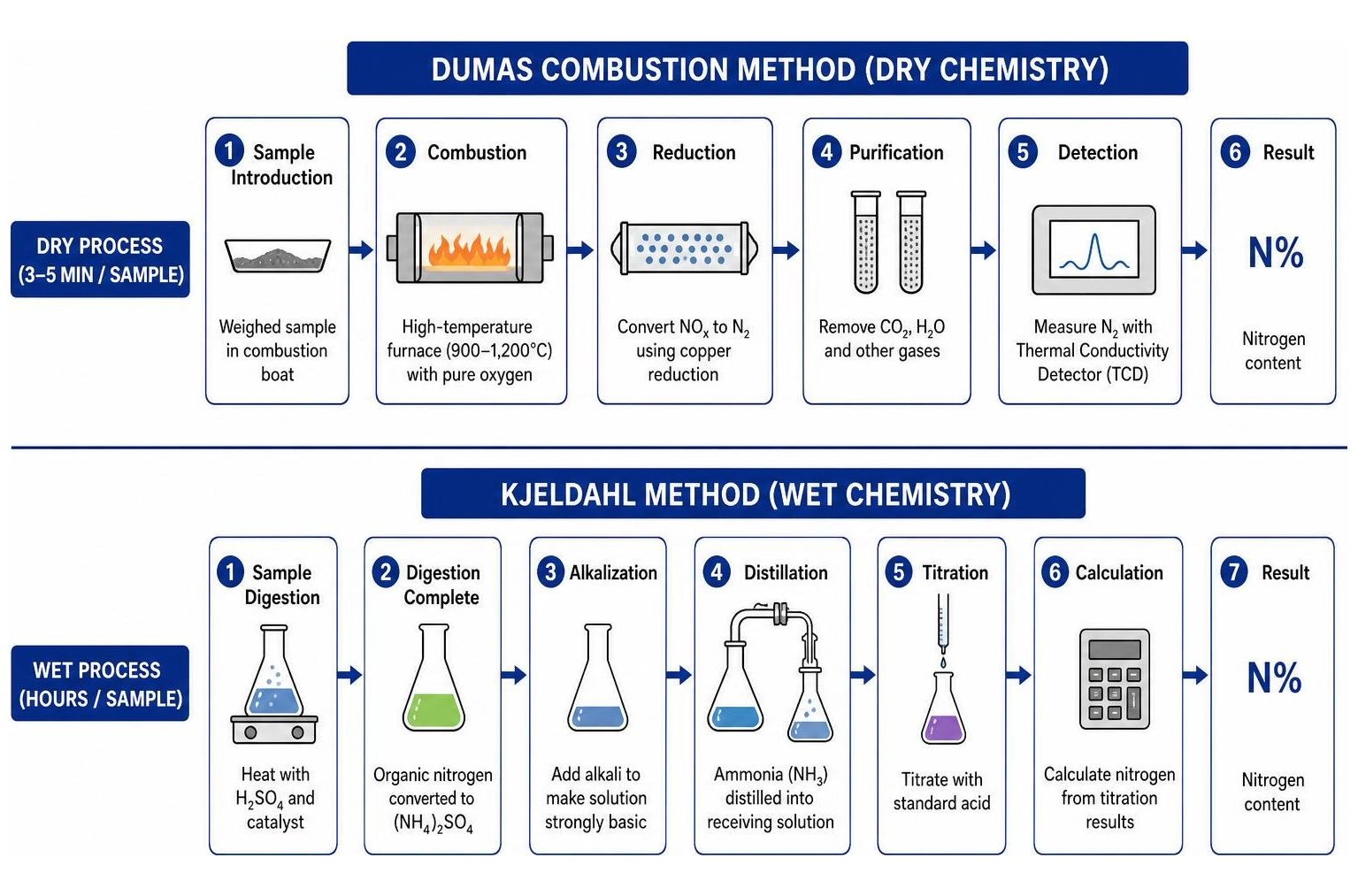
The Kjeldahl method remains a globally accepted standard for food, feed, and soil analysis. It is highly reliable and handles large, heterogeneous sample sizes well. However, it is slow (often taking hours for digestion), requires the handling of hazardous boiling acids, and generates significant chemical waste.
The Dumas method, on the other hand, is a modern marvel of efficiency. It is a completely dry chemistry technique that eliminates the need for toxic acids and chemical waste disposal. A typical run takes just 3 to 5 minutes per sample.
For high-throughput industrial facilities, the speed of Dumas instruments makes them highly cost-effective despite their higher upfront price. For example, systems like the Nitrogen and protein analyzer rapid N exceed PLUS – Elementar use smart design features to lower the cost per sample, making them a strong alternative to wet chemistry.
If your lab is also tasked with measuring other elements alongside nitrogen, you might want to explore how these combustion principles apply to other elements. Check out our detailed guide on Carbon and Sulfur Analysis: Principles, Prices, and Leco Systems.
Kjeldahl Distillation Systems: Semi-Automatic vs. Fully Automatic Costs
If your testing protocols or budget point you toward the Kjeldahl method, you will find a highly segmented market:
- Entry-Level Automatic Distillers ($2,500 – $3,000 USD): Sourced directly from B2B manufacturers, these systems feature automatic alkali and boric acid addition, distillation speeds of 3 to 6 minutes per sample, and basic safety alarms. They are excellent for budget-conscious labs but still require manual titration. For a detailed specification sheet, see the Automatic Kjeldahl Nitrogen Analyzer 0.1mg~240mg N For Laboratory – 110026967.
- Mid-Range Automated Systems ($4,900 – $5,700 USD): These instruments begin to introduce self-cleaning titration cups, automatic waste discharge, and real-time temperature monitoring to ensure high recovery rates (>=99.5%). You can explore this tier further on Kjeldahl Nitrogen Analyzer For Protein Detection And Soil Nutrient Analysis, High Quality Kjeldahl Nitrogen Analyzer For Protein Detection And Soil Nutrient Analysis on Bossgoo.com.
- Premium Fully Automatic Systems ($10,000 – $12,000+ USD): These systems feature integrated color touchscreens, advanced data logging, user access controls, and highly precise titration systems (down to 1.0 µL per step). They are built for rigorous compliance environments where data integrity is paramount.
Dumas Combustion Analyzers: High-Throughput Efficiency
Dumas combustion analyzers are designed for rapid, automated testing. Because they burn samples at extreme temperatures, they require robust internal components, including quartz combustion tubes, copper reduction reactors, and electronic mass flow controllers.
One of the key engineering factors that influences the price of a Dumas analyzer is the choice of carrier gas. Historically, these systems relied on Helium, which provides outstanding thermal conductivity but has become increasingly scarce and expensive. Modern premium Dumas analyzers are engineered to run on Carbon Dioxide (CO₂) or Argon as alternative carrier gases, which can reduce daily operational costs by up to 80%.
If your laboratory requires extremely precise, low-level nitrogen detection, the quality of the detector and the purity of the gas flow are critical. To understand how these high-end combustion systems achieve such high sensitivity, read our In-Depth Guide to Low Detection Limits.
New vs. Refurbished Nitrogen Analyzers: Balancing Cost and Risk
If a new, high-end elemental analyzer is out of your budget, the refurbished market is a viable alternative.
Buying a refurbished nitrogen analyzer can save your lab 40% to 60% compared to buying new. For example, while a new carbon/nitrogen analyzer can easily cost upwards of $80,000, a certified refurbished model can often be purchased for around $36,950.
However, buying used or refurbished equipment comes with distinct trade-offs:
- Warranty Coverage: New instruments typically come with comprehensive 1-to-3-year manufacturer warranties (and sometimes up to 10 years on critical components like furnaces and detector cells). Refurbished units usually offer limited 90-day to 1-year warranties from third-party vendors.
- Parts Availability: Older, discontinued models may be cheap upfront, but finding replacement parts, specialized O-rings, or software updates five years down the road can be difficult and costly.
- Support and Training: Purchasing new equipment often includes on-site installation, calibration, and staff training from factory-certified engineers. With refurbished units, these services are typically billed as expensive add-ons.
If you are weighing the pros and cons of purchasing analytical hardware for multi-element testing, you may find our parallel guide on sulfur analysis equipment useful: The Complete Guide to Total and Trace Sulfur Analysis.
Hidden Costs of Ownership: Consumables, Gases, and Maintenance
Many first-time buyers focus entirely on the purchase price of the analyzer, only to be surprised by the ongoing operational costs. To calculate the true cost per sample, you must budget for several ongoing expenses:
- High-Purity Gases: Dumas combustion systems require continuous supplies of high-purity Oxygen (for combustion) and Helium or Carbon Dioxide (as carrier gases). Gas cylinder rentals and refills can easily add thousands of dollars to your annual operating budget.
- Consumables: Combustion reactors require regular replacement of quartz tubes, copper reduction materials, and ash filters. For Kjeldahl systems, you will need a steady supply of concentrated sulfuric acid, catalyst tablets (copper or selenium), boric acid, and standard titration chemicals.
- Power and Utilities: High-temperature furnaces consume significant power (ranging from 1.3 kW to 12 kW). Kjeldahl distillers also require a continuous flow of cooling water (typically 1.5 Liters per minute) unless you invest in a premium model with water-saving air-cooling technology.
- Routine Maintenance: O-rings, seals, and acid-resistant tubing wear out and must be replaced regularly to prevent system leaks and maintain accuracy.
These operational dynamics are similar to those found in other specialized testing fields. For example, you can see how consumable and maintenance considerations apply to petrochemical testing in our guide, A Guide to Measuring Sulfur in Petroleum and Marine Fuels.
Frequently Asked Questions About Nitrogen Analyzers
What is the price difference between a basic gas purity meter and an elemental analyzer?
A basic gas purity meter is a compact, often handheld device that costs between $600 and $1,000. It uses a simple electrochemical sensor to measure gaseous nitrogen purity (from 0% to 100%) in tires or gas cylinders.
An elemental analyzer is a complex laboratory instrument that costs between $20,000 and $150,000. It uses high-temperature combustion or wet chemistry to digest solid or liquid samples, releasing bound nitrogen as gas to measure organic or inorganic nitrogen at ppm or percentage levels.
How do prices from regional manufacturers compare to international brands?
Instruments sourced from regional manufacturers in emerging markets (such as India or China) are often significantly cheaper upfront. For example, an automatic Kjeldahl distiller from a Chinese B2B supplier may cost $2,500, whereas a comparable system from an established European or American brand can cost $10,000 or more.
However, international buyers must factor in import duties, shipping fees, and potential challenges with local technical support, language barriers in software, and the availability of replacement parts.
Is it more cost-effective to buy an analyzer or outsource testing?
For many laboratories, the most cost-effective solution is not to buy an analyzer at all. If your sample volume is low to moderate (e.g., fewer than 50 to 100 samples per month), the capital expense, maintenance overhead, gas costs, and labor requirements of owning an analyzer rarely justify the investment.
Outsourcing your testing to a specialized contract laboratory allows you to pay only for the analyses you need, completely eliminating capital risk and operational hassle.
Conclusion
Choosing the right approach to nitrogen analysis is a balance between your analytical requirements, sample throughput, and budget. While purchasing a high-end Dumas combustion analyzer or an automated Kjeldahl system provides in-house capability, it also introduces significant capital expense, maintenance responsibilities, and ongoing overhead.
At Elemental Analysis Inc. in Lexington, Kentucky, we help you bypass these capital hurdles entirely. As a premier analytical chemistry laboratory, we provide precise trace element identification, quantification, and speciation services across a wide range of industries. Our unique capability as a commercial Proton Induced X-ray Emission (PIXE) laboratory allows us to deliver fast turnarounds and highly competitive pricing for both destructive and non-destructive testing.
Instead of taking on the high cost and maintenance of in-house hardware, let our team of experts handle your analytical testing with the highest precision and efficiency.
Ready to streamline your testing workflow? Learn more about our capabilities and request a custom quote today by visiting our Elemental Analysis Services page.