
Heavy Metals Testing Starts With the Right Sample
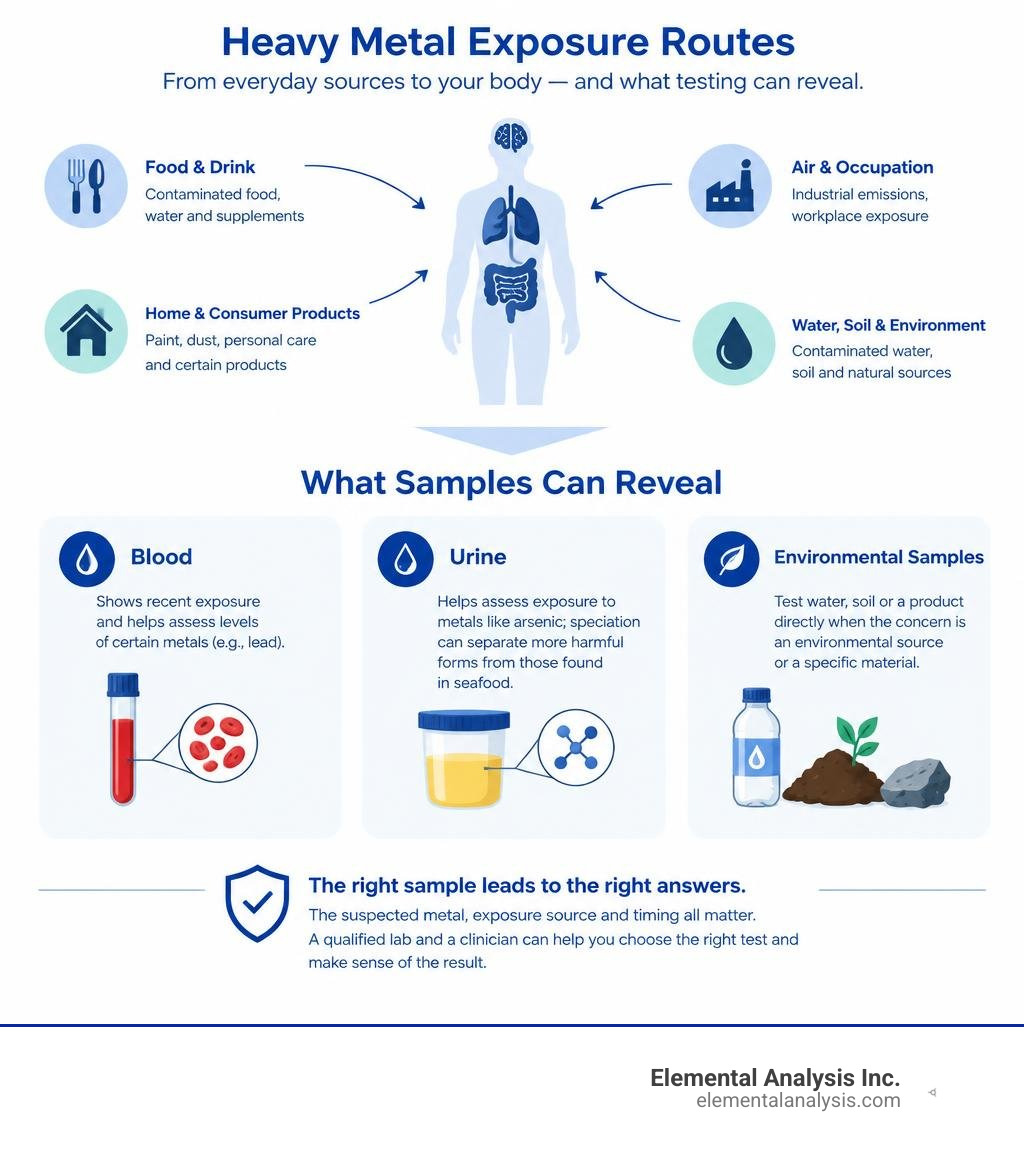
Heavy metals testing measures elements such as lead, arsenic, cadmium, and mercury in a sample. The right test depends on what you need to know. A blood lead test checks a person’s lead exposure. Urine testing can help assess arsenic exposure, but an elevated result may need speciation to separate more harmful forms from those found in seafood. For a concern about water, soil, or a product, test that material directly.
No single panel answers every question. The suspected metal, exposure source, and timing all matter. A qualified lab and a clinician, when testing a person, can help you choose the right sample and make sense of the result.
Understanding Toxic Elements and Health Risks
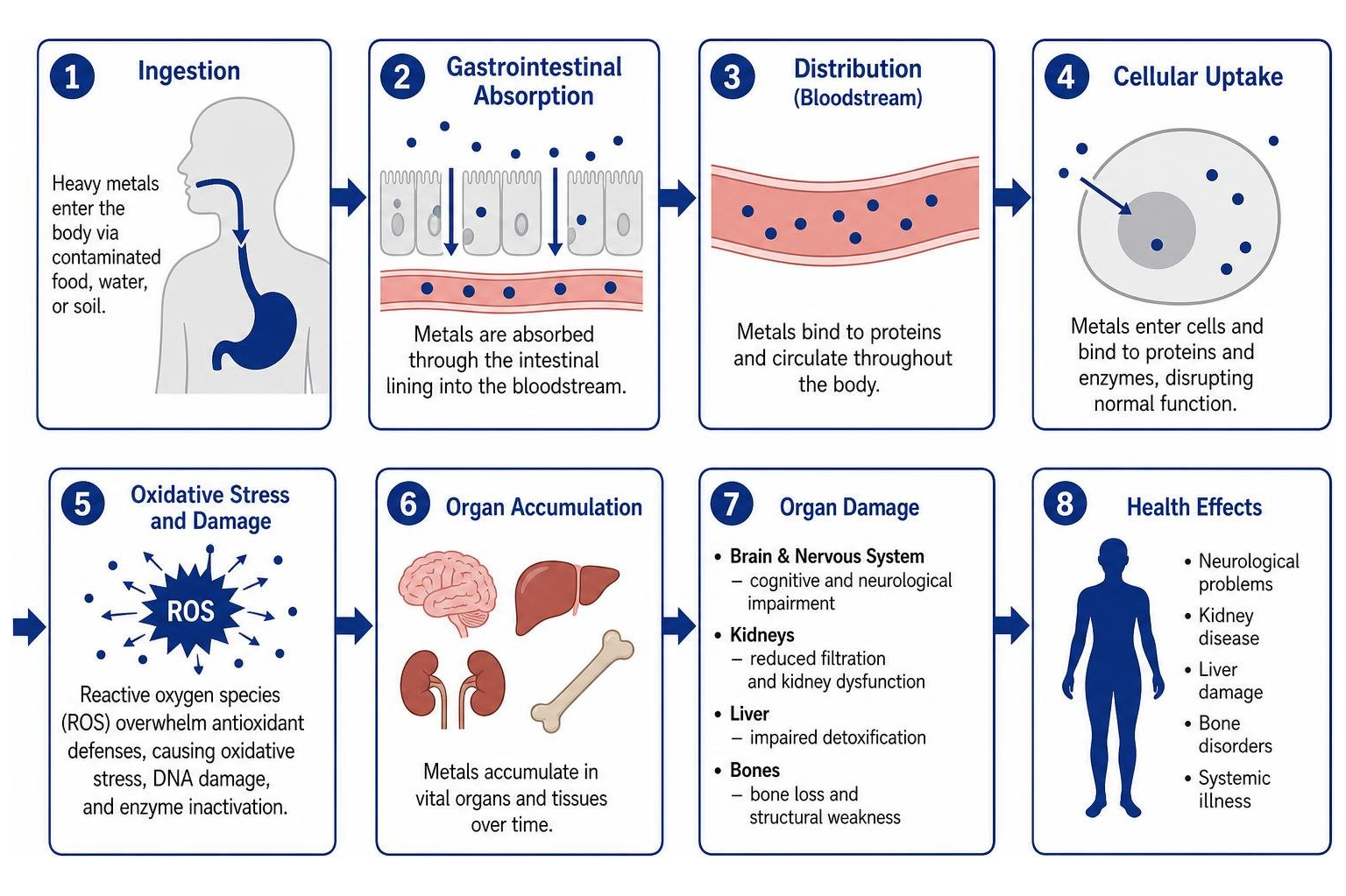
Toxic heavy metals are dense metallic elements that serve no physiological purpose in the human body. Even at microscopic concentrations, elements such as lead, cadmium, mercury, and arsenic induce systemic toxicity (NBK560920). The primary mechanism behind their damage involves the generation of reactive oxygen species (ROS), which overwhelms cellular antioxidant defenses and leads to widespread oxidative stress, lipid peroxidation, DNA damage, and enzyme inactivation.
The Centers for Disease Control and Prevention (CDC) monitors these risks through its National Report on Human Exposure to Environmental Chemicals, tracking 352 environmental chemicals and their metabolites across the U.S. population. Understanding the human health risks of heavy metal exposure is crucial, as a comprehensive clinical heavy metal toxicity review reveals that systemic accumulation can silently compromise vital organs long before severe clinical symptoms emerge.
Common Exposure Routes and Toxicity Mechanisms
Toxic metals enter biological systems through three primary pathways: ingestion, inhalation, and dermal absorption. Everyday environmental contact points include contaminated drinking water, industrial airborne emissions, aging plumbing, and legacy lead-based paint in pre-1978 housing. Contaminated soils also contribute significantly through direct dust inhalation or dietary bioaccumulation in homegrown vegetables, making environmental soil contamination testing an essential tool for evaluating property safety.
At the molecular level, toxic elements mimic essential nutrients while exhibiting a high affinity for sulfhydryl (-SH) groups found on proteins and enzymes. When a heavy metal replaces an essential cofactor—such as lead displacing calcium in neurons or cadmium displacing zinc in enzymes—it alters normal protein folding and blocks biochemical pathways. For a deeper look into the underlying chemical mechanisms, explore the fundamentals of the elemental analysis of metals.
Recognizing Symptoms of Acute and Chronic Toxicity
Clinical manifestations differ dramatically depending on whether exposure is sudden and concentrated (acute) or low-grade and sustained over months to years (chronic).
Historic incidents highlight these long-term dangers: industrial methylmercury discharge in Japan caused severe neurological damage known as Minamata disease, while chronic cadmium contamination of agricultural waterways led to Itai-Itai disease, marked by severe bone softening and renal tubular dysfunction (Fanconi syndrome).
| Metal | Acute Exposure Symptoms | Chronic Exposure Manifestations |
|---|---|---|
| Lead (Pb) | Severe abdominal colic, encephalopathy, vomiting, seizures | Cognitive deficits, peripheral neuropathy, hypertension, anemia |
| Mercury (Hg) | Pulmonary edema, acute respiratory distress, corrosive metallic taste | Tremors, erethism (personality shifts), ataxia, memory loss |
| Arsenic (As) | Garlic-scented breath, severe diarrhea, hypotension, QT prolongation | Hyperpigmentation, palmoplantar hyperkeratosis, peripheral neuropathy |
| Cadmium (Cd) | Chemical pneumonitis, metal fume fever, nausea | Proximal renal tubular damage (Fanconi syndrome), osteomalacia, proteinuria |
Specimen Matrices Used in Heavy Metals Testing

Selecting the appropriate biological matrix requires understanding toxicokinetics—how the body absorbs, distributes, and clears specific elements over time.
Blood and Urine Biomarkers for Systemic Exposure
Whole blood testing serves as the primary standard for recent, circulating exposure. For example, blood lead levels peak within 4 to 5 hours following acute intake and exhibit a half-life of roughly 27 to 30 days before the metal redistributes into soft tissues and cortical bone. Routine monitoring relies on standard protocols detailed in the MedlinePlus guide to heavy metal blood tests, with specialized clinical frameworks tailored for blood lead testing for pediatric populations.
Urine testing, particularly via a 24-hour collection or a spot urine adjusted for creatinine concentration, provides the best indicator for cleared or chronic exposures to inorganic forms. Physiological excretion dynamics dictate matrix selection: for instance, approximately 85% of absorbed cobalt is eliminated through urine, while the remaining 15% is excreted in feces.
Hair and Nail Analysis for Historical Accumulation
Keratinized tissues provide a historical retrospective window. As scalp hair grows at approximately 1 centimeter per month, a standard 3-to-4 centimeter proximal segment reflects elemental deposition over a 3-to-4-month metabolic window. Fingernails reflect an exposure timeline of 5 to 6 months, while toenails span 10 to 12 months.
However, keratin analysis carries notable diagnostic caveats. External contamination from environmental dust, cosmetic hair dyes, perms, or specialized grooming products (such as selenium-based anti-dandruff shampoos) can produce falsely elevated readings (Zajac et al., 2020). Furthermore, physiological element antagonisms—such as zinc depletion co-occurring with cadmium accumulation—must be evaluated carefully alongside clinical blood or urine panels to confirm validity.
Test Selection, Laboratory Methods, and Pre-Test Protocols

Basic vs. Expanded Testing Panels
Clinical screening panels vary based on suspected exposure sources. Standard panels assess the primary toxic quartet, while expanded panels incorporate transition metals and industrial metalloids.
| Profile Category | Analytes Included | Clinical & Environmental Applications |
|---|---|---|
| Basic Toxic Panel | Lead, Mercury, Arsenic, Cadmium | Baseline occupational screening, general environmental exposure |
| Expanded Panel | Basic Panel + Cobalt, Thallium, Chromium, Nickel, Beryllium, Antimony | Metal-on-metal joint implants, industrial fabrication, advanced occupational safety |
| Nutritional Trace Profile | Zinc, Copper, Selenium, Manganese, Molybdenum | Evaluating elemental antagonism, dietary mineral deficiencies, metabolic balance |
Preparing for Clinical Heavy Metals Testing
Strict pre-analytical preparation helps prevent clinically misleading false positives:
- Avoid Seafood for 48 to 72 Hours: Marine organisms naturally accumulate non-toxic dietary organic arsenic (arsenobetaine) and methylmercury. Review how heavy metals tested in seafood and fish influence baseline concentrations before testing.
- Radiographic Contrast Washout: Avoid tests using gadolinium, barium, or iodine-based radiographic contrast media for at least 96 hours before sample collection to eliminate chemical interference.
- Follow Standard Clinical Instructions: Consult testing preparations outlined in the MedlinePlus medical test overview to verify sample integrity.
Analytical Methodologies: ICP-MS, ICP-OES, and PIXE
High-complexity laboratories utilize specialized instrumentation to achieve parts-per-billion (ppb) or parts-per-trillion (ppt) detection limits:
- Inductively Coupled Plasma Mass Spectrometry (ICP-MS): Ionizes specimens in a high-temperature argon plasma and separates ions by their mass-to-charge ratio. Learn more about running advanced heavy metal analysis by ICP-MS.
- Inductively Coupled Plasma Optical Emission Spectrometry (ICP-OES): Measures the characteristic light wavelengths emitted by excited atoms. Review the technical differences when choosing between ICP-OES and ICP-MS.
- Proton-Induced X-Ray Emission (PIXE): As the first commercial PIXE laboratory, Elemental Analysis Inc. offers non-destructive elemental identification and broad quantification without destroying delicate or limited sample matrices.
Test Accuracy, Diagnostic Pitfalls, and Result Interpretation
Background environmental levels are common across modern populations. For example, a 2004 CDC biomonitoring study identified detectable mercury concentrations in nearly 8,000 participants. Finding a detectable trace element does not automatically indicate clinical toxicity; interpreting results requires comparing values against validated reference intervals with guidance on choosing a heavy metal testing laboratory.
At-Home Test Kits vs. Laboratory Heavy Metals Testing
Over-the-counter and at-home colorimetric test strips offer low-cost visual screening, but they lack the analytical sensitivity and specificity of formal laboratory assays. In water testing, field strip kits can yield false negatives or suffer interference from water hardness and non-target minerals. Review the core differences between heavy metal test kits versus professional lab analysis for water before making remediation decisions.
Diagnostic Pitfalls, Provoked Urine Challenges, and False Positives
Unvalidated testing methodologies introduce notable clinical risks. A clinical study revealed that 9% of patients presenting at an environmental and occupational medicine clinic had previously undergone inappropriate or unvalidated tests, with unstandardized hair tests and metal panels being the most frequent (Zajac et al., 2020).
A major diagnostic concern is “provoked” urine testing, where a patient receives a synthetic chelator (such as DMSA or DMPS) prior to collection without a baseline indication. Chelating agents artificially strip essential and non-essential minerals from tissues, yielding elevated urinary levels that are then erroneously compared against standard unprovoked reference ranges (Zajac et al., 2020). This practice often leads to unnecessary, potentially harmful treatments.
Interpreting Results, Chelation Protocols, and Mitigation
When evaluating laboratory results:
- Request Speciation When Indicated: If urinary arsenic is elevated, laboratory speciation separates harmless organic compounds (such as dietary arsenobetaine) from toxic inorganic arsenic (arsenite and arsenate).
- Pediatric Reference Thresholds: For childhood lead screening, public health guidelines designate a blood lead reference value of 5 micrograms per deciliter (µg/dL) as the threshold for environmental intervention.
- Clinical Chelation Therapy: Medical chelation utilizes agents like Succimer (DMSA), DMPS, or Calcium Disodium EDTA (CaEDTA) (NBK560920). These pharmaceuticals bind heavy metal ions into stable, water-soluble complexes excreted through urine. Chelation carries risks—including renal stress and essential mineral depletion—and is strictly reserved for confirmed, clinically significant poisoning under medical supervision.
Frequently Asked Questions
How do I choose the right test for my specific exposure scenario?
Match the test matrix to the exposure pathway and timeline. Suspected recent inhalational or ingestion exposures (within hours to days) call for whole blood or spot urine testing. Long-term environmental or historical exposures are best evaluated using 24-hour urine excretion, unprovoked clinical panels, or accredited material testing of the suspected source (such as water or paint).
Why is seafood restricted prior to heavy metal testing?
Fish and shellfish contain naturally high levels of organic arsenic (arsenobetaine) and methylmercury. Consuming seafood within 48 to 72 hours before sample collection can produce elevated values that mimic toxic exposure, complicating clinical interpretation.
What is chelation therapy and when is it clinically indicated?
Chelation therapy is a medical treatment that introduces chelating compounds to chemically bind circulating and tissue-stored heavy metal ions, promoting their elimination via the kidneys (NBK560920). It is indicated only for medically diagnosed, acute or severe chronic toxicity, and should not be used as an unvalidated wellness protocol.
Conclusion
Navigating heavy metals testing requires an evidence-based approach: pairing the right sample matrix with accredited analytical methods to avoid common diagnostic errors. Whether assessing clinical biomarkers or investigating environmental vectors, reliable data is the foundation of effective exposure management. If you suspect environmental contamination in your facility or home, start with a comprehensive analysis of heavy metals in water and material testing to pinpoint risks at their source.
References
Zajac L, Johnson SA, Hauptman M. “Doc, can you test me for “toxic metals”? Challenges of testing for toxicants in patients with environmental concerns..” Current problems in pediatric and adolescent health care, 2020. PMCID PMC7230008. NBK560920.