
How Heavy Metals Are Tested in Seafood and Fish
Why Seafood Heavy Metal Testing Matters for Public Health and Food Safety
Seafood heavy metal testing is the process of analyzing fish and shellfish products for toxic elements — primarily mercury, arsenic, cadmium, and lead — to determine whether they are safe for human consumption.
Here is a quick overview of how it works and why it matters:
| Step | What Happens |
|---|---|
| Sample collection | Fish tissue (muscle, liver, gills) is collected from target species |
| Preparation | Samples are homogenized and digested using acids under heat |
| Analysis | Instruments like ICP-MS measure trace element concentrations |
| Risk assessment | Results are compared to regulatory limits and exposure models |
| Action | Non-compliant products are flagged; consumption advisories may be issued |
Fish and seafood are among the most nutritious foods on the planet. They are also one of the primary pathways through which humans are exposed to toxic metals like mercury and arsenic.
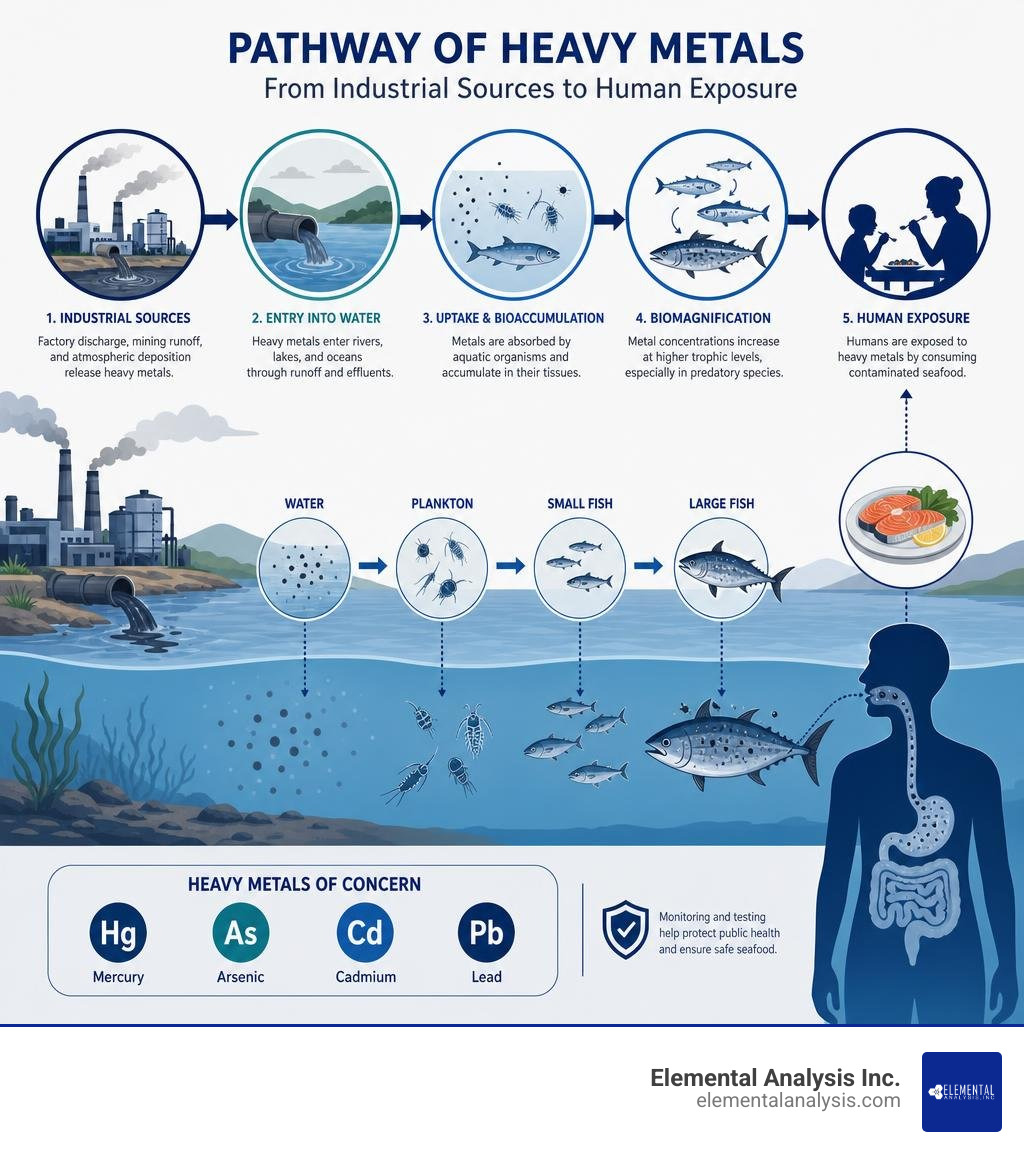
This is not a minor concern. Toxic metals enter rivers, lakes, and oceans through industrial discharge, mining runoff, atmospheric deposition, and legacy pollution from past industrial activity. Once in the water, they are absorbed by aquatic organisms — and they do not simply pass through. They accumulate.
A ten-year analysis of over 5,800 seafood samples found that 2.43% exceeded regulatory limits for heavy metals, with swordfish showing a non-compliance rate above 11%. Arsenic was detected in 99.6% of seafood samples tested in a Canadian government survey. These are not rare edge cases — contamination is widespread and highly species-dependent.
For lab supervisors and technical managers responsible for food safety compliance, understanding how testing works — and where the science currently stands — is essential for making fast, defensible decisions.
The Threat of Toxic Elements in Aquatic Ecosystems
To understand why we test, we have to look at how these elements enter our waters in the first place. Aquatic environments are highly vulnerable to both natural weathering processes and anthropogenic (human-caused) pollution. Industrial effluents, municipal wastewater, agricultural runoff, and atmospheric deposition from burning fossil fuels all dump a toxic cocktail of metals into our waterways.
Because fish live, breathe, and feed in these environments, they act as environmental mirrors. In scientific terms, we often look at Fish as environmental sentinels for metal contaminants of human … . If a river system is suffering from heavy metal pollution, the local fish populations will show it first—often in their livers, gills, and muscle tissues.

Bioaccumulation and Biomagnification of Heavy Metals
How do tiny amounts of dissolved metals in water turn into dangerous doses on our dinner plates? The answer lies in two critical biological processes: bioaccumulation and biomagnification.
- Bioaccumulation occurs when an organism absorbs a toxic substance at a rate faster than it can excrete or metabolize it. Over time, the concentration of the metal in the animal’s tissues increases.
- Biomagnification occurs as you move up the trophic levels of the food web. When a small fish eats contaminated algae, it retains those metals. When a larger predatory fish eats hundreds of those small fish, it absorbs the combined metal burden of all of them.
This is why large predatory fish—such as swordfish, sharks, and bluefin tuna—have the highest concentrations of methylmercury. Conversely, filter feeders like bivalves (clams, oysters, and mussels) do not sit at the top of the food chain, but because they filter massive volumes of water to feed, they act as hyperaccumulators for metals like cadmium and lead.
Health Risks of Chronic Exposure to Mercury, Lead, Cadmium, and Arsenic
These four metals are considered the “big four” of food safety concern due to their severe toxicity:
- Mercury (specifically Methylmercury): Highly neurotoxic. It easily crosses the blood-brain barrier and the placenta. In pregnant women, chronic exposure can cause severe developmental delays, cognitive deficits, and motor impairment in the unborn child.
- Lead: A potent neurotoxin that affects nearly every organ system. In children, even low-level exposure can lead to learning disabilities, behavioral disorders, and reduced IQ.
- Cadmium: Highly nephrotoxic (damages the kidneys) and can lead to bone demineralization (making bones brittle and prone to fracturing).
- Arsenic: In its inorganic form, arsenic is a known human carcinogen. Chronic exposure is linked to skin, lung, and bladder cancers, as well as cardiovascular disease.
Global Regulatory Limits and Regional Variations
Because of these health risks, food safety authorities worldwide have established strict maximum permissible concentrations for heavy metals in seafood. Keeping track of these limits is a primary driver behind commercial seafood heavy metal testing.
An extensive Monitoring of Cadmium, Lead, and Mercury Levels in Seafood Products: A Ten-Year Analysis highlights that regulatory compliance is highly species-specific. For example, while a tuna sample might pass regulatory muster for mercury, a swordfish sample from the exact same waters might fail because predatory species have higher legal tolerances to account for natural bioaccumulation, yet still frequently exceed them.
| Metal | FDA Action Levels / Tolerances (US) | EU Maximum Limits (Commission Regulation 2023/915) | Eurasian Customs Union Limits |
|---|---|---|---|
| Methylmercury / Total Hg | 1.0 ppm (mg/kg) | 0.5 ppm (1.0 ppm for predatory species) | 0.3 ppm (non-predatory) / 0.6 ppm (predatory) |
| Lead (Pb) | 0.5 ppm (crustaceans/shellfish guidance) | 0.3 ppm (fish muscle) | 1.0 ppm |
| Cadmium (Cd) | Variable | 0.05–0.25 ppm (fish) / 1.0 ppm (bivalves) | 0.1 ppm (fish) / 2.0 ppm (mollusks) |
| Arsenic (As) | 76 ppm (total As in shellfish guidance) | Under review (focus on inorganic As) | 1.0 ppm (freshwater) / 5.0 ppm (saltwater) |
FDA, EU, and International Seafood Safety Standards
In the United States, the FDA monitors heavy metals through programs like the Total Diet Study and enforces action levels. Across the Atlantic, European standards are governed by Commission Regulation 2023/915, which sets highly specific, legally binding maximum limits for contaminants.
Import controls at international borders rely heavily on rapid laboratory testing. If a shipment of imported seafood is found to exceed these limits, the entire batch can be rejected, destroyed, or sent back—resulting in massive financial losses for seafood distributors.
Dietary Exposure and Contamination Challenges in Central Asia
While we operate out of Lexington, Kentucky, we track global contamination challenges to help our clients navigate international supply chains. One region under intense scientific scrutiny is Central Asia. Due to legacy industrial operations from the Soviet era, mining runoff, and historical nuclear testing, water bodies in this landlocked region show extreme contamination.
For instance, in Kazakhstan’s Ili River, cadmium levels have been recorded up to 28.7 μg/L and lead up to 87.0 μg/L, exceeding WHO drinking water guidelines more than five times in certain areas. In Kyrgyzstan’s Issyk-Kul Lake, arsenic levels hover around 16 μg/L, well above acceptable drinking water standards. Furthermore, fish caught in Lake Balkyldak near a former chlor-alkali plant showed mercury levels up to 2.2 mg/kg.
Even though per capita fish consumption in Central Asian countries is relatively low (ranging from 0.63 kg/year in Tajikistan to 3.86 kg/year in Uzbekistan), communities living near these contaminated water bodies face localized, highly elevated health risks.
Analytical Methods for Seafood Heavy Metal Testing
How do we actually find a microgram of lead hidden inside a piece of salmon? It requires highly specialized Services that utilize state-of-the-art analytical chemistry.
Sample Preparation and Acid Digestion Protocols
Before any instrument can read a sample, that sample must undergo rigorous preparation. You cannot simply stick a piece of fish into a spectrometer.
- Homogenization: The fish tissue (typically the edible muscle fillet, though sometimes the liver or gills depending on the study) is thoroughly blended to create a uniform mixture.
- Moisture Determination: Because moisture content can vary wildly (averaging around 72% in seafood), recording the wet-to-dry ratio is essential for accurate concentration calculations.
- Microwave-Assisted Acid Digestion: A small portion of the homogenized sample (usually about 0.5 grams) is placed in a high-pressure vessel with concentrated nitric acid ($HNO3$) and sometimes hydrogen peroxide ($H2O_2$). The vessel is heated in a laboratory microwave to temperatures around 200°C. This aggressive process breaks down all organic matter, leaving a clear, liquid solution containing only dissolved inorganic minerals and metals.
Advanced Instrumentation: ICP-MS, AAS, and PIXE
Once digested, the liquid sample is ready for instrumental analysis. The industry standard methods include:
- ICP-MS (Inductively Coupled Plasma Mass Spectrometry): This is the gold standard for trace element analysis. By injecting the sample into an argon plasma torch burning at roughly 10,000 Kelvin, the atoms are ionized and directed into a mass spectrometer. ICP-MS can detect metals at parts-per-billion (ppb) or even parts-per-trillion (ppt) levels. Learn more about our ICP testing capabilities.
- AAS (Atomic Absorption Spectrophotometry): Particularly Cold Vapor AAS (CVAAS), which is highly specific and efficient for measuring total mercury.
- PIXE (Proton-Induced X-ray Emission): As the very first commercial PIXE laboratory, Elemental Analysis Inc. offers a unique advantage. PIXE is a powerful, non-destructive analytical technique that uses an ion beam to excite atoms in a sample, causing them to emit characteristic X-rays. This allows for incredibly fast, multi-element screening without destroying precious samples when non-destructive approaches are preferred.
Risk Assessment Models and Seasonal Variations
Simply finding a heavy metal in fish does not automatically mean it is unsafe. Scientists and regulators use mathematical models to calculate actual human health risks based on average consumption rates, body weight, and exposure duration.
A crucial concept in modern toxicology is the Comprehensive Risk Assessment of Metals and Minerals in Seafood Using Bioaccessibility Correction . Bioaccessibility refers to the actual portion of a heavy metal that is released from the food matrix during digestion and becomes available for absorption by the human body. For instance, while total arsenic might be high in shellfish, much of it may pass through the body unabsorbed.
Calculating Target Hazard Quotient (THQ) and Carcinogenic Risk
To evaluate non-carcinogenic risks, toxicologists calculate the Target Hazard Quotient (THQ). This is the ratio of the estimated daily intake (EDI) of a metal to its oral reference dose ($RfD$):
$$THQ = \frac{EDI}{RfD}$$
If the THQ is less than 1, the exposure is considered safe. If it exceeds 1, there is a potential non-carcinogenic health risk.
For carcinogenic elements like arsenic, we calculate the Carcinogenic Risk (CR). According to studies like the Risk Assessment of Toxic Heavy Metal Exposure in Selected Seafood Species from Thailand – PMC , age-stratified consumption data is vital. Children are at a much higher risk because their body weight is lower relative to their dietary intake, meaning a smaller portion of contaminated seafood can lead to a much higher toxic dose.
How Seasonal Shifts Affect Seafood Heavy Metal Testing Results
Heavy metal concentrations in aquatic species are not static; they fluctuate throughout the year.
- Water Temperature and Metabolism: During warmer summer months, fish have higher metabolic and feeding rates, which can accelerate the bioaccumulation of metals.
- Runoff and Flooding: Spring rains and snowmelt can wash high concentrations of industrial and agricultural pollutants from the soil into local river basins.
- Spawning Cycles: Changes in fat content and body weight during spawning seasons can artificially concentrate or dilute heavy metal measurements in fish tissue.
Because of these variations, a single annual test is rarely enough to guarantee safety. Continuous, seasonal monitoring is required to establish reliable consumption advisories.
Addressing Research Gaps and Consumer Safety
To protect the public, government agencies establish monitoring programs and issue consumption advisories. For example, the Alaska Department of Environmental Conservation runs a robust fish monitoring program to track Contaminants in Alaska’s Fish | AK Dept. of Environmental … , ensuring that the state’s multi-billion dollar seafood industry remains safe.
Closer to home, the Kentucky Department of Fish & Wildlife Resources regularly updates its Fish Consumption Advisories – Kentucky Department of Fish & Wildlife to warn local anglers about elevated mercury or PCB levels in specific bodies of water.
Practical Consumer Safety Tips
- Diversify your seafood diet: Do not rely on a single species of fish. Mixing low-trophic species (like wild salmon, sardines, and trout) with occasional high-trophic species minimizes cumulative exposure.
- Pay attention to local advisories: If you fish recreationally in Kentucky or surrounding states, always check state-specific fish consumption advisories before eating your catch.
- Remove the gills and organs: Heavy metals accumulate in much higher concentrations in the liver, kidneys, and gills than in the edible muscle tissue. Properly cleaning and filleting your fish significantly reduces your heavy metal intake.
Current Gaps in Central Asian Aquatic Research
Globally, many regions still suffer from severe research gaps. In Central Asia, for instance, there is a distinct lack of systematic monitoring infrastructure, centralized baseline databases, and funding. Localized exposure risks remain unquantified because many subsistence fishers consume local catches without any regulatory oversight or public awareness campaigns to guide them.
Best Practices for Commercial Seafood Heavy Metal Testing
For food processors, distributors, and retailers, implementing a robust testing protocol is key to brand protection and regulatory compliance. When designing a testing program using our A to Z Testing services, consider the following best practices:
- Use Certified Reference Materials (CRMs): Always run standardized reference materials alongside seafood batches to verify instrument accuracy and recovery rates.
- Perform Speciation Analysis: This is especially critical for arsenic and mercury. Total arsenic testing can be misleading because organic arsenic (like arsenobetaine found in fish) is virtually non-toxic, whereas inorganic arsenic is highly dangerous. Speciation testing separates these forms to give you an accurate safety profile.
Frequently Asked Questions about Seafood Contamination
Which seafood species have the highest levels of heavy metals?
Large, long-lived predatory marine fish like swordfish, sharks, king mackerel, and tilefish contain the highest levels of methylmercury due to biomagnification. Additionally, bivalve mollusks (oysters and mussels) tend to accumulate higher levels of cadmium and lead because of their filter-feeding behavior. A regional study on Heavy Metal Distribution in Aquatic Products from Eastern Guangdong and Associated Health Risk Assessment confirmed that bivalves consistently show higher cadmium accumulation than fish or crustaceans from the same waters.
How does cooking affect the bioaccessibility of heavy metals in fish?
Cooking (boiling, baking, or frying) does not destroy heavy metals because they are stable chemical elements. However, thermal processing can alter the fish protein structure, which sometimes binds the metals more tightly or changes their bioaccessibility. In vitro digestion models show that cooking generally decreases the bioaccessible fraction of mercury and arsenic, meaning your body absorbs slightly less of the metal than is present in the raw wet weight of the fish.
What is the difference between organic and inorganic arsenic in seafood?
Arsenic exists in two primary chemical forms:
- Organic Arsenic (mainly arsenobetaine): This is the predominant form found in marine fish. It is highly stable, organic, and quickly excreted by the human body in urine without causing harm.
- Inorganic Arsenic: Highly toxic and a known carcinogen. It is typically found in higher proportions in certain seaweeds, freshwater environments, and shellfish. Speciation testing is required to differentiate between the two and avoid false positives during quality control.
Conclusion
Ensuring the safety of our seafood supply chain requires a combination of strict regulatory compliance, ecological monitoring, and advanced laboratory science. At Elemental Analysis Inc., based in Lexington, Kentucky, we provide the high-precision trace element identification, quantification, and speciation services you need to make critical food safety decisions.
Whether you need rapid, high-throughput ICP-MS analysis or specialized non-destructive testing, our laboratory delivers fast turnaround times and competitive pricing to keep your business compliant and your consumers safe.
Ready to secure your seafood safety testing workflow? Contact us today to explore our comprehensive Services.