
Heavy Metal Blues: Why Blood Lead Testing is Crucial for Kids
Why Blood Lead Testing Matters More Than You Think
Blood lead testing is the only reliable way to detect lead exposure in a child — and the stakes are high. Lead is a potent neurotoxin. Even tiny amounts can permanently damage a developing brain, lower IQ, and cause lifelong behavioral problems. The worst part? A child can have dangerously elevated lead levels and show zero visible symptoms.
Here’s what you need to know at a glance:
- What it is: A blood test that measures lead concentration in micrograms per deciliter (μg/dL)
- Why it matters: No safe blood lead level in children has ever been identified
- CDC threshold: A result of 3.5 μg/dL or higher places a child in the top 2.5% of U.S. children for lead exposure
- Who needs it most: Children under 6, especially those in homes built before 1978
- What it detects: Recent and ongoing lead exposure — even when there are no symptoms
- What happens next: Elevated results trigger environmental investigation, dietary changes, and possible medical treatment
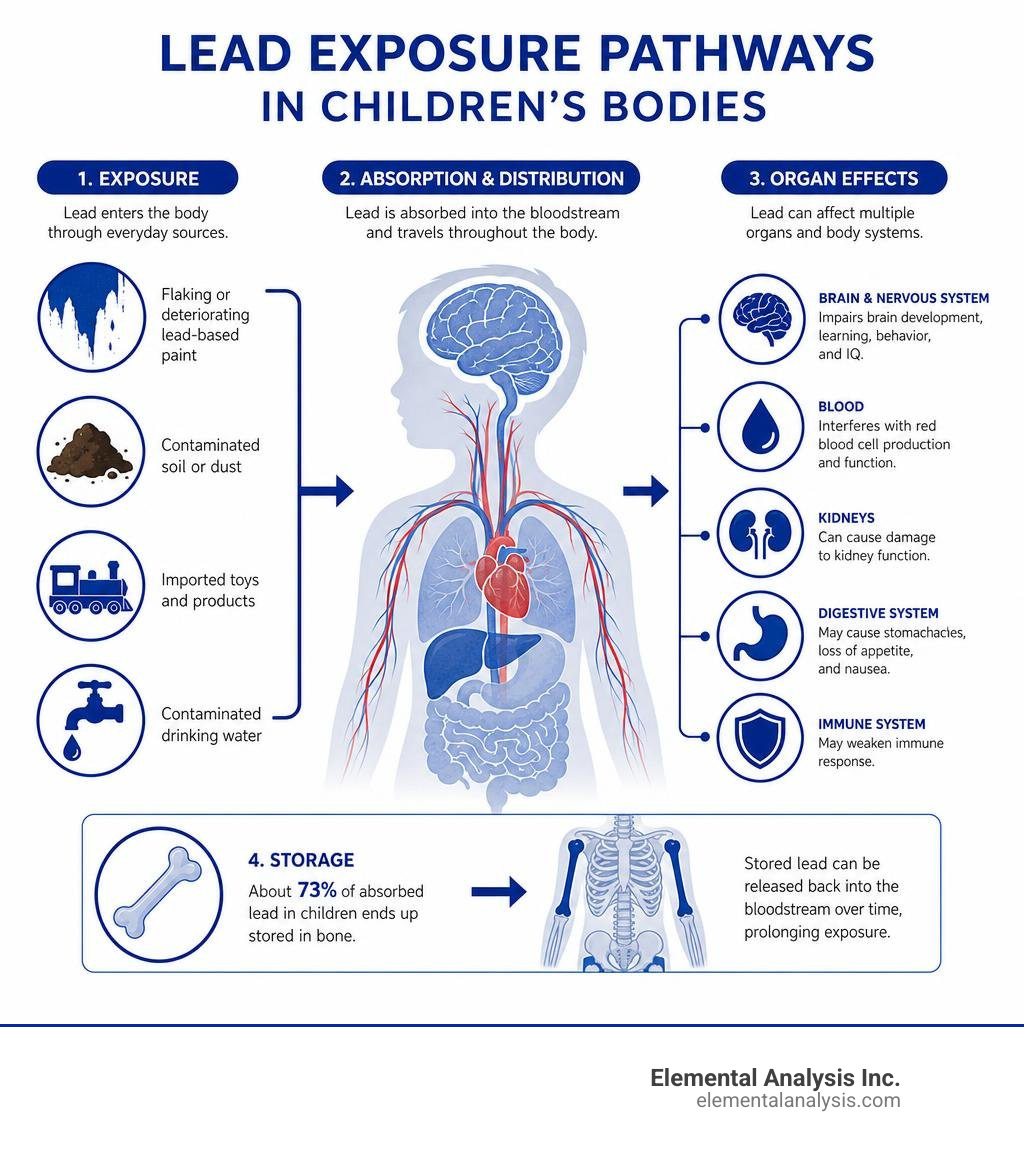
Lead hides in old paint, contaminated soil, imported toys, and even drinking water. It accumulates in the body — about 73% of absorbed lead in children ends up stored in bone. And by the time symptoms appear, exposure has often been happening for months.
Early testing is the only way to catch it in time.
What is Blood Lead Testing and Why is it Crucial?
Lead is a highly toxic metal that has no physiological role in the human body. When lead is inhaled or ingested, it enters the bloodstream and mimics essential minerals like calcium, iron, and zinc. This molecular mimicry allows lead to cross the blood-brain barrier, where it interferes with neurotransmitters and disrupts normal neurological development. To understand the broader chemistry of toxic metals, you can explore our guide on Heavy Metal Chemistry: A Beginner’s Guide to Elemental Analysis of Metals.
The biological kinetics of lead explain why it is so dangerous, especially for young children. In the United States, a typical diet contributes roughly 1 to 3 mcg of lead per day. While adults absorb only 1% to 10% of their dietary lead intake, children absorb as much as 50%.
Once inside the body, lead does not disappear quickly. It distributes to the blood, soft tissues, and bones:
- Soft tissue: Lead has a turnover half-life of approximately 120 days in soft tissues.
- Bone incorporation: Over time, lead is deposited into the skeletal system. Approximately 94% of absorbed lead in adults and 73% in children is incorporated into bone, where it can remain stored for decades, potentially re-entering the bloodstream during periods of physiological stress, bone remodeling, or pregnancy.
Because lead acts silently, blood lead testing is crucial. It is the only definitive way to measure recent and ongoing exposure before irreversible neurological damage occurs.
Who Needs to Be Screened for Lead Exposure?
Because lead is an environmental pollutant, screening guidelines target individuals at the highest risk. The primary sources of exposure include legacy lead-based paint in pre-1978 housing, contaminated soil near roadways and industrial sites, lead service lines in drinking water systems, and imported consumer products (such as certain toys, traditional medicines, cosmetics, and glazed ceramics).
To help families identify these risks early, public health agencies emphasize clinical screening. For detailed childhood protocols, refer to the CDC’s resource on Testing for Lead Poisoning in Children | Childhood Lead Poisoning Prevention | CDC.
In Kentucky, local health departments play an active role in screening and education. For example, the Lead Screening & Investigation | JCHD program in Jessamine County and the Lead Screening – Lake Cumberland District Health Department provide critical testing services and environmental investigations for local families.
Pediatric Guidelines for Blood Lead Testing
For young children, the central nervous system is in a rapid state of development, making them uniquely vulnerable to the toxic effects of lead. State and federal guidelines outline clear testing intervals:
- Medicaid Requirements: Federal law mandates that all children enrolled in Medicaid must receive a blood lead test at 12 months and 24 months of age. If a child between 36 and 72 months of age has no record of a prior test, they must be screened immediately.
- State-Level Programs: The Childhood Lead Poisoning Prevention Program – CHFS.ky.gov works to ensure comprehensive tracking and screening across the Commonwealth, and historical data summaries like the [PDF] Blood lead testing in Kentucky – LeadCare II highlight the ongoing efforts to expand point-of-care testing in pediatric clinics.
- High-Risk Communities: Public health departments use demographic data to identify neighborhoods with older housing stock. For instance, researchers have worked on Integrating data to identify most at-risk communities for lead … in Louisville, KY, to map out high-risk zip codes and direct testing resources where they are needed most.
Adult and Occupational Exposure Risks
Adult lead exposure is primarily occupational or hobby-related. Industries such as battery manufacturing, construction, demolition, radiator repair, and firearms training ranges present significant risk of airborne and dust-borne lead exposure.
The Occupational Safety and Health Administration (OSHA) enforces strict standards to protect workers:
- Removal Thresholds: OSHA requires the temporary removal of a worker from lead-exposed duties if a periodic and follow-up blood lead level is 60 μg/dL or greater (or 50 μg/dL or greater for those in construction), or if the average of tests over the preceding 6 months is 50 μg/dL or greater.
- Return-to-Work: An employee can return to their regular duties once their blood lead level drops to 40 μg/dL or less.
- Adult Reference Value: Even outside of industrial settings, adults can be exposed to lead. The 97.5th percentile for blood lead levels in U.S. adults aged 16 years and older is 3.46 μg/dL.
For adults who suspect environmental or occupational exposure, commercial laboratories offer specialized testing options such as the 007625: Lead, Whole Blood (Adult) | Labcorp.
Capillary vs. Venous: Understanding the Testing Methods
When you or your child gets a blood lead test, the sample is collected using one of two primary methods: a capillary (finger-prick or heel-prick) sample or a venous (vein draw) sample. Each method has distinct clinical advantages and limitations.
Because lead dust is pervasive in the environment, even microscopic particles on a child’s finger can contaminate a capillary sample, leading to a falsely elevated result. Therefore, public health guidelines stress that any capillary result of 3.5 μg/dL or higher must be confirmed with a venous blood draw before initiating environmental or medical interventions.
The Role of ICP-MS in Blood Lead Testing
Once the specimen is collected, it is sent to an analytical chemistry laboratory for precise measurement. Historically, laboratories relied on Graphite Furnace Atomic Absorption Spectrometry (GFAAS) or Anodic Stripping Voltammetry (ASV). However, modern clinical laboratories overwhelmingly utilize Inductively Coupled Plasma Mass Spectrometry (ICP-MS) due to its superior sensitivity, speed, and multi-element capabilities.
To understand how this advanced technology works to detect trace levels of toxins, you can read our comprehensive overview on Heavy Metal Analysis by ICP-MS: The Ultimate Guide to Screening Toxins.
To ensure consistency and accuracy across testing facilities, professional standards such as the C40 | Measurement Procedures for the Determination of Lead in Whole Blood guideline published by the Clinical and Laboratory Standards Institute (CLSI) provide laboratories with rigorous protocols for specimen collection, contamination control, and analytical performance.
Interpreting the Results: Reference Values and Action Levels
Understanding what a blood lead level (BLL) means is critical for determining the next steps. Because there is no safe level of lead in human blood, the CDC utilizes a statistical benchmark known as the Blood Lead Reference Value (BLRV).
Currently, the CDC’s BLRV is set at 3.5 μg/dL. This value is based on the 97.5th percentile of blood lead levels in U.S. children aged 1 to 5 years, derived from national survey data (NHANES). This means that a child with a BLL of 3.5 μg/dL or higher has more lead in their blood than 97.5% of peer children in the United States.
When a child’s blood lead level is elevated, healthcare providers follow a structured timeline for confirmatory testing and clinical action:
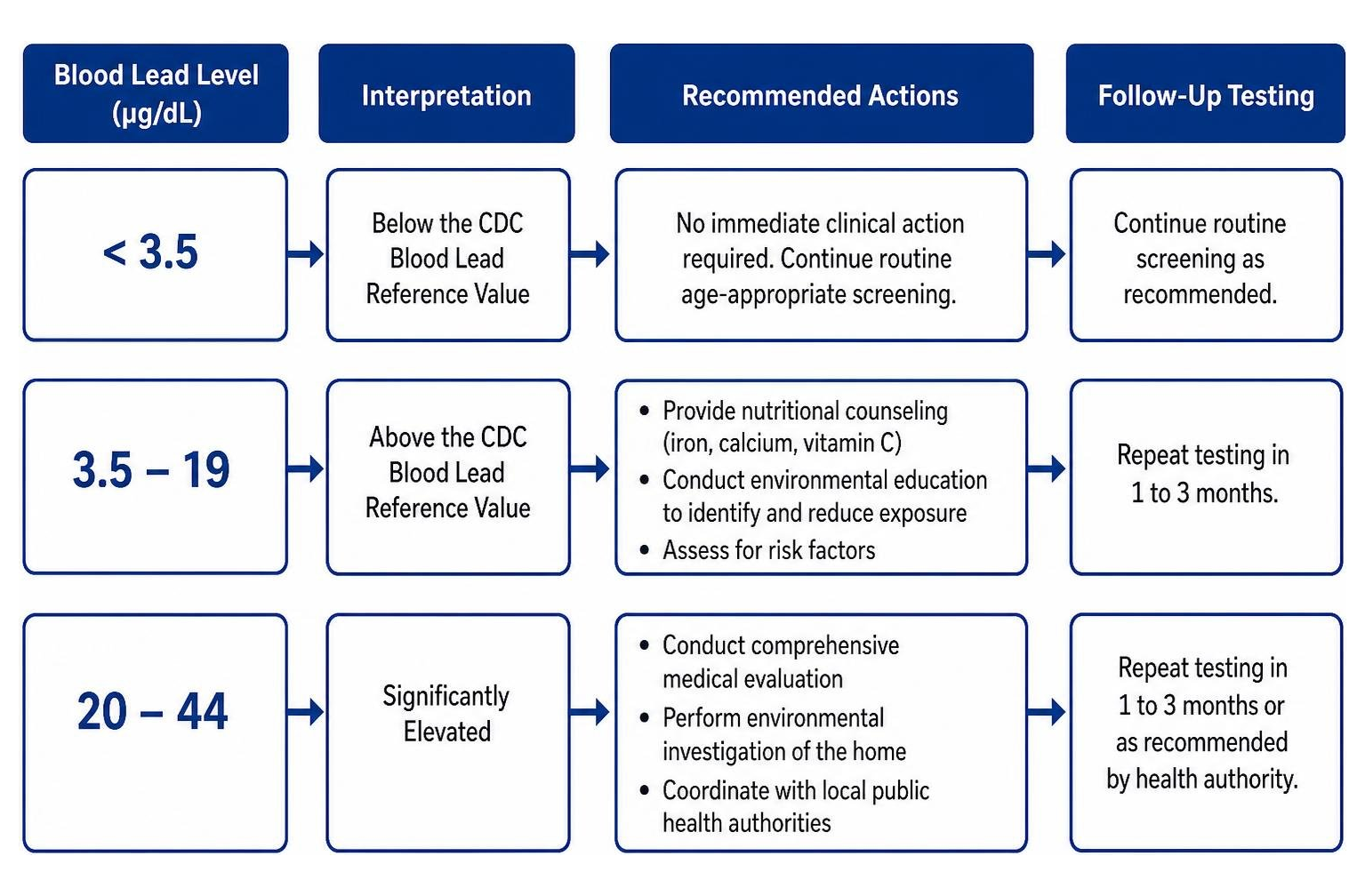
The clinical actions recommended by the CDC scale with the severity of the exposure:
- BLL < 3.5 μg/dL: No immediate clinical action is required, though routine age-appropriate screening should continue.
- BLL 3.5 to 19 μg/dL: Provide nutritional counseling (emphasizing iron, calcium, and vitamin C to decrease lead absorption), conduct environmental education to identify and mitigate exposure sources, and schedule follow-up testing within 1 to 3 months.
- BLL 20 to 44 μg/dL: Conduct a comprehensive medical evaluation, perform an environmental investigation of the home to identify lead hazards, and coordinate closely with local public health authorities.
- BLL >= 45 μg/dL: This is a critical level. Immediate medical intervention, including hospitalization and oral or intravenous chelation therapy (using agents like succimer or EDTA to bind lead for excretion), is indicated.
For a complete breakdown of clinical protocols, refer to the CDC’s official guide on Recommended Actions Based on Blood Lead Level | Childhood Lead Poisoning Prevention | CDC.
Frequently Asked Questions about Blood Lead Testing
What is a safe blood lead level for children?
There is no safe blood lead level in children. Even extremely low levels (below 3.5 μg/dL) have been shown to negatively impact cognitive development, attention span, and academic achievement. Prevention and early identification through testing are the most effective ways to protect children.
How often should adults with occupational exposure be tested?
Under OSHA standards, workers exposed to lead dust or fumes above the action level of 30 μg/m³ for more than 30 days per year must undergo blood lead testing at least every 6 months. If a worker’s BLL exceeds 40 μg/dL, testing frequency must increase to every 2 months until the level drops.
What are the primary symptoms of lead poisoning?
In both children and adults, lead poisoning is often entirely asymptomatic in its early stages. When symptoms do appear, they are frequently non-specific:
- In children: Irritability, developmental delays, learning difficulties, loss of appetite, weight loss, sluggishness, abdominal pain, vomiting, and hearing loss.
- In adults: High blood pressure, joint and muscle pain, memory or concentration difficulties, headaches, abdominal pain, mood disorders, reduced sperm count, and miscarriage or premature birth in pregnant women.
Conclusion
Detecting toxic exposures early is the most powerful tool we have to protect developing minds and busy workforces. At Elemental Analysis Inc., based in Lexington, Kentucky, we understand the critical role that precise analytical chemistry plays in environmental safety and public health.
As the first commercial PIXE (Proton Induced X-ray Emission) laboratory, we offer specialized trace element identification, quantification, and speciation services across multiple industries. Whether you need non-destructive testing, rapid turnarounds, or highly competitive pricing, our expert team is here to help you navigate complex elemental challenges.
Learn more about our elemental analysis services and discover how we can support your analytical testing needs.