
Heavy Metal Test Kits vs. Professional Lab Analysis for Water
Why Water Heavy Metal Testing Matters More Than You Think
Water heavy metal testing is the process of analyzing a water sample to detect and measure toxic metals — such as lead, arsenic, mercury, cadmium, and copper — that can cause serious health harm even at very low concentrations.
Here is a quick breakdown of your main options:
| Method | Best For | Accuracy | Cost |
|---|---|---|---|
| DIY test strips | Quick screening | Low (qualitative only) | $15–$25 |
| Mail-in lab kit | Home use with lab results | Moderate | $80–$195 |
| Professional ICP-MS lab | Regulatory, health, compliance decisions | Very high (parts per trillion) | Varies |
More than 9,000 households buy DIY water test kits on Amazon every single month. That number tells you one thing clearly: people are worried about what is coming out of their taps.
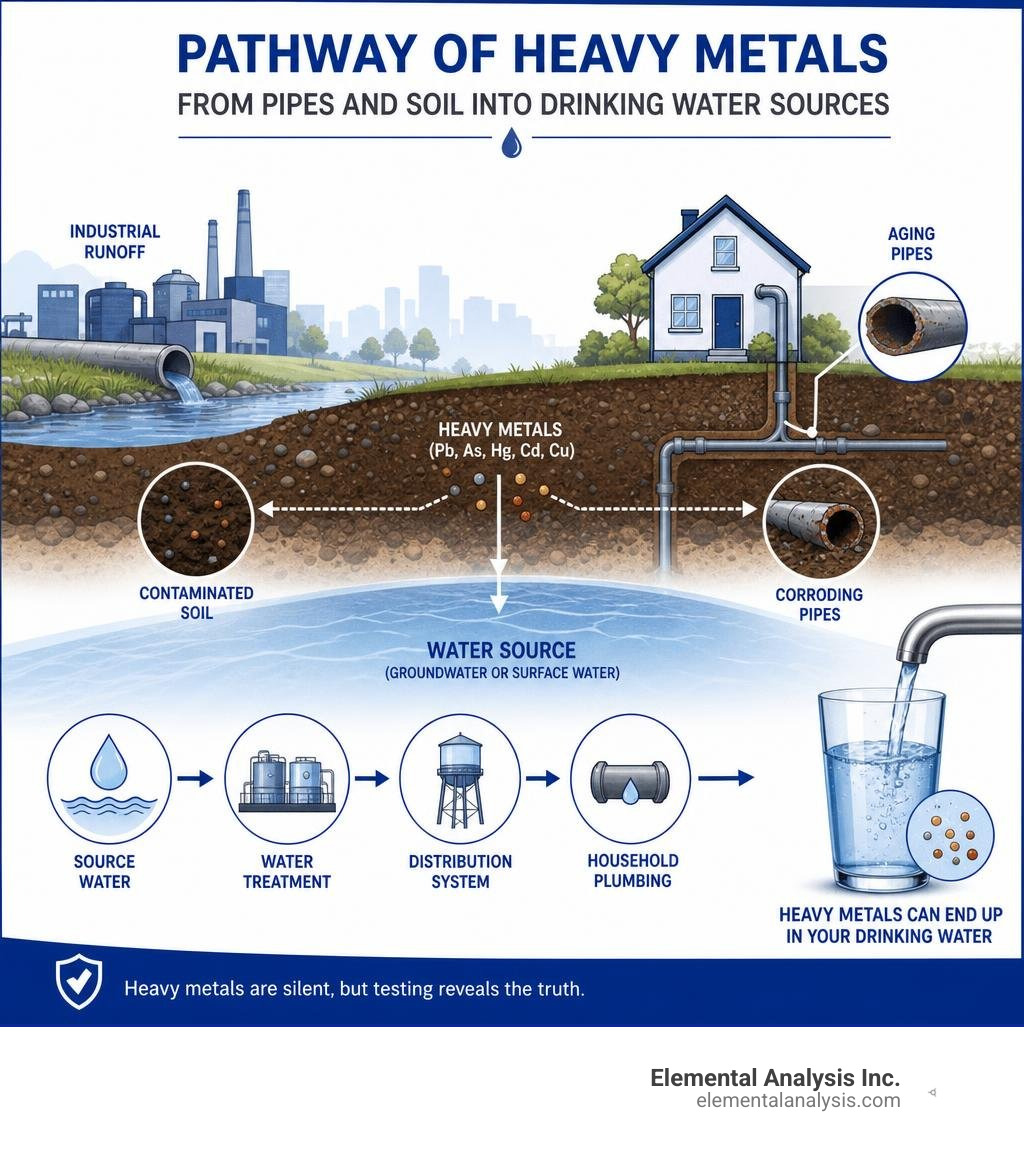
And they are right to be concerned. Heavy metals can enter drinking water through aging pipes, industrial runoff, and corroding household plumbing — often with no visible sign of contamination. You cannot see lead. You cannot taste arsenic.
But here is the problem: not all testing methods are equal. A $15 color-change strip and a certified laboratory running EPA Method 200.8 are not the same tool. One gives you a rough yes/no signal. The other gives you a defensible, quantified result accurate down to parts per trillion.
This guide compares both approaches — so you can choose the right level of testing for your situation.
Common Contaminants and the Need for Water Heavy Metal Testing
When we think of pure drinking water, we think of clear, refreshing streams. But the reality of municipal and well water infrastructure in July 2026 is much more complex. Heavy metals are elemental structures that do not break down over time. Instead, they bioaccumulate in the human body, meaning they build up in our organs and tissues faster than our bodies can eliminate them.
Understanding which metals are lurking in your plumbing is the first step toward protecting your household. Here are the primary culprits targeted in water heavy metal testing:
- Lead: There is no safe level of lead exposure. Commonly leaching from old brass fixtures, lead-soldered copper pipes, and aging municipal service lines, lead is a potent neurotoxin. In children, even trace amounts cause developmental delays, behavioral issues, and learning disabilities. In adults, it leads to cardiovascular issues and kidney damage.
- Arsenic: Often found in groundwater, arsenic can contaminate private wells through natural geological deposits or agricultural runoff. Chronic exposure is linked to skin lesions, cardiovascular disease, and several forms of cancer.
- Mercury: Entering the water cycle from industrial emissions, coal-burning power plants, or landfill runoff, mercury is highly toxic to the brain and nervous system, particularly during fetal development.
- Cadmium: Used heavily in industrial manufacturing, batteries, and metal plating, cadmium can enter water systems through industrial waste discharge. It targets the kidneys and skeletal system, causing bone density loss and renal failure over time.
- Copper: While copper is an essential nutrient in tiny amounts, elevated levels from corroding household copper pipes can cause severe gastrointestinal distress, liver damage, and kidney complications.
Because these toxins are completely odorless, tasteless, and invisible, you cannot rely on your senses to detect them. For a deeper look at how these elements behave in aquatic environments, check out our guide on Testing the Waters: A Complete Guide to the Analysis of Heavy Metals in Water.
DIY Heavy Metal Test Kits vs. Professional Laboratory Analysis
To understand the gap between home-testing convenience and scientific certainty, we have to look at the underlying technology. Most home kits rely on colorimetric chemical reactions, while professional laboratories use high-energy plasma and mass spectrometry.
The table below outlines the core differences between what you can buy online and what a certified testing facility provides:
| Feature | DIY Test Strips | Mail-In Consumer Kits | Professional Lab Testing (ICP-MS) |
|---|---|---|---|
| Average Cost | $15 – $25 | $80 – $195 | Varies based on scope |
| Turnaround Time | Immediate (under 10 minutes) | 5 to 10 business days | Fast, tailored turnaround |
| Detection Limits | High (often misses trace levels) | Moderate | Ultra-low (parts per trillion) |
| Data Type | Qualitative (color match range) | Semi-quantitative | Fully quantitative & compliant |
| EPA Compliance | No | Seldom | Yes (EPA Method 200.8/200.7) |
| Speciation | No | No | Yes (differentiates toxic forms) |
The Environmental Protection Agency (EPA) sets legally enforceable standards called Maximum Contaminant Levels (MCLs) for public water systems to protect public health. They also suggest standards for secondary contaminants, which affect aesthetic qualities like taste, color, and odor. You can read more about these in the Analytical Methods Recommended for Drinking Water Compliance Monitoring of Secondary Contaminants .
The fundamental issue with DIY testing is that home kits lack the sensitivity to detect contaminants at or below these strict EPA action levels. Furthermore, home kits do not account for sample preservation. Without acidification, metals in a water sample can adhere to the walls of the container, leading to artificially low readings when tested.
Limitations of DIY Water Heavy Metal Testing Strips

While it is tempting to trust a $15 kit with over 9,000 monthly Amazon purchases, it is vital to know what you are actually buying. Most cheap, multi-parameter kits (such as 6-in-1 or 20-in-1 test strips) bundle heavy metals with general water chemistry tests.
Typically, these DIY kits include:
- General parameters: pH, Total Hardness, Total Alkalinity, Chlorine.
- Heavy metals: Lead, Copper, Iron, and sometimes Mercury or Chromium.
However, the visual interpretation required for colorimetric strips is incredibly subjective. Is that square “light pink” or “medium pink”? Depending on the ambient lighting in your kitchen, you could easily misinterpret the color chart.
More importantly, the detection limits of these strips are often shockingly high. For example, the EPA action level for lead in drinking water is 15 parts per billion (ppb), which is equivalent to 0.015 mg/L. Many DIY strips cannot reliably detect lead below 50 ppb or even 100 ppb. This means your strip could show a clean “negative” result even though your water contains lead at three times the legal safety limit! This creates a dangerous false sense of security.
Additionally, these test strips expire. If a kit sits in an Amazon fulfillment center or your hot mailbox for too long, the sensitive reagents degrade, leading to completely invalid readings. If you want to understand how laboratories measure these tiny fractions of contaminants with absolute accuracy, read our In-Depth Guide to Low Detection Limits.
When to Use Home Water Heavy Metal Testing Kits
Despite their scientific limitations, DIY kits do have a place in your water safety toolbox. Think of them as a smoke detector rather than a forensic fire investigation. They are useful for:
- Preliminary Screening: If you have absolutely no idea what is in your water and want a quick, broad sweep to see if there are massive, off-the-chart levels of copper or iron.
- Quick Checks After Plumbing Work: If you have recently replaced copper pipes or brass fixtures and want to do a rapid check to ensure no major chemical residues remain.
- Educational Demonstrations: Showing children how chemical reactions work and introducing them to basic water parameters like pH and hardness.
- Emergency Situations: If municipal authorities issue an advisory and you need an immediate, rough check while waiting for official testing.
If your DIY kit flags a potential issue, however, you should never treat that as a definitive diagnosis. It is simply a signal that you need to follow up with professional testing.
Inductively Coupled Plasma Mass Spectrometry (ICP-MS)

When public health and safety are on the line, professional laboratories rely on the gold standard of elemental analysis: Inductively Coupled Plasma Mass Spectrometry (ICP-MS).
Instead of using a simple chemical reagent on a paper strip, ICP-MS uses an argon plasma torch burning at roughly 10,000 Kelvin—about as hot as the surface of the sun. When your water sample is nebulized and introduced into this plasma, it instantly atomizes and ionizes the elements. These ions are then directed into a mass spectrometer, which separates and counts them based on their mass-to-charge ratio.
This allows us to achieve:
- Unrivaled Precision: Detection limits reaching parts per trillion (ppt). That is the equivalent of a single drop of water in an Olympic-sized swimming pool.
- Multi-Element Analysis: The ability to screen for dozens of heavy metals simultaneously from a single, small sample.
- Defensible Data: Highly accurate, repeatable results that stand up to regulatory scrutiny and legal compliance.
To learn more about how this incredible technology works, explore our From H2O to Heavy Metals: A Guide to ICP-MS Water Analysis.
EPA Method 200.7 and 200.8 Standards
To ensure that laboratory testing is uniform, accurate, and legally defensible, the EPA has established strict analytical methodologies. Two of the most common standard methods for metals are:
- EPA Method 200.7: This method utilizes Inductively Coupled Plasma-Atomic Emission Spectrometry (ICP-AES). It measures the light emitted by excited atoms to identify and quantify elements. It is highly effective for major minerals and metals like iron, calcium, and copper, but has slightly higher detection limits than ICP-MS. You can review the exact specifications in the Method 200.7: Trace Elements in Water, Solids, and Biosolids by Inductively Coupled Plasma-Atomic Emission Spectrometry; Revision 5.0 .
- EPA Method 200.8: This method uses ICP-MS and is the preferred choice for ultra-trace heavy metals like lead, arsenic, cadmium, and mercury because of its superior sensitivity.
By adhering to these industry-standard methods, professional laboratories eliminate human error, visual bias, and chemical interference. You can read more about how these compliance frameworks protect consumers in our guide, A Beginner Guide to Industry Standard Methods.
How to Collect and Interpret Your Water Samples
If you decide to bypass the unreliability of DIY strips and opt for a professional water analysis, the accuracy of your results depends heavily on how you collect your sample.
For a comprehensive heavy metal panel, we require a minimum sample volume of 500 mL. Follow these steps to ensure sample integrity:
- Select the Right Container: Use a clean, sterile, leak-proof plastic bottle or glass jar provided by the laboratory. Do not rinse the bottle before collection, as some containers contain trace acid preservatives.
- Determine the Testing Goal:
- First Draw: If you are testing for lead leaching from your home’s pipes, collect the water first thing in the morning after it has sat stagnant in your plumbing for at least 6 hours.
- Flushed Sample: If you want to test the water entering your home from the municipal main or well, let the tap run for 2 to 3 minutes before filling the bottle.
- Eliminate Air Bubbles: Turn your faucet down to a gentle stream. Fill the bottle slowly to prevent splashing. If you are also testing for volatile compounds alongside metals, fill the vial until a “dome” of water stands above the rim, then cap it tightly to prevent any air pockets from forming.
- Ship Promptly: Avoid collecting or shipping samples on Fridays, Saturdays, or Sundays. Ship your package via guaranteed next-day delivery on a Monday through Thursday to ensure the lab receives it within 24 hours of collection.
Once you receive your laboratory report, compare your quantified values against the EPA’s Maximum Contaminant Levels. If any heavy metal exceeds the recommended safety threshold, you must take immediate action, which may include installing point-of-use filtration (such as reverse osmosis), replacing old plumbing, or finding an alternative drinking water source. For commercial-grade reference testing options, you can also look at the City Water Test – Crystal Quest Water Filters .
Frequently Asked Questions about Water Quality
Can home test kits detect heavy metals in food or beverages?
No, standard home water test kits cannot be used for food, beverages, or seafood. Food products present what scientists call “matrix interference.”
Unlike simple water, food contains proteins, fats, sugars, and complex organic compounds. To test food for heavy metals, the sample must first undergo a rigorous digestion process using concentrated acids and high heat to break down the organic matter, leaving only the elemental metals behind for ICP-MS analysis. You can learn more about this complex process in our specialized article on How Heavy Metals Are Tested in Seafood and Fish.
What is heavy metal speciation and why does it matter?
Basic heavy metal tests tell you the total amount of a metal in your water, but they do not tell you the chemical form it takes. This is where speciation comes in.
The toxicity of a metal depends entirely on its chemical state. For example, Chromium-3 is an essential dietary nutrient with very low toxicity, whereas Chromium-6 is highly toxic and carcinogenic. Standard DIY kits cannot distinguish between the two, but professional laboratory speciation can. To understand the science behind speciation, check out our guide on Heavy Metal Analysis by ICP-MS: The Ultimate Guide to Screening Toxins.
How often should private well water be tested for heavy metals?
Unlike municipal tap water, which is regulated and monitored under the Safe Drinking Water Act, private wells are entirely the responsibility of the property owner.
We recommend that well owners test their water at least once a year for heavy metals, nitrates, and bacteria. You should test more frequently if you live near agricultural areas (where runoff can introduce arsenic or cadmium), mining operations, or if you notice sudden changes in the taste, color, or odor of your water.
Conclusion
While a $15 DIY test strip from Amazon is a cheap and quick way to satisfy basic curiosity, it simply cannot guarantee the safety of your family’s drinking water. When dealing with invisible, bioaccumulative toxins like lead, arsenic, and mercury, false security is worse than no security at all.
For definitive, high-precision water analysis that DIY kits simply cannot match, contact Elemental Analysis Inc. in Lexington, KY. As the first commercial Proton Induced X-ray Emission (PIXE) laboratory, we offer advanced trace element identification, quantification, and speciation services. Whether you require non-destructive PIXE testing or high-sensitivity ICP-MS analysis, our team provides fast turnaround times and competitive pricing to give you absolute peace of mind.
Ready to secure your water safety with certified scientific data? Explore our Elemental Analysis Services today and let our experts handle the rest.