
How Contract Laboratory Elemental Analysis Keeps Your Products Safe
How Contract Laboratory Elemental Analysis Protects Product Safety
Outsource elemental testing when you need an independent lab to identify contaminants, verify material composition, or measure trace elements without adding specialized equipment and staff in-house. Contract laboratory elemental analysis helps you choose the right method for the sample, detection limit, turnaround target, and whether the sample must remain intact.
For a fast, defensible testing plan:
- Define the elements, reporting limits, and applicable product or environmental requirements.
- Share the sample matrix and whether destructive preparation is acceptable.
- Select a method that fits the job, such as ICP for digested samples, XRF or PIXE for non-destructive screening, or NAA for highly sensitive multi-element work.
- Confirm quality controls, reporting format, and delivery timing before samples are submitted.
For aerospace, pharmaceutical, and environmental teams, the goal is simple: find harmful impurities or composition errors before they become failed lots, compliance problems, or safety risks. Elemental Analysis Inc. combines destructive and non-destructive methods, including ICP, XRF, PIXE, and NAA, to support broad elemental testing through one laboratory relationship.
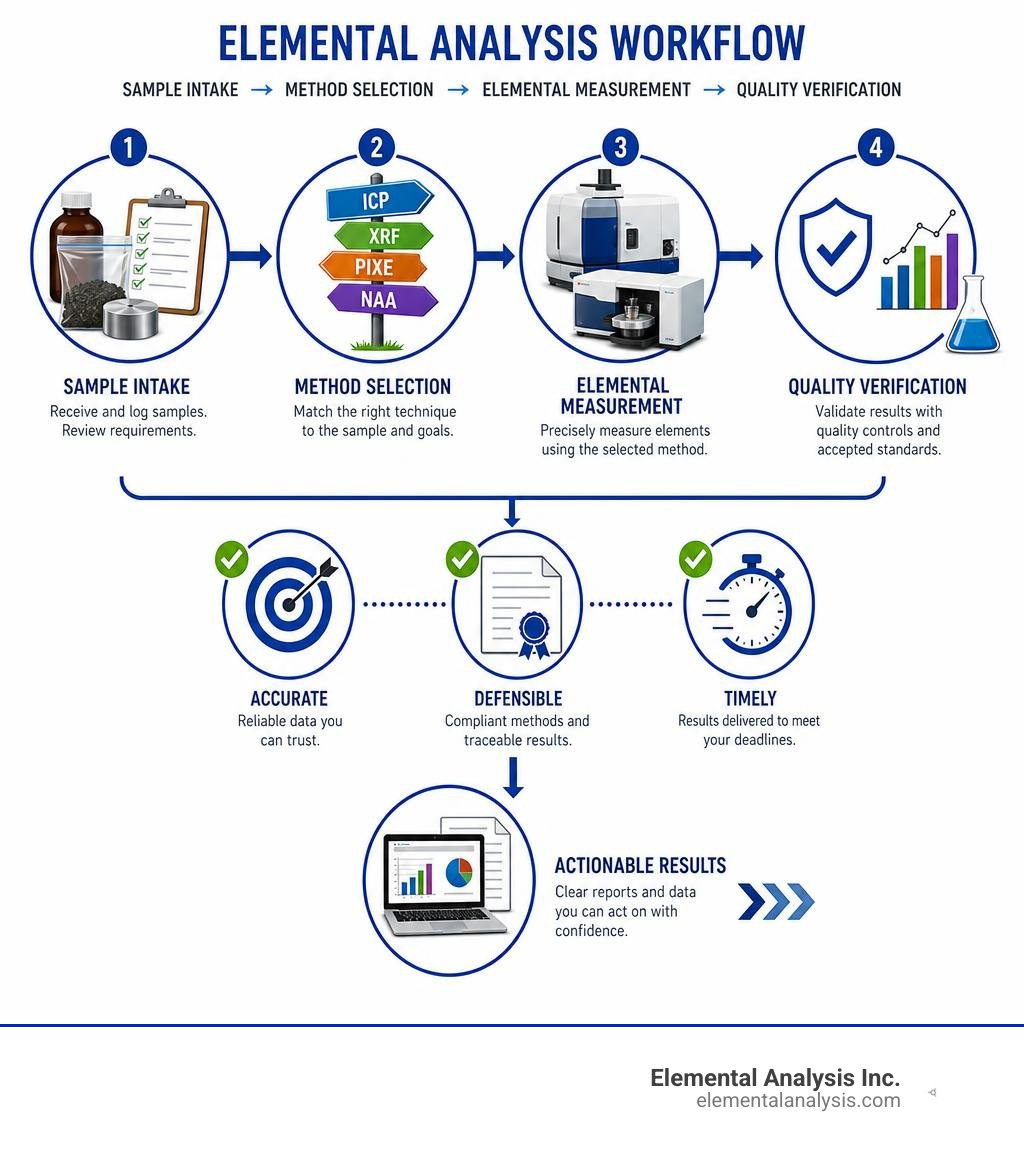
Contract laboratory elemental analysis terminology:
- accredited testing laboratory services
- specialized analytical chemistry services
- custom method development laboratory
Why Product Safety Demands Contract Laboratory Elemental Analysis
Every manufactured product—from high-performance alloy turbine blades to life-saving pharmaceuticals and everyday consumer goods—relies on strict chemical composition standards. When rogue elements sneak into your production line, the consequences can range from structural failure to catastrophic health hazards.
Securing the integrity of modern supply chains is an ongoing challenge. Raw materials often pass through multiple suppliers across the globe before reaching your facility. Without rigorous, independent verification, a single contaminated batch of raw materials can compromise an entire production run. We work as an extension of your quality control team, providing independent verification to catch these issues before your products ever reach the market.
Trace Contaminant Identification Across Supply Chains
Heavy metal toxicity is one of the most severe threats to product safety. Toxic heavy metals such as lead, cadmium, arsenic, and mercury pose severe health risks even at parts-per-billion (ppb) concentrations. In industries like pharmaceuticals, cosmetics, dietary supplements, and food production, identifying these trace impurities is a mandatory public safety requirement.
Understanding how to choose the right heavy metal testing laboratory for your needs ensures that your testing protocols can detect low-level contaminants in challenging matrices.

Whether you are dealing with raw botanical extracts, specialty polymers, or complex organic liquids, trace contaminants must be identified and quantified before commercial distribution. Robust risk mitigation begins with early detection.
Navigating Compliance with Industry Standard Methods
Staying ahead of regulatory compliance requires more than just high-end instruments; it requires strict adherence to standardized analytical protocols established by bodies such as ASTM International, EPA, USP, and ISO. Preparing for regulatory audits means your analytical data must be legally defensible, traceable, and repeatable.
Utilizing accredited testing laboratory services that keep you audit-ready helps you avoid costly product recalls and regulatory fines. If you are new to the regulatory landscape, reviewing a beginner guide to industry standard methods will help you understand how standard operating procedures safeguard your manufacturing pipeline.
Core Testing Methodologies: Destructive vs. Non-Destructive Techniques
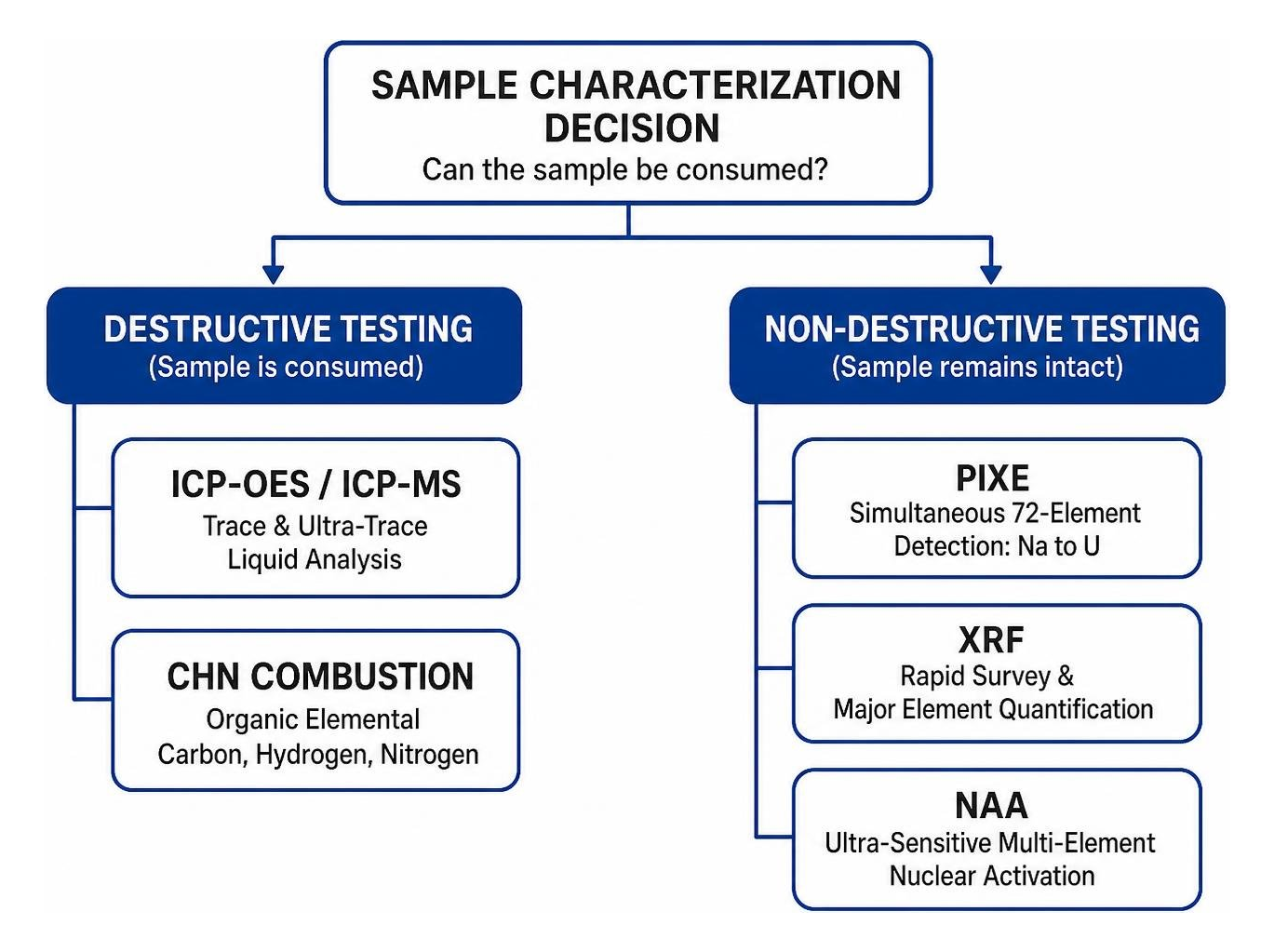
When designing an elemental analysis testing program, the first major decision is whether your sample can be consumed during testing or must remain intact. Both destructive and non-destructive techniques have distinct advantages depending on your analytical goals, sample availability, and material value.
Implementing Contract Laboratory Elemental Analysis via Spectroscopy and ICP
Inductively Coupled Plasma Optical Emission Spectroscopy (ICP-OES) and ICP Mass Spectrometry (ICP-MS) serve as the foundation of modern trace elemental spectroscopy. These destructive methods require liquid samples or solid samples dissolved via acid digestion.
Once in liquid form, the sample is nebulized and introduced into an argon plasma sustained at temperatures exceeding 6,000 to 8,000 K. At these extreme temperatures, atoms and ions are excited, emitting light at characteristic wavelengths that correspond to specific elements.
Modern instruments like the PlasmaQuant 9200 ICP-OES series have elevated this capability by providing optical resolution down to 2 pm. This level of resolution allows testing laboratories to resolve spectral interferences in complex matrices such as petrochemicals, brine solutions, and metallurgical alloys.
Furthermore, dual-view plasma observation and high matrix tolerance allow commercial labs to analyze both trace elements and major constituents in a single run. Advanced torch configurations and fast startup times—achieving operational readiness in under 10 minutes—streamline high-throughput operations.
For a foundational review of these core methods, explore elemental testing lab 101.
| Analytical Technique | Sample State | Destructive? | Detection Limit Range | Key Strengths |
|---|---|---|---|---|
| ICP-OES | Liquid / Digested Solid | Yes | Sub-ppb to ppm | High throughput, broad linear dynamic range, excellent precision |
| ICP-MS | Liquid / Digested Solid | Yes | Sub-ppt to ppb | Ultra-trace sensitivity, isotopic ratio analysis |
| PIXE | Solid, Powder, Thin Film | No | ppm to sub-ppm | Non-destructive, simultaneous detection of 72 elements (Na to U) |
| XRF | Solid, Liquid, Powder | No | ppm to percentage | Rapid elemental surveys, major component verification without standards |
| NAA | Solid, Liquid, Powder | Minimal / No Digestion | Sub-ppb to ppm | Matrix-independent, highly sensitive, no digestion contamination |
| CHN / Thermal-Optical | Solid / Filter Deposit | Yes | ppm to percentage | Bulk organic carbon, hydrogen, nitrogen, and EC/OC differentiation |
Advanced Nuclear Techniques: NAA and Non-Destructive PIXE Testing
Not all samples can be ground down, dissolved in hot concentrated acids, or destroyed. Precious archaeological artifacts, forensic evidence, expensive precision-machined alloys, and thin-film electronics often need to be returned intact. In other scenarios, complex matrices like pure graphite, refractory ceramics, or silicon carbide resist even the most aggressive microwave acid digestions.
This is where nuclear analytical techniques provide critical capabilities:
- Proton Induced X-ray Emission (PIXE): As the first commercial PIXE laboratory, Elemental Analysis Inc. uses high-energy proton beams to excite inner-shell electrons in sample atoms. When outer electrons fill these vacancies, they emit characteristic X-rays. PIXE delivers non-destructive, simultaneous multi-element quantification across 72 inorganic elements—from Sodium ($Z=11$) all the way through Uranium ($Z=92$).
- Neutron Activation Analysis (NAA): Neutron Activation Analysis is one of the most sensitive multi-element analytical techniques available. By irradiating samples with thermal neutrons in a nuclear reactor, stable isotopes are converted into radioactive isotopes. As these decay, high-resolution gamma-ray spectrometers measure the emitted gamma rays. NAA eliminates sample dissolution errors and matrix interferences, making it an ideal primary reference method.
- X-ray Fluorescence (XRF): XRF provides rapid, non-destructive identification of major and minor elements, making it ideal for rapid alloy verification and screening without extensive reference standards.

When selecting analytical options for high-performance metals, review how to choose the best alloy verification laboratory for your projects.
Key Criteria for Selecting the Right Testing Partner
Outsourcing elemental testing requires careful evaluation of technical credentials, data integrity, and laboratory infrastructure. The right laboratory should feel like a direct extension of your internal engineering and quality management teams.

Evaluating Technical Capabilities for Contract Laboratory Elemental Analysis
When auditing a contract laboratory’s capabilities, consider the following evaluation criteria:
- Analytical Scope and Versatility: Does the facility offer both destructive (ICP-OES, ICP-MS, CHN combustion) and non-destructive (PIXE, XRF, NAA) techniques? Single-source analytical facilities prevent the logistical friction of sending divided samples to multiple vendors.
- Spectral Resolution and Matrix Tolerance: High-performance spectrometers capable of resolving spectral lines down to 2 pm avoid false positives in complex matrices like specialty chemicals and metallurgical alloys.
- Quality Accreditations: Look for ISO/IEC 17025 accreditation, cGMP compliance, and full traceability back to NIST standards.
- Specialized Carbon Analysis: When evaluating aerosols or particulate matter, facilities offering Thermal-Optical Analysis (EC/OC) can differentiate elemental carbon from organic carbon on quartz-fiber filters.
For an in-depth breakdown of outsourcing strategies, consult the ultimate guide to outsourcing inorganic elemental analysis alongside our advice on how to find specialized analytical chemistry services without losing your sanity.
Balancing Turnaround Times, Precision, and Analytical Method Development
In commercial manufacturing, time is money. A production lot held in quarantine awaiting chemical release testing costs your business every single day.
Contract laboratories achieve fast turnaround times—often offering same-day or 24-hour expedited services—by optimizing laboratory operations. Modular sample introduction systems, dual-view optics, and rapid instrument startup under 10 minutes minimize downtime and sample re-runs.
However, standard testing protocols do not always fit non-standard products. If you are formulating a novel nanomaterial, an advanced polymer blend, or an unusual petrochemical distillate, standard compendial methods may yield poor recoveries or severe matrix suppressions.
Working with a custom method development laboratory ensures that your analytical method is validated for specificity, linearity, precision, and ruggedness. When standard runs run into roadblocks, our experts know how to solve your lab woes by troubleshooting analytical method problems.
Frequently Asked Questions About Elemental Testing
What is the difference between destructive and non-destructive elemental testing?
Destructive elemental testing (such as ICP-OES, ICP-MS, and CHN combustion) requires dissolving, digesting, or burning the sample. This transforms solid materials into liquid solutions or combustion gases to measure elemental concentrations.
Non-destructive testing (such as PIXE, XRF, and certain NAA protocols) bombards the sample with protons, X-rays, or neutrons without altering its physical shape or structural integrity. Non-destructive methods are essential when sample quantities are limited, when samples must be preserved for legal or archival purposes, or when materials are insoluble in standard acids.
How do contract laboratories achieve trace-level detection limits?
Contract testing laboratories achieve parts-per-billion (ppb) and parts-per-trillion (ppt) detection limits through clean sample preparation, high-purity reagents, and advanced optical and mass spectrometry instrumentation. High spectral resolution (up to 2 pm in advanced ICP-OES systems) separates target analyte emission lines from adjacent matrix interferences. Combined with background correction algorithms, matrix-matched calibration standards, and high-sensitivity detector arrays, labs can isolate trace signals from complex backgrounds.
When should a business outsource elemental analysis instead of testing in-house?
Setting up an in-house elemental analysis laboratory requires substantial capital investment—often hundreds of thousands of dollars per instrument—along with ongoing expenses for ultra-pure gases, cleanroom infrastructure, hazardous waste disposal, and specialized personnel.
Outsourcing elemental testing is recommended when:
- Sample volumes do not justify internal capital expenditure.
- Specialized nuclear techniques (like PIXE or NAA) or high-resolution ICP are required.
- Independent, third-party data defensibility is required for regulatory audits or litigation.
- Novel matrices require custom method development and validation.
Conclusion
Product safety, regulatory compliance, and brand reputation depend on accurate elemental characterization. Whether you are screening for toxic heavy metals, verifying high-temperature alloy chemistry, or troubleshooting trace contamination in complex chemical matrices, selecting the right analytical methodology is essential.
With over 42 years of experience operating from Lexington, Kentucky, Elemental Analysis Inc. provides trace element identification, quantification, and speciation services across virtually every element on the Periodic Table. By combining destructive and non-destructive capabilities under one roof, we deliver defensible analytical data with fast turnaround times.
Explore our comprehensive analytical services or contact our team to discuss our expert ICP analysis solutions for your testing requirements today.