
What a Destructive Chemical Testing Laboratory Can Tell You
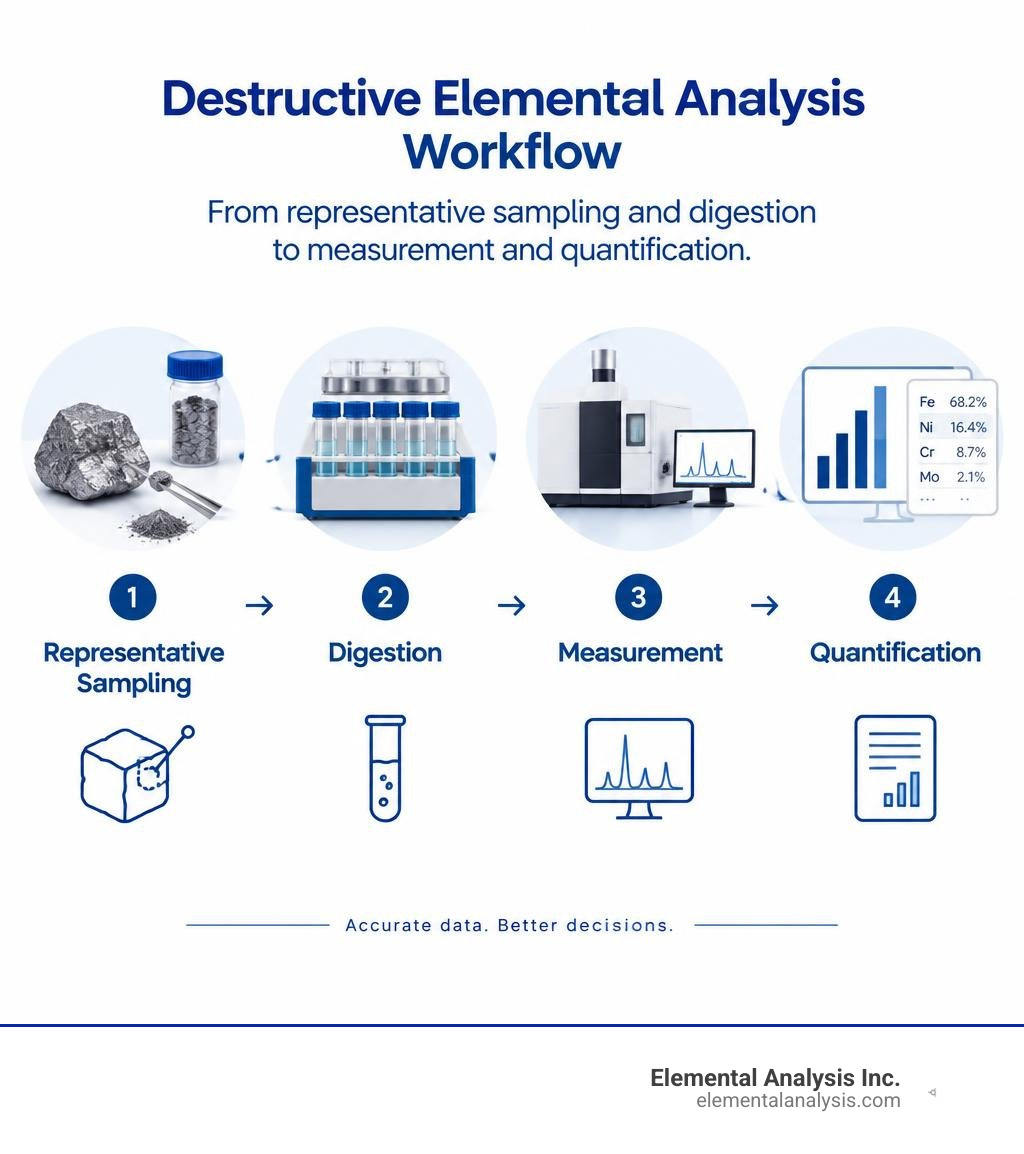
A destructive chemical testing laboratory consumes or permanently changes part of a sample to find out what it contains or how it responds to chemical exposure. For bulk composition and trace-element analysis, a lab may dissolve a representative portion and measure the resulting solution with ICP-OES or ICP-MS.
To choose a method, start with the material, the elements you need to measure, the required detection limits, and how much sample you can spare. Those details help determine how the sample is prepared and whether the results will answer your engineering question.
Destructive chemical testing laboratory terms to remember:
- contract laboratory elemental analysis
- specialized analytical chemistry services
- custom method development laboratory
Core Capabilities of a Destructive Chemical Testing Laboratory
When you send a critical alloy, polymer, or composite to an analytical laboratory, the primary objective is straightforward: achieve total chemical clarity. In a destructive chemical testing laboratory, we break down material matrices to analyze what makes up a substance at the atomic and molecular levels.
Unlike non-destructive screening methods that only evaluate the outer few micrometers of a surface, destructive testing completely consumes a representative specimen. By transforming solid materials into homogeneous liquid solutions or gaseous products, we eliminate surface contamination artifacts, grain boundary variations, and geometry biases.

This complete matrix breakdown is essential for:
- Identifying bulk elemental composition with high precision.
- Detecting trace impurities down to parts-per-billion (ppb) or parts-per-trillion (ppt) levels.
- Investigating material failure causes, including stress corrosion cracking, embrittlement, and phase segregation.
- Validating raw material compliance against ASTM, ISO, or military specifications.
Understanding your core analytical requirements allows you to navigate the testing landscape effectively. To explore fundamental techniques, review our guide to elemental analysis methods.
Materials Evaluated Across Industrial Applications
Destructive chemical analysis applies across manufacturing, aerospace, biomedical, and energy sectors. Over 70% of destructive chemical tests focus on metals and alloys, while polymers, advanced ceramics, and composite materials make up the remainder.
Common material classes include:
- Metallic Alloys: Superalloys, stainless steels, titanium grades, and aluminum stocks requiring trace element verification to prevent catastrophic in-service failure.
- Engineering Polymers & Resins: Thermoplastics and thermosets requiring additive quantification, filler concentration checks, and volatile organic compound profiling.
- Ceramics & Refractories: High-temperature oxides and carbides requiring lithium borate fusion to evaluate structural purity.
- Raw Feedstocks & Minerals: Ores, chemical powders, and masterbatches requiring bulk assay verification before production processing.
Globally, destructive testing facilities report that 5% to 10% of routine industrial production samples fail chemical specifications, underscoring the necessity of strict quality assurance.
Destructive vs. Non-Destructive Chemical Analysis
Materials engineers frequently debate whether to choose destructive or non-destructive techniques. Non-destructive methods—such as surface X-ray fluorescence (XRF) or Particle Induced X-ray Emission (PIXE)—leave the sample completely intact, making them invaluable for precious artifacts, finished components, or rapid incoming inspections.
However, non-destructive tools have physical boundaries: they sample shallow depths and can struggle with trace detection or light elements. Destructive testing dissolves or combusts the matrix, ensuring that every element is uniformly suspended for quantitative evaluation.
| Testing Parameter | Destructive Chemical Analysis | Non-Destructive Chemical Testing |
|---|---|---|
| Sample State Post-Test | Permanently consumed or altered | Unchanged; fully reusable |
| Depth of Analysis | True bulk representation | Surface to near-surface (microns) |
| Detection Limits | Down to parts-per-trillion (ppt) | Parts-per-million (ppm) levels |
| Matrix Effects | Minimized via digestion/dilution | Significant matrix corrections needed |
| Geometry Constraints | None (sample is pulverized/dissolved) | Rigid sample shape requirements |
| Typical Techniques | ICP-MS, ICP-OES, Combustion, IGF | PIXE, Handheld XRF, Benchtop EDX |
Choosing the appropriate path depends on whether you have material to spare and how low your detection threshold must reach. You can evaluate balanced destructive and non-destructive testing options to select the right fit for your quality program.
Primary Destructive Chemical Testing and Dissolution Methods
To measure an inorganic sample accurately on optical or mass spectrometers, we must first convert the solid matrix into a stable liquid solution. Wet chemical dissolution uses high-purity inorganic acids—such as nitric, hydrochloric, hydrofluoric, and perchloric acids—to cleave chemical bonds and liberate target analytes.
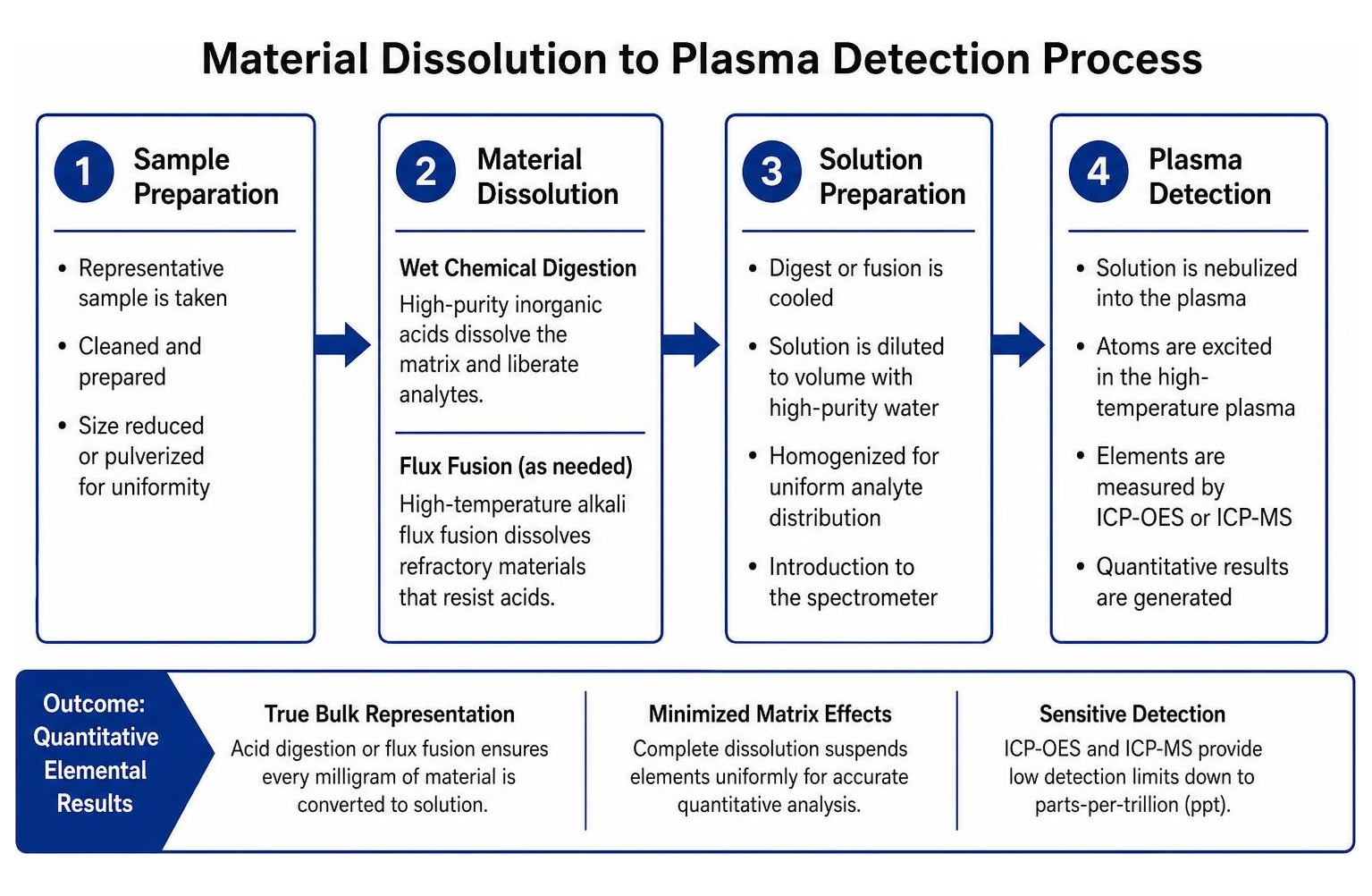
Acid digestion eliminates crystal lattices and surface oxide layers, ensuring that every milligram of analyzed material evenly enters the analytical stream. For refractory materials that resist mineral acids, high-temperature alkali flux fusion provides an alternative dissolution path. For a deeper look into the chemistry of digestion, explore sample dissolution and ICP-MS testing.
Inductively Coupled Plasma Spectroscopy (ICP-OES and ICP-MS)
Inductively Coupled Plasma Optical Emission Spectroscopy (ICP-OES) and Inductively Coupled Plasma Mass Spectrometry (ICP-MS) represent the gold standard in destructive inorganic chemical analysis.
In both systems:
- The digested liquid sample is converted into a fine aerosol via a nebulizer.
- The aerosol passes into an argon plasma discharge operating at temperatures between 6,000 K and 10,000 K.
- The extreme thermal energy completely atomizes and ionizes the constituent elements.
ICP-OES measures the characteristic wavelengths of light emitted by relaxing electrons, making it ideal for major-to-trace constituent quantification down to parts-per-million levels.
ICP-MS directs the generated ions into a mass spectrometer, separating them based on their mass-to-charge ratio. This achieves sub-parts-per-billion detection limits, which is vital for meeting strict pharmaceutical and aerospace standards. Learn how these methods apply to regulatory thresholds in our guide to elemental impurities testing procedures.
Combustion and Inert Gas Fusion Techniques
Light interstitial elements like carbon, sulfur, nitrogen, oxygen, and hydrogen dictate the brittleness, ductility, and corrosion resistance of metallic alloys. Because these elements often volatilize as acids or form atmospheric background interferences during wet chemical prep, specialized combustion and fusion methods are required.
- Automated Combustion Analysis: The sample is placed in a high-purity ceramic crucible within an induction furnace and combusted in a pure oxygen stream. Carbon and sulfur oxidize to carbon dioxide and sulfur dioxide, which are quantified using solid-state non-dispersive infrared (NDIR) detectors.
- Inert Gas Fusion (IGF): Used for oxygen, nitrogen, and hydrogen determinations. The sample is placed into a graphite crucible and heated to extreme temperatures inside a helium or argon atmosphere. Interstitial gases extract cleanly, where thermal conductivity cells and infrared detectors determine concentrations down to single-digit ppm.
Chemical Corrosion, Environmental Exposure, and Flammability Testing
Destructive chemical evaluation also measures how finished materials react when exposed to aggressive operating environments:
- Intergranular Corrosion Testing (ASTM A262 / G28): Evaluates stainless steels and nickel alloys by immersing specimens in boiling acid solutions to determine susceptibility to grain boundary attack.
- Salt Spray and Accelerated Weathering (ASTM B117): Subjects coated components to continuous atomized saline mist to test corrosion-inhibiting finishes to failure.
- Flammability Profiling (UL94): Evaluates polymer burn rates, ignition persistence, and dripping characteristics under controlled flame contact.
Sample Preparation Protocols and Laboratory Safety
Sample preparation is the most critical step in destructive testing. If a sample is contaminated, incompletely dissolved, or improperly weighed, the most advanced spectrometer in the world will yield faulty data.

Key sample prep protocols include:
- Mechanical Comminution: Milling or crushing bulk solids to maximize surface area without introducing tool-wear contamination.
- Closed-Vessel Microwave Digestion: Utilizing sealed fluoropolymer vessels under elevated pressures (up to 1,500 psi) and temperatures (up to 300°C) to digest tough organic matrices while preventing the loss of volatile trace elements like arsenic, mercury, and selenium.
- Alkali Fusion: Melting refractory oxides, silicates, and ceramics with lithium metaborate or tetraborate fluxes at 1,000°C to create soluble glass beads.
When working with aggressive reagents like hydrofluoric acid (HF)—which dissolves silicates and titanium matrices—laboratories enforce strict safety measures, including specialized PPE, calcium gluconate antidotes, and dedicated fluoropolymer fume containment. For additional context on sample preparation practices, the National Institute of Standards and Technology offers a detailed reference on sample preparation in inorganic analysis.
Essential Instrumentation in a Destructive Chemical Testing Laboratory
A fully equipped destructive chemical testing facility requires robust infrastructure to support wet chemistry, dissolution, and instrumental measurement.
Essential equipment includes:
- Digestion Equipment: Automated hot blocks, high-pressure closed-vessel microwave digestion systems, and platinum crucible fusion furnaces.
- Spectrometric Analyzers: Dual-view ICP-OES instruments, triple-quadrupole ICP-MS platforms, and cold-vapor atomic absorption spectrometers.
- Combustion Analyzers: High-frequency induction combustion and inert gas fusion units for interstitial elemental profiling.
- Clean Environment Infrastructure: Class 100/1000 cleanroom laminar flow hoods and sub-boiling acid distillation systems that produce ultra-pure reagents for trace analysis.
To see how these instruments operate within daily quality workflows, read our overview on elemental testing laboratory operations.
Environmental Controls and Hazardous Waste Management
Dissolving industrial solids produces hazardous chemical waste streams containing concentrated acids, oxidizing agents, and toxic heavy metals. Destructive laboratories maintain rigorous environmental and disposal systems:
- Effluent Neutralization: Continuous pH monitoring and neutralization systems neutralize waste acids before discharge.
- Heavy Metal Precipitation: Dedicated precipitation and filtration systems capture regulated elements—such as cadmium, lead, chromium, and arsenic—for safe transport and recovery.
- Organic Waste Segregation: Halogenated and non-halogenated solvents are collected separately in grounded, fire-rated storage containment cells.
Responsible stewardship ensures compliance with EPA guidelines and local municipality limits. Learn more about identifying quality-controlled environmental practices in our guide on how to choose a heavy metal testing laboratory.
Standards, Data Interpretation, and Quality Assurance
Data generated by destructive chemical testing drives critical engineering decisions—from accepting multi-ton raw material master heats to certifying flight-critical turbine components. Validating this data requires alignment with recognized testing standards and quality frameworks.
Common consensus standards include:
- ASTM E1479: Standard Practice for Describing and Specifying Inductively Coupled Plasma Atomic Emission Spectrometers.
- ASTM E1019: Standard Test Methods for Determination of Carbon, Sulfur, Nitrogen, and Oxygen in Steel, Iron, Nickel, and Cobalt Alloys.
- ISO 11885: Water quality — Determination of selected elements by inductively coupled plasma optical emission spectrometry (ICP-OES).
Every analytical result must be accompanied by an evaluation of measurement uncertainty, accounting for balance precision, volumetric dilutions, instrument drift, and digestion recoveries. To streamline your project management when commissioning these tests, review our guide to outsourcing inorganic elemental analysis.
Quality Standards and Accreditation for a Destructive Chemical Testing Laboratory
To guarantee data defensibility in audits and legal settings, testing should be conducted under an ISO/IEC 17025 accredited quality management system.
Key QA/QC practices include:
- Certified Reference Materials (CRMs): Analyzing NIST-traceable CRMs alongside unknown samples to verify matrix digestion efficiency and instrumental accuracy.
- Method Blanks & Spikes: Running routine process blanks and matrix spikes to monitor for background contamination and analyte recovery.
- Blind Replicates: Periodically testing blind duplicates to ensure operator repeatability and instrument reproducibility.
Review our breakdown of accredited testing laboratory services to see how standard operating procedures protect your operations from regulatory risk.
Technical Personnel Qualifications and Competency
Advanced instrumentation is only as dependable as the chemists operating it. Analysts in a destructive testing environment hold degrees in analytical chemistry, materials science, or chemical engineering.
Continuous competency programs ensure our staff maintains mastery in:
- Wet chemical sample prep and stoichiometric calculations.
- Matrix interference corrections, such as correcting polyatomic ion interferences in ICP-MS.
- Instrument maintenance, optical alignment, and torch cleaning.
- Safe handling of hazardous reagents, cleanroom protocols, and chemical hygiene standards.
Sourcing and Evaluating External Testing Partners
The global destructive testing market is projected to reach $4.1 billion by 2030, growing at a 6.2% CAGR. Chemical laboratories conducting destructive testing account for roughly 15% of all industrial testing facilities worldwide. With many contract testing options available, selecting the right partner requires assessing their technical capabilities and operational fit.
When evaluating an analytical testing partner, keep these considerations in mind:
- Turnaround Timelines: Standard turnaround ranges from 5 to 10 business days, but emergency production stoppages often demand expedited 24- to 48-hour turnarounds.
- Sample Form Constraints: Ensure the facility can handle your incoming sample format, whether that involves machining heavy castings, cutting sheet stock, or cryogenic milling of flexible polymers.
- Cost Structures: Destructive chemical tests generally range from $50 to $500 per test or element package, depending on sample digestion complexity, toxic safety requirements, and target detection limits.
- Custom Method Development: Determine whether the lab possesses the chemistry expertise to build custom digestion protocols for novel, highly refractory alloys or complex multi-layer composites.
For further advice on managing your supplier partnerships, consult our guide on finding specialized analytical chemistry services without project delays.
Frequently Asked Questions About Destructive Chemical Testing
Why choose destructive chemical testing over non-destructive methods?
Destructive testing dissolves or combusts the entire material specimen, completely eliminating surface bias, coating effects, and metallurgical grain orientation artifacts. It enables ultra-trace detection limits (down to parts-per-billion and parts-per-trillion) that non-destructive surface methods cannot reach.
What is the typical cost and turnaround time for destructive chemical analysis?
A standard destructive test typically costs between $50 and $500 per sample, depending on the digestion method and the number of elements analyzed. Standard analytical turnaround runs 5 to 10 business days, with expedited rush analysis available for urgent engineering needs.
What sample volume is required for destructive elemental analysis?
Modern spectroscopic instrumentation requires very little material. For standard ICP-OES or ICP-MS analysis, 0.1 to 1.0 grams of sample is usually sufficient. For combustion analysis of carbon and sulfur, 0.2 to 0.5 grams per replicate provides reliable, representative data.
Conclusion
Destructive chemical analysis provides the data integrity, low detection thresholds, and matrix-wide accuracy materials engineers need to make confident manufacturing choices. By converting complex solids into clean, measurable solutions, a specialized destructive chemical testing laboratory delivers clear insights into material composition, regulatory compliance, and failure analysis.
At Elemental Analysis Inc., located in Lexington, KY, we deliver comprehensive analytical chemistry services, from trace element identification and chemical speciation to non-destructive PIXE and destructive ICP testing. When your materials require definitive chemical characterization backed by fast turnaround times and ISO-accredited quality systems, connect with our team for advanced ICP analysis services to solve your materials challenges.