
What Does CHNO Mean?
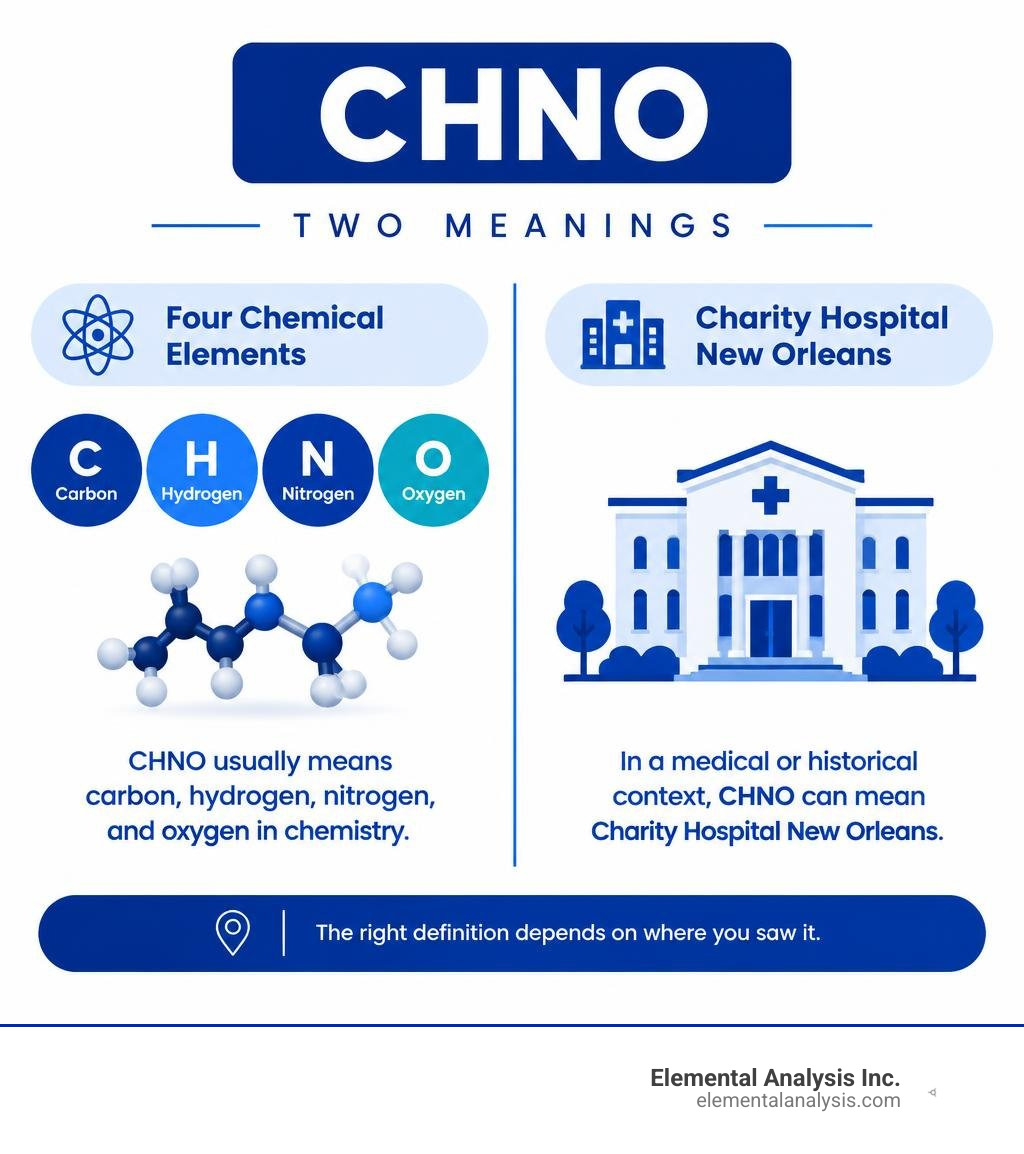
CHNO usually means carbon, hydrogen, nitrogen, and oxygen in chemistry. These four elements are common building blocks of organic and biological compounds. In a medical or historical context, CHNO can mean Charity Hospital New Orleans.
The right definition depends on where you saw it. A lab report likely refers to elements; a hospital record may refer to the institution. This guide also separates CHNO from the similar acronym CHN and from look-alike words in other languages.
Basic chno meaning terms:
Primary CHNO Meaning in Chemistry and Medicine
Acronyms often serve as convenient shortcuts, but their true definitions depend entirely on the field in which they appear. When encountering CHNO, two primary interpretations dominate modern literature: analytical biochemistry and historical healthcare administration.
According to general lexical compilations like the AcronymFinder reference on CHNO, the abbreviation bridges the gap between atomic building blocks and landmark institutional care. In natural sciences, it groups the four non-metallic elements that constitute the vast majority of all living matter on Earth. In institutional history, it designates one of the most famous public safety-net hospitals in the United States.
The Biochemical Meaning of CHNO: Carbon, Hydrogen, Nitrogen, and Oxygen
In chemistry, CHNO represents the elemental quartet: Carbon (C), Hydrogen (H), Nitrogen (N), and Oxygen (O). Together, these elements account for roughly 96% of the mass of the human body and form the foundation of organic chemistry.
- Carbon (C): Known as the backbone of life, carbon possesses four valence electrons, allowing it to form stable covalent bonds with other carbon atoms as well as with hydrogen, nitrogen, and oxygen. This enables the formation of long chains, branched structures, and aromatic rings.
- Hydrogen (H): The simplest and most abundant element in the universe. In organic systems, hydrogen caps carbon bonds and drives hydrogen bonding, which stabilizes the secondary and tertiary structures of proteins and nucleic acids.
- Nitrogen (N): A critical component of amino acids (the building blocks of proteins) and nitrogenous bases (adenine, thymine, guanine, cytosine, and uracil) within DNA and RNA.
- Oxygen (O): Highly electronegative and reactive, oxygen plays an essential role in cellular respiration, water formation, and functional chemical groups like hydroxyls, carboxyls, and carbonyls.
In analytical testing, determining the exact mass ratios of these elements is the foundational step used to calculate empirical formulas for newly synthesized pharmaceuticals, polymers, and extracted natural products.
Institutional CHNO Meaning: Charity Hospital New Orleans

Outside chemistry laboratories, CHNO stands for Charity Hospital New Orleans. Founded in 1736 by French shipbuilder Jean Louis, Charity Hospital served as one of the longest continuously operating public healthcare institutions in American history.
For nearly three centuries, Charity Hospital provided free medical treatment to underserved populations across Louisiana and the Gulf Coast. It grew into a massive, 20-story Art Deco medical tower in downtown New Orleans, functioning as a primary teaching hospital for both the LSU and Tulane University medical schools.
The hospital gained worldwide attention in 2005 during Hurricane Katrina, when floodwaters knocked out backup generators and stranded hundreds of staff and patients. Following the storm, the historic main building was closed, but the acronym CHNO remains an important piece of American medical history.
Academic Competitions: Chinese National Chemistry Olympiad
In secondary and higher education, CHNO can also refer to the Chinese National Chemistry Olympiad. This prestigious competition tests top high school students in advanced theoretical and practical chemistry.
Students who excel in the tournament often represent their country at the International Chemistry Olympiad (IChO). For students and educators navigating competitive science events, reviewing an academic overview of CHNO provides valuable insight into the preparation standards and curriculum frameworks required at this elite level.
Comparing CHNO vs. CHN Across Scientific and Commercial Domains
A single letter changes both analytical testing workflows and institutional definitions. While CHNO includes oxygen, CHN omits it or accounts for it by difference. In commercial and global sectors, CHN carries dozens of separate definitions that are distinct from CHNO.
| Dimension | CHNO | CHN |
|---|---|---|
| Primary Chemistry Meaning | Carbon, Hydrogen, Nitrogen, Oxygen | Carbon, Hydrogen, Nitrogen |
| Analytical Combustion Mode | Simultaneous combustion & pyrolysis | Standard oxidative combustion |
| Institutional Acronyms | Charity Hospital New Orleans; Chinese National Chemistry Olympiad | Community Health Network; Children’s Hunger Network |
| Aviation & Finance | None recognized | Chonju Airport (Korea); China Fund, Inc. (NASDAQ ticker) |
| Software / Computing | Molecular formula notation | Ethnograph 3 data file extension |
Elemental Analysis: CHN vs. CHNO Terminology
In analytical combustion analysis, laboratories frequently contrast standard CHN testing with expanded CHNO testing.
Standard CHN analysis burns an organic sample in an oxygen-rich environment inside a high-temperature furnace. The combustion products—carbon dioxide, water vapor, and nitrogen oxides—are swept by an inert carrier gas through reduction tubes and thermal conductivity detectors (TCD) or infrared (IR) cells to quantify carbon, hydrogen, and nitrogen simultaneously.
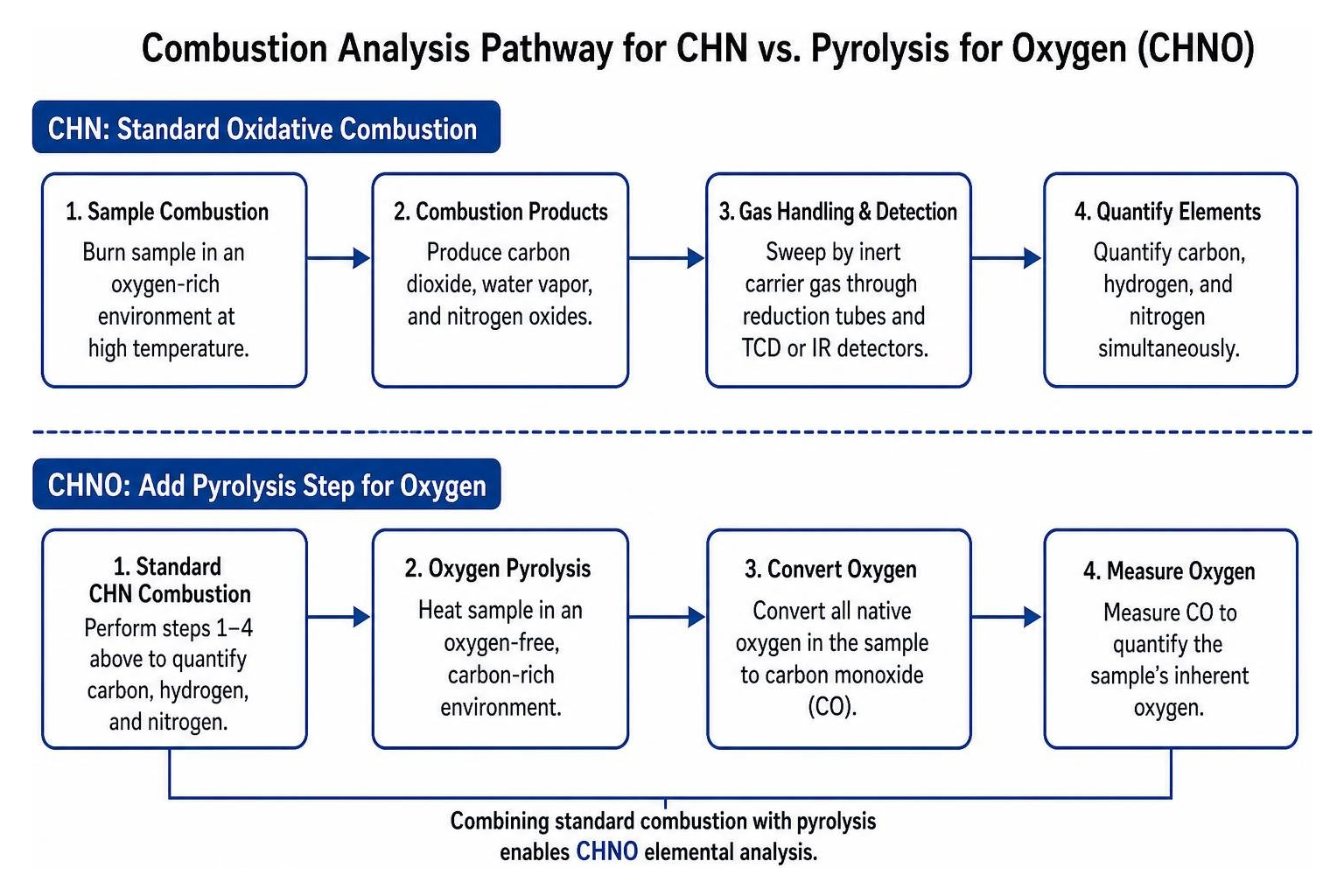
Because oxygen is introduced during combustion, directly quantifying the sample’s inherent oxygen requires a separate pyrolysis step. In this process, the sample is heated in an oxygen-free, carbon-rich environment to convert all native oxygen into carbon monoxide, which is then measured.
Laboratories use established industry standard methods to characterize these samples. For advanced matrices, combining standard combustion with trace sulfur analysis expands the data set to CHNS or CHNS-O profiles. Anyone new to combustion testing can consult an introductory analytics guide to understand how instrumental detection limits and calibration standards work together.
Cross-Industry Acronyms: What Does CHN Stand For?
Unlike CHNO, which has a relatively small number of definitions, CHN has over 40 distinct meanings across global industries. As detailed in the full CHN acronym directory, several widespread uses include:
- Aviation: CHN is the IATA airport location code for Chonju Airport in South Korea.
- Financial Markets: CHN serves as the NASDAQ stock ticker symbol for the China Fund, Inc., an established closed-end management investment fund.
- Data Computing: In legacy computing and qualitative research,
.chnis the file extension for Ethnograph 3 data files. - Non-Profit & Healthcare: CHN is widely used for organizations such as Community Health Network, Children’s Hunger Network, and Child Healthcare Network.
Slang and Linguistic Variants: CHMO, Chino, Concho, Cholo, and Chocho

When spoken aloud or typed without exact punctuation, CHNO can be confused with phonetically similar slang words, foreign terms, and cultural labels. Disambiguating these variants clarifies their distinct meanings across languages.
Russian Slang Etymology: The Origins of ‘чмо’ (CHMO)
The Russian slang term чмо (often transliterated as chmo or tchmo) and its derivative чмошник (chmoshnik) describe a weak, contemptible, unkempt, or morally degraded person. Although it functions as an insult, linguists and historians have documented several competing theories regarding its historical origins, as explored in an Express Gazeta etymological report:
- Dictionary Roots (Vladimir Dahl): Nineteenth-century lexicographer Vladimir Dahl recorded the dialectal verb чмарить (chmarit’), meaning to languish, waste away, or live in squalor.
- Soviet Military Acronym: A widely cited military theory claims CHMO originated as an acronym for Части Материального Обеспечения (Chasti Materialnogo Obespecheniya — Parts of Material Support). Frontline soldiers used it pejoratively to mock rear-guard supply clerks who avoided direct combat.
- Yiddish Linguistic Borrowing: Another theory traces the word to the Yiddish term shmok (a vulgar insult), which entered Russian urban dialects through Jewish communities in southern port cities like Odesa.
- Criminal Argot (Gulag Backronyms): In Soviet labor camps, criminal subcultures created backronyms for prisoners who had lost their dignity, defining CHMO as Человек Морально Опустившийся (Chelovek Moralno Opustivshiysya — Morally Degraded Person) or Человек, Мешающий Обществу (Chelovek, Meshayushchiy Obshchestvu — Person Obstructing Society).
- Onomatopoeic Folk Slang: A simpler colloquial theory links the term to чмокать (chmokat’), mimicking the sound of smacking lips during eating or sloppy kissing.
Spanish Regional Meanings: Chino, Concho, Cholo, and Chocho
Spanish contains several words that look or sound similar to CHNO, each with distinct regional meanings:
Chino
As outlined in the Collins Spanish-English dictionary, chino primarily translates to “Chinese” (as an adjective, nationality, or the language). However, regional dialects add several unique meanings:
- In Mexico, chino commonly means “curly” (referring to hair) or a hair roller.
- In parts of South America, it historically referred to individuals of mixed Amerindian descent or domestic workers.
- Common idioms include trabajar como un chino (to work tirelessly) and me suena a chino (equivalent to “it’s all Greek to me”).
Concho
According to the bab.la concho definition, concho carries distinct regional definitions:
- In Chile, it refers to the dregs or sediment at the bottom of a wine bottle or coffee cup.
- Across Andean nations (Peru, Ecuador, Bolivia), it colloquially refers to the youngest child in a family.
- In the Dominican Republic, a concho (or carro público) is a shared collective taxi.
- In various dialects, it acts as a mild euphemistic exclamation, similar to “shoot!” or “darn!”
Cholo
The cultural term cholo is examined in detail by the cultural context of cholo guide. Its definition varies across borders:
- In colonial Latin America, it originated as a caste classification for individuals of mixed European and Indigenous ancestry.
- In Peru and Bolivia, it describes people of Indigenous or mestizo background, carrying complex social connotations that range from cultural pride to derogatory class stereotyping.
- In the United States and Northern Mexico, cholo describes a Mexican-American urban subculture associated with distinct aesthetics (khakis, plaid shirts, lowrider culture, and hand-lettered tattoo art).
Chocho
As analyzed in the WordReference forum linguistic analysis, chocho has entirely different meanings depending on where it is spoken:
- In Spain, it is vulgar slang for female genitalia, though it is occasionally used colloquially in southern Andalusia as an informal term of endearment among close friends.
- In Mexico, it refers to a small round candy, pill, or homeopathic sugar tablet.
- In Peru and Ecuador, it denotes the edible lupin seed (Lupinus mutabilis, locally known as tarwi).
- In Argentina and Uruguay, being chocho means being exceptionally happy or joyful, while in older contexts it can describe elderly senility.
Frequently Asked Questions About CHNO Meaning
What are the most common scientific and institutional uses of CHNO?
The two primary uses of CHNO are:
- Biochemical and Analytical Chemistry: The elemental symbols for Carbon, Hydrogen, Nitrogen, and Oxygen.
- Medical History: The common acronym for Charity Hospital New Orleans, the historic Louisiana safety-net hospital established in 1736.
Is the cultural term ‘cholo’ considered offensive?
It depends on the speaker, context, and region. In Peru and Bolivia, using cholo toward someone can be offensive if intended as a racial or socioeconomic slur, though many Indigenous groups have reclaimed the term as a symbol of identity. In the United States, within Mexican-American communities, cholo refers to a distinct cultural subculture and is generally not considered offensive when used respectfully by community members.
What does ‘chocho’ mean across different Spanish dialects?
In Spain, chocho is a vulgar slang term for female anatomy. In Mexico, it refers to small candies or medicinal tablets. In Andean countries like Peru, it is an edible legume seed. In Argentina and Uruguay, it describes a state of joy (estar chocho).
Conclusion
Understanding the acronym CHNO requires looking at the setting in which it appears. In a laboratory or scientific paper, it represents carbon, hydrogen, nitrogen, and oxygen—the four elements that form the basis of organic matter. In healthcare history, it refers to Charity Hospital New Orleans. Differentiating CHNO from similar terms like CHN, as well as distinct linguistic variants across Russian and Spanish, ensures accurate communication across fields.
At Elemental Analysis Inc., located in Lexington, Kentucky, our team focuses on trace element identification, quantification, and speciation across diverse sample matrices. Whether you need reliable compositional testing or customized analytical workflows, explore our comprehensive CHNO elemental analysis services to support your quality control and research needs.