
How to Balance Carbon and Nitrogen in Compost
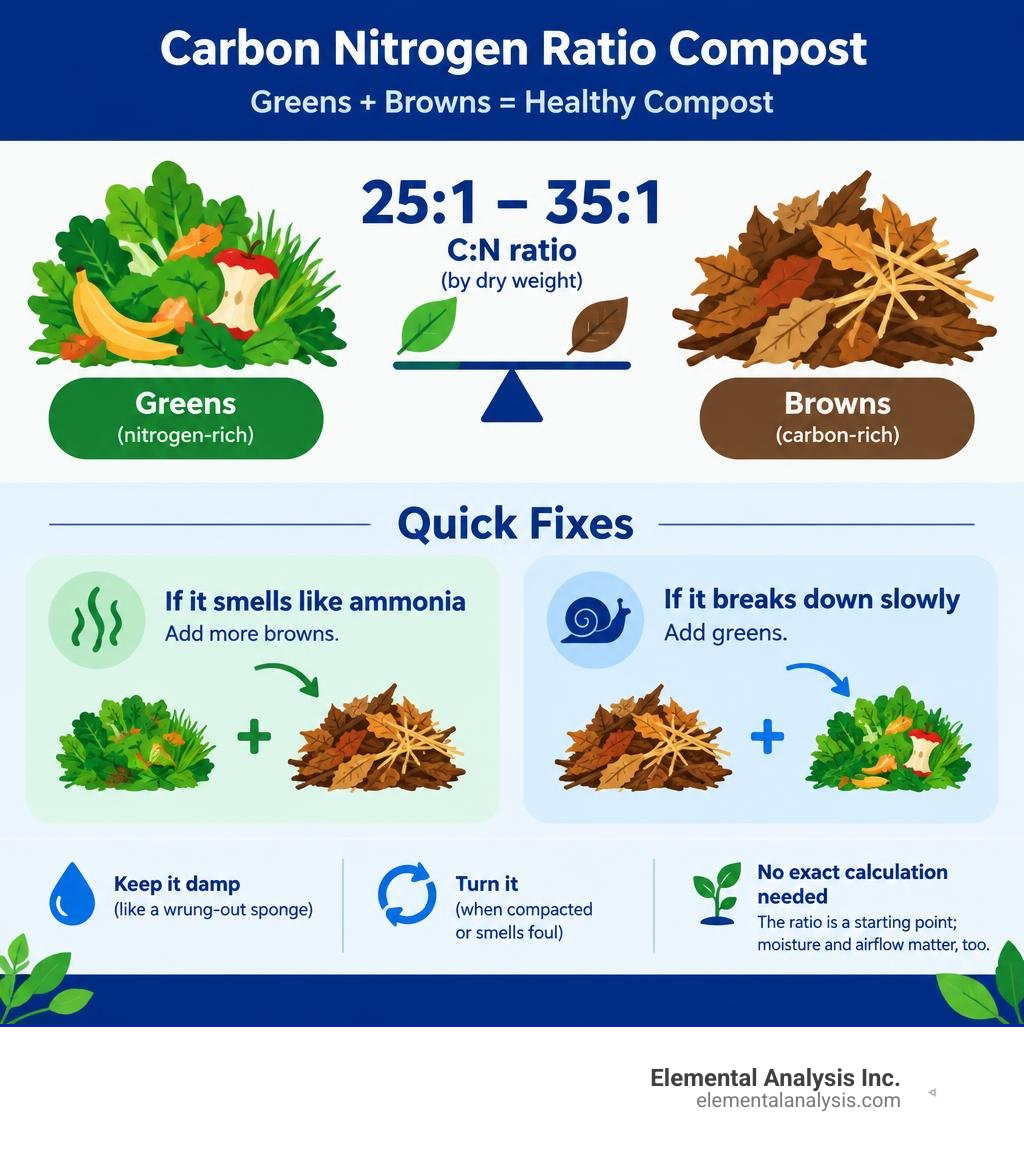
Aim for an initial carbon-to-nitrogen (C:N) ratio of about 25:1 to 35:1, measured by dry weight. Mix nitrogen-rich greens, such as food scraps and grass clippings, with carbon-rich browns, such as dry leaves and straw. If the pile smells like ammonia, mix in more browns. If it breaks down slowly, add greens. Keep it as damp as a wrung-out sponge, and turn it when it becomes compacted or smells foul.
You do not need an exact calculation to make good compost. The ratio is a starting point; moisture and airflow matter, too. Getting the carbon-to-nitrogen ratio in compost right is the fastest way to turn raw yard waste into stable, plant-ready humus.
Related chemical analysis concepts:
Understanding the Fundamentals of Microbial Composting Chemistry
Composting is an aerobic biological process driven by microorganisms. Billions of bacteria, actinomycetes, and fungi break down organic waste into dark, nutrient-rich humus. To drive this conversion, microbes need a balanced diet of carbon and nitrogen.
Carbon serves as the primary energy source and basic structural building block for cellular development. Microbes oxidize carbon through cellular respiration, releasing roughly two-thirds of it as carbon dioxide while incorporating the remaining third into their cellular mass. Nitrogen is required for synthesizing proteins, amino acids, nucleic acids, and enzymatic machinery.
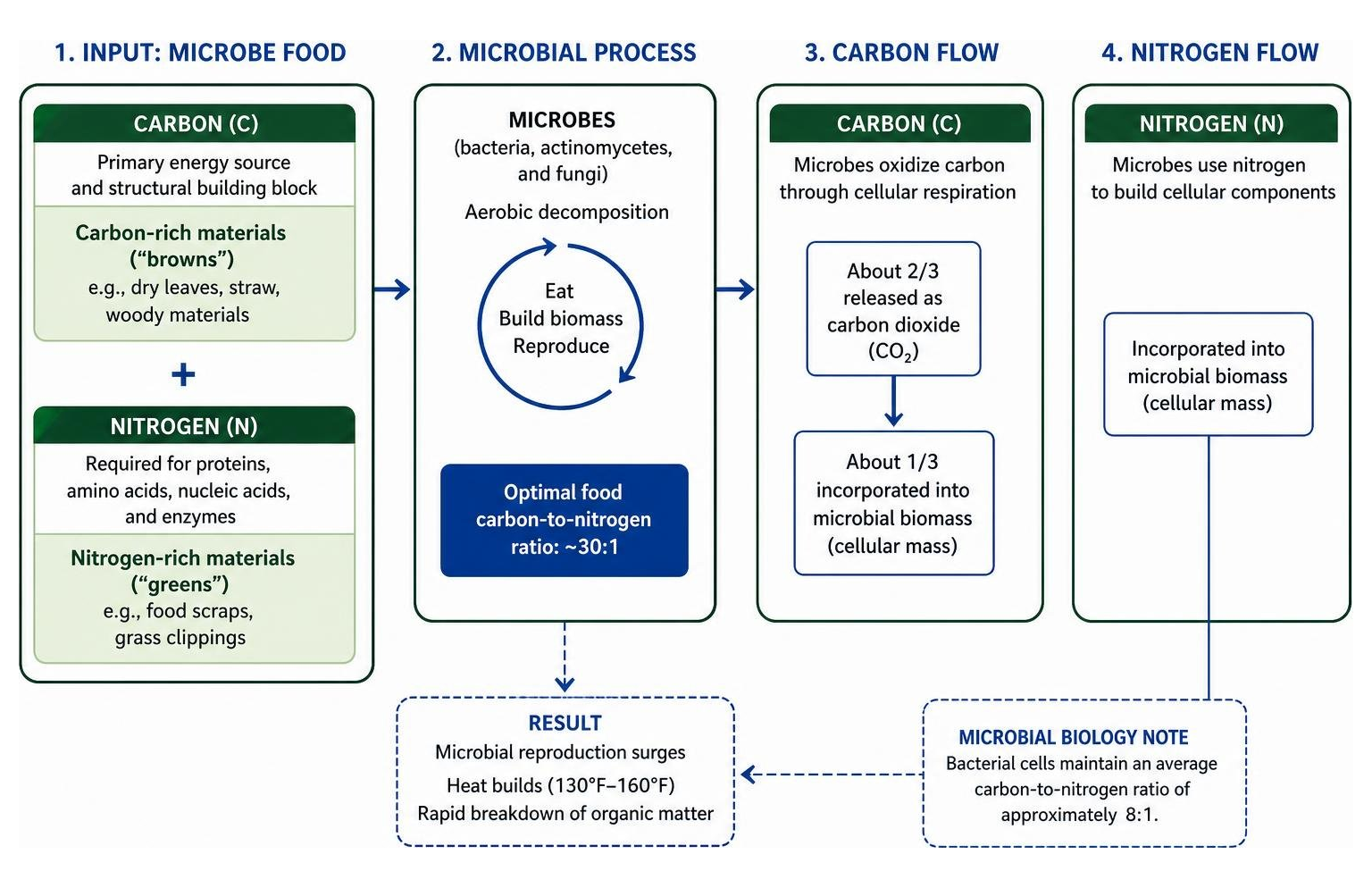
According to Cornell compost chemistry research, bacterial cells themselves maintain an average carbon-to-nitrogen ratio of approximately 8:1 (eight parts carbon for every one part nitrogen). To sustain their metabolism, consume carbon for energy, and build new cellular biomass, microbial communities require about 30 parts of available carbon for every part of nitrogen in their food supply.
When your starting materials match this 30:1 proportion, microbial reproduction surges. Thermophilic (heat-loving) bacteria rapidly colonize the substrate, generating core temperatures between 130°F and 160°F. These elevated temperatures destroy weed seeds and pathogens while rapidly breaking down organic matter.
If you are managing agricultural blends or commercial compost batches, maintaining this nutritional balance relies on precise testing. We often measure these fundamental elements in organic substrates using a nitrogen combustion analyzer to determine exact baseline values before building large-scale piles.
Optimizing the Carbon-to-Nitrogen Ratio of Compost for Maximum Efficiency

Achieving an efficient compost pile comes down to blending raw inputs so the overall mix lands within an initial 25:1 to 35:1 window. Research indicates that an initial ratio of 25:1 minimizes total nitrogen loss, preserving valuable plant nutrients in the final humus.
Green vs. Brown Feedstocks: Chemical Compositions and Breakdown Rates
In composting, raw organic inputs are grouped into two functional categories:
- Greens (Nitrogen-Rich Feedstocks): Moist, dense materials that break down quickly. They supply the nitrogen needed for rapid microbial population growth. Common examples include fresh grass clippings, kitchen scraps, livestock manures, and coffee grounds.
- Browns (Carbon-Rich Feedstocks): Dry, fibrous materials that degrade slowly. They provide structural energy, absorb excess moisture, and create structural pore spaces for oxygen flow. Examples include dried autumn leaves, straw, wood shavings, and corrugated cardboard.
Not all carbon breaks down at the same rate. Simple carbohydrates and cellulose break down within days, but complex woody compounds like lignin resist enzymatic degradation. Highly lignified browns (such as hardwood bark or coarse wood chips) take significantly longer to release their carbon, requiring smaller particle sizes and steady moisture to decompose completely.
| Material Type | Feedstock Name | Typical C:N Ratio | Bulk Density (lbs/yd³) | Decomposition Rate |
|---|---|---|---|---|
| Greens | Poultry Manure (fresh) | 8:1 – 10:1 | 1,200 – 1,400 | Very Fast (days to weeks) |
| Greens | Vegetable & Kitchen Scraps | 12:1 – 15:1 | 1,000 – 1,300 | Fast |
| Greens | Fresh Grass Clippings | 15:1 – 25:1 | 600 – 900 | Fast |
| Greens | Coffee Grounds | 20:1 | 1,000 | Moderate to Fast |
| Browns | Dry Autumn Leaves | 40:1 – 80:1 | 100 – 300 | Moderate |
| Browns | Wheat / Oat Straw | 50:1 – 100:1 | 100 – 200 | Moderate |
| Browns | Corrugated Cardboard (shredded) | 200:1 – 400:1 | 150 – 250 | Slow |
| Browns | Softwood Sawdust / Shavings | 400:1 – 500:1 | 350 – 500 | Very Slow |
Calculating Your Baseline Compost Carbon-to-Nitrogen Ratio Recipe
Home gardeners can often rely on simple volumetric rules of thumb (such as mixing two parts loose dry browns with one part dense moist greens). However, commercial and municipal operations rely on mathematical models based on dry weight and moisture content.
According to UF/IFAS composting ratio recommendations, you can estimate your combined recipe using a weighted average based on dry mass:
- Determine the Dry Weight: Multiply the total wet weight of each material by its total solids percentage (100% minus the moisture content percentage).
- Calculate Total Nitrogen Units: Divide the dry weight of each component by its specific C:N ratio factor to find relative nitrogen units.
- Calculate Total Carbon Units: Multiply the nitrogen units by the individual material’s C:N value.
- Determine the Combined Ratio: Sum the total carbon units from all materials and divide by the sum of all nitrogen units.
For operations using standardized analytical equipment, verifying raw feedstock components using methods across analytical settings ensures recipe accuracy before constructing full-scale windrows.
Critical Environmental Factors Governing Compost Kinetics
A balanced C:N blend provides the fuel for your pile, but decomposition kinetics depend heavily on physical factors like moisture, aeration, particle geometry, and structural stability.
Particle Size, Bulk Density, and Free Air Space
Microbial decomposition occurs on the wet surfaces of organic matter. Shredding, chopping, or grinding materials increases their total surface area, providing more contact area for bacterial and fungal enzymes.
However, grinding materials too finely creates compaction problems. If particle sizes fall below 0.5 inches without structural bulking agents, bulk density rises above 1,200 lbs/yd³, collapsing the pile’s internal pores.
According to Colorado State University Extension composting guidance, maintaining coarse, structural carbon fragments (such as 1- to 2-inch wood chips or chopped straw) preserves an optimal free air space between 30% and 50%. This structural porosity allows cool, oxygen-rich air to enter through the pile’s base while venting warm carbon dioxide out through the top.
Moisture Dynamics, Oxygen Concentration, and Pile pH
Moisture and oxygen must remain balanced throughout the composting lifecycle:
- Moisture Thresholds: Microbes require a continuous water film to transport nutrients across their cell membranes. The optimal moisture range is 40% to 60%. Use the standard field “sponge test”: take a handful of compost from deep inside the pile and squeeze firmly. It should feel like a wrung-out sponge, leaving your hand damp while releasing only one or two drops of water. If water streams out, the pile is waterlogged and risks turning anaerobic.
- Oxygen Saturation: Aerobic bacteria thrive when oxygen concentrations within the pore spaces remain above 10% (ambient air is roughly 21%). If oxygen drops below 5%, anaerobic microbes take over, producing foul odors like hydrogen sulfide (rotten eggs) and volatile organic acids.
- pH Trajectory: During the first few days of active breakdown, acid-forming bacteria produce organic acids, causing the pile’s pH to drop into a mildly acidic range (5.5 to 6.0). As temperatures climb and proteins break down into ammonium compounds, the pH rises, stabilizing between 6.5 and 8.0 in mature compost.
System-Specific C:N Dynamics: Thermophilic Piles, Vermicomposting, and Manures
Different composting systems and raw inputs require specific adjustments to their initial carbon-to-nitrogen ratios.
Hot Composting vs. Worm Bins: Differing Carbon Demands
- Thermophilic Hot Composting (Target C:N 25:1 – 35:1): Relies on rapid bacterial reproduction to drive internal temperatures between 130°F and 160°F. This high heat requires readily available nitrogen to support exponential bacterial growth.
- Vermicomposting (Target C:N 50:1 or higher): Red wiggler worms (Eisenia fetida) thrive in cool, mesophilic environments between 55°F and 80°F. Temperatures above 95°F can be fatal to them. As a result, worm bin bedding requires high-carbon materials (such as shredded cardboard, aged leaf mold, or paper mulch) with a starting C:N ratio of 50:1 or higher. This prevents the bedding from heating up while providing a safe, carbon-rich environment for worms to process added kitchen scraps.
Manure Management: Insights from Poultry, Swine, and Ruminant Studies
Animal manures are high in nitrogen and provide valuable biological inoculants, but their chemical properties vary widely:
- Poultry Litter (Initial C:N 20:1 – 25:1): UKy poultry litter composting research shows that raw chicken manure has a low C:N ratio (around 8:1 to 10:1) and high moisture levels. Composting poultry manure requires blending it with dry, high-carbon wood shavings or sawdust to reach an initial 20:1 to 25:1 ratio, which binds volatile ammonia and manages moisture.
- Swine (Pig) Manure (Initial C:N 20:1 – 25:1): A comprehensive meta-analysis of 192 agricultural composting studies found that pig slurry and manure reach stability within 45 days when balanced to an initial C:N of 20:1 to 25:1 using fine straw or sawdust amendments.
- Ruminant (Cow and Sheep) Manures (Initial C:N 25:1 – 35:1): Because cattle and sheep consume fibrous, cellulose-rich diets, their manure has a higher baseline C:N ratio (typically 15:1 to 25:1). Blending ruminant manure with dry pasture straw or leaves easily brings the mix into the optimal 25:1 to 35:1 range.
Troubleshooting and Monitoring the Decomposition Lifecycle
Observing changes in temperature, odor, and pile volume allows you to identify and correct biological imbalances before they stall decomposition.
Troubleshooting Carbon-to-Nitrogen Imbalances and Odors in Compost
When a compost pile runs into problems, the issue can usually be traced back to an imbalance in carbon, nitrogen, moisture, or oxygen. UGA Extension composting troubleshooting guidelines outline practical fixes for these common pile issues:
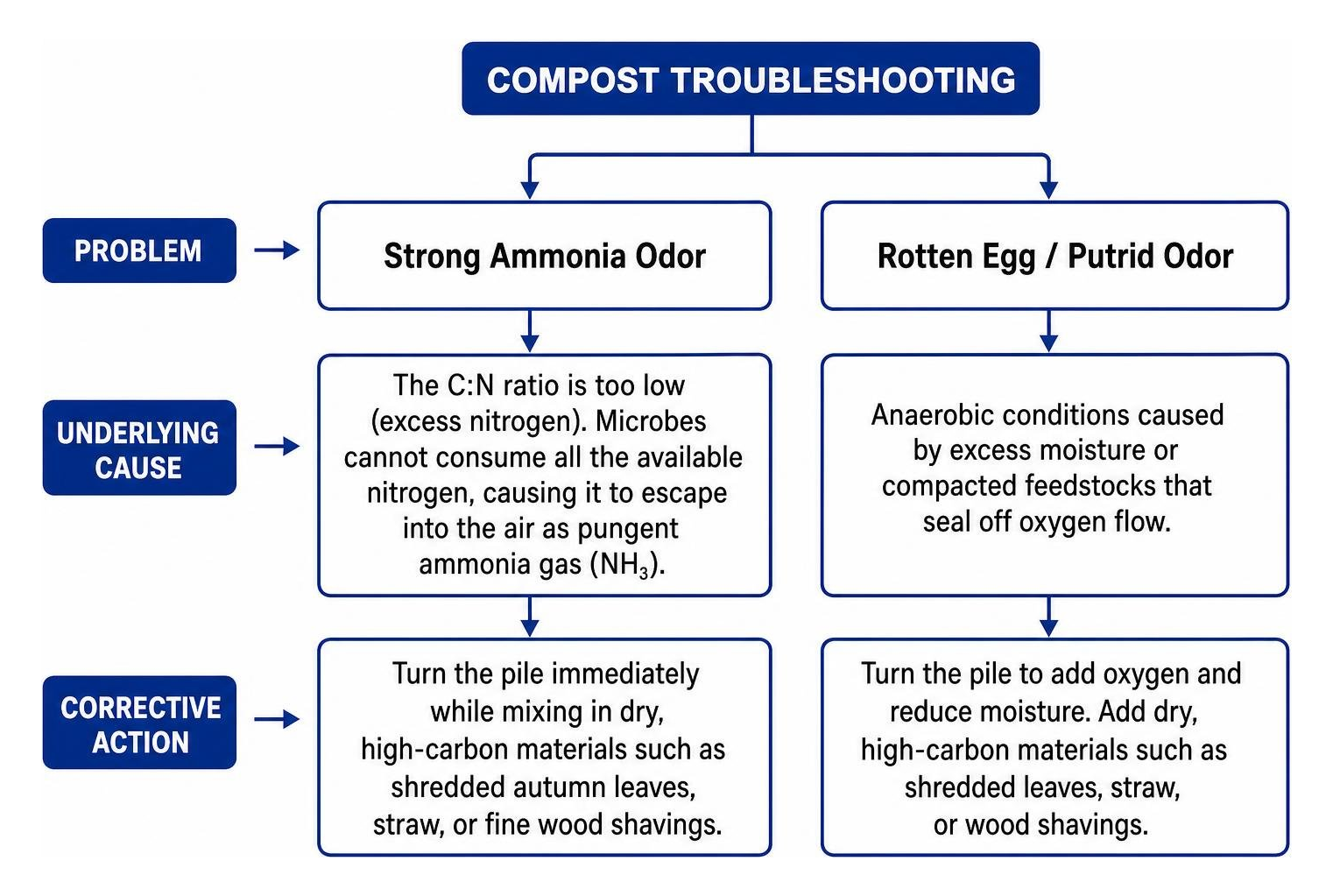
- Problem: Strong Ammonia Odor
- Underlying Cause: The C:N ratio is too low (excess nitrogen). Microbes cannot consume all the available nitrogen, causing it to escape into the air as pungent ammonia gas (NH₃).
- Corrective Action: Turn the pile immediately while mixing in dry, high-carbon materials such as shredded autumn leaves, straw, or fine wood shavings.
- Problem: Rotten Egg / Putrid Odor
- Underlying Cause: Anaerobic conditions caused by excess moisture or compacted feedstocks that seal off oxygen flow.
- Corrective Action: Turn the pile to introduce fresh oxygen, mix in coarse carbonaceous bulking agents (such as 1-inch wood chips), and shelter the pile from heavy rainfall.
- Problem: Cold Pile / No Heat Generation
- Underlying Cause: The C:N ratio is too high (excess carbon/starvation), moisture is below 40%, or the pile volume is too small (under 3 feet by 3 feet by 3 feet) to hold core heat.
- Corrective Action: Mix in nitrogen-rich greens (such as fresh grass clippings, vegetable scraps, or manure), add water until the mix feels like a damp sponge, and ensure the pile is at least one cubic yard in size.
- Problem: Hot Core but Slow Breakdown Along the Edges
- Underlying Cause: Natural temperature gradients between the heated core and the cooler outer layers.
- Corrective Action: Turn the pile by moving the dry, undecomposed outer shell into the center while shifting the dark, heated core material to the outside.
Tracking C:N Ratio Decline from Initial Mix to Cured Finished Compost
As organic waste breaks down, the overall carbon-to-nitrogen ratio drops steadily over time. Microbes continually release carbon into the air as carbon dioxide, while recycling and holding nitrogen within their living and decomposing cells.
According to Sustainable Market Farming C:N curing guidelines and insights from Purdue University yard waste composting insights, finished, stable compost reaches a C:N ratio of 10:1 to 15:1.
Applying unaged compost with a C:N ratio above 25:1 directly to your garden beds can cause nitrogen immobilization (often called “nitrogen tie-up” or “nitrogen drawdown”). Soil microbes will pull available mineral nitrogen directly from the surrounding soil to break down the remaining carbon, temporarily starving plant roots and turning foliage yellow.
Letting your compost cure for 30 to 60 days after its thermophilic phase allows it to stabilize at a 10:1 to 15:1 ratio, ensuring balanced nutrient availability when mixed into garden soil.
Frequently Asked Questions About Compost Chemistry
What happens if the carbon-to-nitrogen ratio is too high or too low?
If the initial C:N ratio is too high (above 40:1), microbial growth slows due to nitrogen starvation. The pile will remain cool, taking many months or even years to break down.
If the ratio is too low (below 20:1), the excess nitrogen cannot be fully processed by microbial cells. It volatilizes into the surrounding air as ammonia gas, generating foul odors and losing valuable soil fertility.
How do I know when compost is finished and stable for garden beds?
Finished compost features a uniform, crumbly texture, a dark brown or black color, and a pleasant, forest-floor aroma with no recognizable parent materials.
You can confirm stability using a simple seed germination bioassay: plant sensitive seeds (such as radish or cress) in a container filled with a 50/50 mix of your compost and potting soil. If more than 75% to 80% of the seeds sprout and develop healthy green leaves without burning or yellowing, the compost is mature and ready for your garden.
Can high-lignin materials like wood chips or newspaper stall decomposition?
Yes. Lignin forms a rigid, protective matrix around plant cell walls, shielding internal cellulose from simple bacterial breakdown.
Large wood chips or thick stacks of paper decompose very slowly because only specialized white-rot and brown-rot fungi produce the enzymes needed to break down lignin bonds. Shredding cardboard, chipping woody branches into smaller pieces, and mixing in moist, nitrogen-rich greens helps speed up degradation across these carbon-heavy materials.
Conclusion
Managing the carbon-to-nitrogen ratio in your compost pile is one of the most effective ways to turn everyday yard waste, food scraps, and agricultural residues into fertile, disease-suppressing humus. By pairing greens and browns at an initial 30:1 dry-weight ratio—while maintaining steady moisture, porosity, and airflow—you give beneficial microbes the exact conditions they need to thrive.
For commercial operations, compost blenders, and agricultural facilities in Lexington, KY, and across the United States, managing bulk feedstocks often requires precise, certified laboratory data. When you need exact characterization of total organic carbon, nitrogen, sulfur, or trace minerals, our team at Elemental Analysis Inc. provides fast, accurate analytical testing.
Learn more about our elemental testing and characterization services to optimize your compost recipes, ensure product safety, and verify finished soil stability.