
How Lead Isotope Ratios Help Us Decode the Past
What Are Lead Isotope Ratios — And Why Do They Matter?
Lead isotope ratios are the measured proportions of lead’s four stable isotopes — ²⁰⁴Pb, ²⁰⁶Pb, ²⁰⁷Pb, and ²⁰⁸Pb — relative to one another in a given sample. Because three of these isotopes are produced by radioactive decay at known rates, their ratios act as a permanent geochemical fingerprint that survives melting, smelting, weathering, and even long-range atmospheric transport.
Here is a quick-reference summary:
| Isotope | Abundance | Origin | Key Use |
|---|---|---|---|
| ²⁰⁴Pb | ~1.4% | Primordial only | Baseline for all ratio calculations |
| ²⁰⁶Pb | ~24.1% | Decay of ²³⁸U | Uranium-lead dating; source tracing |
| ²⁰⁷Pb | ~22.1% | Decay of ²³⁵U | Age modeling; pollution fingerprinting |
| ²⁰⁸Pb | ~52.4% | Decay of ²³²Th | Heaviest stable nuclide; thorium series |
These ratios are used across a surprisingly wide range of fields:
- Geology — dating rocks and tracing ore deposit origins
- Environmental science — identifying pollution sources in air, soil, and water
- Archaeology — reconstructing ancient trade routes through artifact provenance
- Medicine — delivering targeted radiation therapy via radioactive lead isotopes
- Nuclear physics — shielding ultra-sensitive detectors using ancient, low-radiation lead
Here is a striking example of that last point: physicists hunting for dark matter actively search for ancient Roman lead recovered from shipwrecks. The reason is purely isotopic — modern lead still contains measurable amounts of ²¹⁰Pb, a radioactive isotope with a 22.2-year half-life. Roman lead is roughly 2,000 years old, so its ²¹⁰Pb has long since decayed to negligible levels, making it extraordinarily “quiet” as a radiation shield for the world’s most sensitive detectors.
That single example captures what makes lead isotope ratios so powerful: the past is literally written into the atomic structure of the metal, and modern analytical tools can read it with remarkable precision.
Understanding the Four Stable Lead Isotope Ratios
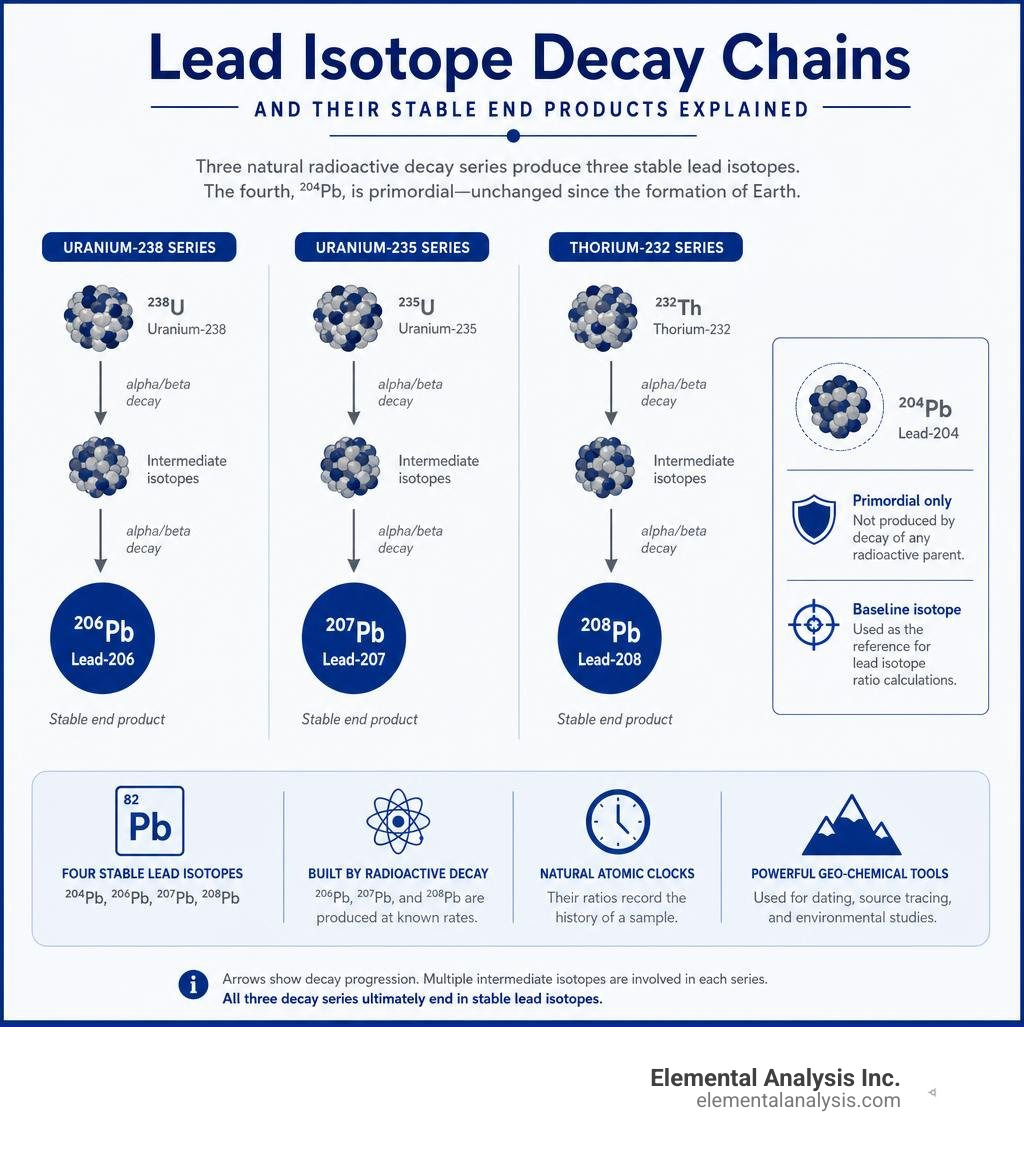
To truly understand how we read these atomic clocks, we have to look closely at the stable isotopes of lead. In nature, lead is found as a mixture of four observationally stable isotopes: ²⁰⁴Pb, ²⁰⁶Pb, ²⁰⁷Pb, and ²⁰⁸Pb. When we say “observationally stable,” we mean that while some of these isotopes are theoretically predicted to undergo extremely slow radioactive decay, no such decay has ever been measured. For all practical purposes, they are permanent.
The relative abundance and atomic weight of lead in any given material can vary significantly depending on its geological history. This variability is detailed extensively in the IUPAC Technical Report on lead isotopic composition, which highlights how lead’s atomic weight is not a single, fixed constant but rather a range that depends on the sample’s origin.
The Origin of Primordial and Radiogenic Lead Isotope Ratios
Why do these ratios vary so much from one rock to another? The secret lies in their origin stories. Lead isotopes are divided into two categories: primordial and radiogenic.
- Primordial Lead (²⁰⁴Pb): This isotope was created in the supernovae and stellar mergers that occurred before our solar system formed. It is not the product of any radioactive decay chain. Because its total amount on Earth has remained constant since the planet’s birth, ²⁰⁴Pb serves as our unchanging baseline.
- Radiogenic Lead (²⁰⁶Pb, ²⁰⁷Pb, ²⁰⁸Pb): These isotopes are continuously being created by the slow, steady decay of uranium and thorium.

This radioactive decay occurs via three distinct pathways:
- The Uranium Series: Uranium-238 (²³⁸U) decays through a series of steps to stable Lead-206 (²⁰⁶Pb) with a half-life of approximately 4.468 billion years. (Interestingly, because of its excellent neutron economy, ²⁰⁶Pb has even been proposed as a coolant in fast breeder nuclear reactors to suppress radioactive byproducts).
- The Actinium Series: Uranium-235 (²³⁵U) decays to stable Lead-207 (²⁰⁷Pb) with a half-life of roughly 704 million years.
- The Thorium Series: Thorium-232 (²³²Th) decays to stable Lead-208 (²⁰⁸Pb) with an incredibly long half-life of 14.05 billion years.
Because uranium, thorium, and lead behave differently during geological processes like melting and crystallization, different rock reservoirs end up with different starting ratios of these elements. Over millions of years, as the uranium and thorium decay, they pump fresh radiogenic ²⁰⁶Pb, ²⁰⁷Pb, and ²⁰⁸Pb into the rocks, altering the overall lead isotope ratios in a way that reflects both the age of the rock and its original chemical makeup.
Why Lead-208 is a Doubly Magic Isotope
Among the stable isotopes, Lead-208 holds a special place in nuclear physics. It is the heaviest stable nuclide known to science. It is also what physicists call a “doubly magic” isotope.
In nuclear physics, certain numbers of protons or neutrons correspond to completely filled nuclear shells, giving the atom exceptional stability. These are known as “magic numbers.” Lead-208 possesses exactly 82 protons and 126 neutrons—both of which are magic numbers.
For a long time, scientists assumed that such a highly stable, doubly magic nucleus would be perfectly spherical. However, a fascinating study suggested that the nucleus of ²⁰⁸Pb is actually a “prolate spheroid”—shaped like a rugby ball rather than a perfect sphere. This discovery has provided nuclear physicists with exciting new insights into the forces that hold atomic nuclei together.
Geochronology and the Role of Lead-204 in Geological Dating
Because we understand the exact rates at which uranium and thorium decay into lead, we can use these systems as highly accurate geological clocks. This is the foundation of geochronology.
When geologists want to date a rock formation, they often turn to uranium-lead (U-Pb) or lead-lead (Pb-Pb) dating. In these calculations, ²⁰⁴Pb plays a vital role. Because ²⁰⁴Pb is non-radiogenic, its concentration does not change over time. By measuring the ratios of the radiogenic isotopes relative to ²⁰⁴Pb (such as ²⁰⁶Pb/²⁰⁴Pb and ²⁰⁷Pb/²⁰⁴Pb), scientists can establish a baseline. This baseline allows them to calculate exactly how much of the radiogenic lead was present when the rock first formed versus how much has accumulated since then due to radioactive decay.
To learn more about the instrumentation used to measure these delicate ratios, you can read our guide on Unlocking Geological Secrets with Isotope Ratio ICP-MS.
Deciphering Earth’s History with Lead-Lead Dating
In cases where uranium has been lost or gained over time (which can disrupt U-Pb dating), geologists rely on Pb-Pb dating. This method compares the ratio of ²⁰⁷Pb to ²⁰⁶Pb directly. Because both isotopes decay from uranium isotopes at different rates, their ratio changes systematically over time.
To model this evolution, geochemists use historical baselines, starting with the “primeval” lead ratios found in the Canyon Diablo meteorite, which represents the starting material of our solar system 4.54 billion years ago. From there, they apply sophisticated mathematical models, such as the Stacey-Kramers two-stage evolution model or the plumbotectonics model. These models account for how lead has migrated and mixed between Earth’s major reservoirs—the mantle, the lower crust, the upper crust, and active mountain-building zones (orogenes)—over geological eons.
For a deeper dive into how these isotopic models help us locate valuable mineral deposits, see the academic chapter on Applications of Lead Isotopes to Ore Geology.
Environmental Source Identification and Air Quality Monitoring
Beyond dating ancient rocks, lead isotope ratios are incredibly effective tools for tracking modern environmental pollution. This process, known as source apportionment, relies on a simple fact: lead mined from different geological ore deposits around the world carries a unique isotopic signature. When that lead is manufactured into products—like coal, paint, or fuel—it retains that exact signature. Even after being burned, released into the atmosphere, and deposited miles away, the lead’s isotopic “fingerprint” remains completely unaltered.
This technique is widely used in air quality monitoring, particularly for analyzing PM10 particulate matter (particles smaller than 10 micrometers). By collecting PM10 samples on filters and analyzing their isotopic ratios, scientists can determine whether the lead in our air comes from active local industries, legacy soil dust, or distant coal-burning plants.
For more details on how we screen for these environmental toxins, check out our Heavy Metal Analysis by ICP-MS.
Tracking Leaded Petrol Signatures in Modern Air Quality
A classic example of source tracing involves leaded petrol. Although leaded gasoline was phased out decades ago, its isotopic signature still lingers in our environment.
Studies of ambient air quality often reveal that a significant portion of atmospheric lead does not come from active industrial emissions. Instead, it comes from the resuspension of historical, lead-rich soil dust that was contaminated during the peak petrol era of the 1970s and 1980s.
Additionally, leaded aviation gasoline (avgas) is still used in piston-engine aircraft. Isotopic studies around regional airfields frequently detect distinct ²⁰⁷Pb/²⁰⁶Pb ratios that match avgas, demonstrating that small aircraft continue to contribute to localized lead levels. To see how researchers map these atmospheric pathways on a global scale, read the paper on Source assessment of atmospheric lead at Svalbard.
Analyzing Environmental Lead Isotope Ratios in Soil and Water
In urban environments, tracing the source of lead exposure can be a major challenge because multiple sources often overlap. A famous historical study in Edinburgh, Scotland, highlighted this complexity by measuring ²⁰⁶Pb/²⁰⁷Pb ratios across various materials:
- Leaded petrol: 1.082 ± 0.024
- Street dust: 1.109 ± 0.016
- Tap water (from old lead pipes): 1.160 ± 0.012
- British lead ore and coal: 1.170 to 1.190
- Lead-based paint: 1.083 to 1.183
Because lead paint has such a wide and overlapping isotopic range, identifying whether a child was exposed to lead via paint chips, tap water, or street dust requires careful, multi-isotope profiling. For those interested in how these geological baselines are established in the field, the USGS report on Lead-Zinc Exploration offers valuable insights into regional ore signatures.
Radioactive Isotopes of Lead: Sedimentation and Targeted Alpha Therapy
While lead’s stable isotopes are excellent for tracing long-term history, its radioactive isotopes are highly valued in modern environmental science and medicine. Two isotopes of particular interest are Lead-210 (²¹⁰Pb) and Lead-212 (²¹²Pb).

Lead-210 in Sedimentation Chronology and Soil Erosion
Lead-210 is a naturally occurring beta emitter with a half-life of 22.2 years. It is produced continuously in the atmosphere from the decay of radon-222 gas (which seeps out of the ground) and quickly rains out, depositing onto soil and water surfaces.
Because of its relatively short half-life, ²¹⁰Pb is ideal for dating recent environmental samples on timescales of less than 100 years. By measuring the depth-dependent activity profile of ²¹⁰Pb in lake beds or marine sediments, environmental scientists can reconstruct sedimentation rates, trace soil erosion patterns, and build a detailed geomorphic record of the past century.
Lead-212 in Targeted Alpha Therapy for Cancer Treatment
At the other end of the spectrum is Lead-212, a short-lived radioisotope with a half-life of 10.627 hours. In healthcare, ²¹²Pb is a rising star in Targeted Alpha Therapy (TAT) for cancer treatment.
In TAT, ²¹²Pb is attached to a tumor-targeting molecule (such as a monoclonal antibody) using specialized chelation chemistry. Once injected, the molecule binds specifically to cancer cells. As the ²¹²Pb decays, it acts as an in-vivo generator, producing Bismuth-212 (²¹²Bi), which emits highly energetic alpha particles (6.1 MeV). These alpha particles travel only a tiny fraction of a millimeter—just a few cell diameters—delivering a lethal dose of localized radiation to the tumor while leaving the surrounding healthy tissue completely unharmed.
Advanced Analytical Techniques for High-Throughput Isotopic Analysis
To measure lead isotope ratios with the precision required for geological dating or environmental forensics, laboratories rely on advanced mass spectrometry.
Historically, the gold standard was Multi-Collector Inductively Coupled Plasma Mass Spectrometry (MC-ICP-MS) or Thermal Ionization Mass Spectrometry (TIMS). However, these methods traditionally required a slow, labor-intensive step: separating the lead from the sample matrix using ion-exchange resins in a cleanroom.
Recently, analytical chemistry has taken a massive leap forward. Researchers have developed methods to perform highly precise measurements without this tedious separation. You can read the breakthrough study on the Precise determination of lead isotope ratios by MC-ICP-MS without matrix separation.
To understand the core physics of how these instruments operate, check out our guide, ICP-MS Explained: How We Weigh Atoms in a Plasma Fire.
High-Throughput ICP-MS/MS in Complex Matrices
For commercial applications where rapid turnaround times are essential, triple-quadrupole ICP-MS (ICP-MS/MS) has become a game-changer. By utilizing a collision/reaction cell, ICP-MS/MS can suppress matrix interferences directly. This enables the direct, high-throughput analysis of complex environmental matrices—like PM10 filters or soil digests—without prior chemical separation.
To maintain extreme accuracy during these rapid runs, laboratories use:
- Sample-Standard Bracketing: Frequently analyzing a known reference material (such as NBS 981) to monitor and correct for instrument drift.
- Thallium Spiking: Adding a small, known amount of thallium (isotopes ²⁰³Tl and ²⁰⁵Tl) to the sample. Because thallium behaves almost identically to lead in the plasma, measuring the thallium ratio allows the instrument to correct for mass discrimination in real-time.
For practical advice on getting the most accurate results from your laboratory testing, see our ICP-MS Lab Guide.
Global Reference Databases and GlobaLID
As laboratories worldwide generate massive amounts of isotopic data, organizing this information has become crucial. For decades, archaeologists and geochemists relied on OXALID, a database compiled by the University of Oxford. However, OXALID ceased updates in 2012, leaving a significant gap in the scientific community.
To solve this, researchers launched GlobaLID, a modernized, open-access database built on FAIR (Findable, Accessible, Interoperable, and Reusable) data principles. Compiling over 20,000 lead isotope datasets of ores, minerals, and artifacts from around the globe, GlobaLID allows scientists to instantly compare their laboratory results against a massive global reference library to pinpoint the origin of their samples. Learn more about this modern tool in the paper From OXALID to GlobaLID.
Frequently Asked Questions about Lead Isotope Ratios
Why do physicists use ancient Roman lead for sensitive experiments?
Modern lead is contaminated with Lead-210 (²¹⁰Pb), a radioactive isotope with a 22.2-year half-life that is naturally introduced during the smelting process. Because Roman lead was smelted roughly 2,000 years old, its ²¹⁰Pb has had ample time to decay to virtually zero. This makes it an incredibly “quiet” material, perfect for shielding ultra-sensitive dark matter and neutrino detectors from background radiation.
How do lead isotope ratios help trace archaeological artifacts?
Lead isotopes do not undergo significant fractionation (shifting in ratio) during pyrometallurgical processes like smelting, refining, alloying, or casting. This means a finished bronze sword, silver coin, or lead pipe perfectly preserves the exact geological signature of the ore mine from which the metal was extracted, allowing archaeologists to map ancient trade networks with incredible accuracy.
What is J-lead and how does it assist in mineral exploration?
“J-lead” (named after Joplin, Missouri, where it was first discovered) refers to lead that is exceptionally enriched in radiogenic isotopes (²⁰⁶Pb, ²⁰⁷Pb, and ²⁰⁸Pb) compared to ordinary lead. This enrichment is highly characteristic of Mississippi Valley-type ore deposits. By mapping these isotopic gradients across a region, exploration geologists can locate the core of major underground lead-zinc ore bodies.
Conclusion
Whether we are dating the birth of our planet, tracking modern urban air pollution, uncovering ancient Roman trade routes, or destroying cancer cells with targeted radiation, lead isotope ratios serve as an incredibly versatile tool across modern science.
At Elemental Analysis Inc., based in Lexington, Kentucky, we specialize in helping industries and researchers read these atomic signatures. As pioneers in commercial Proton-Induced X-ray Emission (PIXE) and advanced mass spectrometry, we offer a full suite of non-destructive and destructive testing services. From trace element identification to high-precision isotopic quantification, we deliver rapid turnaround times and highly competitive pricing to support your most challenging projects.
Ready to unlock the secrets hidden within your samples? Learn more about PIXE testing services or contact us today to discuss your analytical needs.