
What Is ICP-MS and How Does the Technology Work?
Inductively Coupled Plasma Mass Spectrometry (ICP-MS) is an analytical platform that combines the high ionization efficiency of an argon plasma torch with the rapid, sensitive mass separation of a mass spectrometer.
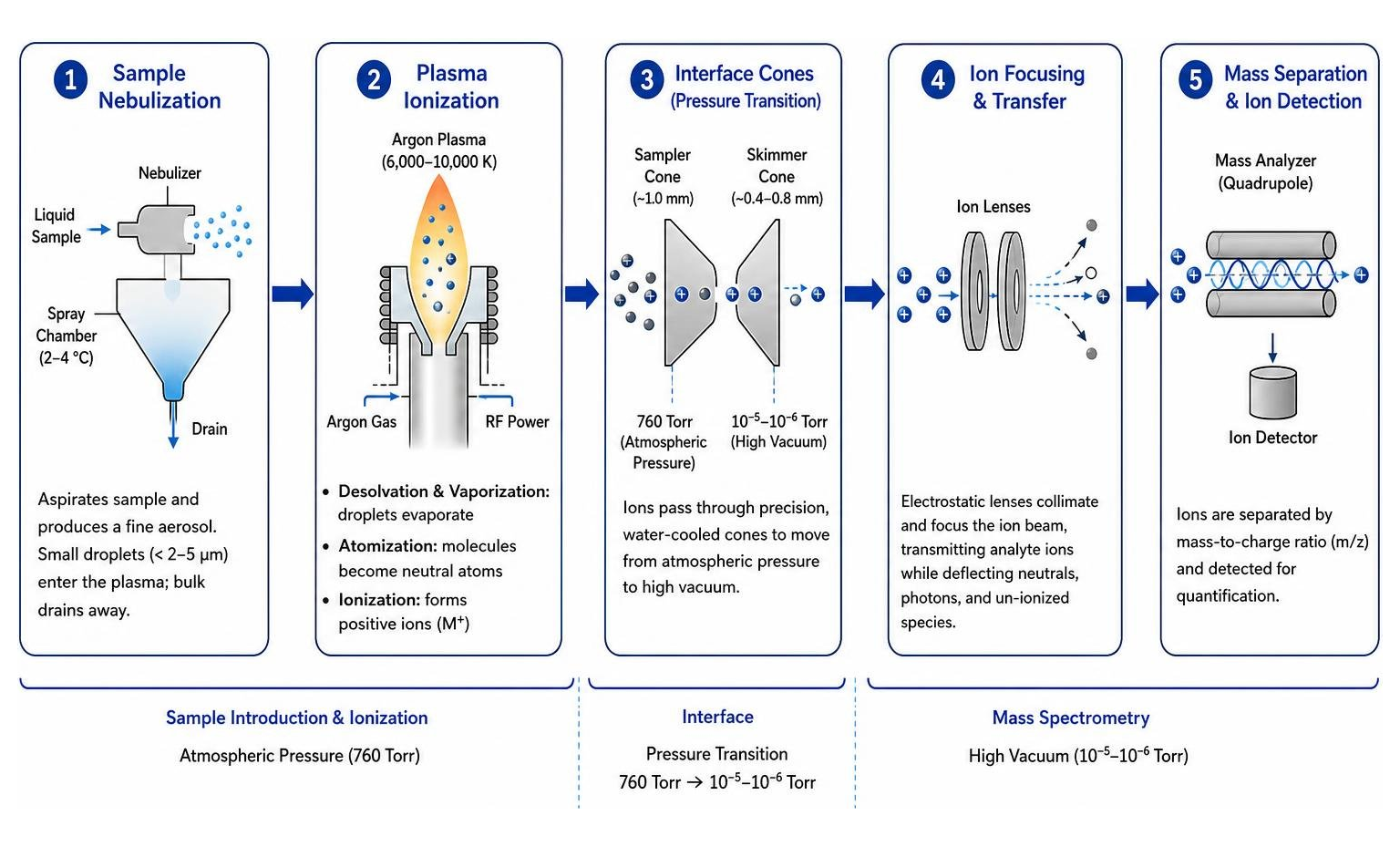
To analyze a liquid sample, the instrument first aspirates the fluid through a pneumatic nebulizer, converting it into a fine mist inside a temperature-regulated spray chamber. Only the smallest droplets (typically under 2 to 5 µm in diameter) travel into the core of the plasma torch. The remaining bulk drains away to prevent thermal overloading of the discharge.
The plasma torch itself is sustained by radiofrequency (RF) power coupled into a continuous stream of ultra-high-purity argon gas. Operating at extreme temperatures between 6,000 K and 10,000 K, this plasma serves three distinct physical roles:
- Desolvation and Vaporization: Droplets instantly flash-evaporate, shedding their solvent shells and leaving behind solid micro-particulates.
- Atomization: Thermal energy breaks molecular bonds, reducing compound complexes into discrete neutral ground-state atoms.
- Ionization: The high ionization potential of argon ($15.76\text{ eV}$) strips electrons from sample atoms, generating a stream of predominantly singly charged positive ions ($M^+$).
Once ionized, these positive ions must transfer from atmospheric pressure ($760\text{ Torr}$) into the high-vacuum region of the mass analyzer ($10^{-5}$ to $10^{-6}\text{ Torr}$). This transition occurs across an interface consisting of two precision-machined, water-cooled metal cones: the sampler cone (orifice diameter $\approx 1.0\text{ mm}$) and the skimmer cone (orifice diameter $\approx 0.4\text{ to }0.8\text{ mm}$).
As the ion beam passes through the skimmer cone, electrostatic ion lenses collimate the stream, steering positively charged analyte ions into the mass analyzer while deflecting neutral gas molecules, un-ionized particulates, and photons away from the detector to maintain a quiet analytical background. Inside the mass filter, ions are separated strictly according to their mass-to-charge ratio ($m/z$).
Because modern detectors handle both analog and pulse-counting modes, ICP-MS quantifies 50 to 70+ elements simultaneously across a wide linear dynamic range spanning up to nine orders of magnitude in a single measurement cycle. To explore the underlying physics of this process in greater detail, see our technical breakdown of how ions are generated and measured in high-temperature plasma.
Core Components of an ICP-MS System
An ICP-MS instrument relies on five integrated functional assemblies:
- Sample Introduction System: Comprises a peristaltic pump, a concentric or cross-flow nebulizer, and a Peltier-cooled spray chamber (held at 2 °C to 4 °C). This assembly ensures uniform aerosol generation while condensing excess solvent vapor to stabilize plasma temperature.
- Plasma Torch and RF Generator: A set of concentric quartz tubes delivering outer plasma gas, intermediate auxiliary gas, and central nebulizer carrier gas. An RF load coil (operating at 27 or 40 MHz with 1,000 to 1,600 W of forward power) generates the electromagnetic field that sustains the argon discharge.
- Vacuum Interface and Extraction Optics: Platinum or nickel cones extract the central channel of the plasma. Downstream ion optics (extraction lenses, chicane deflectors, or octopole ion guides) focus the positive ions into a narrow, high-velocity beam.
- Mass Analyzer: The sorting engine of the instrument. Common configurations include:
- Single Quadrupole: Four parallel hyperbolic metal rods driven by combined direct current (DC) and radiofrequency voltages to filter ions sequentially by $m/z$.
- Time-of-Flight (TOF): Accelerates ion packets down a field-free drift tube, calculating $m/z$ by measuring arrival times for high-speed spectral acquisition.
- High-Resolution Magnetic Sector (HR-ICP-MS): Uses magnetic and electrostatic sectors to physically bend ion trajectories, separating isobaric and polyatomic overlaps with resolving powers exceeding $m/\Delta m > 10,000$.
- Detection System: Electron multipliers (discrete dynode designs) and Faraday detectors capable of converting single ion impacts into measurable electric pulses with response times below 100 microseconds.
How Does ICP-MS Compare to Alternative Elemental Techniques?
Selecting the right elemental spectroscopy tool depends on required detection limits, sample throughput, operational budgets, and sample matrices. Laboratories evaluating trace-metal capabilities typically weigh ICP-MS against Inductively Coupled Plasma Optical Emission Spectroscopy (ICP-OES).
ICP-MS delivers the lowest routine detection limits of any commercial elemental technique. In relatively clean aqueous matrices, instrument detection limits (IDLs) for the majority of the periodic table fall below $0.1\ \mu\text{g/L}$ ($100\text{ ppt}$), with many heavy metals detectable at sub-part-per-trillion levels (nanograms per liter). For challenging or less sensitive elements like selenium ($\text{Se}$) and arsenic ($\text{As}$), IDLs generally stay at or below $1.0\ \mu\text{g/L}$.
In contrast, ICP-OES measures light emitted by excited atoms and ions relaxing back to their ground state. While rugged and capable of handling high dissolved solids, its detection limits typically bottom out in the parts-per-billion ($\mu\text{g/L}$) to parts-per-million ($\text{mg/L}$) range—roughly two to three orders of magnitude higher than ICP-MS.
When evaluating your testing workflow, practical guidance on choosing between ICP-OES and ICP-MS helps clarify how sample volumes and target thresholds shape instrument selection.
| Analytical Parameter | ICP-MS (Quadrupole) | ICP-OES |
|---|---|---|
| Typical Detection Range | $0.001\text{ to }0.1\ \mu\text{g/L}$ ($\text{ppt}\text{–}\text{ppb}$) | $0.5\text{ to }10\ \mu\text{g/L}$ ($\text{ppb}\text{–}\text{ppm}$) |
| Multi-Element Capability | Simultaneous ($50\text{–}70+$ elements) | Simultaneous ($60\text{–}70+$ elements) |
| Sample Throughput | $20\text{–}40\text{ samples/hour}$ | $30\text{–}60\text{ samples/hour}$ |
| TDS Tolerance Limit | $\le 0.2\%$ ($2,000\ \text{mg/L}$) | Up to $10\text{–}20\%$ ($200,000\ \text{mg/L}$) |
| Linear Dynamic Range | Up to $10^9$ | $10^5\text{ to }10^6$ |
| Isotopic Analysis | Yes (Ratios, Tracers) | No |
| Operational Gas Demand | High ($\text{Ar}$, collision gas) | High ($\text{Ar}$) |
Matrix Tolerance and Operational Trade-Offs
The primary limitation of ICP-MS centers on total dissolved solids (TDS). Because samples enter the high-vacuum region through small cone orifices, introducing solutions containing more than $0.2\%$ ($2,000\ \text{mg/L}$) dissolved solids causes salt deposition on the skimmer cone tip. Over time, this leads to orifice narrowing, signal drift, loss of sensitivity, and eventual shutdown.
Laboratories working with seawater, brine streams, or high-alloy digests must apply aerosol dilution systems, clean wet chemistry digestions, or physical sample dilutions before analysis.
Operational costs for ICP-MS are also higher than optical emission instruments due to high-purity collision gases (such as helium and hydrogen), routine interface cone maintenance, and periodic vacuum pump servicing. However, ICP-MS remains the only standard laboratory tool capable of measuring isotopic ratios—such as evaluating $^{206}\text{Pb}/^{207}\text{Pb}$ for environmental source tracking or resolving actinide isotope variations.
What Are the Most Critical Applications of ICP-MS Across Industries?

ICP-MS is widely used across materials testing, pharmaceutical manufacturing, environmental safety, and advanced manufacturing. Its ability to screen for low-level contaminants makes it indispensable when monitoring toxicity or process-limiting impurities.
In environmental programs, laboratories rely on ICP-MS for screening toxic heavy metals like lead ($\text{Pb}$), cadmium ($\text{Cd}$), arsenic ($\text{As}$), and mercury ($\text{Hg}$) in consumer goods, municipal water networks, and industrial manufacturing streams.
Petrochemical Refining and Catalyst Protection
In crude oil refining and petrochemical synthesis, metal contaminants can impair unit operations even at low concentrations. Trace organometallic species found in heavy feedstocks and gas condensates cause equipment degradation and reduce process efficiency:
- Vanadium ($\text{V}$) and Nickel ($\text{Ni}$): Naturally occurring petroporphyrin complexes deposit directly onto Fluid Catalytic Cracking (FCC) zeolites. Vanadium acts as a flux, destroying catalyst crystalline structures at regenerator temperatures ($>700\ ^\circ\text{C}$). Nickel promotes unwanted dehydrogenation reactions, increasing hydrogen and coke production at the expense of valuable gasoline and diesel yields.
- Arsenic ($\text{As}$): Present in volatile petroleum fractions, arsenic permanently blocks active acid sites in platinum/palladium hydrotreating and isomerization catalyst beds, causing premature bed deactivation.
- Mercury ($\text{Hg}$): Ultra-trace elemental and organomercury in natural gas condensates amalgamate with aluminum heat exchangers in cryogenic cold boxes, leading to liquid metal embrittlement and catastrophic unit failures.
- Sodium ($\text{Na}$) and Iron ($\text{Fe}$): Sodium accelerates catalyst coking and thermal cracking, while particulate iron creates pressure-drop spikes in hydroprocessor guard beds.
Refinery laboratories monitor these poisons using standardized protocols, such as ASTM D5708 (for nickel, vanadium, and iron in crude oils) and ASTM D7691 (for trace elements in fuel and lubricant bases). Catching metal spikes early helps operators optimize demetallization feed blending and protect high-value catalyst inventories.
Environmental Monitoring and Regulatory Testing
Environmental regulatory frameworks depend on ICP-MS to quantify toxic contaminants in natural and engineered waters. For solid waste extracts, industrial discharges, and soils, testing frequently follows Method 6020B: Inductively Coupled Plasma – Mass Spectrometry, the standard reference from the EPA’s SW-846 compendium for measuring sub-$\mu\text{g/L}$ concentrations of more than 60 elements.
For surface runoff, drinking water distribution systems, and groundwater monitoring wells, laboratories apply strict environmental water analysis protocols governed by EPA Method 200.8. ICP-MS easily resolves regulatory action levels—such as the revised Lead and Copper Rule improvements—by establishing detection limits below $0.05\ \mu\text{g/L}$, safeguarding water quality before trace contaminants reach communities.
How Do You Overcome Common ICP-MS Interferences and Matrix Challenges?
Because ICP-MS relies on mass filtering, spectral overlaps can distort analytical readings. Interferences are grouped into two primary classes: spectral and non-spectral.
1. Spectral Interferences
- Isobaric Overlaps: Occur when two distinct elements share isotopes at the same nominal mass (e.g., $^{114}\text{Cd}^+$ and $^{114}\text{Sn}^+$ at $m/z\ 114$). These are corrected mathematically by monitoring an alternate interference-free isotope of the offending element (e.g., measuring $^{118}\text{Sn}$ to calculate and subtract $^{114}\text{Sn}$).
- Polyatomic (Molecular) Ions: Formed when argon, matrix solvent atoms ($\text{H}$, $\text{O}$, $\text{N}$), and sample components recombine in the cooler plasma boundary or interface region. Classic examples include:
- $^{40}\text{Ar}^{35}\text{Cl}^+$ overlapping $^{75}\text{As}^+$ at $m/z\ 75$ (common in chlorinated or saline matrices).
- $^{40}\text{Ar}^{16}\text{O}^+$ overlapping $^{56}\text{Fe}^+$ at $m/z\ 56$.
- $^{40}\text{Ar}_2^+$ overlapping $^{80}\text{Se}^+$ at $m/z\ 80$.
- $^{35}\text{Cl}^{16}\text{O}^+$ overlapping $^{51}\text{V}^+$ at $m/z\ 51$.
- Doubly Charged Ions ($M^{2+}$): Elements with low second-ionization potentials (such as barium and rare earth elements) strip two electrons, appearing at half their true atomic mass (e.g., $^{138}\text{Ba}^{2+}$ overlapping $^{69}\text{Ga}^+$ at $m/z\ 69$).
2. Non-Spectral Interferences
- Physical Matrix Effects: Variations in viscosity, dissolved solids, or surface tension that alter nebulization efficiency and droplet transport.
- Ionization Suppression: High concentrations of easily ionized elements (like sodium, potassium, or calcium) drain plasma energy, lowering the ionization efficiency of high-ionization-potential analytes.
Collision and Reaction Cell Strategies
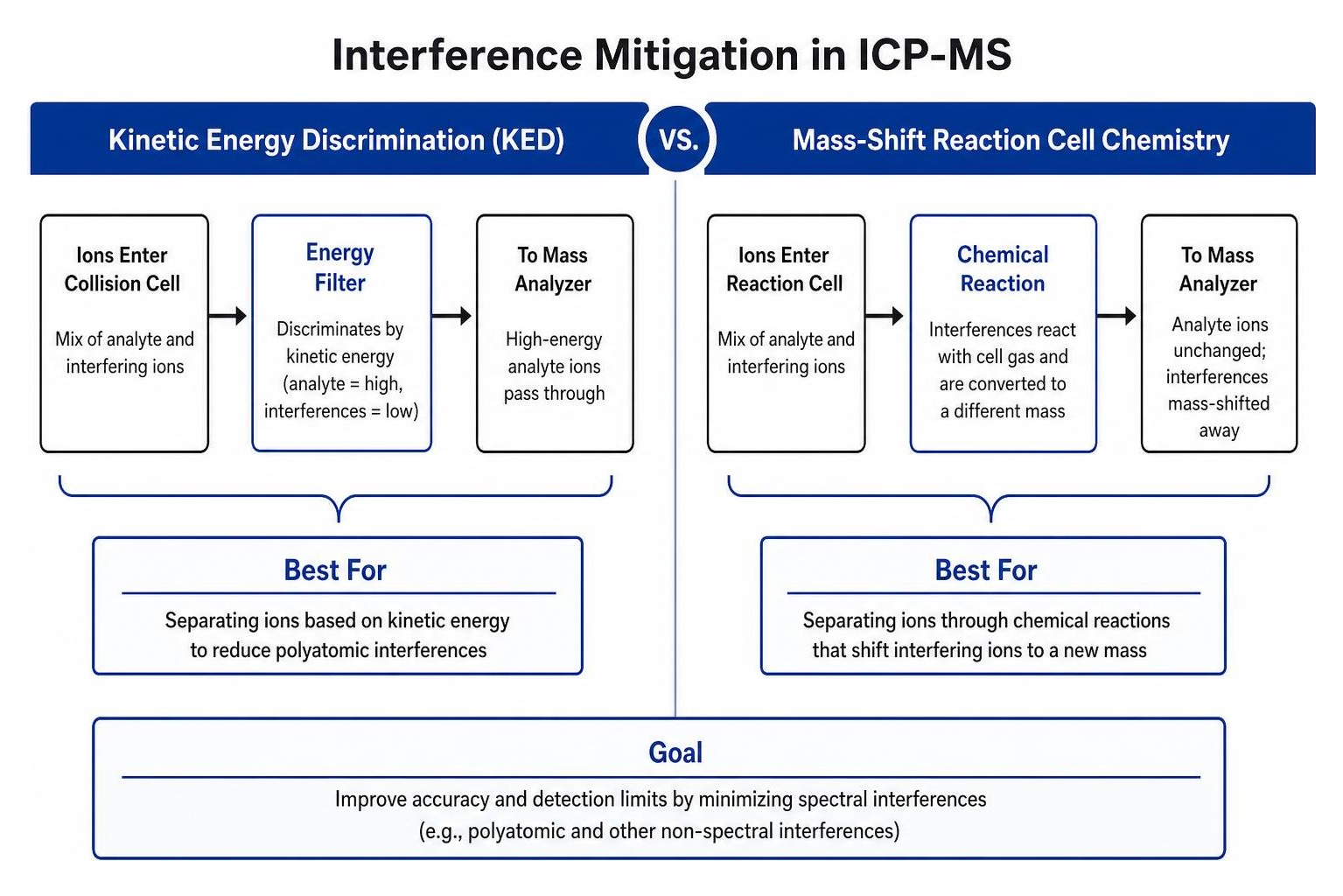
Modern instruments resolve polyatomic interferences using Collision/Reaction Cells (CRCs) placed before the mass analyzer:
- Kinetic Energy Discrimination (KED) with Helium: Pressurizing the cell with an inert gas like pure helium causes polyatomic ions (which have larger collision cross-sections than monatomic analyte ions) to collide more frequently with helium atoms. The molecular ions lose kinetic energy and are filtered out by a downstream electrostatic potential barrier. KED provides a universal interference-reduction mode that handles common argide and chloride overlaps without creating new product ions.
- Reaction Mode with Reactive Gases: Introducing active gases ($\text{O}_2$, $\text{H}_2$, $\text{NH}_3$, $\text{N}_2\text{O}$) drives specific gas-phase chemical reactions. In tandem quadrupole instruments (ICP-MS/MS), the first quadrupole selects a single mass, the reaction cell shifts the analyte or interference to a new mass channel (e.g., shifting $^{75}\text{As}^+$ with oxygen to measure $^{75}\text{As}^{16}\text{O}^+$ at $m/z\ 91$), and the second quadrupole filters out the background. This mass-shift mechanism is detailed extensively in recent research on tandem quadrupole mass spectrometry.
Sample Preparation and Matrix Management
Effective sample preparation prevents cone fouling, eliminates background bias, and ensures stable plasma transmission:
- Closed-Vessel Microwave Acid Digestion: For difficult matrices like crude oils, polymers, and refractory minerals, high-pressure microwave digestion with concentrated high-purity nitric acid ($\text{HNO}_3$), hydrochloric acid ($\text{HCl}$), and hydrofluoric acid ($\text{HF}$) breaks down the carbon backbone and solubilizes complex silicates.
- Organic Solvent Dilution: When testing volatile petroleum products and lubricant bases directly, samples are diluted in high-purity solvents (such as xylene, odorless kerosene, or mineral spirits). An auxiliary oxygen flow ($20\text{ to }50\ \text{mL/min}$) is mixed into the plasma carrier gas to oxidize carbon into gaseous $\text{CO}_2$, preventing carbon soot from depositing on the interface cones.
- Trace-Clean Laboratory Workflows: Contamination control is essential at ppt detection levels. Digestion vessels should be acid-leached, reagents must be double-distilled Optima-grade, and dilutions require deionized water ($>18.2\ \text{M}\Omega\cdot\text{cm}$). A practical breakdown of sample preparation protocols is available in our overview of accurate trace element testing procedures.
Calibration, Tuning, and Internal Standardization
System reliability begins with a structured daily startup protocol:
- Instrument Tuning: A multi-element tune solution containing low-abundance isotopes across the mass spectrum (e.g., $1.0\ \mu\text{g/L}$ of $\text{Li}$, $\text{Y}$, $\text{Ce}$, $\text{Tl}$, and $\text{Co}$) confirms lens voltage alignment, mass calibration, and resolution ($\le 0.8\text{ u}$ at $10\%$ peak height).
- Plasma Robustness Checks: Technicians verify that the oxide ratio ($^{156}\text{CeO}^+/^{140}\text{Ce}^+$) remains under $1.5\text{ to }2.0\%$ and the doubly charged ratio ($^{70}\text{Ce}^{2+}/^{140}\text{Ce}^+$) stays under $3.0\%$ to ensure high ionization efficiency with minimal oxide generation.
- Internal Standard Tracking: Internal standards—elements naturally absent from the sample, such as scandium ($^{45}\text{Sc}$), yttrium ($^{89}\text{Y}$), indium ($^{115}\text{In}$), terbium ($^{159}\text{Tb}$), and bismuth ($^{209}\text{Bi}$)—are added inline to all calibration standards, blanks, and samples. The instrument normalizes target analyte counts against internal standard recoveries ($70\text{ to }130\%$), correcting for minor nebulizer drift, physical matrix suppression, and aerosol transport variations over long analytical batches.
Frequently Asked Questions About ICP-MS?
What is the typical detection limit achievable with ICP-MS?
For the vast majority of elements in clean, acidified aqueous solutions, ICP-MS achieves instrument detection limits below $0.1\ \mu\text{g/L}$ (100 parts per trillion), with many elements reaching single-digit parts-per-trillion ($<0.005\ \mu\text{g/L}$) or parts-per-quadrillion levels.
Elements with elevated first-ionization potentials, high atmospheric blanks, or persistent polyatomic interferences—such as selenium ($\text{Se}$), arsenic ($\text{As}$), iron ($\text{Fe}$), and silicon ($\text{Si}$)—may show baseline detection limits of $0.5\text{ to }1.0\ \mu\text{g/L}$ on single-quadrupole systems without advanced collision cell configurations.
Method Detection Limits (MDLs) will also reflect any necessary digestion and dilution factors applied to the original sample.
Why are internal standards essential during ICP-MS testing?
Internal standards correct for physical and non-spectral analytical errors that occur during run sequences.
Variations in total dissolved solids, sample viscosity, and acid concentrations alter nebulization rates and suppress ionization efficiency in the argon plasma. Additionally, physical deposition on interface cones can cause gradual instrumental drift over multi-hour runs.
By measuring a known, constant concentration of reference elements ($\text{Sc}$, $\text{Y}$, $\text{In}$, $\text{Bi}$) across every sample, the software normalizes target analyte responses against the internal standard signal, correcting for instrumental drift and sample transport changes.
When should a laboratory choose ICP-MS/MS (triple quad) over standard quadrupole ICP-MS?
A laboratory should select a tandem quadrupole system (ICP-MS/MS) when working with complex samples where standard kinetic energy discrimination (KED) cannot resolve severe, overlapping spectral interferences.
Standard single-quadrupole systems pass all ions into the collision cell, creating the potential for secondary reactions that form new polyatomic interferences. ICP-MS/MS uses an initial quadrupole filter (Q1) to select a narrow target mass before the ion enters the reaction cell (Q2). A reactive gas ($\text{O}_2$, $\text{NH}_3$, $\text{H}_2$) then chemically shifts the target analyte or the interferent to a distinct mass channel, where the final quadrupole (Q3) isolates it for detection.
This approach is critical for resolving challenging matrices in rare earth element purification, nuclear actinide characterization, and ultra-trace sulfur, phosphorus, or silicon analysis.
How Can Elemental Analysis Inc. Support Your Trace Element Testing Needs?
At Elemental Analysis Inc., we provide trace element identification, quantification, and speciation services designed to help you meet stringent regulatory limits, protect sensitive equipment, and verify product purity. Our laboratory in Lexington, Kentucky, serves industrial manufacturers, petrochemical refiners, environmental managers, and research teams across the United States.
What sets our capabilities apart is our multi-technique laboratory infrastructure. We combine destructive wet chemical techniques—including high-resolution ICP-MS and ICP-OES—with non-destructive methods like Particle-Induced X-ray Emission (PIXE), a service we pioneered as the first commercial PIXE laboratory.
Whether you need to monitor catalyst poisons in hydrocarbon feedstocks, satisfy EPA discharge permits, or characterize advanced nanomaterials, our team delivers defensible data with fast turnaround times.
Learn more about our complete analytical scope in our guide to comprehensive elemental analysis, or contact our technical team in Lexington today to discuss testing protocols, sample submission workflows, and customized project quotes.