
Evaluating Chemical Safety Through Professional Toxicology Support
Why Toxicology Support Services Matter for Chemical Safety
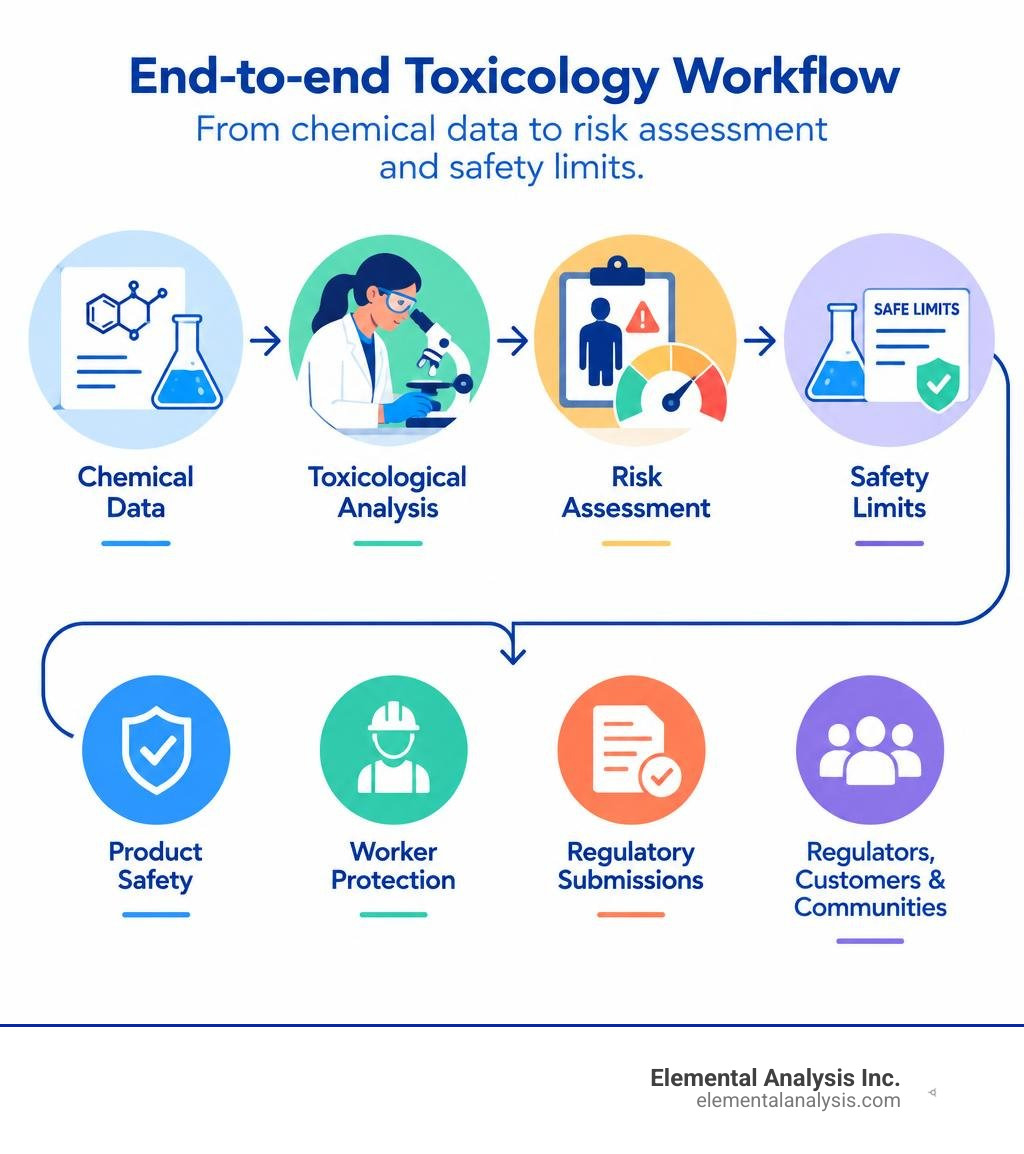
Toxicology support services help organizations turn chemical test results into clear safety decisions. A qualified toxicologist can identify hazards, assess realistic exposure, set safe limits, and prepare defensible documentation for regulators, workers, and customers.
For lab supervisors and technical managers, the practical starting point is simple:
- Define the material, use case, and likely exposure routes.
- Obtain reliable analytical data, including trace contaminants where needed.
- Have a toxicology expert assess dose-response, exposure risk, and applicable safety limits.
- Use the findings to support product safety, worker protection, and regulatory submissions.
This work can cover pharmaceutical impurities, potent compounds, elemental contaminants, extractables and leachables, environmental exposures, and consumer-product risks. It also connects analytical results with wider needs such as FDA, EMA, ICH, REACH, and occupational health compliance.
The goal is not merely to find a chemical. It is to understand whether its amount, route of exposure, and real-world use could create an unacceptable risk.
Discover more about toxicology support services:
Scope of Core Toxicology Support Services Across Industries
Whether you operate a pharmaceutical facility, manage chemical synthesis, or develop medical devices, determining the boundary between an effective product and a toxic hazard requires rigorous scientific evaluation. Toxicology consulting bridges the gap between raw analytical chemistry data and actionable risk mitigation.
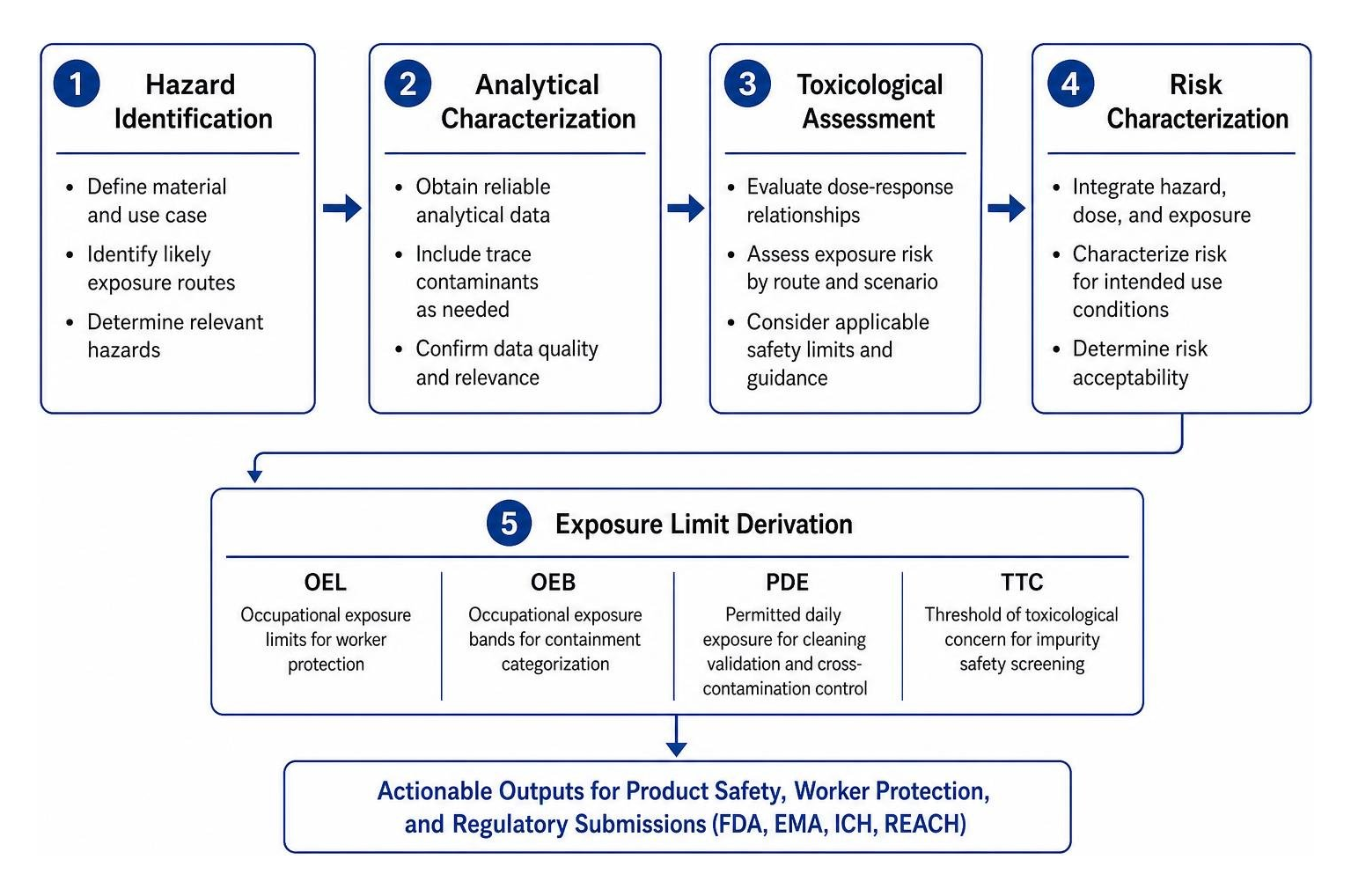
At its core, a complete toxicological evaluation systematically breaks down chemical hazard identification, dose-response assessment, exposure profiling, and risk characterization. When working with highly potent substances, industrial hygienists and safety officers rely heavily on derived safety thresholds to engineer effective containment strategies.
| Exposure Limit / Parameter | Primary Application | Key Regulatory / Industry Driver | Typical Output Format |
|---|---|---|---|
| Occupational Exposure Limit (OEL) | Worker safety in manufacturing environments | OSHA, SafeBridge®, ECHA | $\mu\text{g/m}^3$ (8-hour TWA) |
| Occupational Exposure Band (OEB) | Containment categorization for early-stage or uncharacterized compounds | Industrial Hygiene Best Practices | Band 1 through Band 5/6 |
| Permitted Daily Exposure (PDE) | Cleaning validation and shared facility cross-contamination limits | EMA, FDA, ICH Q3C/Q3D | $\text{mg/day}$ or $\mu\text{g/day}$ |
| Threshold of Toxicological Concern (TTC) | Impurity safety screening with limited toxicity data | ICH M7, EFSA | $\mu\text{g/day}$ intake |
Regulatory Strategy and Global Dossier Submissions
Navigating the landscape of international regulatory authorities can feel like deciphering an ancient dialect. Health authorities worldwide—including the US FDA, the European Medicines Agency (EMA), and the European Chemicals Agency (ECHA)—demand comprehensive nonclinical safety profiles before granting market authorizations.
Toxicology consulting services directly support these milestones by structuring Common Technical Document (CTD) Module 4 nonclinical study reports, compiling safety documentation for Investigational New Drug (IND) applications, and registering industrial substances under REACH. By aligning testing programs with OECD and ICH harmonized guidelines early in development, sponsors avoid costly redundant studies and regulatory pushback.
Establishing Permitted Daily Exposure and Occupational Exposure Limits
In shared manufacturing facilities, multi-product cross-contamination represents a major compliance hazard. Regulatory agencies mandate clear, scientifically derived Permitted Daily Exposure (PDE) values—also referred to as Acceptable Daily Exposures (ADEs)—to establish validated equipment cleaning limits.
Calculating an accurate PDE requires a certified toxicologist to evaluate:
- The No Observed Adverse Effect Level (NOAEL) or Lowest Observed Adverse Effect Level (LOAEL) from robust animal and clinical studies.
- Route-to-route bioavailability adjustments (oral, parenteral, inhalation, dermal).
- Compound-specific adjustment factors ($F1$ through $F5$) accounting for interspecies variability, human inter-individual variation, study duration, toxicity severity, and data completeness.
Simultaneously, Occupational Exposure Limits (OELs) protect chemical operators handling bulk active pharmaceutical ingredients (APIs), excipients, and fine reagents. Setting accurate 8-hour time-weighted average air concentrations ensures engineering controls—such as isolators, laminar flow hoods, and specialized HVAC systems—are matched precisely to compound potency.
Potent Compound Safety and SafeBridge® Certification
As pharmaceutical research leans increasingly into targeted oncology therapeutics, antibody-drug conjugates (ADCs), and highly potent synthetic peptides, safe handling requirements have intensified. A compound exhibiting biological activity at microgram or sub-microgram thresholds demands specialized verification.
SafeBridge® Potent Compound Safety Certification serves as an industry gold standard for evaluating and validating facility containment. Toxicologists classify molecules into discrete occupational hazard categories, audit facility engineering barriers, review industrial hygiene monitoring protocols, and certify that manufacturing sites safely handle potent APIs without endangering personnel or contaminating adjacent production suites.
Nonclinical Safety Evaluation and Advanced Methodologies
Before a new therapeutic candidate enters human clinical trials, its biological behavior, pharmacokinetics, and safety liabilities must undergo exhaustive testing. Nonclinical toxicology services guide developers through protocol design, Good Laboratory Practice (GLP) compliance, and in-depth study monitoring.
Integrating Toxicology Support Services in Nonclinical Study Design
Formulating an IND-enabling safety package is not a one-size-fits-all endeavor. Small molecules require standard battery testing—including safety pharmacology, genetic toxicology, acute toxicity, and repeat-dose studies in rodent and non-rodent models. Conversely, advanced modalities such as cell therapies, gene therapies, oligonucleotides, and recombinant proteins demand custom-tailored regimens.
Toxicology consultants manage outsourced work packages by:
- Selecting and vetting qualified Contract Research Organizations (CROs).
- Designing specialized study architectures, including juvenile animal toxicity for pediatric indications, combination toxicity for co-packaged drug-device products, and specialized non-human primate (NHP) models for species-specific biologics.
- Performing independent peer reviews and continuous GLP study monitoring to maintain audit readiness.
Computational Toxicology, Toxicogenomics, and New Approach Methodologies (NAMs)
Modern safety science has evolved far beyond traditional animal testing. Driven by the 3Rs principles (Replacement, Reduction, and Refinement), the industry increasingly relies on New Approach Methodologies (NAMs) and computational screening tools.
Quantitative Structure-Activity Relationship (QSAR) modeling and read-across assessments enable toxicologists to predict mutagenicity, carcinogenicity, and skin sensitization for novel intermediates and synthetic impurities without sacrificing animal life. Furthermore, integrating toxicogenomics allows researchers to analyze early molecular markers of cellular stress, altered gene expression, and metabolic disruption, identifying liabilities long before overt organ pathology manifests.
Certified Toxicologist Oversight and Peer Review
Regulatory agencies expect toxicology reports to be authored and reviewed by accredited experts. Registrations like the European Registered Toxicologist (ERT) credential through EUROTOX or board certification via the American Board of Toxicology (DABT) verify rigorous peer-recognized competence.
Securing certified toxicologist oversight guarantees that risk assessments feature transparent rationale, defensible uncertainty factors, and full audit traceability. When selecting testing partners to feed data into these evaluations, learning how to choose the right heavy metal testing laboratory ensures that baseline analytical data withstands scrutiny from both peer reviewers and regulatory auditors.
Impurity Profiling, Contaminant Risk Assessments, and Chemical Testing
Regulatory authorities expect manufacturers to actively screen, identify, and control chemical impurities across product life cycles. Whether an impurity originates from raw materials, synthetic degradation, manufacturing contact surfaces, or packaging materials, its presence demands a swift safety assessment.

Nitrosamines, Elemental Impurities, and Extractables & Leachables
Unintended contaminants pose significant safety risks if left unmanaged:
- Nitrosamines: These cohort-of-concern compounds exhibit potent mutagenic and carcinogenic properties at trace levels. Toxicologists evaluate synthetic pathways and raw material chemistry to establish compound-specific acceptable intake limits.
- Extractables and Leachables (E&L): Processing equipment, single-use bags, tubing, elastomers, and final container closure systems can leach organic and inorganic chemical species into formulations. Toxicological evaluation characterizes toxicological thresholds for volatile, semi-volatile, and non-volatile leachables.
- Elemental Impurities: Heavy metals and residual catalysts can compromise product stability and patient safety. Navigating these risks requires adherence to USP elemental impurities standards and international harmonized directives. Consulting an established guide to elemental impurities testing and FDA guidelines helps manufacturers determine permitted daily exposures based on product dosing regimens.
Inhalation Toxicology and Target Organ Health Risk Evaluations
Exposure routes profoundly influence toxic outcomes. While an ingested metal may pass through the gastrointestinal tract with limited bioavailability, aerosolized particulates or volatile organic compounds (VOCs) deposited in deep alveolar tissue can trigger acute and chronic pulmonary disease.
Toxicological consulting evaluates pulmonary pathologies—such as occupational asthma, chronic obstructive pulmonary disease (COPD), reactive airway dysfunction, and pulmonary fibrosis. Comprehensive risk assessments map exposure to target-organ mechanisms, drawing upon heavy metals analysis and human health risks to quantify cellular damage, oxidative stress, and long-term systemic toxicity. In urgent situations, these methodologies parallel principles used in clinical toxicology and emergency management to identify toxicant etiologies and guide exposure interventions.
Forensic Investigations and Product Liability Consulting
Beyond manufacturing and drug development, toxicology consulting plays an indispensable role in legal disputes, occupational health claims, and forensic investigations. When health injury, workplace contamination, or consumer product liability claims arise, objective scientific evaluation determines whether a verified biological causal link exists between chemical exposure and claimed injury.
Toxicologists support both plaintiff and defense counsel by providing rigorous, fact-based exposure reconstruction. This process involves evaluating:
- Biomarkers and Pharmacokinetics: Reviewing blood, urine, or tissue concentrations and calculating post-exposure elimination kinetics.
- Dose-Response Verification: Determining whether real-world environmental or occupational concentrations were sufficient to trigger the alleged clinical pathology.
- Alternative Etiologies: Evaluating background exposures, medical history, and confounding factors that could explain the symptoms.
- Surveillance Data Integration: Corroborating clinical patterns with regional health networks and regional poison and exposure surveillance data.
Forensic and Legal Applications of Toxicology Support Services
In product liability, environmental contamination, and occupational disability litigation, certified toxicologists deliver expert witness services, independent report evaluations, and deposition testimony. From evaluating California Proposition 65 chemical exposure safe harbor levels to resolving out-of-specification (OOS) industrial contamination disputes, specialized toxicological analysis delivers evidence that stands up in court.
Evaluating Chemical Adulteration, Consumer Exposures, and Impairment
Forensic toxicology also extends into food safety, commercial consumer goods, and impairment determinations. In cases involving suspected food adulteration, undeclared allergens, or toxic packaging migrants, toxicologists evaluate ingestion metrics against established acute reference doses.
Similarly, in industrial workplace incidents or transportation accidents, toxicologists analyze drug and alcohol metabolomics to determine psychomotor impairment at the precise time of machinery operation, distinguishing between parent drug activity and inactive metabolic remnants.
Frequently Asked Questions About Toxicology Support Services
What credentials should you look for in a professional toxicology consultant?
When engaging a toxicology consultant, prioritize professionals holding recognized board certifications, such as a Diplomate of the American Board of Toxicology (DABT) or registration as a European Registered Toxicologist (ERT) through EUROTOX. Look for consultants with demonstrated experience in your specific product classification, direct familiarity with global regulatory frameworks (FDA, EMA, ECHA, OECD), and a proven track record of authoring audit-ready safety dossiers.
How do toxicology support services establish Permitted Daily Exposure limits?
Establishing a Permitted Daily Exposure (PDE) involves identifying the critical toxicological effect and determining the point of departure—typically the No Observed Adverse Effect Level (NOAEL) or Lowest Observed Adverse Effect Level (LOAEL)—from relevant animal or human clinical studies.
The toxicologist then applies compound-specific adjustment factors ($F1$ through $F5$) to account for species extrapolation, human variability, study duration, nature of the toxicity, and database completeness, alongside adjustments for body weight and bioavailability:
$$\text{PDE} = \frac{\text{NOAEL} \times \text{Weight Adjustment}}{F1 \times F2 \times F3 \times F4 \times F_5}$$
Why are New Approach Methodologies increasingly used in regulatory toxicology?
New Approach Methodologies (NAMs)—including in silico QSAR modeling, high-throughput cell assays, organ-on-a-chip technologies, and read-across frameworks—are gaining regulatory traction because they accelerate screening timelines, reduce R&D costs, and align with ethical 3Rs mandates (Replacement, Reduction, Refinement). Regulators increasingly accept validated NAM data to qualify synthetic impurities, screen chemical libraries, and characterize mechanisms of action where traditional animal models provide limited predictive value.
Conclusion
Navigating the complexities of chemical safety, regulatory submissions, and occupational health requires more than just raw data—it demands expert interpretation. Professional toxicology support translates complex exposure profiles into actionable, defensible strategies that protect workers, consumers, and product timelines.
At Elemental Analysis Inc., located in Lexington, Kentucky, we combine high-precision analytical chemistry with rapid turnaround to support your safety goals. As the nation’s premier commercial Particle Induced X-ray Emission (PIXE) laboratory, our team delivers non-destructive and destructive trace element identification, quantification, and speciation down to low detection limits. Pair your toxicology evaluations with our comprehensive analytical testing services to achieve complete regulatory confidence and product safety.