
Why ICP-MS for Biofuel Testing Matters
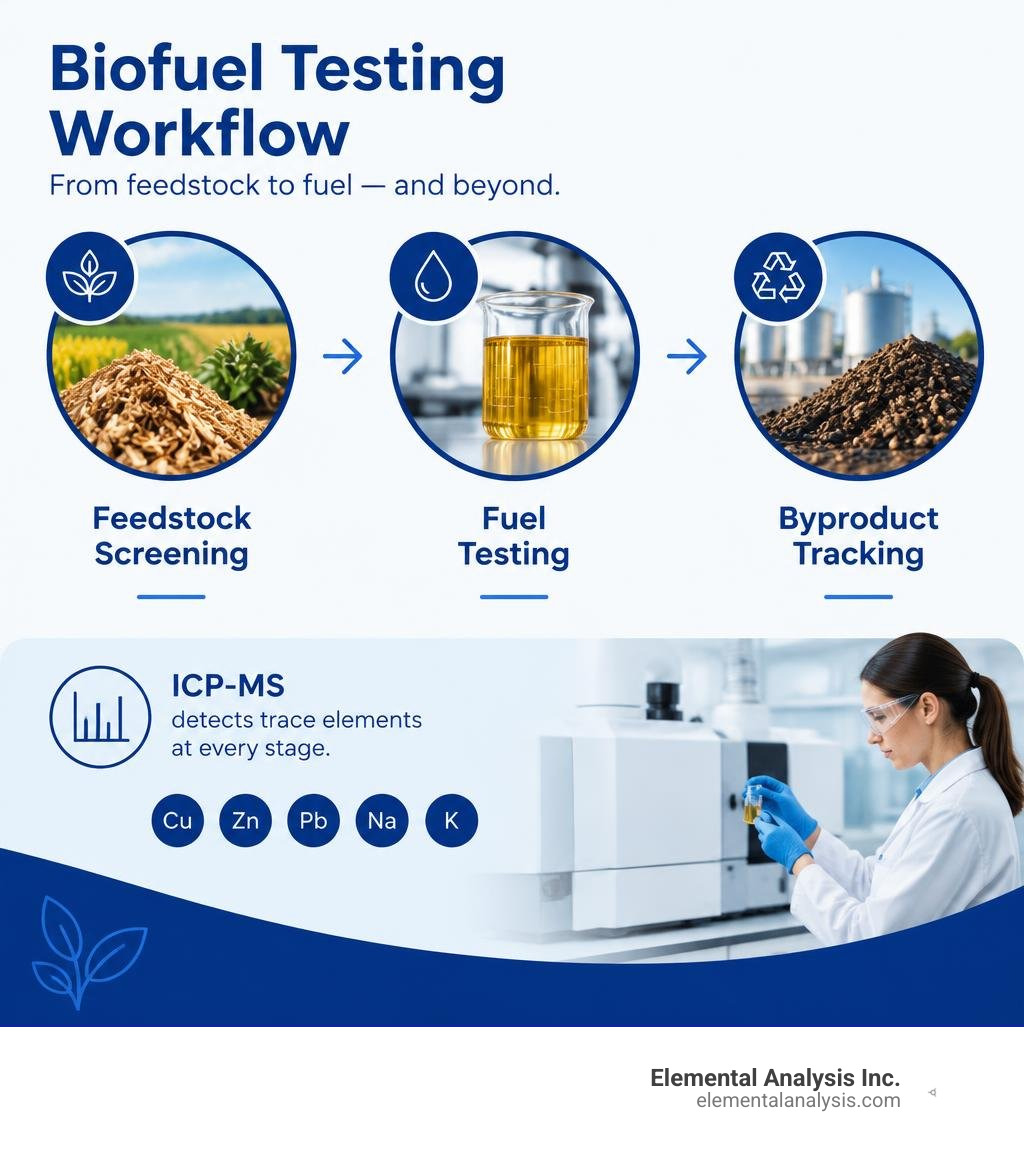
ICP-MS for biofuel testing measures trace elements in feedstock, finished fuel, and byproducts. It can detect very small amounts of metals such as copper, zinc, and lead, along with residual catalyst elements such as sodium and potassium. That helps labs spot contamination before it affects fuel quality or moves into co-products.
The key is to test at more than one stage. Feedstock results can guide processing; finished-fuel results help check quality; and byproduct results show where contaminants ended up. Because oily samples are hard to measure accurately, the lab must also choose suitable sample preparation and check its results against quality controls.
Icp ms for biofuel vocab explained:
Why ICP-MS for Biofuel Trace Element Analysis Outperforms Other Methods
When analyzing trace elements in modern bio-based fuels, laboratories frequently weigh techniques such as Atomic Absorption Spectrometry (AAS), Inductively Coupled Plasma Optical Emission Spectrometry (ICP-OES), and Inductively Coupled Plasma Mass Spectrometry (ICP-MS). While traditional flame or graphite furnace AAS serves single-element routines and ICP-OES delivers robust high-throughput screening, ICP-MS provides unmatched analytical sensitivity, an expansive dynamic range, and comprehensive multi-element capabilities.
When choosing between ICP-OES and ICP-MS, the primary deciding factors are detection limits and matrix complexity. Biofuels such as pure fatty acid methyl esters (B100), hydrotreated vegetable oil (HVO), and bioethanol require stringent elemental purity checks. In a comparative study on metals analysis in biodiesel blends, ICP-MS consistently demonstrated lower limits of detection and superior precision across complex organic blends compared to legacy emission spectroscopy.
| Analytical Parameter | Flame / Graphite Furnace AAS | ICP-OES | ICP-MS |
|---|---|---|---|
| Typical Detection Limits | ppm (Flame) to ppb (Furnace) | Sub-ppm to mid-ppb | Parts-per-trillion (ppt) to sub-ppb |
| Sample Throughput | Sequential (Single element) | Simultaneous multi-element | Rapid simultaneous multi-element |
| Dynamic Linear Range | 2 to 3 orders of magnitude | 5 to 6 orders of magnitude | Up to 10 orders of magnitude |
| Spectral Interferences | Low spectral, high chemical | Moderate (emission line overlap) | Predictable polyatomic / isobaric |
| Isotopic Analysis | Not capable | Not capable | Fully capable |
| Halogen / Non-Metal Detection | Extremely limited | Moderate (P, S at higher limits) | High (with collision/reaction cells or MS/MS) |
Detection Limit Superiority Over ICP-OES and AAS
The core advantage of ICP-MS lies in its fundamental architecture. Instead of measuring light photons emitted by excited atoms as in ICP-OES, an ICP-MS extracts the ions directly from the plasma and separates them based on their mass-to-charge ratio. This yields detection limits that are several orders of magnitude lower than optical emission techniques (Triantafillidis et al., 2023).
For critical elements such as phosphorus, sodium, potassium, calcium, and magnesium, standard test methods often struggle when concentrations fall below 1 ppm. In biodiesel blends (such as B20), ICP-MS achieves detection limits around 0.001 ppm for phosphorus, potassium, and magnesium, 0.009 ppm for sodium, and down to 0.0005 ppm for calcium. Reviewing ICP mass spectrometry fundamentals shows how direct ion counting minimizes background noise, making it straightforward to quantify trace contaminants well below international regulatory thresholds.
Isotopic Differentiation and Non-Metal Screening Capabilities
Beyond raw sensitivity, ICP-MS can distinguish between different isotopes of the exact same element. This enables isotope dilution mass spectrometry (IDMS), a primary ratio-metric method that delivers high accuracy by compensating for physical and chemical matrix suppression.
In research on sulfur characterization in biodiesel, isotope-dilution tandem mass spectrometry (ID-ICP-MS/MS) provided certified values down to 7.17 ± 0.51 mg/kg, matching independent combustion ion chromatography benchmarks. As explored in our guide to understanding ultra-trace elemental detection, isotopic differentiation also enables forensic origin-tracing of raw biomass feedstocks and fuel adulteration tracking.
Critical Elemental Contaminants in Biofuels and Their Industrial Impacts
Trace inorganic contaminants enter biofuels through soil uptake by oilseed crops, cooking additives during food preparation, chemical reagents added during refining, or corrosion from storage tanks and transport pipelines.

Catalyst Poisons: Phosphorus, Alkali, and Alkaline Earth Metals
Biodiesel standards such as ASTM D6751 and EN 14214 enforce strict limits on residual metals:
- Sodium (Na) and Potassium (K): Combined limit of 5 ppm max. These arise primarily from homogeneous alkaline catalysts (NaOH, KOH, or sodium methoxide) used during transesterification. Residual alkali metals form abrasive soaps that clog fuel filters, foul injectors, and induce high-temperature corrosion.
- Calcium (Ca) and Magnesium (Mg): Combined limit of 5 ppm max. These minerals originate in natural seed gums or hard wash water. They contribute to hard injector deposits and accumulate as non-combustible ash in diesel particulate filters (DPFs).
- Phosphorus (P): Limit of 10 ppm max. Originating from unremoved phospholipids (plant lecithin), phosphorus irrevocably poisons precious-metal catalytic converters and selective catalytic reduction (SCR) systems in modern exhaust aftertreatments.
Performing direct elemental analysis of biodiesel ensures that these catalyst-poisoning elements are detected and resolved during water-washing, resin purification, or acid degumming (Woods & Fryer, 2007).
Heavy Metals and Halogens: Cu, Zn, Pb, As, and Chlorine
Transition metals and halogens present severe operational and ecological hazards:
- Copper (Cu) and Zinc (Zn): Strong oxidation catalysts. Even at sub-ppm levels, copper rapidly degrades the oxidative stability of biodiesel, causing gum formation, fuel darkening, and polymerization during storage.
- Lead (Pb) and Arsenic (As): Highly toxic heavy metals derived from contaminated waste oils or agricultural pesticides. When combusted, these metals are emitted directly into the atmosphere, creating environmental and human health risks. Routine heavy metal screening by ICP-MS ensures compliance with clean-air mandates.
- Chlorine (Cl): Chlorinated compounds introduced during food preparation or municipal waste recycling volatilize during refining to form hydrochloric acid gas, causing rapid stress corrosion in boilers and poisoning hydrotreating catalysts.
Feedstock Variability, Thermal History, and Metal Distribution in Biofuels
Biofuel refiners rely on a diverse spectrum of feedstocks, ranging from virgin vegetable oils (canola, soybean, palm) to used cooking oils (UCO), tallow, and grease trap waste. Proactively screening biofuel feedstock allows refiners to adjust chemical dosing, wash cycles, and catalyst choices before unrefined contaminants enter the production line.

Applying ICP-MS for Biofuel Feedstock Thermal Degradation Tracking
The thermal history of waste feedstocks alters how metals behave during chemical conversion. In an ICP-MS study on metal content in biodiesel and bioglycerol, researchers examined transesterification kinetics and metal partition across virgin and thermally stressed canola oils (Bojesomo et al., 2023).
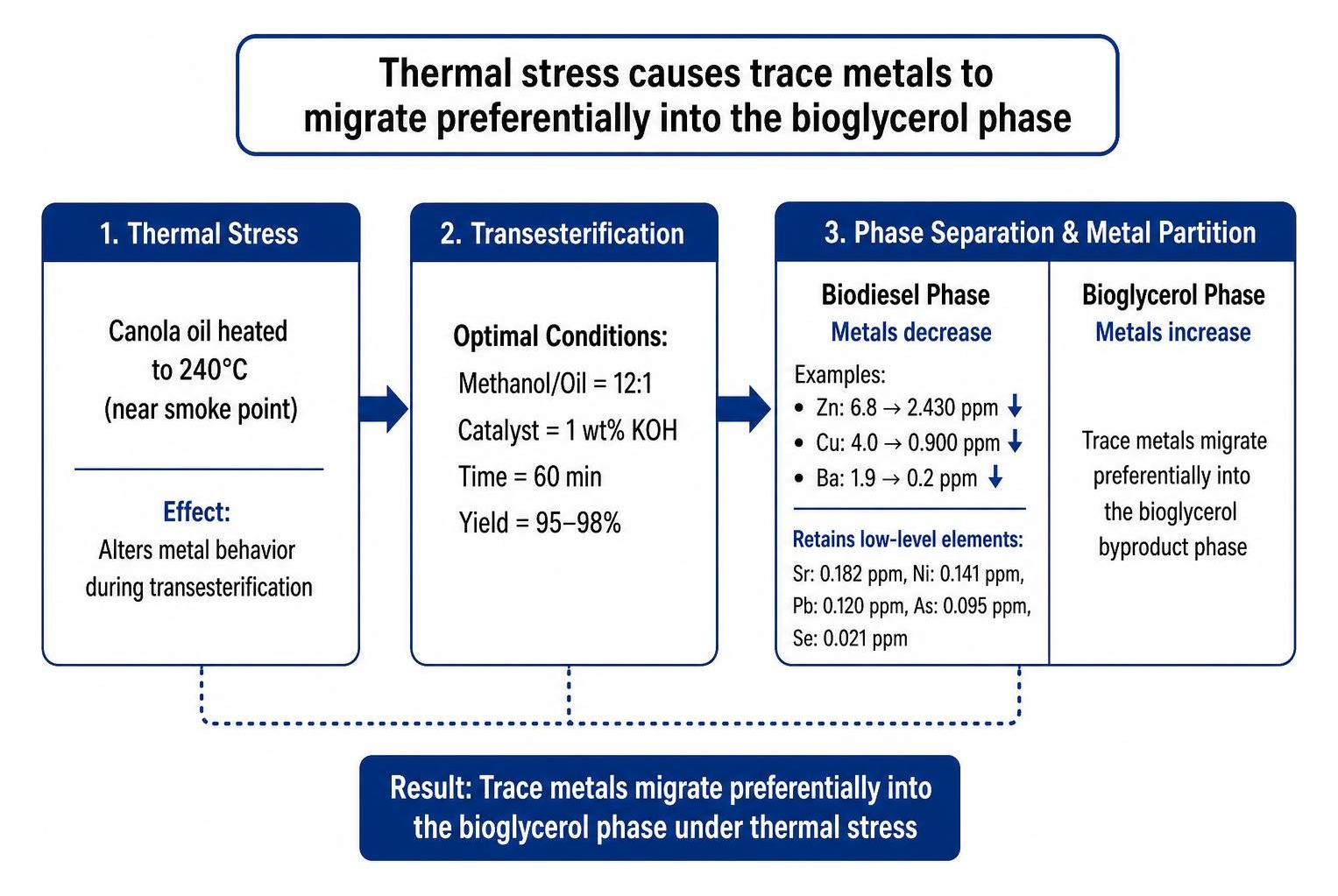
When virgin canola oil was thermally stressed at 240°C (near its smoke point), the concentration of trace metals remaining in the finished biodiesel decreased, while the metals migrated preferentially into the bioglycerol byproduct phase:
- Zinc (Zn): Decreased from 6.8 ppm in biodiesel from unheated oil to 2.430 ppm in biodiesel from oil heated to 240°C.
- Copper (Cu): Dropped from 4.0 ppm to 0.900 ppm (and as low as 0.6 ppm in specific fractions).
- Barium (Ba): Dropped from 1.9 ppm to 0.2 ppm.
- Low-level elements: Finished 240°C biodiesel retained strontium (0.182 ppm), nickel (0.141 ppm), lead (0.120 ppm), arsenic (0.095 ppm), and selenium (0.021 ppm).
Quality control standards tested at 10 ppb concentrations maintained low deviations (e.g., Ba at 9.9 ± 3.2%, Be at 9.8 ± 1.7%, Co at 10.0 ± 2.5%), proving that modern ICP-MS setups reliably track these sub-ppm shifts across complex thermal matrices.
Heavy Metal Migration into Biodiesel and Co-Products
The destination of these partitioned metals carries significant commercial value. Crude bioglycerol is frequently refined into pharmaceutical-grade glycerin, cosmetics, and animal feed supplements. When canola oil was processed at 240°C, copper in the resulting bioglycerol doubled from 1.1 ppm to 2.2 ppm.
Furthermore, different waste oil types introduce unique elemental baselines. Comparative ICP-MS screenings reveal zinc concentrations of:
- Waste sunflower oil biodiesel: 1.624 ppm
- Waste palm oil biodiesel: 1.661 ppm
- Restaurant waste cooking oil biodiesel: 2.194 ppm
- Thermally processed canola oil biodiesel: 2.430 ppm
Following an accurate trace element testing guide ensures testing laboratories distinguish between oil-soluble organometallic species and particulate suspensions across both fuel and byproduct phases.
Analytical Challenges and Advanced ICP-MS Solutions for Biofuels
Introducing viscous, volatile organic liquids directly into a high-temperature argon plasma presents distinct chemical challenges. Understanding how plasma fires ionize samples helps analysts mitigate common issues such as carbon soot deposition on interface cones, plasma instability, and intense carbon-based polyatomic interferences (such as carbon-carbon and carbon-oxygen clusters).
Sample Preparation Innovations in ICP-MS for Biofuel Matrices
To prepare organic fuels for stable mass spectrometry, laboratories deploy two main approaches:
- Microwave-Assisted Acid Digestion: As detailed in a microwave digestion study for biodiesel elements, digesting up to 700 mg of biodiesel using diluted nitric acid (7 mol/L) with 2 mL hydrogen peroxide (H2O2) inside closed quartz vessels (operating up to 280°C and 80 bar) completely breaks down organic carbon bonds. This eliminates organic solvent volatility and yields a clean aqueous solution optimized for high-resolution sector field ICP-MS (SF-ICP-MS) determination of Ba, Cr, Cu, Mn, Mo, Ni, Pb, Sr, V, and Zn.
- Direct Solvent Dilution: Diluting fuel samples 1:10 or 1:20 in high-purity kerosene, xylene, or mineral spirits enables fast turnaround. When using direct organic aspiration, introducing a small auxiliary flow of oxygen (typically 20 to 50 mL/min) into the argon carrier gas burns off carbon before it deposits onto the sampler and skimmer orifice cones.
Our quick start guide to ICPMS technique outlines routine optimization practices for both digestion and direct-injection pathways.
Tandem Mass Spectrometry (ICP-MS/MS) and High-Temperature Introduction (hTISIS)
Interference removal is critical when analyzing problematic non-metals and transition metals. Quadrupole systems with Kinetic Energy Discrimination (KED) use inert helium gas collisions to suppress polyatomic species. For challenging elements such as sulfur, phosphorus, and chlorine, tandem mass spectrometry (ICP-MS/MS) utilizes reactive cell gases (such as oxygen or hydrogen) to perform controlled mass-shift reactions (for example, shifting sulfur from mass 32 to mass 48 as sulfur monoxide ions), steering clear of oxygen-dimer interferences.
Furthermore, advanced sample introduction systems such as the high-temperature Torch-Integrated Sample Introduction System (hTISIS) completely vaporize organic micro-droplets. In methodologies for elemental and isotopic bioethanol analysis, coupling hTISIS with ICP-MS/MS achieved a 65% transport efficiency and a 0.3 ppm detection limit for chlorine, helping refineries safeguard hydrotreating catalysts from acid degradation.
Frequently Asked Questions about Biofuel ICP-MS Analysis
Why is ICP-MS preferred over ICP-OES for assessing ultra-low metal limits in biodiesel?
While ICP-OES functions well for major process contaminants at part-per-million scales, international fuel standards (such as ASTM D6751, ASTM D7467, and EN 14214) increasingly require compliance confirmation at sub-ppm levels. ICP-MS delivers parts-per-trillion sensitivity, multi-element analysis, and isotope-ratio precision, allowing refiners to detect micro-leaks of catalyst poisons, oxidation-inducing metals, and environmental toxins before fuel distribution.
How does thermal processing of waste cooking oil affect trace metal concentrations in biodiesel?
Thermal stress alters how metals partition during alkaline transesterification. Heating oil up to its smoke point (around 240°C) reduces the solubility of transition metals in the non-polar fatty acid methyl ester (biodiesel) phase. Consequently, metals such as copper and zinc partition heavily into the polar crude bioglycerol byproduct, reducing metal burdens in the finished fuel while concentrating impurities in byproduct streams.
What sample preparation method works best for organic biofuel analysis via ICP-MS?
Closed-vessel microwave digestion using diluted nitric acid and hydrogen peroxide is widely considered the gold standard for high-accuracy compliance testing because it destroys the organic matrix and eliminates carbon-based spectral interferences. For rapid refinery process control, direct organic dilution in matrix-matched solvents with auxiliary oxygen gas addition provides rapid turnaround without acid handling.
Conclusion: Ensuring Biofuel Compliance and Purity
Maintaining tight control over elemental impurities protects fuel systems, catalytic aftertreatments, and downstream byproduct value. Inductively coupled plasma mass spectrometry provides the ultra-trace sensitivity, multi-element capability, and interference-suppression technology needed to evaluate raw feedstocks, monitor transesterification efficiency, and certify finished renewable fuels against global standards.
At Elemental Analysis Inc., based in Lexington, Kentucky, we provide commercial trace element identification, quantification, and chemical speciation testing across the energy and refining sectors. Utilizing destructive acid digestion alongside non-destructive testing as the first commercial PIXE laboratory, our analytical specialists deliver fast turnaround, competitive pricing, and certified data you can trust.
Connect with our trace element specialists at Elemental Analysis Inc. to discuss customized screening protocols, regulatory compliance profiles, and comprehensive elemental testing for your biofuel operations.
Scientific Citations
Aristotelis Triantafillidis, Prokopis Stogiannis, Panagiotis Amarantos, Ioannis Kontodimos, Chrysovalantis Ketikidis, Panagiotis Grammelis. “Trace and Major Elements Analysis of Alternative Solid Fuels by Means of Inductively Coupled Plasma Mass Spectrometry: Comparison with Atomic Absorption Spectrometry and X-ray Fluorescence Results.” The 4th International Electronic Conference on Applied Sciences, 2023. DOI 10.3390/asec2023-16634. Woods GD, Fryer FI. “Direct elemental analysis of biodiesel by inductively coupled plasma-mass spectrometry..” Analytical and bioanalytical chemistry, 2007. PMID 17657481. Bojesomo RS, Raj A, Elkadi M, Ali MIH, Stephen S. “An ICP-MS study on metal content in biodiesel and bioglycerol produced from heated and unheated canola oils..” Environmental science and pollution research international, 2023. PMCID PMC10691977.