
The Easiest Way to Test for Metals in Water
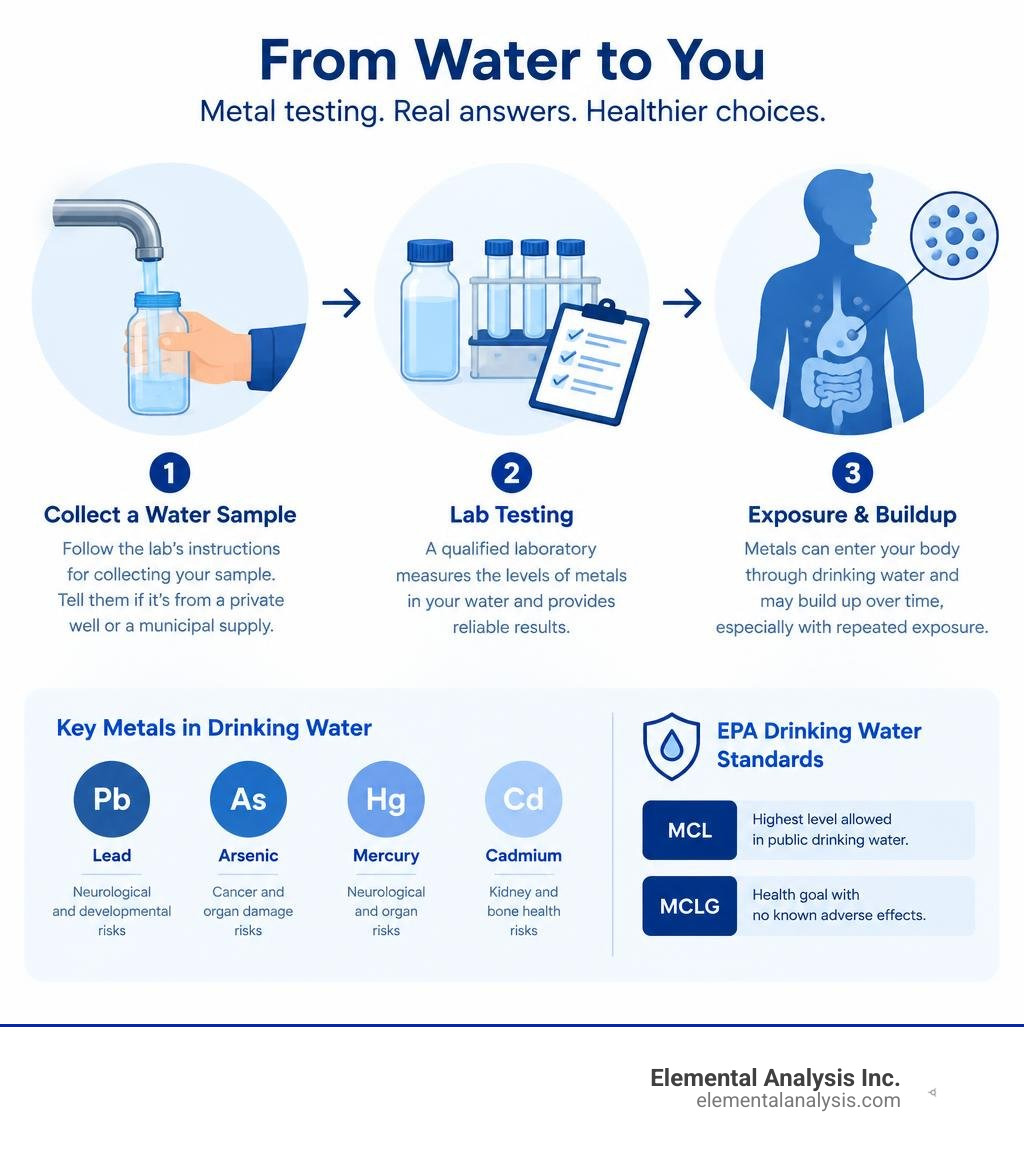
The easiest reliable approach to metal testing in water is to send a water sample to a qualified laboratory. Tell the lab whether your water comes from a private well or a municipal supply, and ask which metals to test for. Follow its collection instructions: a sample taken after water sits in your pipes can answer a different question than one taken after the tap runs.
Lead and arsenic can be present without a noticeable taste, smell, or color. Testing gives you a measured result you can compare with drinking water standards before deciding whether treatment is needed.
Primary Metal Contaminants and Health Risks in Drinking Water
Drinking water can contain dissolved minerals and trace elements. While our bodies need trace amounts of essential minerals like zinc and iron to function, toxic heavy metals pose severe physiological hazards. Understanding how these elements interact with the body begins with understanding toxic heavy metals and health risks across different exposure levels.
The United States Environmental Protection Agency (EPA) regulates public drinking water under the Safe Drinking Water Act by establishing two primary metrics: Maximum Contaminant Levels (MCLs) and Maximum Contaminant Level Goals (MCLGs). An MCL is the highest concentration of a contaminant legally allowed in public drinking water, balanced by feasibility and treatment technology. An MCLG is a non-enforceable health goal set at a level where no known adverse health effects occur, providing a margin of safety.
- Lead (Pb): Lead is a potent neurotoxin with an MCLG of zero because no safe blood level in children has been identified. Chronic exposure impairs cognitive development, damages the central nervous system, and induces kidney dysfunction and hypertension in adults.
- Arsenic (As): Naturally present in geologic formations and introduced via agricultural legacy pesticides, arsenic is a confirmed human carcinogen. The federal MCL is set at 10 parts per billion (PPB), though developmental impacts in children have been documented at levels as low as 5 PPB. Long-term exposure increases the risk of bladder, lung, and skin cancers.
- Mercury (Hg): Liquid at room temperature and highly bioaccumulative, inorganic and methylmercury target the nervous system and renal organs. Utilizing practical methods for mercury water testing is essential because mercury toxicity develops silently over sustained exposure periods.
- Copper (Cu): Copper carries an enforceable action level and an MCLG of 1.3 parts per million (PPM). Elevated copper concentrations irritate the gastrointestinal tract, causing nausea, vomiting, and abdominal cramps, with potential liver and kidney damage under prolonged exposure.
- Hexavalent Chromium (Cr-VI): Total chromium has an EPA MCL of 100 PPB. However, hexavalent chromium is carcinogenic, leading health authorities such as California’s OEHHA to establish a public health goal of 0.02 PPB to guard against gastrointestinal tumors.
- Uranium (U): As a naturally occurring radioactive heavy metal found in deep bedrock, uranium exhibits chemical nephrotoxicity that exceeds its radiological risk. The EPA enforces an MCL of 30 PPB to prevent chronic kidney damage.
Aesthetic Indicators vs. Odorless Toxins
Some metal contaminants provide physical clues, while others are completely silent.
When tap water develops an astringent, metallic tang, or deposits blue-green stains along porcelain basins, dissolved copper leaching from internal plumbing is often the culprit. High iron concentrations leave red-brown rust scaling across fixtures and impart a cloudy orange hue above its secondary standard of 0.3 PPM. Manganese creates black speckling and dark staining on laundry at concentrations exceeding its secondary aesthetic standard of 0.05 PPM, although levels should remain below 1 PPM to avoid health concerns. Aluminum can cause water discoloration and flocculent cloudiness above its secondary threshold of 0.05 to 0.2 PPM.
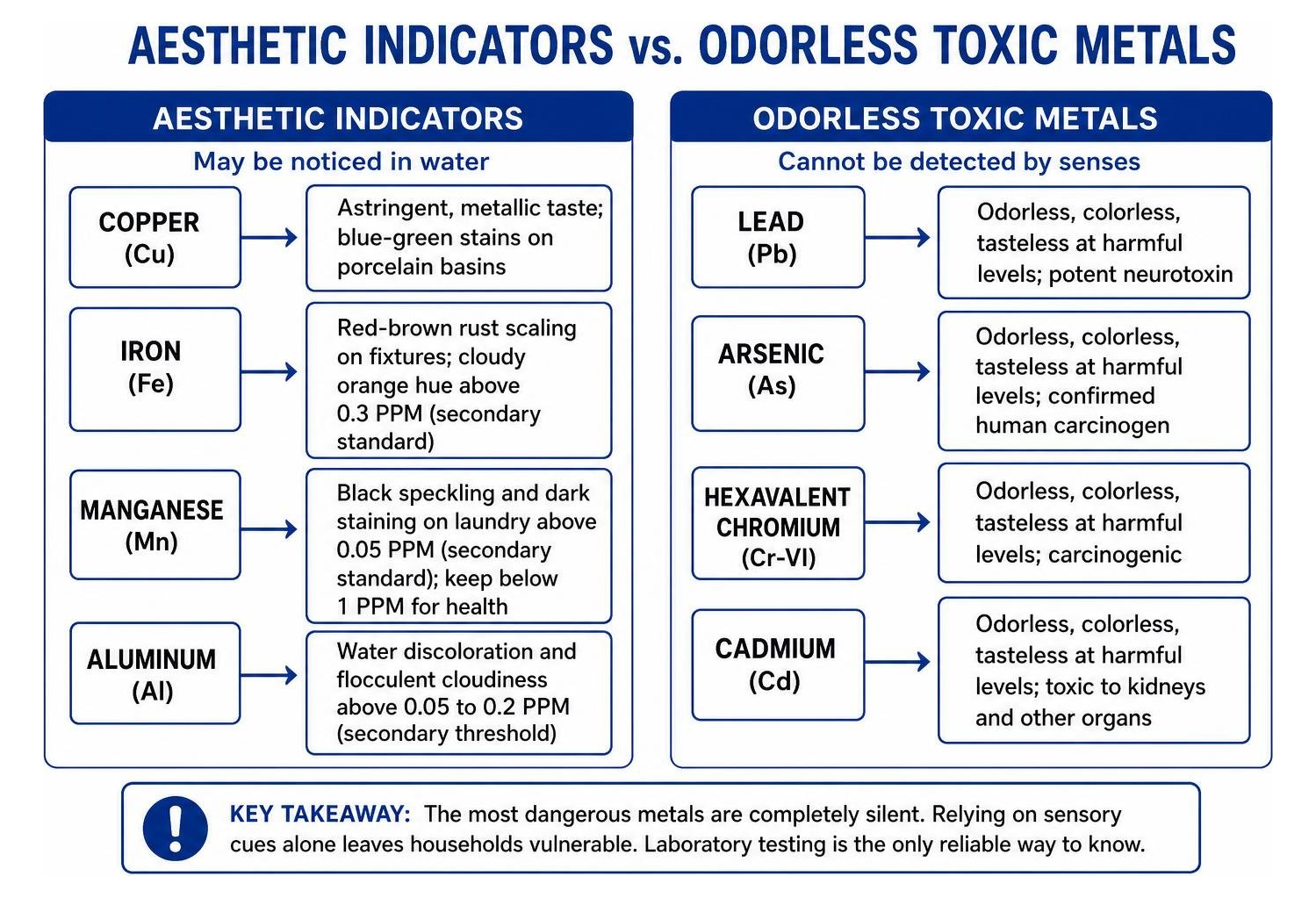
The most dangerous metals—lead, arsenic, hexavalent chromium, and cadmium—are entirely odorless, colorless, and tasteless at concentrations that cause severe health issues. Relying on sensory cues alone leaves households vulnerable. Recognizing the subtle physical signs indicating you need heavy metal water testing helps pinpoint when hidden contaminants require laboratory analysis.
Municipal Tap Water vs. Private Well Contamination Sources
The path heavy metals take into your glass depends heavily on whether your supply originates from a centralized utility or a private groundwater well.
Municipal water providers routinely test and treat finished water to ensure compliance with EPA primary drinking water standards. However, utilities do not own or control the service lateral running under private lawns or the interior plumbing of older structures. Homes built prior to the 1986 Safe Drinking Water Act lead ban frequently harbor lead solder, brass fixtures containing up to 8% lead, or direct lead service lines. When treatment chemistry fluctuates or corrosion inhibitors fail, toxic metals leach directly into the water stream between the water main and your faucet.
Private well owners face a different set of challenges. Wells draw directly from local aquifers without municipal filtration or continuous disinfectant barriers. Contaminants migrate into groundwater via natural weathering of mineral deposits, legacy pesticide applications, surface agricultural runoff, or industrial discharge. Furthermore, seasonal fluctuations in water tables and regional mining activities can alter groundwater chemistry, mobilizing dissolved metals into previously clean private wells.
Comparing Methods for Metal Testing in Water
Selecting an appropriate method to assess water quality requires matching the testing technology to the specific metals of concern and required sensitivity levels.
Homeowners and environmental managers generally encounter three tiers of water evaluation: rapid at-home strip tests, mail-in consumer kits, and certified environmental laboratory analysis.
| Testing Method | Typical Cost | Detection Range | Accuracy Level | Turnaround Time | Primary Best Use |
|---|---|---|---|---|---|
| At-Home Test Strips | $15 – $40 | Parts Per Million (PPM) | Low to Qualitative; prone to false negatives | Instant (1 – 5 mins) | Rapid field screening for general hardness, iron, and high copper |
| Mail-In Consumer Kits | $80 – $180 | Low PPB to PPM | Moderate; variable quality control | 5 – 10 business days | Broad screening of common nuisance elements |
| Certified Laboratory Analysis | $100 – $250+ | Sub-PPB to Parts Per Trillion (PPT) | Maximum precision; compliant with EPA methods | 5 – 10 business days | Definite health-risk assessments, well baselines, and filtration design |
Choosing the Right Option for Metal Testing in Water
At-home dip strips rely on colorimetric chemical reactions. When dipped into water, impregnated chemical pads shift color based on reactant concentration. While convenient for spotting massive plumbing corrosion or high hardness, color strips rarely offer the low-PPB sensitivity required to detect dangerous lead or arsenic concentrations.
Reading subtle shade gradients on paper exposes users to false negatives, giving a false sense of security when low-level chronic toxins are present. Reviewing the trade-offs when comparing home test kits and professional lab analysis shows why screening tools cannot substitute for calibrated analytical instrumentation.
For actionable health decisions, certified laboratory analysis remains the gold standard. Regulated facilities operate under stringent quality assurance programs, utilizing calibrated instruments capable of detecting contaminants down to parts per trillion. Knowing how to select a certified heavy metal testing lab ensures that your final data report meets regulatory standards and provides an accurate basis for engineering effective water filtration.
Laboratory Standards: ICP-MS and EPA-Approved Analytical Methods
Modern trace element analysis relies on Inductively Coupled Plasma Mass Spectrometry (ICP-MS). Under EPA Method 200.8 ICP-MS protocols, analytical laboratories achieve sub-microgram per liter (sub-PPB) quantification across more than 20 trace metals simultaneously. The EPA catalogs these verified procedures within its EPA approved Clean Water Act test methods for metals.
During ICP-MS operations, the preserved liquid sample is nebulized into a fine aerosol and carried into an extremely hot argon plasma discharge (ranging between 6,000 and 8,000 Kelvin). This thermal energy desolvates, atomizes, and ionizes the elemental constituents.
The resulting ions are extracted through vacuum interfaces into a quadrupole mass spectrometer, which separates elements according to their mass-to-charge ratio. This provides unmatched precision while mathematical collision-cell algorithms correct for isobaric and polyatomic spectral interferences. For a deeper technical perspective, explore our comprehensive guide to ICP-MS water analysis.
How to Properly Collect and Submit a Drinking Water Sample
An analytical result is only as reliable as the sample submitted to the laboratory. Following standardized EPA drinking water sample collection protocols ensures that the water collected at the faucet accurately reflects the chemical conditions of your plumbing system or groundwater well.

Reviewing our step-by-step instructions for water sample collection outlines the complete chain-of-custody process, but several core sampling rules apply to every evaluation:
- Determine the Sampling Objective (First-Draw vs. Fully Flushed):
- First-Draw Sampling: To evaluate whether home plumbing, brass fixtures, or soldered joints are leaching metals, collect water first thing in the morning after it has sat motionless in the pipes for a minimum of 6 hours. Do not flush the line prior to collection.
- Fully Flushed Sampling: To assess the baseline groundwater aquifer entering from a private well, remove the faucet aerator and run cold water at full velocity for 3 to 5 minutes until the water temperature stabilizes before filling the container.
- Use Laboratory-Grade Containers: Never use standard household jars or repurposed beverage bottles. Certified labs provide dedicated, acid-washed high-density polyethylene (HDPE) or fluoropolymer vessels free from background elemental contamination.
- Preserve Sample Integrity: Trace metals can adsorb onto the internal walls of collection plastic over time. Environmental testing protocols require sample acidification using high-purity nitric acid to reduce the pH below 2.0. This keeps metal ions fully dissolved in solution throughout transit.
- Adhere to Strict Holding Times: While acid-preserved metal samples maintain chemical stability for up to 6 months (and 28 days for mercury), unpreserved raw samples must be shipped on ice and delivered to the laboratory promptly to prevent biological alteration and chemical precipitation.
- Complete Chain-of-Custody Documentation: Fill out the laboratory submission document completely, noting sample location, collection timestamp, water source, and requested analysis panels.
When to Perform Metal Testing in Water for Private Wells
Unlike municipal systems, private wells do not receive third-party regulatory monitoring. Well owners should schedule testing based on distinct environmental and operational triggers:
- Annual Routine Intervals: Test annually for coliform bacteria and basic parameters, and run a comprehensive heavy metal panel every 3 years.
- Post-Flood and Severe Weather Events: Surface floodwaters can breach well caps, channeling agricultural fertilizers, surface runoff, and dissolved minerals directly into well casings.
- Nearby Industrial or Mining Operations: Changes in nearby land use—such as excavation, mining, industrial manufacturing, or agricultural expansion—warrant immediate baseline re-testing.
- Plumbing Upgrades or Service Interventions: Replacing pumps, pressure tanks, or interior supply lines dislodges internal scale, releasing particulate lead and copper into domestic fixtures.
- Property Transfers: Establishing certified water quality documentation protects buyers and sellers during residential real estate transactions.
How to Interpret Water Test Results and Choose Effective Filtration
When your analytical test report arrives, it will display quantified concentrations alongside federal regulatory benchmarks.
Reports typically express values in either parts per million (PPM, equivalent to milligrams per liter or mg/L) or parts per billion (PPB, equivalent to micrograms per liter or ug/L). To convert units:
1 PPM = 1,000 PPB
Compare your measured values directly against the EPA National Primary Drinking Water Regulations for health hazards, and Secondary Drinking Water Regulations for aesthetic parameters.
If your laboratory report identifies metal concentrations above recommended health standards, select an appropriate, certified treatment technology:
- Reverse Osmosis (RO): RO units force water under pressure through a semi-permeable membrane with microscopic pores, rejecting up to 95–99% of dissolved inorganic metals, including lead, hexavalent chromium, uranium, and cadmium. Ensure point-of-use RO systems are certified under NSF/ANSI Standard 58.
- Solid Carbon Block and Specialized Media Filters: Point-of-use filtration cartridges utilizing blended ion-exchange resins and extruded activated carbon remove dissolved lead and copper while maintaining domestic flow rates. Verify that filtration devices carry NSF/ANSI Standard 53 certification for specific health-related contaminant reduction claims.
- Ion Exchange Softeners: Conventional water softeners exchange hardness minerals (calcium and magnesium) for sodium or potassium ions. They also extract moderate amounts of dissolved ferrous iron and manganese. Specialized selective ion-exchange resins are used for targeting uranium and heavy metal cations.
- Activated Alumina: Highly porous aluminum oxide media selectively adsorbs arsenic and fluoride from water streams, provided the incoming water pH is balanced.
- Distillation: Distillation systems heat water into steam, leaving non-volatile heavy metals and minerals behind in the boiling chamber before condensing the purified vapor into a clean collection reservoir.
Frequently Asked Questions About Water Metal Testing
Does boiling water remove heavy metals?
No. Boiling water does not remove heavy metals. Heavy metals such as lead, arsenic, and mercury are non-volatile elements with boiling points far higher than water. When water boils, pure water evaporates into steam while the dissolved heavy metals remain behind in the pot. Prolonged boiling reduces the total liquid volume, which actually concentrates the metal contaminants and increases the toxic dosage per glass.
How often should private wells be tested for metals?
Private well owners should test their water for basic contaminants annually, and run a broad-spectrum certified laboratory heavy metals panel every three years. Immediate testing should also be conducted whenever water clarity, odor, or taste shifts unexpectedly, after severe regional flooding, or following mechanical repairs to the wellhead or pump assembly.
What is the most accurate way to test for heavy metals in water?
The most accurate method for testing heavy metals in drinking water is laboratory analysis using Inductively Coupled Plasma Mass Spectrometry (ICP-MS) adhering to EPA Method 200.8 protocols. ICP-MS provides trace elemental quantification down to sub-parts-per-billion and parts-per-trillion levels, eliminating the ambiguity, spectral interferences, and false-negative risks associated with consumer field test kits.
Conclusion
Safe, clean drinking water is essential to long-term health. Because the most toxic heavy metals—including lead, arsenic, and hexavalent chromium—are invisible to human senses, quantitative laboratory testing is the only definitive way to confirm what is coming out of your tap. Identifying specific contaminants and their exact concentrations allows you to choose an effective filtration system without guessing.
At Elemental Analysis Inc., based in Lexington, Kentucky, we specialize in high-precision trace element identification, quantification, and elemental speciation across municipal, well, and industrial water matrices. As the first commercial PIXE laboratory, we combine advanced instrumentation—including EPA Method 200.8 compliant ICP-MS—with rapid turnaround times and competitive pricing. To learn more about selecting the right analysis panel for your home or facility, explore our complete guide to heavy metals analysis in water or contact our analytical team today.