
How to Evaluate an Authentic Atocha Shipwreck Coin
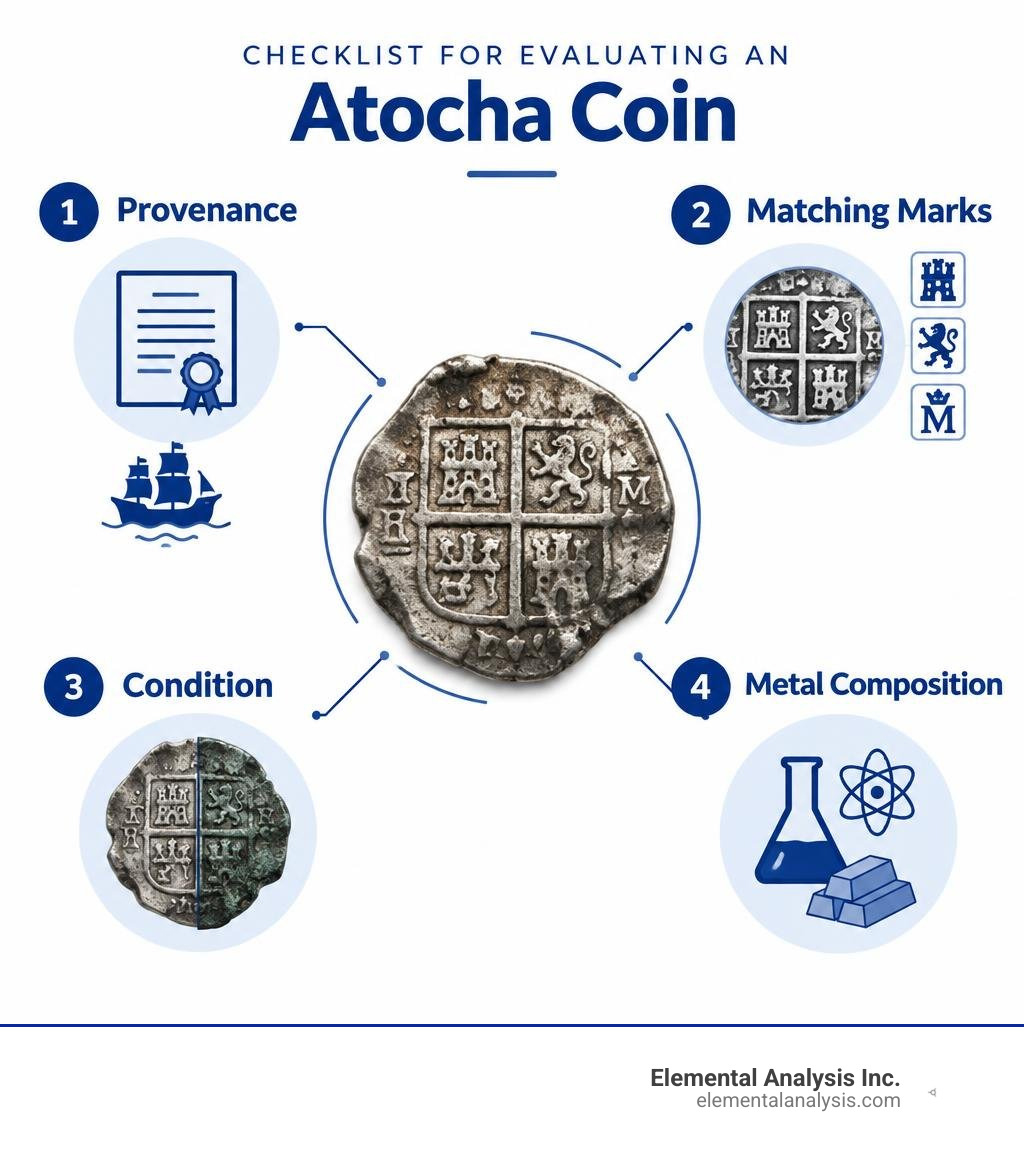
To evaluate an Atocha shipwreck coin, start with its provenance. Ask for a certificate that identifies the individual coin and links it to the documented recovery. Then compare its weight, mint and assayer marks, visible design, and condition with the certificate. An old-looking silver coin is not proof of Atocha origin. Metal testing can help assess its composition, but it cannot establish which ship carried it.
Most recovered Atocha coins are hand-struck silver cobs from the Spanish galleon that sank in 1622. Their uneven shapes are normal; clear marks, limited corrosion, and reliable documentation matter more when judging a coin.
Atocha shipwreck coin word guide:
- all about the atocha shipwreck treasure discovery
- uncover the untold story behind mel fishers legendary atocha find
- explore the astronomical fortune behind mel fishers atocha discovery
The 1622 Tragedy and the Discovery of the Atocha Hoard
The story of the Spanish treasure fleet remains one of the most compelling sagas in maritime history. In late summer 1622, the heavily armed galleon Nuestra Señora de Atocha served as the almiranta (rear guard) for the Tierra Firme Fleet, carrying an immense fortune destined for King Philip IV of Spain. The cargo represented years of mineral extraction from colonial mines across the Americas, including roughly 47 tons of silver bars, approximately 255,000 hand-stamped silver coins, 7,175 ounces of gold in discs and ingots, and 71 pounds of rough-cut Muzo emeralds.
The Loss of the Tierra Firme Flagship
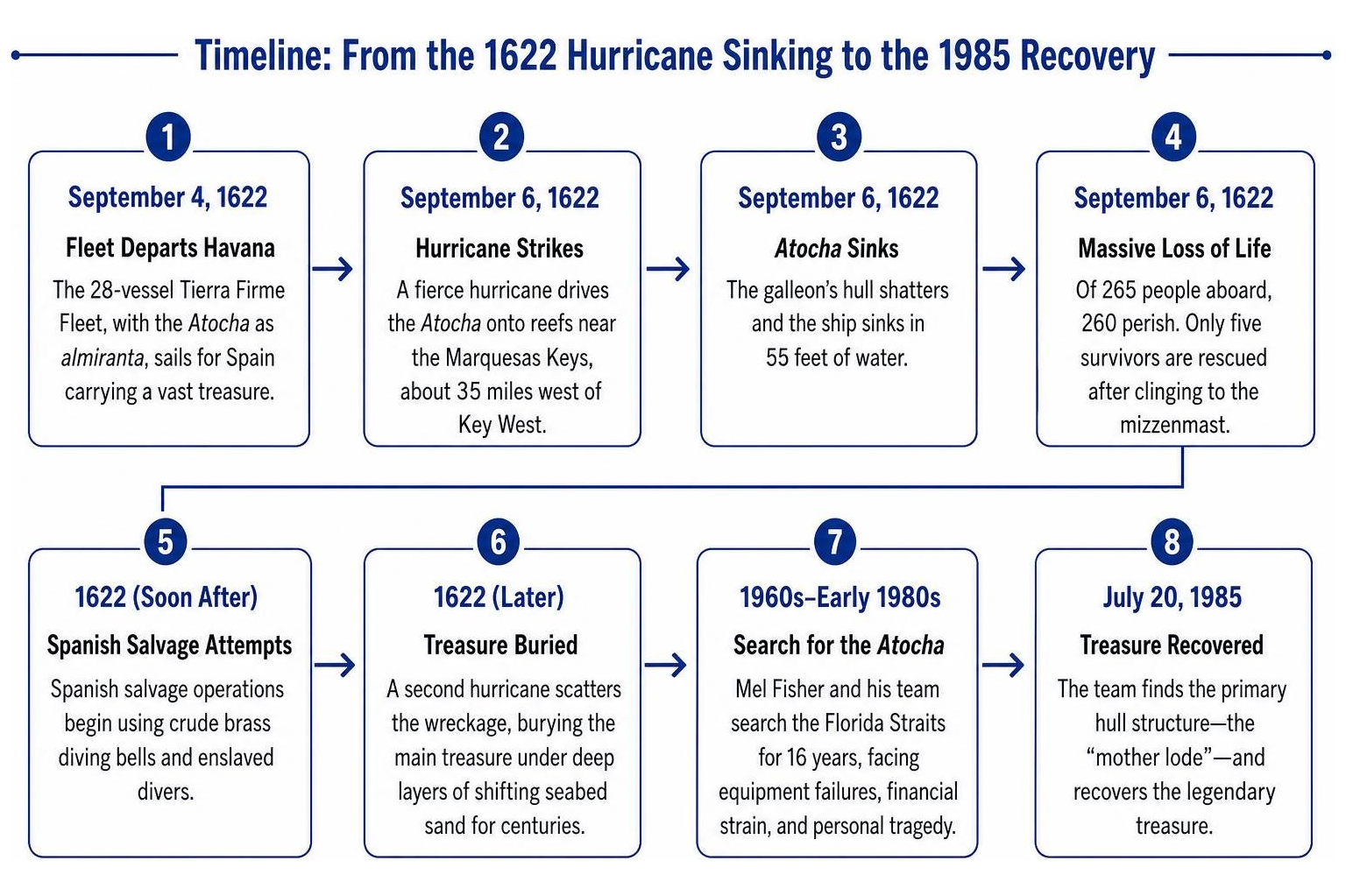
After severe construction and administrative delays in Havana Harbor, the 28-vessel fleet finally set sail for Spain on September 4, 1622. Only two days out of port, a fierce hurricane swept across the Straits of Florida. On September 6, violent winds drove the Atocha and its sister ship, the Santa Margarita, across the shallow reefs near the Marquesas Keys, roughly 35 miles west of Key West.
The galleon’s hull shattered against the coral, and the vessel foundered in 55 feet of water. Of the 265 passengers, crewmen, and soldiers aboard, 260 perished. Only five survivors—three sailors and two slaves—survived by clinging desperately to the exposed mizzenmast until rescue arrived. The loss dealt a catastrophic blow to the Spanish Crown, depriving King Philip IV of the capital needed to fund military campaigns during the Thirty Years’ War. Spanish salvage operations began almost immediately, using crude brass diving bells operated by enslaved divers, but a second hurricane scattered the remains of the superstructure, burying the main treasure under deep layers of shifting seabed sand for centuries.
Mel Fisher’s 16-Year Search and the Supreme Court Victory
Modern search efforts began in the late 1960s when treasure hunter Mel Fisher and his salvage firm, Treasure Salvors, Inc., launched an ambitious expedition across the Florida Straits. Motivated by his famous daily mantra, “Today’s the day!”, Fisher and his dedicated crew endured 16 grueling years of equipment failures, financial strain, and personal tragedy.
You can read the untold story behind Mel Fisher’s find to understand how diver perseverance finally paid off on July 20, 1985, when the salvage team discovered the primary hull structure—the legendary “mother lode.” The team brought up an astronomical fortune recovered from the wreck, valued at an estimated $450 million in historic bullion, jewels, and numismatic artifacts.
The recovery was accompanied by an intense legal struggle. The State of Florida initially asserted ownership over the wreck site, requiring 25% salvage splits under state permits, while the United States federal government later attempted to claim the entire treasure hoard under territorial maritime statutes. Following a decade of litigation under admiralty law, the United States Supreme Court ruled definitively in favor of Treasure Salvors in 1982, establishing private finder ownership of historic shipwrecks discovered in international waters.
Anatomy of an Atocha Shipwreck Coin: Types, Mints, and Cobs
Collectors studying the Coins of the Nuestra Señora de Atocha encounter a fascinating numismatic form known as the cob. Rather than being struck on uniformly round, factory-milled planchets, early 17th-century Spanish colonial coins were produced rapidly by hand under royal production quotas. Detailed in our Spanish silver collector’s handbook, these irregular silver pieces formed the backbone of global commerce for over two centuries.
Cob Minting and Silver Denominations
The word “cob” originates from the Spanish phrase cabo de barra, meaning “end of the bar.” Indigenous and Spanish mint workers cast refined silver into elongated bars, then sheared blank planchets directly from the ends using heavy iron chisels. Workers adjusted the planchet weight by trimming corners with shears before placing the blank between two hand-carved steel dies and striking it with a sledgehammer.
Because the planchets were irregular in shape and thickness, a single manual blow rarely transferred the full die design. As a result, complete dates, mint marks, and full royal coats of arms are exceptionally rare on silver cobs. The Atocha hoard yielded coins produced across major New World colonial mints:
- Potosí (Upper Peru, modern Bolivia): The source of roughly 90% of Atocha silver cobs, recognized by the mint mark “P” and assayers such as Juan Ximenez de Tapia (“T”), Juan de Ballesteros (“B”), and Augustin de la Quadra (“Q”).
- Mexico City: Marked with an “M” or “oM,” these cobs often feature distinct cross flory designs and sharp shield work.
- Lima and Cartagena: Present in smaller quantities, these pieces represent early mint operations and command significant collector premiums.
Silver cobs were struck in standard denominations based on the Spanish Real system:
- 8 Reales (Piece of Eight): Official weight of 27.5 grams; diameter approx. 35–40 mm.
- 4 Reales: Official weight of 13.5 grams; diameter approx. 30 mm.
- 2 Reales: Official weight of 6.7 grams; diameter approx. 22–25 mm.
- 1 Real: Official weight of 3.4 grams; diameter approx. 15–18 mm.
The 1–5 Grading System for an Atocha Shipwreck Coin
Treasure Salvors established an official five-tier grading scale to categorize recovered silver coins based on visual clarity, strike completeness, and weight loss from marine corrosion:
| Grade | Preservation Level | Weight Retention | Visual Characteristics | Market Desirability |
|---|---|---|---|---|
| Grade 1 | Mint / Near Mint | 90% – 100% of original weight | Sharp, crisp details; full or near-complete shield and cross; visible assayer/mint marks; minimal sea wear | Highest tier; premier investment specimens |
| Grade 2 | Very Fine | 80% – 90% of original weight | Clear central design elements; minor perimeter saltwater etching; easily readable assayer mark | High collector and luxury jewelry demand |
| Grade 3 | Fine | 65% – 80% of original weight | Moderate saltwater corrosion; partially obscured shield or cross; legible denomination | Popular entry-level collector pieces |
| Grade 4 | Good / Fair | 50% – 65% of original weight | Heavy saltwater corrosion; thin planchet; indistinct design features with faint outlines | Budget-friendly historical artifacts |
| Grade 5 | Fragment / Cull | Under 50% of original weight | Severe marine erosion; coin fragments or smooth silver discs without identifiable markings | Primarily utilized for craft jewelry |
Authentication, Conservation, and Scientific Verification
Recovering historic silver from the ocean floor is only the first step. When divers brought up the Atocha shipwreck treasure discovery, centuries of immersion in warm, oxygenated seawater had converted much of the raw silver surface into hard black silver sulfide encased within dense coral calcifications.
Marine Conservation Techniques and Coin Chests
Many coins were discovered welded together inside encrusted wooden crates known as coin chests. The heaviest individual coin chest recovered weighed 140 pounds, while another 137-pound chest yielded 2,516 individual 8 Reales coins. Conservators applied a precise, multi-stage protocol to stabilize the silver without destroying delicate numismatic details:
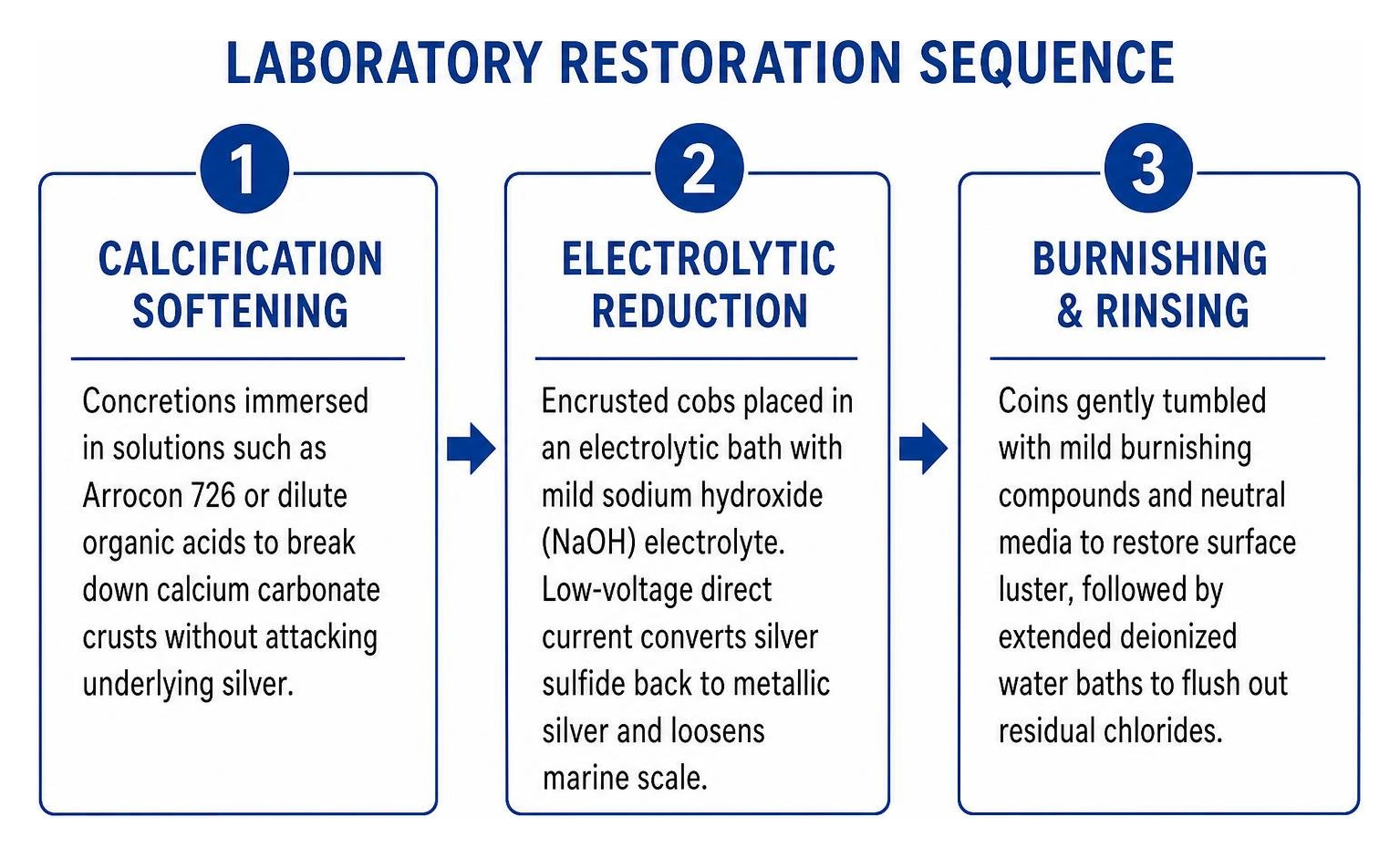
- Chemical Softening: Conservators immersed concretions in solutions such as Arrocon 726 or dilute organic acids to break down calcium carbonate crusts without attacking underlying silver.
- Electrolytic Reduction: Encrusted cobs were placed in an electrolytic bath containing a mild sodium hydroxide electrolyte. By passing a low-voltage direct current through the bath, electrical charge converted brittle silver sulfide back into metallic silver while loosening stubborn marine scale.
- Mechanical Burnishing and Rinsing: Coins were gently tumbled with mild burnishing compounds and neutral media to restore surface luster, followed by extended deionized water baths to flush out residual chlorides.
Provenance Documentation and Counterfeit Detection
The high market value of Spanish shipwreck artifacts makes authentication essential. Detailed in collector guides on shipwreck coin valuation and authenticity, authentic Atocha cobs possess distinctive physical signatures that set them apart from cast replicas, modern restrikes, and silver-plated fakes.
Genuine Atocha coins feature original documentation issued by Treasure Salvors, Inc. or Mel Fisher’s Treasures. Modern authentic certificates incorporate high-security elements, including raised corporate foil seals, tamper-proof serial holograms, high-resolution photographic records, and matching alphanumeric inventory tracking numbers (e.g., #85A-133506, where “85” indicates the 1985 recovery year).
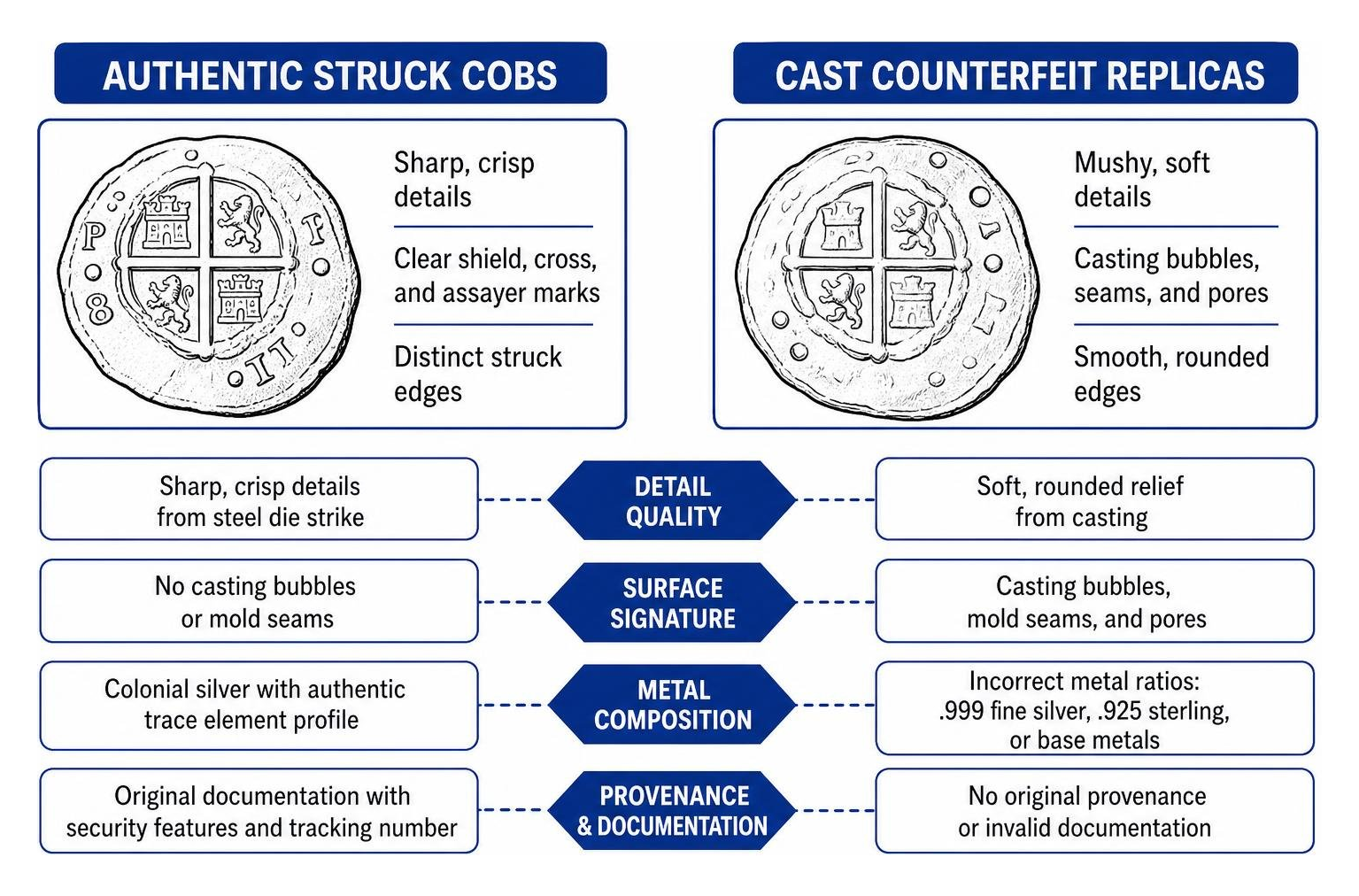
Counterfeit specimens frequently exhibit:
- Casting Bubbles and Seams: Microscopic surface porosity, smooth circular depressions, or mold seam lines along the outer rim.
- Mushy Details: Soft, rounded relief on the cross and coat of arms rather than the sharp edges produced by a steel die strike.
- Incorrect Metal Ratios: Modern counterfeits often use pure .999 fine silver, sterling silver (.925), or base pewter cores, lacking the authentic trace element profile of colonial Spanish bullion.
Market Value Factors and Collecting Guidelines
Whether you are evaluating a raw numismatic specimen or reviewing our shipwreck coin jewelry buying guide, market valuations for Atocha artifacts reflect a combination of grade, denomination rarity, and documented provenance.
Market Valuations for an Atocha Shipwreck Coin and Fine Jewelry
The retail market for verified Atocha silver cobs spans a broad pricing spectrum:
- Grade 1 (8 Reales): $6,000 to $12,000+ for raw specimens; pieces featuring visible four-digit dates (e.g., 1618–1622) or rare mint/assayer combinations can command $15,000 to $25,000+.
- Grade 2 (4 & 8 Reales): $3,500 to $7,500 depending on shield centering and clarity of the Jerusalem cross.
- Grade 3 (2, 4, & 8 Reales): $1,800 to $4,000, offering balanced visual appeal and historical connection.
- Grade 4 & 5 (Fragments & Worn Pieces): $800 to $1,800 for fragments, worn denominations, or small planchets.
- Custom 14K/18K Gold Bezel Jewelry: Pendants and rings custom-mounted by jewelry artisans typically retail from $1,935 (for small fragments or 1 Real pieces) up to $18,950+ for pristine Grade 1 specimens accented with natural Muzo emeralds or diamonds.
Raw Cobs versus Mounted Bezel Jewelry
Collectors generally choose between two primary ownership paths:
Raw Numismatic Cobs: Serious numismatists prefer unmounted coins preserved in protective archival capsules or certified slabs. Raw specimens preserve the edge surfaces intact, allowing clear examination of coin weight, planchet thickness, and shear marks.
Heirloom Bezel Jewelry: Many collectors prefer wearable history. Custom mountings protect the coin using secure, non-invasive prongs or custom-fit 14K/18K gold bezels that do not apply solder or adhesive directly to the silver. Bezel-mounted coins retain strong secondary market liquidity, provided the original Certificate of Authenticity remains paired with the piece.
Frequently Asked Questions about Atocha Coins
How many gold coins were recovered from the Atocha shipwreck?
Only 67 gold coins were recovered from the Atocha wreck site, representing an exceptionally small fraction of the vessel’s treasure. The majority of these pieces were 2-escudo gold coins struck at the mints of Seville, Mexico City, and Lima. Because gold does not corrode in saltwater, these coins emerged from the seabed in virtually mint condition.
What is the rarest silver denomination found in the Atocha hoard?
The 1 Real silver cob is the rarest standard denomination recovered from the wreck. Due to their small size (averaging under 3.4 grams) and thin planchets, most 1 Real coins were either severely degraded by saltwater erosion or lost in seabed sediment. Grade 1 specimens from the Mexico City mint represent some of the most sought-after rarities in the entire hoard.
How do certificates of authenticity verify genuine Atocha provenance?
Official certificates issued by Mel Fisher’s salvage enterprise document the individual coin’s recovery year, tag number, weight in grams, assayer initials, mint mark, and assigned grade (1 through 5). Genuine certificates feature matching database records, raised corporate seals, watermarked security paper, and photographic records linking the physical coin directly to the original salvage manifests.
Conclusion
The silver and gold coins recovered from the Nuestra Señora de Atocha connect collectors directly to 17th-century Spanish maritime commerce. Preserving and validating these pieces requires careful documentation, rigorous condition analysis, and sound numismatic science.
At Elemental Analysis Inc., based in Lexington, Kentucky, we apply advanced analytical chemistry to help numismatists, auction houses, and institutions study and authenticate historic metal artifacts. As the first commercial PIXE (Proton Induced X-ray Emission) laboratory, we provide non-destructive trace element identification, bullion alloy quantification, and metallurgical analysis. These non-destructive methods reveal the unique chemical and trace-element signatures of early Spanish colonial silver without damaging irreplaceable coins.
To explore the complete maritime history, discover our comprehensive guide to the wreck of the Nuestra Señora de Atocha. Whether you are curating a private collection or researching colonial coinage, combining historical provenance with rigorous scientific analysis ensures that your pieces of eight remain authentic treasures for generations to come.