
How Much Was Mel Fisher’s Atocha Treasure Worth?
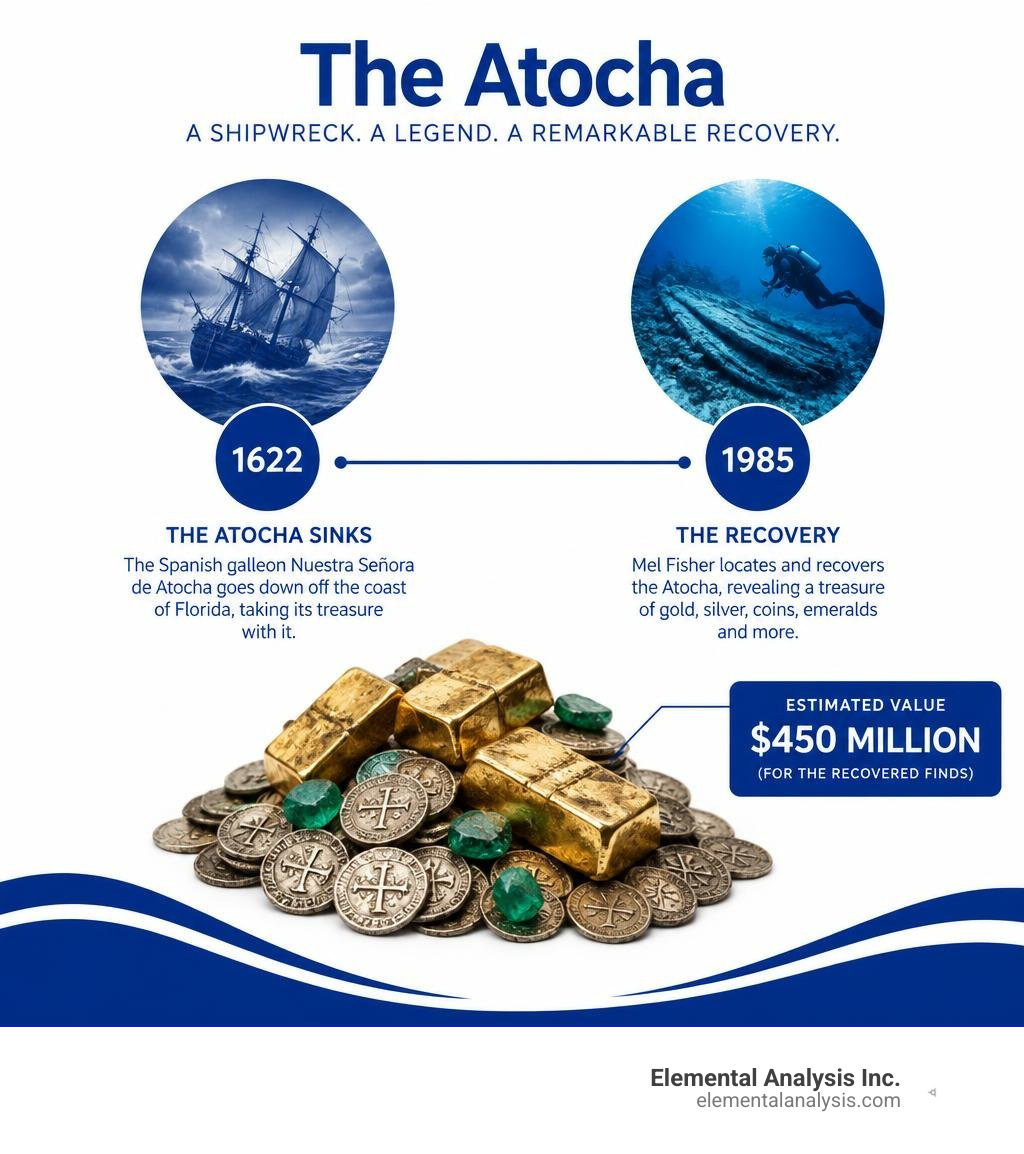
The worth of Mel Fisher’s treasure is commonly estimated at $450 million for the gold, silver, coins, emeralds, and other artifacts recovered from the Nuestra Señora de Atocha. That is an estimated value of the finds, not the amount Fisher received in cash or his personal net worth.
The figure reflects more than the metal alone. A coin or gold bar from a documented shipwreck can also be valued for its rarity and history. This guide separates the headline estimate from what individual artifacts may sell for and what remains undiscovered.
Essential mel fisher treasure worth terms:
Total Mel Fisher Treasure Worth: Breaking Down the $450 Million Motherlode
On July 20, 1985, Mel Fisher’s salvage team radioed a long-awaited phrase back to Key West: “Put away the charts; we’ve found the main pile!” After sixteen grueling years of scanning barren sea beds and excavating thousands of empty holes, the team struck the motherlode of the Nuestra Señora de Atocha, an armed Spanish galleon that sank during a fierce hurricane in September 1622. The Los Angeles Times coverage on the historic 16-year galleon search detailed how decades of relentless persistence finally yielded the richest underwater find in modern history.
The sheer scale of the recovered haul stunned historians and numismatists worldwide. When divers penetrated the primary debris field, they brought up over 40 tons of precious metals. The inventory included:
- Approximately 114,000 Spanish silver coins, commonly known as pieces of eight or reales
- Over 1,000 massive silver bullion ingots, many weighing between 60 and 70 pounds each
- 125 solid gold bars and cast discs
- 582 copper ingots representing raw colonial trade materials
- Hundreds of high-grade, uncut Muzo Colombian emeralds
- Ornate gold jewelry, devotional crosses, and personal items worn by Spanish nobility
To understand the broader archaeological timeline, our detailed story of the Atocha shipwreck treasure discovery explores how the fleet sailed from Havana carrying roughly 20 percent of Spain’s imperial revenue before meeting disaster.
Calculating Mel Fisher Treasure Worth: Bullion vs. Numismatic Value
A common misconception is that the $450 million valuation represents raw melt weight alone. In precious metal appraisal, we distinguish sharply between commodity spot value and historic numismatic value. If you melt down a 1622 Spanish eight-reales coin, you are left with less than one troy ounce of silver. However, when preserved with intact markings, that same piece carries significant cultural provenance.
Spanish colonial coins were struck across Viceroyalty mints, primarily in Potosí (modern-day Bolivia) and Mexico City. Collectors pay premiums for visible assayer initials, dates, and clear cross motifs. Those interested in identifying these characteristics can reference our collector’s guide to authenticated Atocha silver coins.
The table below illustrates how historical value outpaces raw metal spot price:
| Artifact Type | Raw Metal Weight | Approx. Melt Value | Historic / Collector Value |
|---|---|---|---|
| Grade 1 Silver 8-Reales Coin | ~0.85 troy oz silver | Under $30 | $1,500 – $4,000+ |
| 70 lb Silver Bullion Ingot | ~1,020 troy oz silver | ~$30,000 | $80,000 – $150,000 |
| Solid Gold Finger Ring w/ Emerald | ~15 grams 22k gold | ~$1,000 | $25,000 – $60,000+ |
| 22k Gold Bar (Approx. 2 lbs) | ~29 troy oz gold | ~$75,000 | $250,000 – $500,000+ |
The 1715 Fleet and Santa Margarita Discoveries
Mel Fisher’s successful recoveries extended beyond the Atocha. In 1980, his crew pinpointed significant sections of the Santa Margarita, the sister galleon lost in the same 1622 storm. The Santa Margarita yielded millions of dollars in gold bars, ornate chains, and silver bullion, laying the financial groundwork for the ongoing search for the Atocha.
Fisher’s teams also worked salvage leases along Florida’s east coast, focusing on the 1715 Spanish Treasure Fleet near Fort Pierce and Douglass Beach. In August 2004, veteran diver John Brandon and his crew recovered a $100,000 cache from the 1715 Fleet, featuring rare silver coins, a pristine 22-karat gold ring valued near $15,000, and an intact 14.5-carat emerald ring. To trace the interconnected logistics behind these multi-ship operations, read our breakdown of the untold history of Fisher’s multi-wreck expeditions.
Legal Battles and Ownership: How Salvage Rights Shaped the Fortune
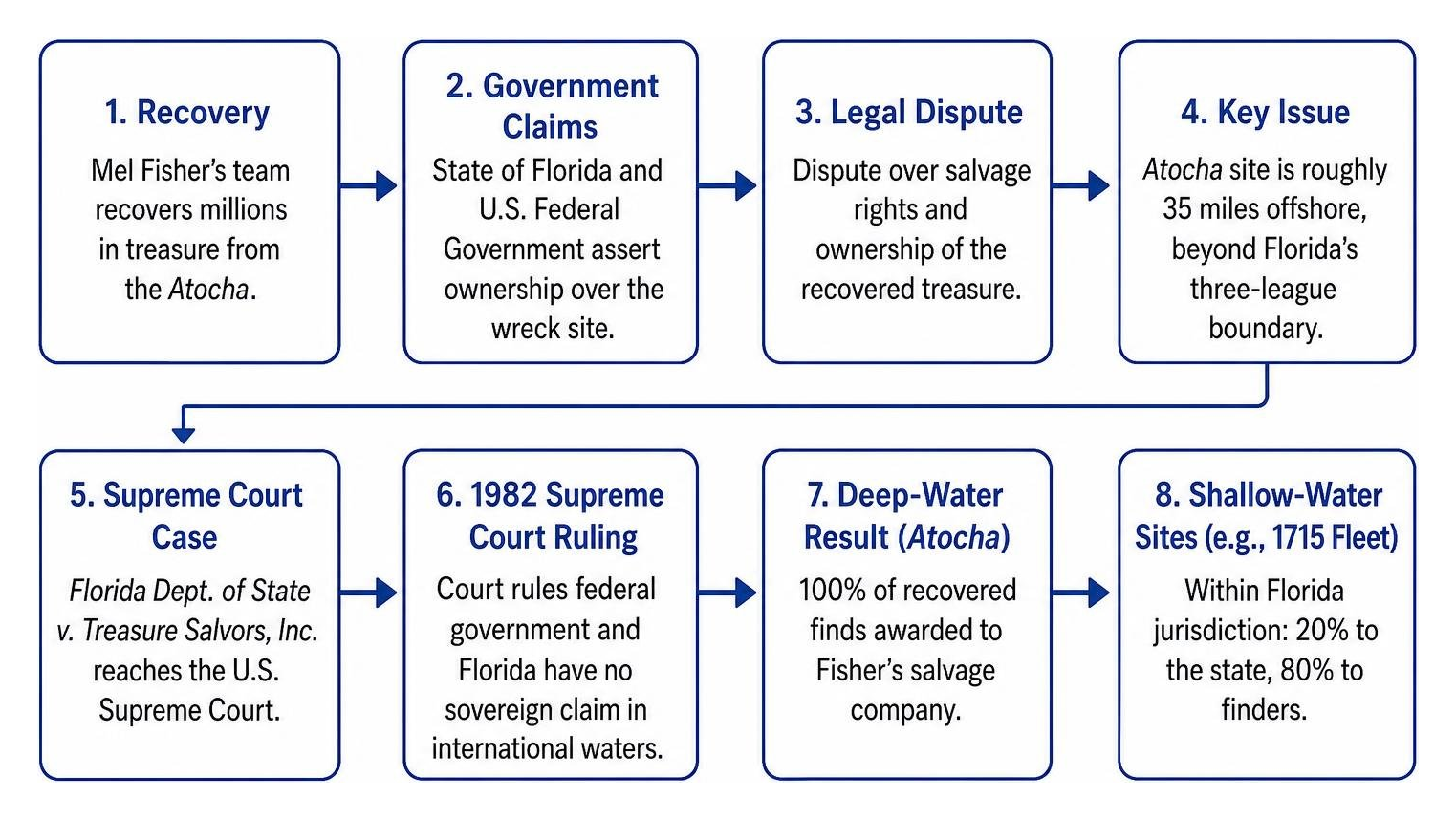
Finding sunken gold is only half the battle; keeping it requires winning in court. As Fisher’s salvage operation brought up millions in treasure, both the State of Florida and the United States Federal Government asserted ownership over the wreck site. A comprehensive New York Times profile on Mel Fisher’s legal and salvage triumphs captured the legal drama that unfolded alongside maritime operations.
The 1982 Supreme Court Ruling and State Division
Under early agreements, the State of Florida claimed a 25 percent stake in all artifacts recovered from historic shipwrecks within state territorial waters. However, Fisher’s team located the main Atocha site roughly 35 miles offshore, beyond Florida’s three-league boundary.
The dispute culminated in the landmark 1982 U.S. Supreme Court case Florida Dept. of State v. Treasure Salvors, Inc. The high court ruled that the federal government and the State of Florida held no sovereign claim over the wreck in international waters, awarding 100 percent of the recovered finds to Fisher’s salvage company. In contrast, for shallow-water sites located strictly within Florida’s jurisdiction (such as the 1715 Fleet wrecks), standard salvage division contracts assigned 20 percent of recovered items to the state for preservation in public archives, while finders retained 80 percent.
Replacement Value vs. Market Price: The Gold Bar 27 Precedent
Valuing centuries-old cultural property creates unique dilemmas in modern law and insurance. A clear example occurred following the theft of “Gold Bar 27,” a historic bar recovered from the Santa Margarita and displayed at the Mel Fisher Maritime Museum in Key West.
Museum appraisal teams assigned Gold Bar 27 a collection value of $556,000 based on its unique provenance and museum appeal. Following its theft, Axa Art Insurance evaluated the loss differently, applying an appraisal model that added a 45 percent premium for Santa Margarita provenance and 15 percent for public notoriety onto historical auction baselines, settling the replacement payout at $101,165.01. The legal analysis of treasure replacement value from Claims Journal highlighted how courts must carefully distinguish replacement costs from estimated market appraisals when adjudicating restitution for irreplaceable historical assets.
The Remaining Fortune: Undiscovered Shipwreck Cargo
While the 1985 find was historic, the seabed has not yielded all of the Atocha. Maritime records reveal that when the galleon struck the reef, its upper structure tore away from the lower hull. The ship’s stern castle—the multi-deck aft cabin housing wealthy passengers, church dignitaries, and aristocratic merchants—drifted away and settled separately.
What Is the Undiscovered Mel Fisher Treasure Worth Today?
Historians comparing recovered inventories against the original Seville cargo registers estimate that substantial portions of registered wealth remain unlocated:
- Missing Silver Bullion: Approximately 300 heavy silver bars remain unaccounted for across the debris field.
- Bronze Artillery: Eight heavy bronze cannons listed on the ship’s armaments manifest are still submerged.
- Registered Bullion: An estimated $400 million in registered gold, silver, and coins remains buried beneath shifting sands.
- Contraband Emeralds: Colonial merchants routinely bypassed the 20 percent Royal Fifth (Quinto Real) tax. Archival estimates suggest up to $500 million in smuggled Colombian emeralds from the Muzo mines were hidden in private chests within the missing stern castle cabins.
Authentication, Provenance, and Counterfeit Challenges
High valuations naturally attract counterfeiters. In 1998, Mel Fisher’s retail division faced scrutiny over replica coins and unauthorized restrikes, prompting investor restitution programs and stricter grading protocols. For numismatists and institutions alike, verifying authentic metallurgy is critical.
At Elemental Analysis Inc., we help collectors, institutions, and auction houses verify antique metallic assets. Determining whether a colonial silver coin or gold alloy matches historical ore sources requires advanced analytical chemistry. By verifying antique jewelry hallmarks and authenticity and applying lead isotope ratios for colonial provenance tracing, our laboratory team identifies trace chemical impurities unique to 17th-century Spanish colonial mines. Buyers should also consult our practical guide to acquiring authenticated shipwreck jewelry before making significant investments.
Museum Collections and Current Valuation in Key West and Sebastian
Significant portions of Fisher’s recoveries are preserved in public institutions. The Mel Fisher Maritime Heritage Museum in Key West and the Mel Fisher Treasure Museum in Sebastian house permanent exhibitions valued in excess of $40 million.
Featured highlights include:
- The Bishop’s Cross: An extraordinary devotional piece crafted from solid gold and mounted with high-clarity Muzo emeralds.
- The Poison Chalice: A solid gold vessel engineered with an interior chamber designed to reveal or counteract poisons before drinking.
- Seven-Pound Gold Chain: A massive wearable bank account whose heavy cast links could be clipped off individually to pay for trade goods without relying on stamped coinage.
- The 78-Carat Uncut Crystal: An intact gemstone specimen representing colonial gem trade across South America.
- Henrietta Marie Collection: Beyond Spanish galleons, Fisher’s team located the English slave vessel Henrietta Marie (sank 1700), recovering iron bilboes, shackles, and a bronze bell that provide crucial educational insight into the transatlantic slave trade.
Frequently Asked Questions About Mel Fisher’s Treasure
What is the single most valuable artifact recovered by Mel Fisher?
While multi-carat emerald rings and heavy bullion bars command high individual values, the solid gold Bishop’s Cross and the poison-detecting gold chalice are widely considered the most valuable single cultural artifacts recovered, each carrying valuations in the multi-million dollar range due to their craftsmanship and rarity.
How much treasure remains lost in the Atocha stern castle?
Historians calculate that over 300 registered silver ingots, eight bronze cannons, and hundreds of millions of dollars in unregistered contraband emeralds remain buried in the unlocated stern castle section of the ship.
How do experts verify authentic Atocha gold and silver?
Verification relies on documentary provenance, documented Spanish tax assay marks (the bitton stamps and purity fineness dots), and non-destructive laboratory testing. Using techniques like Proton Induced X-ray Emission (PIXE) and X-ray fluorescence, we analyze the trace elemental composition to confirm that the metal matches genuine 17th-century colonial refining profiles rather than modern reproductions.
Conclusion
The legacy of Mel Fisher’s maritime discoveries remains unmatched in underwater archaeology. The recovery of the Atocha and Santa Margarita not only uncovered over $450 million in gold, silver, and precious stones, but also helped shape modern admiralty law and historic shipwreck conservation.
At Elemental Analysis Inc., operating from our state-of-the-art testing facility in Lexington, Kentucky, we provide commercial non-destructive PIXE testing, trace element identification, and metallurgical analysis. Whether verifying historical metal artifacts or delivering rapid industrial chemistry insights, our team delivers scientific certainty. To delve deeper into the fleet’s historical journey, explore the complete history and ongoing salvage of the wreck of the Nuestra Señora de Atocha.