
Mel Fisher and the Atocha: The Find That Changed Shipwreck Salvage
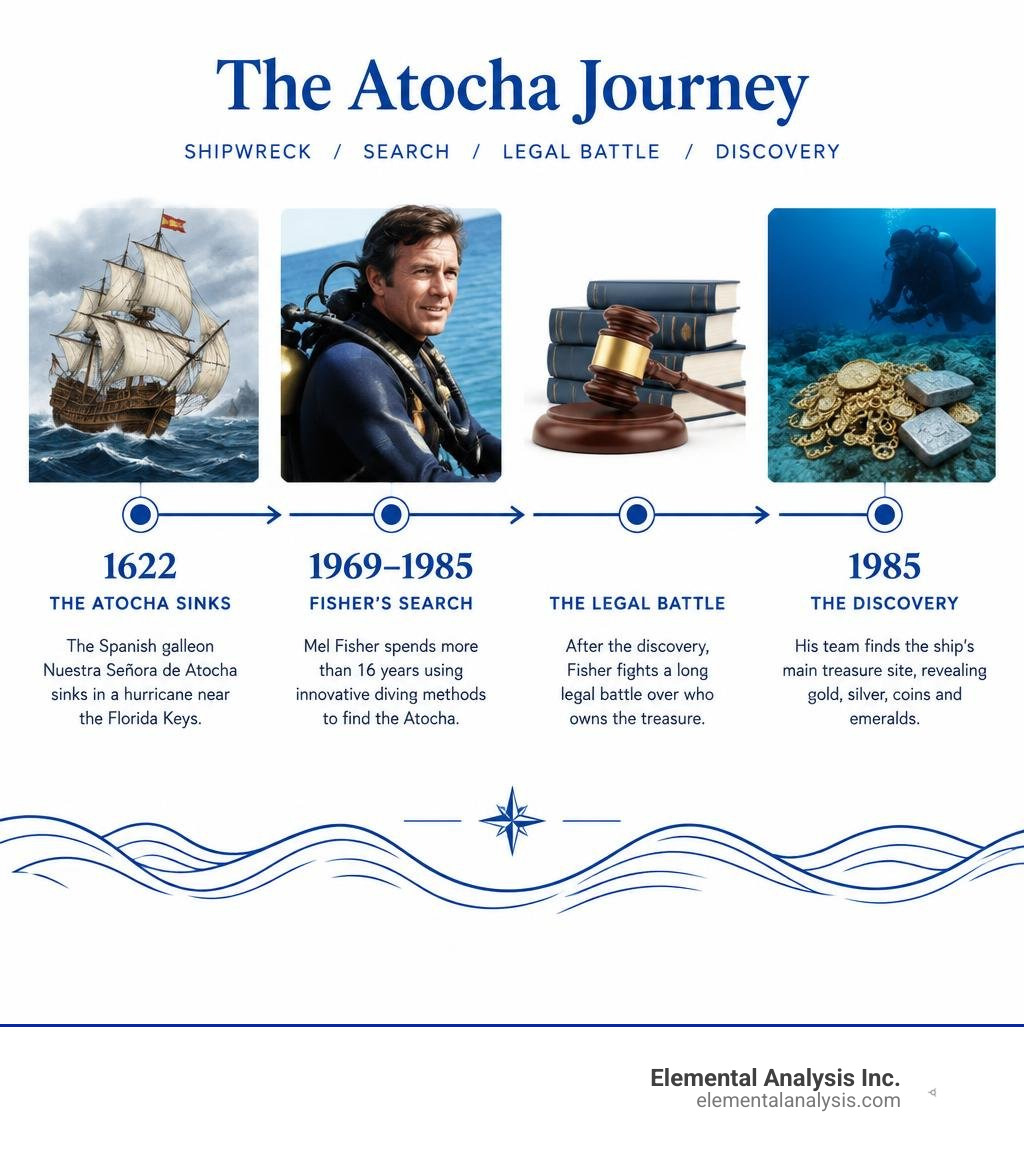
Mel Fisher spent more than 16 years searching for the Nuestra Señora de Atocha, a Spanish galleon that sank near the Florida Keys in a 1622 hurricane. On July 20, 1985, his team found the ship’s main treasure site. The recovered gold, silver, coins, and emeralds have been valued at an estimated $450 million. The story of the Mel Fisher Atocha expedition is one of persistence, innovation, and a landmark legal battle that reshaped shipwreck salvage.
Fisher’s path from an Indiana chicken farm to that discovery involved new diving methods, a devastating family loss, and a long fight over who owned the treasure. His story is also about what happens to historic objects after they leave the seabed.
Key topics to explore:
Who Was Mel Fisher? From Indiana Farmer to Master Salvager
Before he became the world’s most famous treasure hunter, Mel Fisher was an ambitious Midwesterner with an irrepressible fascination for the sea. Born in Indiana in 1922, his early life seemed far removed from the sun-drenched waters of the Florida Straits, yet his drive to explore the deep took root almost immediately.
Mel Fisher’s Early Ingenuity and Diving Ventures
As an eleven-year-old boy in Indiana, Fisher fashioned his very first “hard-hat” diving rig using a repurposed metal paint bucket, a garden hose, and a bicycle tire pump. With this rudimentary gear, he walked along the muddy bottoms of local lagoons, proving that sheer curiosity and mechanical ingenuity could overcome any lack of formal equipment.
Fisher went on to study engineering at Purdue University before serving as an engineer in the U.S. Army during World War II. After the war, he moved out west to run a chicken farm in California. However, commercial poultry could not hold his attention for long.
Drawn back to the ocean, Fisher opened “See Da Sea” in Redondo Beach, widely recognized as one of the world’s first dedicated retail dive shops. He and his wife, Dolores “Deo” Horton, became pioneers of recreational and commercial scuba diving. Deo was an elite diver in her own right, once setting a women’s underwater endurance record by remaining submerged for an astonishing 55 hours and 37 minutes. Together, the couple introduced over 65,000 novices to the underwater realm. For a deeper look at his formative years, read this biographical profile of Melvin A. Fisher.
The 1715 Fleet and Shift to Key West
In the early 1960s, Fisher crossed paths with legendary salvage operator Kip Wagner, who was working the wrecks of the 1715 Spanish Plate Fleet off the eastern coast of Florida. Intrigued by the prospect of finding sunken Spanish riches, Fisher founded Treasure Salvors, Inc. and relocated his family to the Atlantic coast.
His engineering background paid off quickly. After adapting innovative salvage techniques, Fisher’s crew located an astonishing pocket of 1,033 gold coins from the 1715 fleet. But Fisher had set his sights on a far grander prize: the lost Tierra Firme fleet flagship of 1622, the Nuestra Señora de Atocha.
Armed with archival research gathered by historian Dr. Eugene Lyon at the Archivo General de Indias in Seville, Spain, Fisher realized that centuries of searchers had been looking in the wrong place. The Spanish records indicated the fleet had foundered in the shallow reefs off the Marquesas Keys, west of Key West. Fisher relocated his entire operation to Key West to begin what would become a sixteen-year odyssey. You can explore all about the Atocha shipwreck treasure discovery and how those early Spanish manifests mapped the disaster.
The Tragedy and Triumph of the Mel Fisher Atocha Expedition
Searching for a scattered 17th-century wreck in shifting seabed sands requires patience, capital, and specialized technology. Day after day, year after year, Fisher greeted his crew every morning with his enduring, trademark optimism: “Today’s the day!”
Key Technologies Behind the Mel Fisher Atocha Hunt
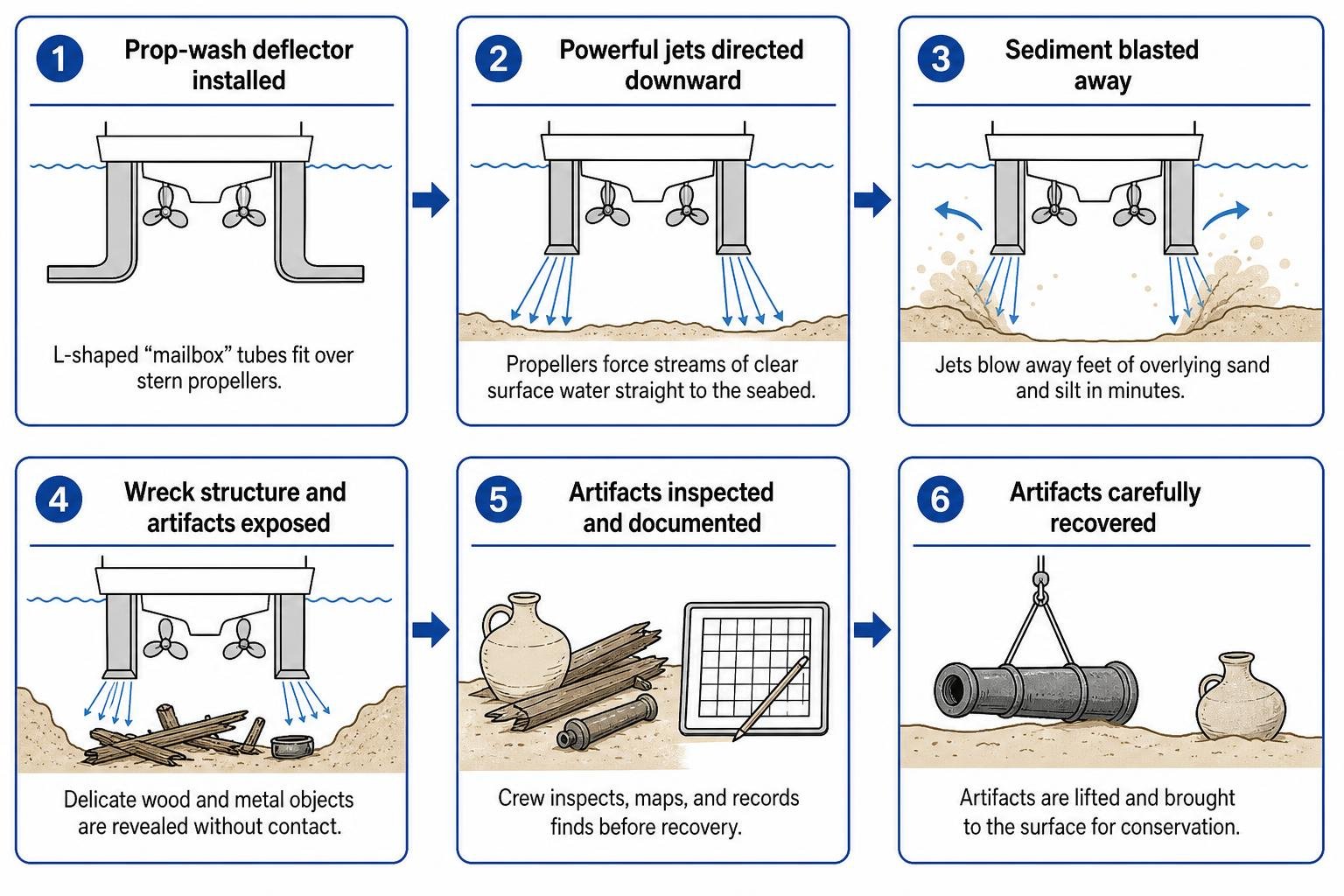
Standard dredging could not clear the deep layers of sediment covering the Florida Keys seabed. To solve this, Fisher invented the “mailbox” prop-wash deflector. These large, L-shaped aluminum tubes fit over a salvage vessel’s stern propellers, directing powerful streams of clear surface water straight down to the sea floor. This blew away feet of overburdening sand in minutes without damaging delicate wooden structures or heavy metal artifacts below.
Alongside the mailbox, Fisher’s team used:
- Proton precession magnetometers to detect iron hull fasteners, anchors, and buried iron fittings.
- Side-scan sonar systems to trace topography anomalies along shallow banks.
- Rigorous visual grid mapping across a vast, 22-foot-deep sandy expanse dubbed “The Bank of Spain.”
Heartbreak at Sea: The 1975 Tragedy
The expedition’s lowest point came immediately after its first major breakthrough. In early July 1975, Fisher’s oldest son, Dirk, located five solid bronze cannons on the seabed. Their cast markings and weight numbers matched the 1622 Atocha manifest, definitively proving that the team was on the right trail.
Tragically, just days later on July 20, 1975, the team’s salvage tug, the Northwind, suffered a catastrophic bilge pump failure while anchored overnight. The vessel capsized. Dirk Fisher, his wife Angel, and crew diver Rick Gage drowned.
The loss crushed the Fisher family, and critics predicted the search was over. Yet, driven by the memory of Dirk’s conviction that the motherlode was close, Mel, Deo, and their surviving sons resolved to press on.
The Mel Fisher Atocha Motherlode Recovery in 1985
Ten years to the day after the Northwind tragedy, on July 20, 1985, Fisher’s son Kane was operating the salvage vessel Dauntless. Diver Greg Wareham swam along a deep sand trench and surfaced with an incredible sight: solid silver bars stacked like cordwood.
Kane Fisher picked up his marine radio mic and broadcast the long-awaited message to his father’s Key West headquarters:
“Put away the charts! We’ve found the Mother Lode!”
Lying in just 22 feet of water was the main hull structure of the Atocha. Over the coming months, divers brought up over 40 tons of gold and silver, including more than 114,000 silver “pieces of eight” coins and over 1,000 massive silver ingots. Explore the historical documentation of Mel Fisher for the complete archival timeline of this monumental discovery.
Inside the $450 Million Atocha Treasure Cache
The sheer scale of the recovered material stunned the numismatic and archaeological worlds. Valued conservatively at $450 million, the cargo offered an unprecedented cross-section of 17th-century Spanish colonial trade, wealth, and craftsmanship.
Precious Metals, Muzo Emeralds, and Rare Artifacts
The Atocha was carrying royal taxes, private mercantile fortunes, and church contributions from across South America. Among the most coveted items were raw and cut emeralds mined from Colombia’s legendary Muzo Mine, celebrated for their deep green fire and crystal purity. Divers also recovered ornate gold chalices, intricate devotional jewelry, gold bars, and silver tableware.
Coin collectors were treated to an extraordinary trove of hand-struck Spanish silver reales from colonial mints in Potosí, Lima, and Mexico City. If you collect or study these pieces, consult our collectors handbook to Spanish silver coins for mintmark identification, or browse our guide to authentic shipwreck jewelry to learn how recovered metals are preserved and mounted.
| Cargo Category | Recovered Motherlode (1985–Present) | Estimated Missing Sterncastle Cargo |
|---|---|---|
| Silver Ingots | ~1,000 bars recovered | ~300 registered silver bars |
| Silver Coins | ~114,000 pieces of eight | Tens of thousands of unregistered coins |
| Gold Coins | 121 confirmed coins (as of recent finds) | Unknown quantity of private merchant gold |
| Raw Emeralds | Thousands of carats (Muzo origin) | Private nobility chests & uncut rough stones |
| Artillery | 5 bronze cannons (identified in 1975) | 8 bronze cannons |
| Primary Location | “The Bank of Spain” ballast site | Scattered drift path / deep reef zone |
The Missing Sterncastle and Ongoing Salvage Operations
Remarkably, historians estimate that roughly half of the Atocha‘s original treasure remains unrecovered. When the hurricane struck in September 1622, the ship ran aground, tore open its hull, and then drifted. A secondary storm wave sheared off the upper sterncastle—the exact cabin area where wealthy nobility, church prelates, and royal officials secured their private fortunes and top-tier Muzo emeralds.
Over 300 registered silver ingots and eight bronze cannons remain unaccounted for. Modern salvage crews, led by second-generation searchers like engineer Zach Moore (whose father Bill Moore worked alongside Mel in 1985), continue to work active concessions in the Florida Keys. In July 2021, Moore located the wreck site’s 121st recorded gold coin—a pristine specimen valued at roughly $98,000—proving that the shifting sands still hold undiscovered wealth.
Landmark Legal Precedents and Controversies
Finding a half-billion-dollar galleon is one thing; keeping it is another. Fisher’s triumph ignited one of the most consequential legal confrontations in modern maritime history.
The Supreme Court Victory Over Florida
Almost immediately after Treasure Salvors, Inc. confirmed the Atocha‘s identity, the State of Florida moved to claim title to the wreck, invoking state antiquities statutes that demanded a mandatory 25 percent share of all recovered artifacts.
Fisher fought the state’s claim in federal court. The resulting legal battle dragged on for nearly eight years, passing through federal district courts and appellate panels until it reached the highest court in the country.
On July 1, 1982, the U.S. Supreme Court ruled unanimously in favor of Treasure Salvors, Inc. The Court established that because the wreck lay outside Florida’s territorial waters in federal contiguous boundaries, state antiquities laws did not apply, and established principles of maritime admiralty and salvage law took precedence. The decision granted Fisher’s team 100 percent ownership of the recovered cargo, creating a foundational legal precedent for private salvage operators worldwide.
Slave Ship Henrietta Marie and Business Controversies
While hunting for the Atocha, Fisher’s team made another historic, though somber, discovery in 1972: the English merchant slave ship Henrietta Marie, which sank in 1700. Divers recovered iron bilboes (shackles), pewterware, and a bronze ship’s bell inscribed with the vessel’s name. Working alongside marine archaeologist Duncan Mathewson, Fisher’s organization cataloged the artifacts, providing profound material evidence of the transatlantic slave trade. These artifacts are now preserved and exhibited for educational outreach at the Mel Fisher Maritime Heritage Museum.
However, Fisher’s commercial operations were not immune to scrutiny. In 1998, a retail subsidiary called Crystals of Delaware resolved a legal inquiry by pleading no contest to charges involving the sale of counterfeit 1733 fleet silver coins bearing signed certificates of authenticity. The incident highlighted the ongoing need for strict numismatic verification, rigorous provenance tracking, and objective material testing within the commercial shipwreck trade.
Frequently Asked Questions About Mel Fisher and the Atocha
How much was the Atocha treasure worth?
The primary motherlode recovered by Mel Fisher in 1985 has been appraised at an estimated $450 million. Containing 40 tons of gold, silver, thousands of Muzo emeralds, and over 114,000 silver coins, it is considered one of the richest underwater treasure discoveries in history, drawing frequent comparisons to the discovery of King Tutankhamun’s tomb.
How much of the Nuestra Señora de Atocha is still missing?
Roughly half of the vessel’s original wealth remains buried under the ocean floor. The missing sterncastle contains an estimated 300 registered silver bars, eight heavy bronze cannons, and the unmanifested private gold, jewels, and emerald chests belonging to wealthy passengers and clergy.
Who owns the Atocha treasure today?
Following the 1982 U.S. Supreme Court decision, the treasure was distributed among Treasure Salvors, Inc., its financial investors, and participating crew members. Portions of the cargo were gifted to the non-profit Mel Fisher Maritime Heritage Society for public museum preservation, while other items have been sold at public auctions to private collectors and museums.
Conclusion: Science, History, and the Legacy of the Atocha
Mel Fisher’s legacy remains larger than life. His sixteen-year quest reshaped the marine salvage industry and inspired generations of divers to dream big. At the same time, the debates surrounding commercial salvage contributed directly to international preservation frameworks, including the 2001 UNESCO Convention on the Protection of the Underwater Cultural Heritage.
For collectors, museums, and historians, the real work begins after an artifact reaches the surface. Untangling genuine 17th-century Spanish colonial metallurgy from contemporary replicas requires rigorous scientific authentication.
At Elemental Analysis Inc. in Lexington, Kentucky, we specialize in high-precision, non-destructive materials testing. As the first commercial laboratory to offer Proton-Induced X-ray Emission (PIXE) analysis alongside advanced trace element identification and quantification, we help numismatists, conservators, and researchers verify alloy compositions and origin signatures without damaging priceless historic artifacts.
To learn more about the 1622 disaster, the fleet’s journey, and the ongoing search for the missing sterncastle, explore our comprehensive guide on the wreck of the Nuestra Señora de Atocha.