
The 1622 Tierra Firme Fleet and Mel Fisher’s Discovery
Mel Fisher Atocha coins are authentic Spanish colonial silver and gold pieces recovered from the Nuestra Señora de Atocha, a 1622 Tierra Firme Fleet galleon lost off the Florida Keys. The most common recoveries are hand-struck silver reales, especially the 8 reales “piece of eight,” along with smaller denominations and rare gold escudos. For collectors, value depends on denomination, condition grade, mint mark clarity, and documented provenance from the 1985 discovery of the main treasure deposit.
On September 4, 1622, the heavily laden ships of Spain’s Tierra Firme Fleet raised their anchors and departed Havana, bound for Cadiz. Two days later, a fierce hurricane battered the convoy as it traversed the Florida Straits. Driven northward onto shallow reefs off the Florida Keys, the flagship Nuestra Señora de Atocha broke apart and sank beneath the waves. For over three and a half centuries, the ocean guarded one of the wealthiest cargos in maritime history. To explore the vessel’s complete story, see our detailed background on the wreck of the Nuestra Senora de Atocha.
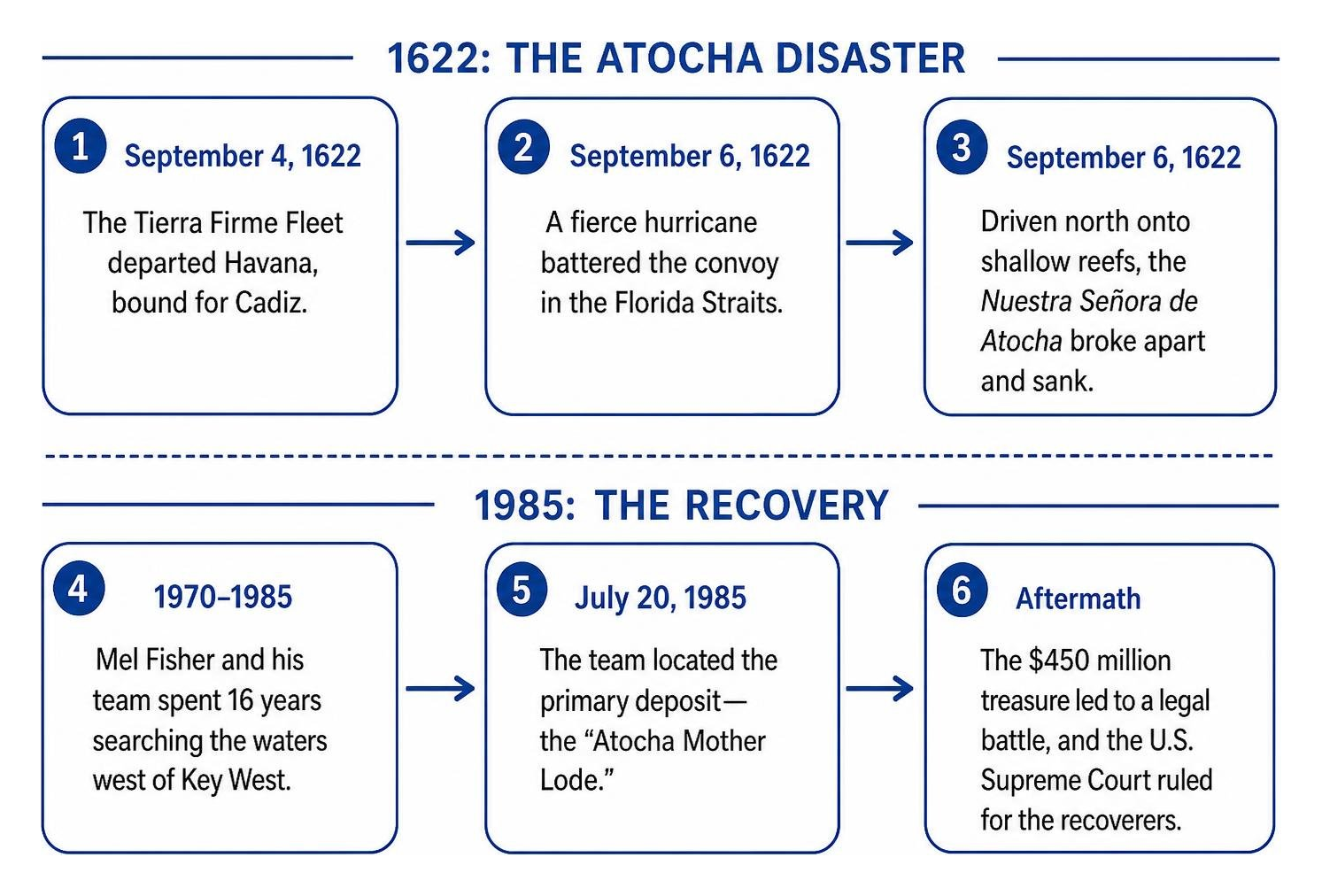
The search for the lost galleon became a legendary modern odyssey led by explorer Mel Fisher. Motivated by his unwavering daily motto, “Today’s the day!”, Fisher and his dedicated salvage team, Treasure Salvors, Inc., spent sixteen relentless years combing the waters west of Key West. The search was fraught with personal sacrifice, including the tragic 1975 loss of Fisher’s son Dirk, daughter-in-law Angel, and diver Rick Gage.
Persistence yielded triumph on July 20, 1985, when the crew located the primary cultural deposit—widely celebrated as the “Atocha Mother Lode.” The estimated $450 million cache included over 40 tons of gold and silver, featuring roughly 114,000 Spanish silver coins known as “pieces of eight,” rare gold coins, 1,000 silver ingots, vibrant Colombian emeralds from the Muzo mine, and thousands of personal artifacts. Even viable plant seeds were brought up from the seabed and later successfully sprouted.
The discovery sparked a protracted legal battle when the State of Florida claimed 25% ownership of the cargo. The dispute escalated to the United States Supreme Court, which ultimately ruled in favor of Treasure Salvors, confirming their exclusive ownership of the recovered artifacts and establishing crucial legal precedents for private admiralty salvage.
Beyond the Atocha, Fisher’s operations yielded significant archaeological recoveries at other historic wrecks, including the sister galleon Santa Margarita, the English slave ship Henrietta Marie, and multiple vessels belonging to the 1715 Spanish Treasure Fleet.
Today, modern salvage operations continue at the Atocha site. Specialized vessels such as the J.B. Magruder systematically scan the debris trail with advanced magnetometers and sub-bottom profilers, recovering additional historical artifacts every season.
Anatomy and Denominations of Mel Fisher Atocha Coins
Colonial Spanish coins recovered from the Atocha were produced using the “cob” method (derived from cabo de barra, meaning “end of the bar”). Mint workers sliced irregular planchets from cast metal bars, adjusted them to statutory weight with metal shears, and hand-struck them between iron dies using heavy hammers.
Because of this crude manufacturing process, no two cobs are visually identical. Flans are frequently off-center, displaying partial strikes of the royal Spanish coat of arms (Habsburg shield) on the obverse and the Jerusalem cross with castles and lions on the reverse. The Atocha carried over 200,000 hand-stamped silver coins, representing the vital economic lifeblood of the Spanish Empire. In the early seventeenth century, a single 8 reales silver coin represented roughly one month’s pay for an ordinary sailor.
| Denomination | Metal | Standard Weight (Grams) | Contemporary Economic Purchasing Power |
|---|---|---|---|
| 8 Reales (“Piece of Eight”) | Silver | ~27.0 g | ~1 month’s sailor wages; bulk trade |
| 4 Reales | Silver | ~13.5 g | Livestock, commercial supplies, travel fare |
| 2 Reales (“Pistareen”) | Silver | ~6.75 g | Weekly provisions, tavern lodging |
| 1 Real | Silver | ~3.38 g | Daily artisan labor, basic market staples |
| 1/2 Real & 1/4 Real | Silver | ~1.69 g / 0.85 g | Small daily purchases, bread, local tavern goods |
| 8 Escudos (“Onza” / Doubloon) | Gold | ~27.0 g | Major international trade, high-ranking officer wages |
| 4 Escudos | Gold | ~13.5 g | Estate transactions, luxury imported cargo |
| 2 Escudos (“Doubloon”) | Gold | ~6.75 g | High-value commerce (16:1 silver-to-gold legal ratio) |
| 1 Escudo | Gold | ~3.38 g | Worth two silver 8 reales coins |
Silver Reales and Gold Escudos
The silver coins recovered from the galleon span all standard colonial denominations: 8 reales, 4 reales, 2 reales, 1 real, and fractional 1/2 and 1/4 reales. The vast majority originated from major New World mints located at Potosí (in modern-day Bolivia), Lima (Peru), and Mexico City. Collectors consult numismatic references like the official Coin Description to study the die varieties and assayer letters associated with each minting center.
Gold coins recovered from the Atocha represent genuine numismatic treasures. To date, only 128 gold Atocha coins have ever been recovered. In 1622, New World colonial mints were not yet authorized to strike gold coinage, meaning every gold escudo aboard was minted directly in mainland Spain (principally Seville and Madrid) before being shipped to the Americas to facilitate trade.
Rare Mint Marks: Cartagena and Nuevo Reino Discoveries
While coins from Potosí and Mexico City comprise the vast bulk of the recovery, numismatists prize specimens displaying mint marks from emerging colonial facilities. Among the rarest finds are silver coins struck at the Cartagena mint in modern-day Colombia.
Only 8 coins recovered from the Atocha have been identified with the Cartagena and Nuevo Reino (“RN”) mint marks, featuring the distinctive assayer mark “A” for Martín de Arbustante (active 1621–1628). Several of these exceptional coins were discovered within heavily fused clusters of silver coins bound together by centuries of thick marine oxidation. Their profound rarity makes them prized centerpiece acquisitions for museum collections and advanced private numismatists.
Authentication and Grading: Original Artifacts vs. Re-creations
Centuries of immersion in shallow, aerated saltwater subject silver coins to electrolytic corrosion and silver sulfide conversion. Once brought to the surface, marine artifacts require meticulous conservation in a laboratory setting. Technicians utilize controlled electrolytic reduction baths to gently convert encrusted silver sulfide compounds back into stable metallic silver without damaging underlying details.
When selecting shipwreck pieces mounted into fine jewelry, it helps to review a comprehensive Mel Fisher jewelry buying guide for shipwreck coin collectors to understand how settings interact with coin grades.
Grading Criteria for Mel Fisher Atocha Coins
Shipwreck coins are categorized into four distinct grades based on metal preservation, clarity of details, and marine corrosion:
- Grade 1: The finest condition. Features full or nearly complete weight with minimal marine erosion. Mint marks, assayer letters, the Habsburg coat of arms, and the cross are sharp, bold, and clearly legible.
- Grade 2: Excellent quality with light surface corrosion or minor edge loss. Crucial central details such as the shield or cross remain highly legible.
- Grade 3: Moderate saltwater corrosion with noticeable weight reduction. While the overall outline of the devices remains discernable, specific mint marks or dates may be partially obscured.
- Grade 4: Heavy marine corrosion and significant metal loss, resulting in thin, fragile planchets with faint designs. These provide an authentic piece of the wreck at an accessible entry-level price point.
Market valuations reflect these condition tiers, with Grade 1 eight-reales specimens commanding prices exceeding $10,000, while lower grades and smaller denominations sell for lower amounts.
Authentic Shipwreck Silver vs. Cast Re-creations
Buyers must differentiate between original, hand-struck seventeenth-century coins and modern re-creations:
- Original Shipwreck Coins: Genuine historical artifacts hand-struck in the 1600s, recovered directly from the seabed, conserved, and assigned individual inventory numbers.
- Silver Bar Re-Creations: Modern commemorative jewelry, medallions, and cast pendants struck or cast using silver refined from recovered Atocha silver ingots. These pieces provide a tangible, certified physical link to the shipwreck at an economical price point, but they are modern castings rather than circulating colonial cobs.
Verifying Mel Fisher Atocha Coins and Certificates of Authenticity
Every authentic artifact recovered by Treasure Salvors was cataloged and paired with an official Certificate of Authenticity (COA). A genuine COA provides:
- The unique computer inventory salvage number matching the coin’s documentation tag.
- The weight, denomination, mint mark, and assayer identification.
- The artifact grade (1 through 4) and recovery date.
- The official embossed corporate seal and authorized signature.
Maintaining strict documentation prevents issues like the 1998 counterfeit scandal involving unauthorized third-party distributors such as Crystals of Delaware, which attempted to market cast replicas as genuine seabed recoveries. Preserving an unbroken chain of custody with original paperwork is essential for protecting long-term numismatic value.
Scientific Authentication and Metallurgical Verification
When historical documentation is missing or a coin requires unequivocal provenance verification, modern laboratory science steps in. Analytical chemistry provides non-destructive testing methods that analyze the exact metallurgical signature of seventeenth-century New World silver and gold.
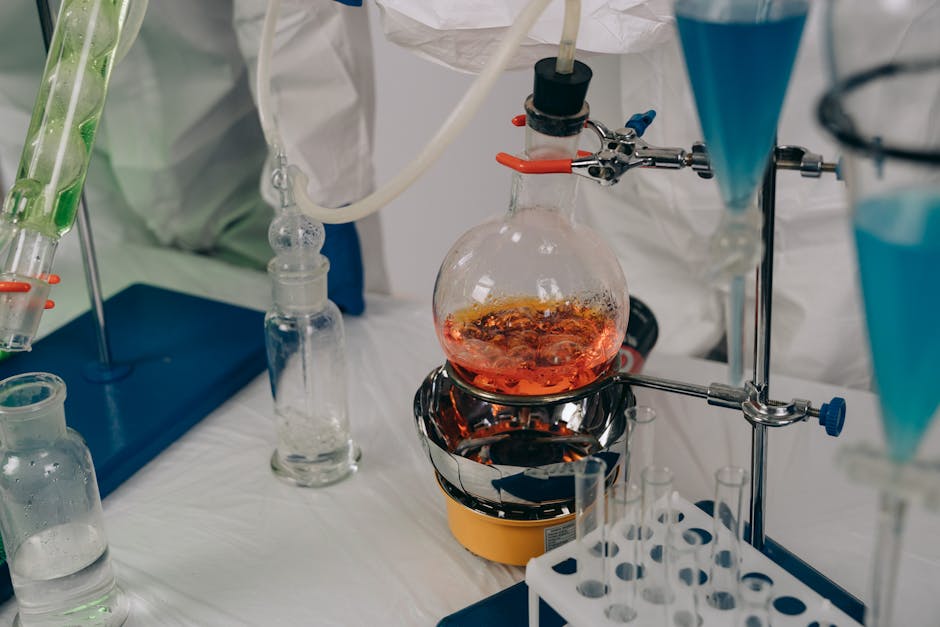
Colonial mints refined metals using rudimentary charcoal smelting and mercury amalgamation processes. As a result, genuine seventeenth-century coinage contains unique trace-element impurities, including trace gold, copper, bismuth, antimony, arsenic, and zinc, in proportions distinct from modern refined bullion.
At Elemental Analysis Inc., operating from our state-of-the-art laboratory in Lexington, Kentucky, we provide advanced non-destructive and destructive analytical testing to determine alloy profiles without altering delicate artifacts:
- X-ray Fluorescence Spectrometry: We utilize X-ray fluorescence spectrometry to measure the principal surface elemental concentrations of precious metals rapidly and non-destructively.
- Particle-Induced X-ray Emission (PIXE): As the first commercial PIXE laboratory, we employ particle-induced X-ray emission to deliver high-sensitivity, non-destructive trace elemental profiling capable of detecting microscopic chemical impurities throughout an artifact’s alloy matrix.
- Lead Isotope Ratio Mass Spectrometry: Because silver ores contain minute trace amounts of lead, measuring lead isotope ratios enables scientists to trace the metal back to specific geological mining deposits, such as the Cerro Rico mountain in Potosí or the mines of Mexico.
These laboratory methods provide conclusive physical verification, separating genuine New World shipwreck silver from modern counterfeit castings.
Frequently Asked Questions About Atocha Shipwreck Coins
How much is an authentic Atocha silver coin worth?
Values range from approximately $1,500 to well over $12,000 depending on denomination, grade, mint mark clarity, and mounting. A high-grade (Grade 1) 8 reales coin featuring a visible date, clear assayer mark, and complete original documentation commands premium collector value.
How many gold coins were found on the Atocha wreck site?
To date, only 128 gold coins have been recovered from the Nuestra Señora de Atocha. The 121st specimen was recovered on July 20, 2021, by the crew of the J.B. Magruder, valued at roughly $98,000. Because gold escudos were minted in mainland Spain rather than colonial mints in 1622, their extreme scarcity commands high market premiums.
Is treasure salvage still happening on the Atocha site?
Yes, salvage operations remain active. Significant portions of the vessel, including the heavily fortified sterncastle where the wealthiest passengers and nobility stored their personal valuables, have never been found. Modern salvage teams continue mapping and excavating the debris field in search of unrecovered silver bars, gold bullion, and bronze cannons.
Conclusion
The silver and gold coins recovered from the Nuestra Señora de Atocha are tangible pieces of seventeenth-century maritime and colonial history. Whether you are an experienced collector acquiring a museum-grade piece of eight or an enthusiast purchasing your first silver cob pendant, ensuring authenticity through rigorous provenance tracking and scientific verification protects both your financial investment and historical heritage.
To explore the history of the 1622 fleet further, dive into our comprehensive analysis of the wreck of the Nuestra Senora de Atocha. If you require precise elemental testing, alloy verification, or non-destructive material analysis for historical artifacts, our team at Elemental Analysis Inc. in Lexington, Kentucky, delivers trusted analytical testing across all sectors.