
What are heavy rare earth metals, and why do they matter?
Heavy rare earth metals are a group of rare earth elements that includes dysprosium, terbium, and holmium. Yttrium is often grouped with them because it behaves similarly. Some help powerful magnets keep working at high temperatures; others are used in lasers, medical technology, and aerospace parts.
Their supply is a concern. China dominates rare earth processing, and the United States was 100% reliant on imports for heavy rare earth compounds and metals in 2025. As demand grows for electric vehicles, wind turbines, and defense equipment, knowing which element a product needs—and where it was processed—matters as much as knowing it contains “rare earths.”
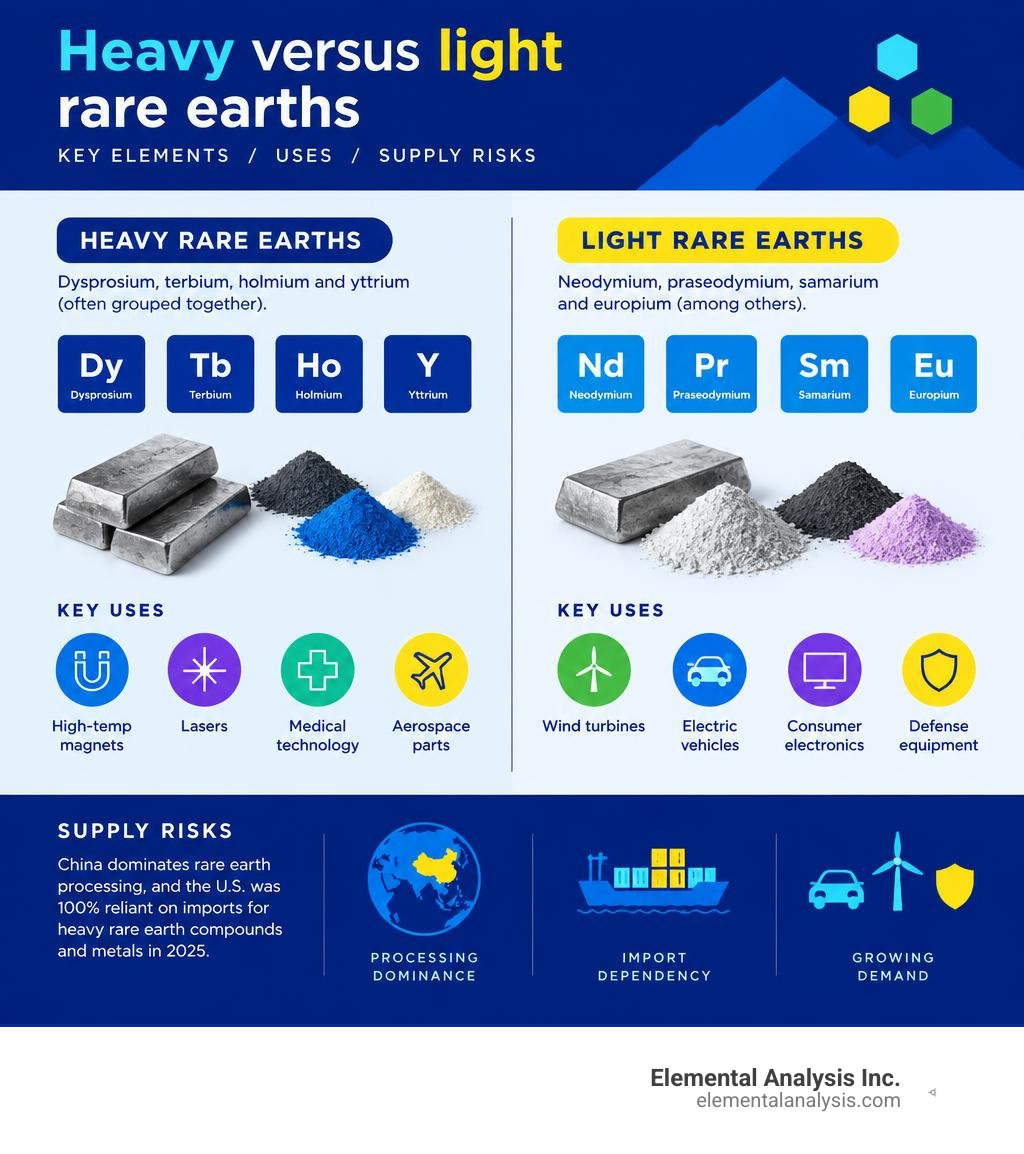
Common heavy rare earth metals vocab:
Classification and Geochemical Properties of Heavy Rare Earth Metals
To truly understand what sets heavy rare earth elements (HREEs) apart, we have to look closely at the atomic architecture of the periodic table. While the light rare earth elements (LREEs)—ranging from lanthanum (atomic number 57) to samarium (atomic number 62) or europium (63)—possess fewer 4f electrons, the heavy rare earths encompass the higher atomic number lanthanides from gadolinium (64) through lutetium (71), alongside yttrium (39).
The defining physical phenomenon across this series is the lanthanide contraction. As nuclear charge increases across the row, the 4f inner-shell electrons do not completely shield the growing positive pull of the nucleus. As a result, the electron cloud is pulled tighter and tighter toward the core. This steady decrease in ionic radii across the heavy lanthanides directly affects crystal field splitting, coordination numbers, and geochemical behavior. Yttrium, despite its significantly lower atomic weight, shares an almost identical trivalent ionic radius with holmium and dysprosium, allowing it to substitute seamlessly into the same crystalline lattices.
| Element | Atomic Number | Density (g/cm³) | Crustal Abundance (ppm) | 2025 Oxide Price (USD/kg) |
|---|---|---|---|---|
| Yttrium (Y) | 39 | 4.47 | 31.0 | ~$1,000 |
| Terbium (Tb) | 65 | 8.23 | 1.2 | $1,010 |
| Dysprosium (Dy) | 66 | 8.54 | 5.2 | $239 |
| Holmium (Ho) | 67 | 8.80 | 1.3 | $70 |
| Erbium (Er) | 68 | 9.07 | 2.8 | $46 |
| Thulium (Tm) | 69 | 9.32 | 0.5 | N/A |
| Ytterbium (Yb) | 70 | 6.97 | 3.2 | $15 |
| Lutetium (Lu) | 71 | 9.84 | 0.8 | $888 |
Individual Elements and Their Physical Characteristics
Each heavy rare earth metal brings a distinct set of physical, optical, and magnetic traits:
- Terbium (Tb): Terbium is surprisingly soft enough to cut with a blade, yet it boasts massive magnetic anisotropy and unmatched magnetostrictive properties. It emits a vivid green fluorescence under ultraviolet radiation.
- Dysprosium (Dy): Known for its exceptional thermal resistance and high magnetic moment, dysprosium is the single most valuable heavy rare earth element by total market value, accounting for roughly 41% of heavy rare earth market revenue.
- Holmium (Ho): Possessing the highest magnetic permeability of any known element, holmium concentrates magnetic flux lines like nothing else in the natural world.
- Erbium (Er): Crucial for telecommunications, erbium features sharp optical absorption and emission spectra centered squarely at the 1.54-micrometer wavelength—the exact sweet spot for minimal signal loss in silica glass.
- Thulium (Tm) & Ytterbium (Yb): Thulium is among the rarest non-radioactive lanthanides, finding uses in portable X-ray devices and solid-state lasers. Ytterbium offers specialized stress-gauging capabilities and optical atomic clock precision.
- Lutetium (Lu): The densest, hardest, and final member of the lanthanide series, lutetium is prized for its high-energy scintillation properties and high-value radiopharmaceutical applications.
Geological Occurrence and Ore Deposits
Unlike light rare earths, which concentrate heavily in massive hard-rock carbonatites like bastnäsite, heavy rare earths occur in far more dispersed mineral environments. The primary economic repositories of HREEs are ion-adsorption clays (weathered crust elution-deposited ores), xenotime, eudialyte, and certain varieties of monazite.
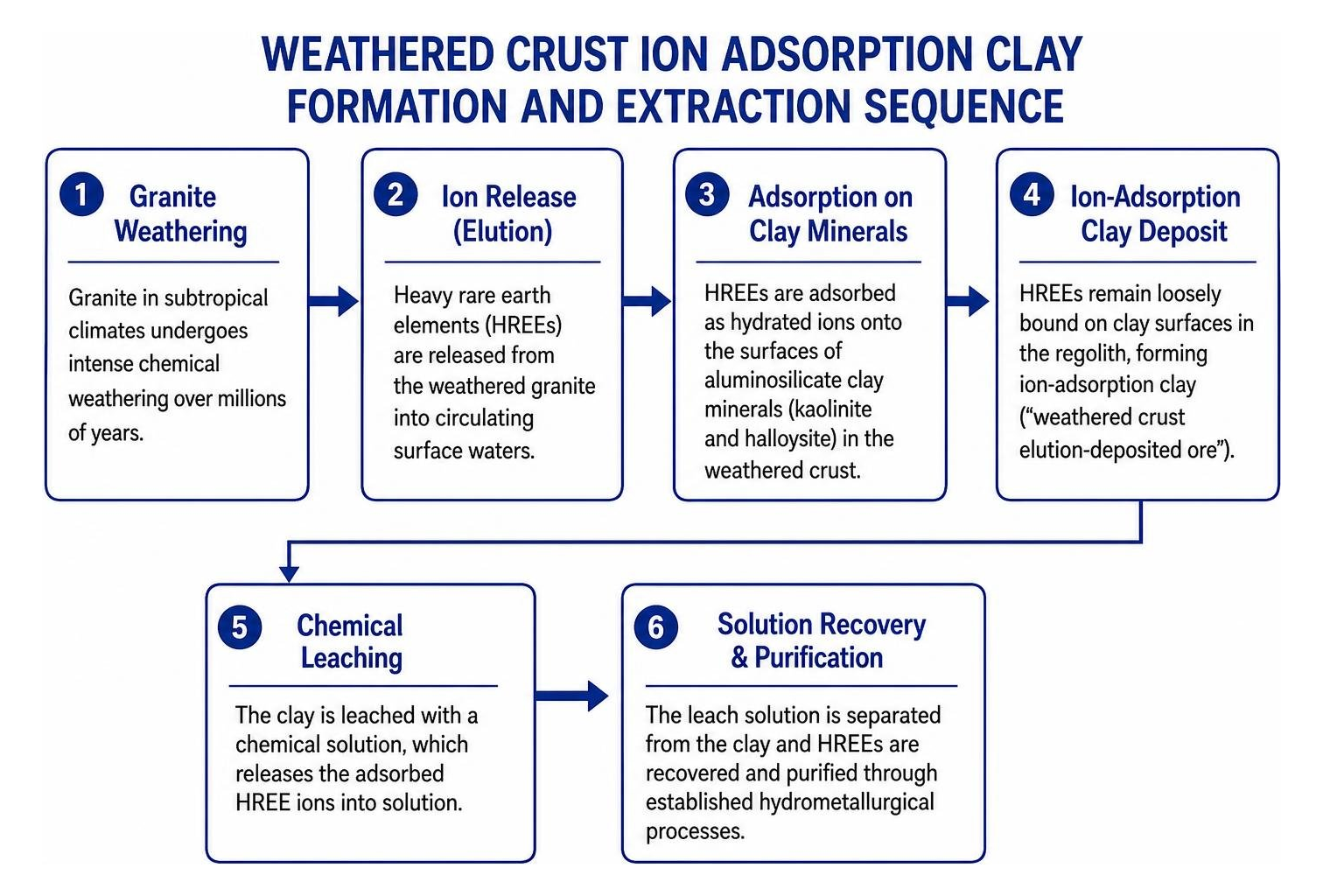
Ion-adsorption clays, formed by millions of years of intense chemical weathering of granite in subtropical climates, hold HREEs loosely bound as hydrated ions onto the surface of aluminosilicate clay minerals like kaolinite and halloysite. Because these elements are adsorbed rather than locked inside stubborn crystalline mineral structures, they can be extracted via chemical leaching without the high-energy crushing and milling associated with hard-rock mining. Detailed geological evaluation of critical minerals demonstrates that while heavy mineral placers and alkaline complexes exist globally, South China’s unique regolith deposits have historically provided the bulk of accessible global heavy rare earth tonnage.
Industrial, Energy, and National Defense Applications
Permanent magnets represent approximately 95% of total rare earth consumption by value. While neodymium-iron-boron (NdFeB) alloys create the strongest magnets commercially available, pure NdFeB magnets suffer from a major limitation: their magnetic coercivity collapses at elevated temperatures.
When you introduce dysprosium and terbium into the crystal lattice, they substitute for neodymium atoms at the grain boundaries. This dramatic structural tweak prevents demagnetization under thermal and mechanical stress, raising the magnet’s thermal operating threshold from a modest 60°C up to an astonishing 240°C.
| Magnet Parameter | Standard NdFeB (No HREE) | HREE-Doped NdFeB (Dy/Tb Added) |
|---|---|---|
| Max Operating Temperature | 60°C to 80°C | Up to 240°C |
| Coercivity (Hcj) | Low to Moderate | Extremely High |
| Thermal Demagnetization Risk | Severe above 100°C | Negligible under high torque/load |
| Primary Industrial Sector | Consumer electronics, toys | EV drivetrains, aerospace, wind turbines |
Critical Applications of Heavy Rare Earth Metals in Clean Energy and Defense
In the modern automotive sector, over 90% of electric vehicle models rely on permanent-magnet drivetrains. By incorporating heavy rare earth dopants, electric motor designers can reduce total motor volume and weight while sustaining massive torque across continuous high-speed driving cycles. Similarly, direct-drive offshore wind turbines—a sector experiencing a projected 12% compound annual growth rate through 2030—utilize hundreds of kilograms of heavy rare earth-doped magnets per generator to eliminate the need for mechanical gearboxes, drastically reducing marine maintenance costs.
In national defense, heavy rare earths are irreplaceable:
- Terfenol-D: An alloy of terbium, dysprosium, and iron that exhibits massive magnetostriction, changing shape when magnetized to drive naval sonar transducers and precision acoustic actuators.
- Flight Surfaces & Actuators: High-coercivity magnets power the wing-flap actuators, fin stabilizers, and hydraulic pumps in fifth-generation fighter jets and precision-guided missile platforms.
- Targeting & Secure Communications: Erbium- and holmium-doped laser crystals power night-vision guidance optics, rangefinders, and satellite communication links.
Medical, Nuclear, and Advanced High-Tech Implementations
Beyond motors and defense, heavy rare earths power essential medical and nuclear infrastructure. Lutetium-177 is at the forefront of targeted radionuclide therapy for prostate cancer and neuroendocrine tumors, destroying malignant cells while sparing healthy tissue. Gadolinium compounds are standard intravenous contrast agents for magnetic resonance imaging (MRI).
In the nuclear industry, samarium, dysprosium, and gadolinium serve as critical neutron absorbers in reactor control rods and emergency shutdown systems due to their vast thermal neutron capture cross-sections. Meanwhile, yttrium stabilized zirconia (YSZ) provides vital thermal barrier coatings for commercial jet engine turbine blades and creates the plasma-resistant ceramic chambers required for semiconductor etching.
Global Supply Chains, Geopolitical Vulnerabilities, and Trade Policies
The global market for rare earth elements stands at roughly 300,000 metric tons annually, representing about US$5 billion per year. However, refining capacity remains concentrated in a single geographic hub: China controls between 85% and 90% of global rare earth mineral refining capacity and roughly 98% of heavy rare earth separation infrastructure.
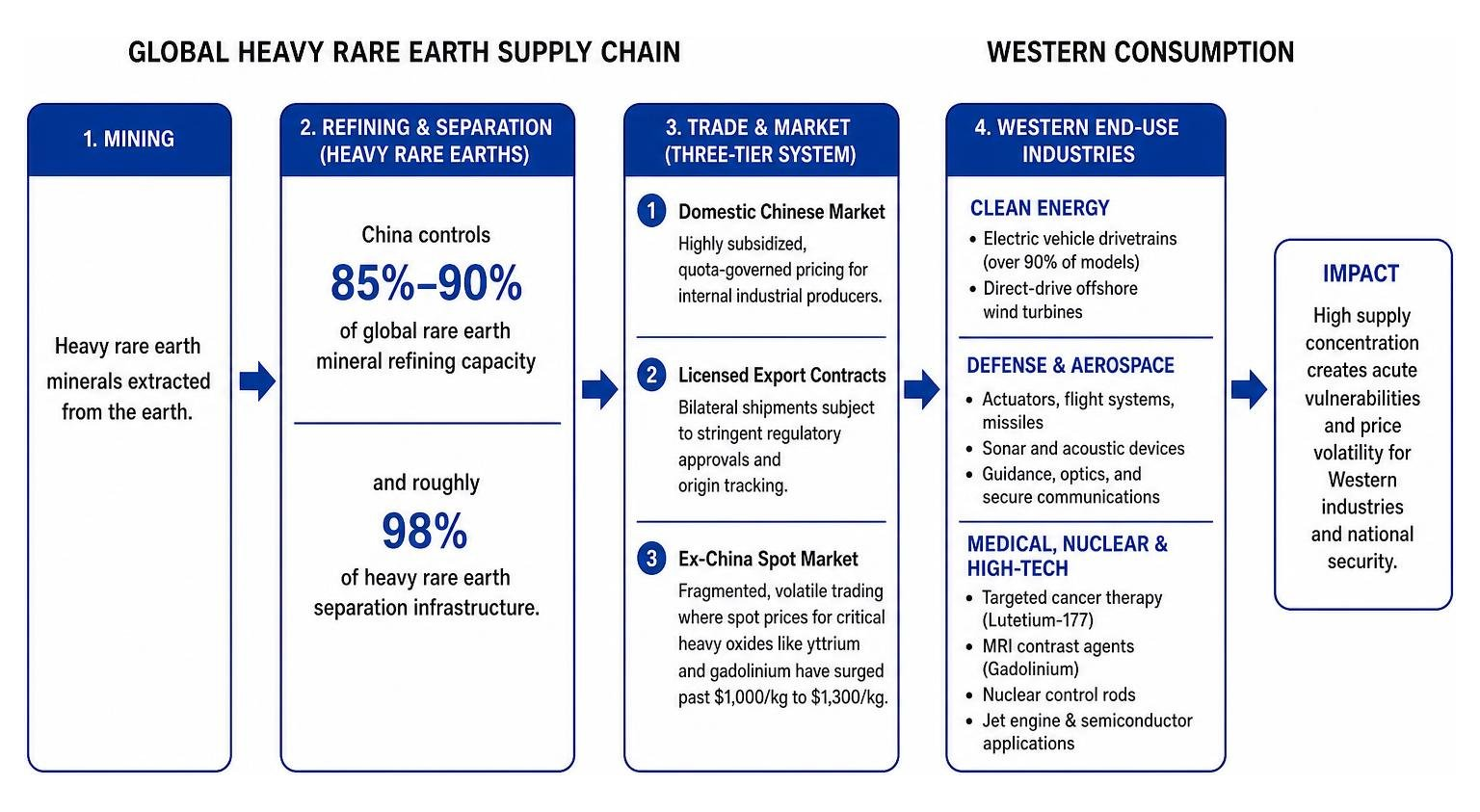
This concentration has created acute supply vulnerabilities. Following the rollout of dual-use export licensing regimes and state-directed quotas, Western manufacturing entered a complex “three-tier market”:
- Domestic Chinese Market: Highly subsidized, quota-governed pricing for internal industrial producers.
- Licensed Export Contracts: Bilateral shipments subject to stringent regulatory approvals and origin tracking.
- Ex-China Spot Market: Fragmented, volatile trading where spot prices for critical heavy oxides like yttrium and gadolinium have surged past $1,000/kg to $1,300/kg.
Understanding how raw feedstocks are refined and separated is critical; you can explore the processing stages in detail inside the high-stakes world of rare earth mining and processing.
United States Import Reliance and Strategic Funding
According to official assessments in the USGS heavy rare earths mineral commodity summary, the United States experienced a 100% net import reliance for heavy rare earth compounds and metals in 2025, importing roughly 100 metric tons. For elements like terbium, holmium, and lutetium, 100% of imported materials over the 2021–2024 window originated directly from China.
To establish supply security, the U.S. government stepped in with decisive capital investments:
- A $150 million direct loan provided by the U.S. Department of War to build a dedicated heavy rare earth separation facility at Mountain Pass, California.
- An $80 million federal loan allocated to domestic commercial magnet recyclers to recover dysprosium and terbium from electronic scrap.
- A $465 million loan approved by the U.S. International Development Finance Corporation to fund heavy rare earth mining and extraction operations in Brazil.
These domestic programs highlight our broader national focus on mineral resilience, an effort we examine further in our domestic mineral security analysis.
Global Diversification, Recycling, and Alternative Projects
Diversifying the heavy rare earth supply chain is an uphill battle. A 2025 analysis by Benchmark Mineral Intelligence warns that Western industry will still remain dependent on China for approximately 91% of its heavy rare earth requirements by 2030.
Nevertheless, international initiatives are gaining momentum. Brazil holds the world’s second-largest rare earth reserves (21 million metric tons, trailing China’s 44 million), and newly funded ionic clay projects in South America are advancing low-cost production routes. At the same time, joint initiatives outlined in European research on rare earth supply chain development are exploring heavy rare earth recovery from bauxite residue (red mud) and eudialyte-bearing alkaline deposits. Permanent magnet recycling could eventually reduce primary mining demand by up to 35% by mid-century, provided robust collection and chemical separation infrastructure is built.
Extraction Challenges, Environmental Impacts, and Analytical Testing
Separating heavy rare earth elements is one of the most chemically demanding tasks in extractive metallurgy. Because adjacent lanthanides share the same +3 oxidation state and differ in ionic radii by mere picometers, standard chemical precipitation cannot cleanly isolate them.
Refiners must deploy liquid-liquid multistage solvent extraction batteries involving hundreds of interconnected mixer-settler tanks. In these circuits, organic extractants selectively bind and strip individual elements across minute pH gradients. Historically, mining ion-adsorption clays involved pumping ammonium sulfate directly into hillsides, producing severe ammonia-nitrogen water pollution, acidic runoff, and soil destabilization. Furthermore, hard-rock ores often contain radioactive thorium and uranium, requiring careful tailings containment and radiation mitigation. Modern operations are pioneering cleaner alternatives, such as magnesium sulfate leaching agents and closed-loop water recirculation systems that avoid tailings dams entirely.
Analytical Characterization and Testing of Heavy Rare Earth Metals
Given the extreme price volatility and stringent purity requirements of aerospace, defense, and high-temperature magnet manufacturing, high-precision chemical characterization is critical. Trace impurities of non-target lanthanides can compromise a magnet’s coercivity or degrade the optical performance of a laser gain medium.
At Elemental Analysis Inc., located in Lexington, Kentucky, we specialize in high-precision elemental identification, quantification, and chemical speciation. As the nation’s premier commercial laboratory utilizing Particle-Induced X-ray Emission (PIXE) alongside traditional spectroscopic methods, we provide non-destructive and destructive testing with rapid turnarounds. Whether you are validating the purity of imported heavy rare earth oxides, certifying defense-grade alloys, or verifying feedstocks from new extraction initiatives, our analytical capabilities deliver the exact trace-level data you need to ensure complete quality compliance.
Frequently Asked Questions about Heavy Rare Earths
What makes a rare earth element “heavy” rather than “light”?
Rare earth elements are split into “light” and “heavy” categories based on their atomic numbers, electron configurations, and resulting chemical behaviors. Heavy rare earth elements have higher atomic numbers (gadolinium through lutetium, plus yttrium) and smaller ionic radii due to the lanthanide contraction. This compact ionic size changes how they bind in mineral lattices and organic extraction solvents compared to lighter lanthanides.
Why are dysprosium and terbium essential for electric vehicle motors?
Standard NdFeB permanent magnets lose their magnetic alignment when exposed to high heat and opposing magnetic fields. In an electric vehicle motor, operating temperatures routinely exceed 150°C under heavy acceleration or towing. Adding small percentages of dysprosium and terbium raises the magnetic coercivity, allowing the motor magnets to operate reliably up to 240°C without risk of permanent demagnetization.
Why is China able to dominate global heavy rare earth processing?
China’s dominance is the result of geological advantages and decades of sustained industrial policy. South China hosts rich deposits of easily leached ion-adsorption clays that contain unusually high ratios of heavy rare earths compared to standard hard-rock deposits. China also invested heavily in building out the complex, capital-intensive solvent extraction and refining infrastructure required to separate individual high-purity heavy rare earth oxides at scale.
Conclusion
Heavy rare earth metals are the quiet enablers of modern technology. From keeping electric drivetrains cool under pressure to guiding defense systems and targeting cancer cells, their unique chemical and physical properties make them indispensable to modern life.
Overcoming global supply constraints and achieving long-term industrial resilience will require expanding mining projects, scaling closed-loop magnet recycling, and maintaining rigorous quality assurance across every step of the supply chain. To dive deeper into the complete history and fundamental science of the 17 rare earth elements, explore our comprehensive breakdown in A Complete Guide to Rare Earth Elements and Their History.